Numina · Book I
Book I
Mesopotamian Mythology
The literature of the land between the Tigris and the Euphrates survives because its people wrote on clay and clay does not burn. Sumerian scribes, and the Akkadian, Babylonian and Assyrian writers who inherited their script, left the earliest sustained mythology in any language.
Its preoccupations are civic. Gods hold offices — Anu the sky, Enlil the storm and the assembly, Enki the fresh water and the wit — and the world is administered rather than merely inhabited. Enuma Elish is a constitutional document as much as a creation story: Marduk is granted supremacy by a vote, and he earns it by killing Tiamat and building the sky out of her. The Epic of Gilgamesh asks what a king is for once he understands he will die.
Nothing here is complete. Tablets break, columns are lost, and a scholar’s brackets stand where a line should be. Read it knowing that the gaps are part of the text.
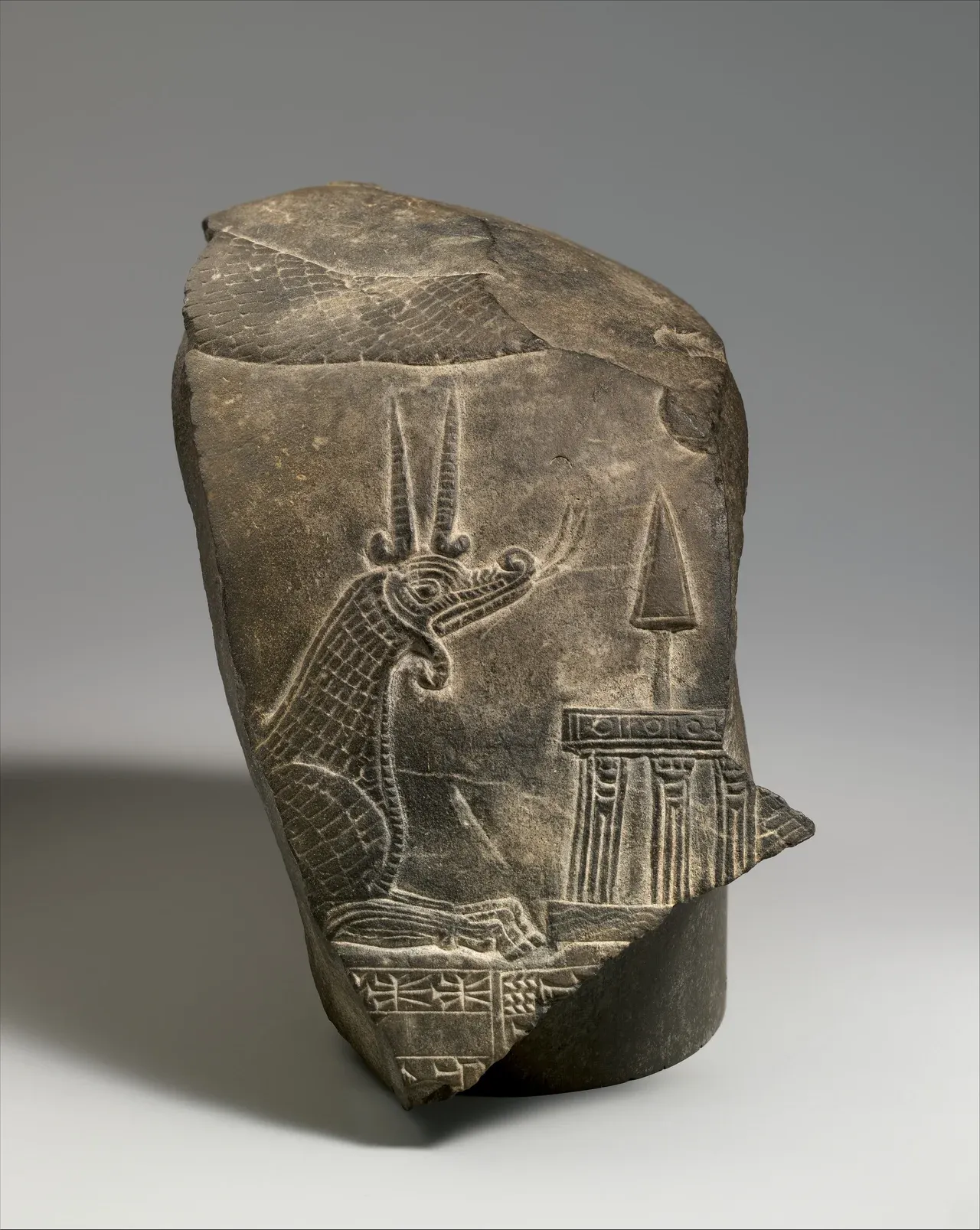
Plate I · Marduk’s dragon
A mushhushshu dragon and Marduk’s spade emblem on a Babylonian kudurru, a stone monument recording a land grant. About 1156 to 1025 BCE. This is not a depiction of Tiamat.
The Metropolitan Museum of Art, 1985.45. Rogers Fund, 1985. Image: The Met, public domain. Museum record · Full image

Contents
- I.1The tablets1 written
Clay, scribes, broken copies, and how we learn to read them again.
- I.2Before the world1 written
Apsu, Tiamat, and a cosmos made out of a corpse.
- I.3The assembly of the gods1 written
Anu, Enlil, Enki, Marduk — divinity as an office with duties.
- I.4Inanna and Ishtar1 written
The one who goes down, and what she has to leave behind to come back.
- I.5Gilgamesh1 written
Kingship, friendship, and the first sustained argument about death.