Numina · Mesopotamian · I.4 Inanna and Ishtar
Chapter I.4
Inanna and Ishtar
Seven gates take away a goddess's clothes and power. Someone above remembers her. Someone below must let her go. The descent of Inanna, the different story of Ishtar, and the people who pay for a return.
Before Inanna goes down, she tells someone how to bring her back.
Her minister Ninshubur must mourn her, visit the great gods, and ask for help. If one god refuses, she must try the next. Inanna names the houses to visit and the words to say. She even knows which god has the means to restore life.1
This is a striking way to begin a journey. The goddess intends to enter a place from which people do not return. She prepares for the possibility that she will be unable to save herself.
In The assembly of the gods, we watched divine power pass through commands, offices, and agreements. Here we follow it through a door. Inanna arrives carrying the signs of her authority. Inside, another goddess makes the rules.
There are two descent stories to keep apart. The longer Sumerian poem follows Inanna. The Akkadian poem follows Ishtar and changes important parts of the action. We will read the Sumerian story first, then turn to the Akkadian one. Combining them too soon hides what each has chosen to tell.
The goddess who goes down
Inanna, also written Inana, is the Sumerian name. Ishtar is the Akkadian name of the goddess identified with her. The pairing is useful, but it should not make us expect every city, period, and poem to describe her in exactly the same way.
She belongs to sexual desire and to war. She is also associated with Venus, seen as the morning and evening star. Uruk is one of her great centres of worship. These are different parts of a large divine life, not a list of traits that every story must display.2
The descent opens by naming what she leaves. Heaven and earth come first. Then come her offices and temples, one after another. The poem makes us pass through a whole geography of worship before she reaches the world of the dead. Her absence will have an address in many cities.
Yet she has not set out empty-handed. She gathers the me, the divine powers, and puts on her ornaments. Lapis beads lie against her neck and chest. She wears a gold ring and a special robe. She carries a measuring rod and line. Her dress belongs to her standing as a goddess.3
Keep that preparation in mind. The force of the seven gates depends on it. We have first been shown a being in possession of herself, carefully dressed for the role she means to play.
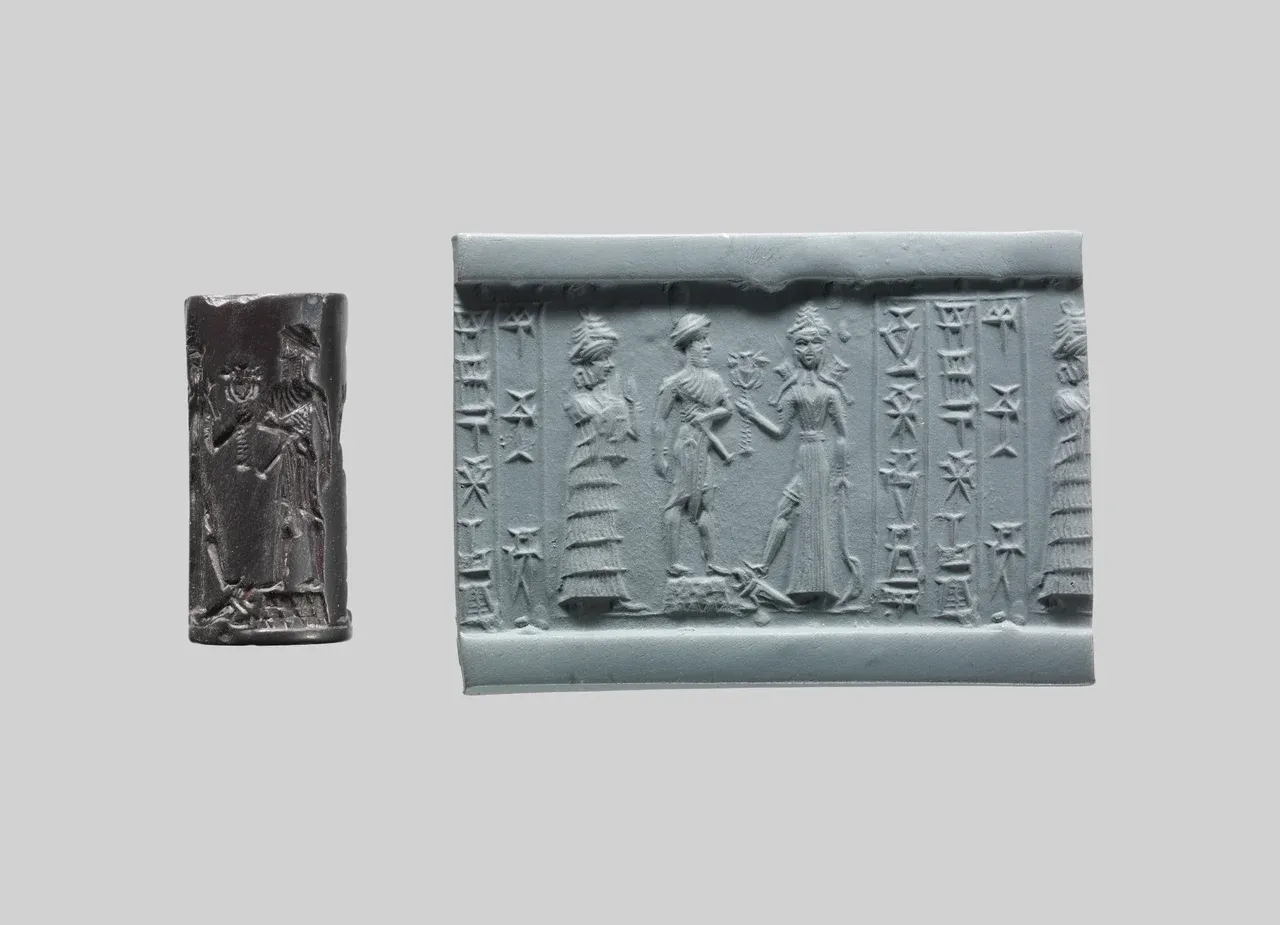
Plate I.4a. Ishtar appears armed on this Babylonian seal, made around the eighteenth or seventeenth century BCE. The museum identifies weapons at her shoulders and a lion-headed eagle beneath her feet. The impression beside the ancient seal is modern. This is an image of the goddess’s power, not a scene securely identified as her descent. The Met, 1987.96.5. Gift of Martin and Sarah Cherkasky, 1987. Image: The Metropolitan Museum of Art, public domain. Object record and full image.
A visit to her sister
Ereshkigal rules below. In this poem she is Inanna’s elder sister. Kinship gives the visitor a reason to come, but it gives her no right to command the household.
At the entrance to the palace Ganzer, Inanna demands admission. The gatekeeper Neti asks who she is and why she has taken this road. She answers that Ereshkigal’s husband, Gugalanna, has died. She has come for his funeral rites.4
That is the reason she gives at the gate. It is not the whole of what the poem lets us see. She has arrived with divine powers and the dress of high office. Later, other gods will describe her journey as an attempt to have too much. We should leave room between her stated purpose and their judgement of it.
One point is clear. She has not come to rescue Dumuzi. He is alive above. His danger grows out of her return, much later in the story.
Neti reports the visitor to Ereshkigal. His account repeats her clothes and ornaments at length. What she wears is important information. The queen hears it and gives precise orders: open the seven gates separately, and strip the visitor as she passes through.5
Ereshkigal does not need to meet her sister outside. She has doors, a gatekeeper, and an order that will be carried out.
Seven gates
At each gate something is taken away. Inanna objects. Each time she is told that the rules of the underworld apply here.
The sequence below follows the main reading in Oxford’s edition of the Sumerian poem. Manuscripts have small differences, and the Akkadian poem has a different list.6
| Gate | What is removed |
|---|---|
| First | Her headgear |
| Second | The small lapis beads at her neck |
| Third | The paired beads on her chest |
| Fourth | Her breast ornament |
| Fifth | Her gold ring |
| Sixth | The lapis measuring rod and line |
| Seventh | Her robe of ladyship |
The repeated exchange slows the reading. We cannot jump from a splendid arrival to nakedness without stopping at the doors between them. At each one she is still Inanna, and at each one her name fails to prevent another loss.
It is tempting to read this as a willing release of pride or possessions. That can be a modern response to the story. The action on the page is harsher. Inanna protests. The gatekeeper will not negotiate. She is being made to enter on terms set by someone else.
Nor does the poem assign a tidy private fault to every ornament. It does not tell us that one bead means envy and one ring means vanity. Those meanings would be ours to add. What the scene clearly removes is the public dress and equipment of a powerful goddess.
There is a familiar human fear in this, though its setting is divine. An honoured name, the right clothes, and a history of being obeyed may count for very little once another authority closes the door.
The body on the hook
Inanna reaches the inner chamber naked and bent low. Even now, the story does not make her simply passive. In the Oxford translation, she makes Ereshkigal rise and takes her place on the throne.
Then seven Anuna judges pronounce against her. The scene gives terrible force to looking and speaking. Their attention brings death. Inanna becomes a corpse, which is hung on a hook.7
The bluntness matters. A goddess who has moved through temples and cities is now a body that can be hung up. There is no speech from her explaining what she has learned. The story leaves her there.
We can recognise a struggle over rule without pretending to know every thought behind it. Ereshkigal controls the place. Inanna has crossed into it and, in this reading, reached for the seat of power. The judges do not treat her fame above as a defence.
This also puts a limit on an easy division between a good sister and an evil one. Ereshkigal is frightening. She is also the ruler of a realm whose laws the poem takes seriously. Inanna is the figure we have followed, but following her does not require us to call every act of hers just.
The one who remembers
Three days and three nights pass. Above ground, Ninshubur begins the work she was told to do.
She mourns, puts on poor clothing, and approaches the gods. The detail of her behaviour matters because grief must become visible and audible. Someone has to carry news of the missing goddess into houses where a decision can be made.
Enlil refuses. Nanna refuses too. Both see Inanna’s fate as the result of reaching beyond her proper share. She wanted the world above and the world below; now the lower world has her.8
Ninshubur keeps going. The refusal of a great god does not erase the instructions she remembers. Eventually she reaches Enki at Eridu, the last name on Inanna’s list.
This time the answer changes. Enki is distressed and begins to prepare a rescue.9
Ninshubur has no battle scene. She does not break a gate or defeat a guard. Much of what she does repeats words we have already heard when Inanna gave her orders. Yet that repetition is the work that keeps the story moving. Without it, the corpse remains below.
There is something exact about the poem’s treatment of loyalty. Feeling sad is not enough. Ninshubur has to remember where to go, endure refusal, and arrive at the next door.
How to reach Ereshkigal
Enki makes two small beings from the dirt beneath his fingernails. Their names are often written kurgarra and galatur. He gives them the means to restore life and tells them how to get close to the queen of the dead.
They will find Ereshkigal in pain. When she cries out, they must answer her pain with matching words. They must refuse the gifts she first offers and ask instead for the body on the hook.10
The plan works. They reach her, respond to her distress, and obtain the corpse. With the life-giving plant and water, they bring Inanna back to life.11
Ereshkigal has changed in our view. We first met her giving orders from inside her palace. Now we see a body in pain. The passage uses the language of motherhood, but its exact situation is difficult to establish. It is safer to notice what the rescue depends on than to turn it into a confident medical account.
The helpers do not tell her that her pain is foolish. They do not argue that Inanna is more important. They answer what she says. For a moment, the ruler who imposed silence at the gates is herself heard.
There is care in that exchange, and there is strategy. Enki has prepared it to obtain a particular result. Both can be present. The scene loses some of its interest if we make the helpers only tricksters or only models of kindness.
Inanna has survived because others could do what her own display of power could not. Ninshubur persisted outside. The two small beings found a way to be admitted inside.
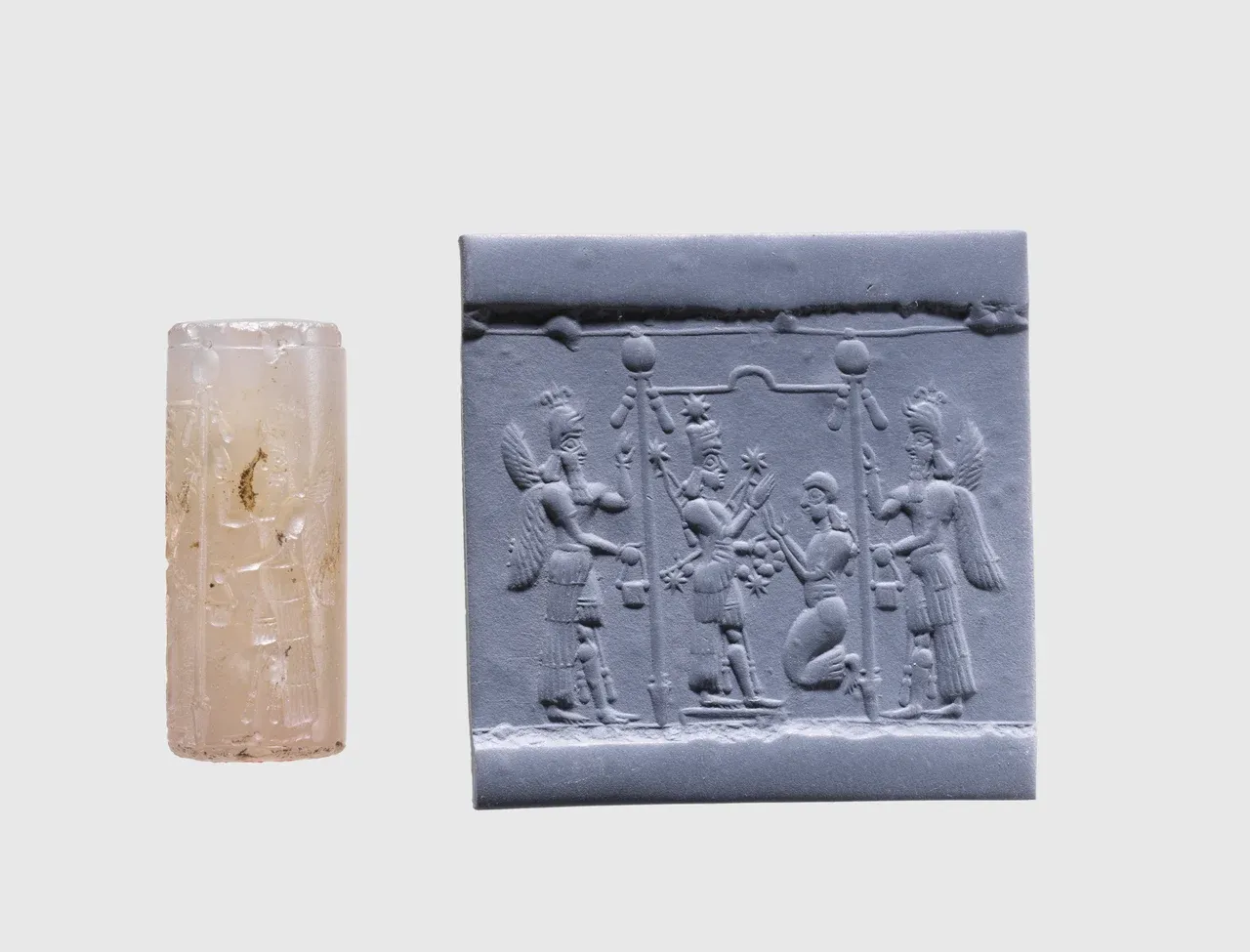
Plate I.4b. An Assyrian seal from the late ninth or early eighth century BCE shows a statue of Ishtar inside a shrine. The Met identifies her through the stars and weapons. The kneeling visitor helps us picture access to a deity, although this is a worship scene, not Enki’s rescue. Ancient seal and modern impression. The Met, 1989.361.1. Gift of Martin and Sarah Cherkasky, 1989. Image: The Metropolitan Museum of Art, public domain. Object record and full image.
A life in exchange
Being alive again is not the same as being allowed to leave.
The underworld demands a substitute. Someone must take Inanna’s place. Demons accompany her as she returns, ready to seize that person. The poem describes beings beyond the usual pleasures and bargains of living society. Food, drink, and affection offer no easy way to turn them aside.12
The return therefore becomes a dangerous procession. Everyone Inanna meets may pay for her escape.
First there is Ninshubur, still dressed in mourning. The demons want her. Inanna refuses. She recalls what her minister has done: the lamenting, the visits to the gods, the rescue made possible by faithful service. She will not hand over the person who brought her back.
Shara is also mourning. Inanna protects him. Lulal, another mourner, is spared as well.13
These scenes make Inanna answer a different question from the one asked at the gates. Then it was what she herself would lose. Now she has to decide whom she will allow to be taken. Her power has returned far enough for her to refuse the demons, but the demand travels with her.
Dumuzi under the tree
They find Dumuzi at Kulaba, a district of Uruk. He is richly dressed and seated on a throne beneath an apple tree.
The contrast with the mourners is plain. What the poem does not give us is a speech from Dumuzi explaining himself. We should not invent a feast at which he celebrates his wife’s death. His fine clothes and comfortable seat are enough to make the scene turn.
Inanna fixes on him the kind of deadly attention that was directed at her below. She tells the demons to take him.14
That echo is hard to miss. The goddess who was condemned now condemns. Her own suffering has not made her incapable of sending someone else to the same place.
Dumuzi pleads with Utu, the sun god and his brother-in-law. He recalls the family tie and asks for help escaping. Utu grants a change to his body that lets him get away. The poem then becomes damaged in places. Its surviving lines do not support an entirely smooth account of the chase.15
They also contain a complication that is easy to lose in a short retelling. Inanna laments her husband. The same poem gives us the act of handing him over and grief for him. Damage makes the sequence harder to follow, but it does not give us permission to erase the grief.16
Near the end, an arrangement divides the year between Dumuzi and his sister. Each spends half of it below. The sister is known elsewhere as Geshtinanna. In this passage she is unnamed, and the surrounding text has gaps.17
The surviving agreement is clear enough to show that Inanna’s return has not cancelled the underworld’s claim. It has spread the cost. We need not fill the gaps with a scene in which the sister volunteers, or borrow a full ending from a different Dumuzi poem, to feel what that means.
A rescue has taken place. It has also created another loss for other people to mourn.
When the story calls her Ishtar
Turn now to the Akkadian poem. Its opening places us in a dark world where the dead eat dust. Ishtar threatens to break in and release the dead against the living. Seven gates again strip her, but the objects differ: this version includes earrings and a girdle, among other ornaments.
Ereshkigal has Namtar afflict Ishtar with diseases. Above ground, sexual activity stops among humans and animals. Ea devises help through a being called Asushunamir. After an angry exchange and a curse against the helper, Ereshkigal orders Ishtar’s release. Life-giving water is applied, and her belongings are returned as she passes back through the gates.18
The emphasis has shifted. The goddess’s absence now interrupts the sexual life of the world. That scene should not be silently inserted into the Sumerian account, where it does not appear.
Other differences are just as revealing. Ninshubur’s repeated appeals and Enki’s two small rescuers belong to the Sumerian story we have followed. The Akkadian poem gives the work to different figures. Its ordered return of the ornaments also gives the gates a pattern the Sumerian return does not narrate in the same way.
These are choices made in telling. Calling one poem a shorter copy of the other would miss how much a changed scene can do. The loss of desire across the living world makes Ishtar’s rescue matter for reasons beyond her own survival.
The SOAS edition linked below lets us read and hear the first 125 lines in Akkadian. That selection reaches the restoration of her crown. It should not be mistaken for the entire poem. It is enough, however, to hear how a familiar descent has taken another shape.
What the return leaves unfinished
There are good reasons to ask about cycles. A goddess associated with Venus goes out of sight and returns. Dumuzi and his sister divide a year. Ishtar’s absence stops sexual activity. Sky, season, and the renewal of life belong among the questions these stories raise.
But none of those questions makes the other details unnecessary. A map of the sky cannot tell us why Ninshubur remains faithful. A seasonal explanation cannot settle whether Dumuzi deserves his fate. A reader still has to sit with the decisions and the damage they cause.
The poems also belong beside laments, prayers, and images through which people approached this goddess. A much later tablet in the Met records a lament in which Inanna mourns the ruin of her cities and shrines. Her former power is set against present loss. It is a different work, but it shows how long scribes continued to give her grief a written voice.19
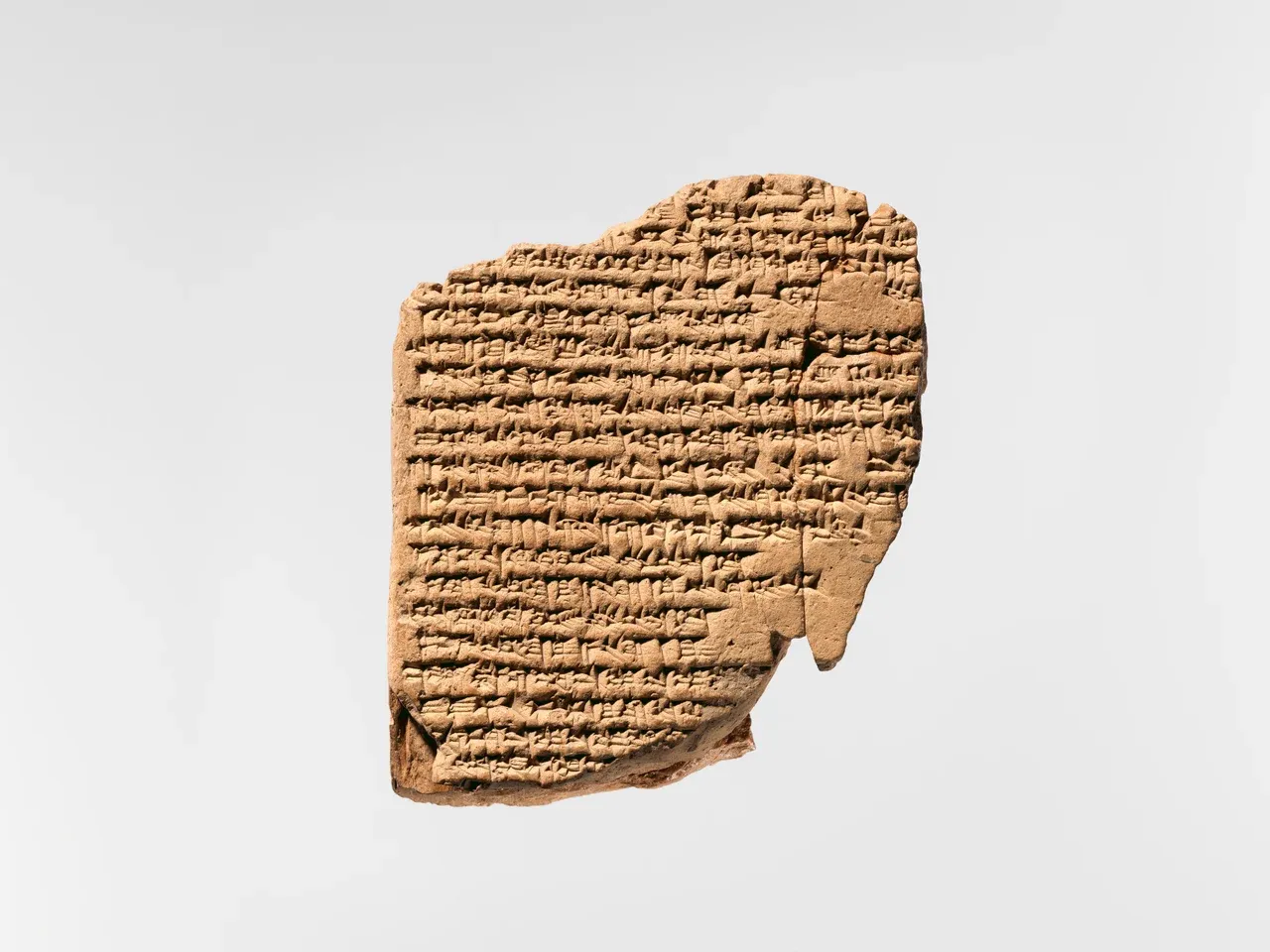
Plate I.4c. A tablet of lament for Inanna/Ishtar, around the second or first century BCE. It preserves Sumerian with Akkadian translation for many lines. This is not a manuscript of the descent. It is a separate witness to the long life of literature about the goddess and her losses. The Met, 86.11.286a. Purchase, 1886. Image: The Metropolitan Museum of Art, public domain. Object record and full image.
What, then, must Inanna leave behind to come back?
The first answer is visible at the gates: her ornaments, equipment, and clothes. A second answer is harder. Her own power cannot secure her release. She needs the minister she left above and the help that minister finds. Finally, the price reaches someone else. Dumuzi, and then his sister, bear a claim that her revival did not remove.
This is why the body on the hook is not the story’s last disturbing image. The richly dressed husband under the tree belongs beside it. So does the unnamed sister in the damaged closing passage. The living goddess returns to a world in which someone else will now be missing.
The Sumerian poem ends by praising Ereshkigal.20
After all that effort to bring Inanna home, the last honour goes to the queen below. Her gates have opened. Her rule has held.
Notes and references
The story is retold here in new prose, not quoted from a modern translation. Line numbers refer to the ancient compositions as numbered in the linked editions. The Sumerian edition combines evidence from several manuscripts and marks variants and gaps. Interpretations in the chapter are distinguished from actions the surviving text actually describes.
Footnotes
-
Inana’s descent to the nether world, lines 28 to 67. ETCSL 1.4.1, University of Oxford. The instructions name Enlil, Nanna, and Enki in that order. ↩
-
Yagmur Heffron, “Inana/Ishtar,” Ancient Mesopotamian Gods and Goddesses, Oracc, especially “Functions” and “Cult Places.” This is a modern scholarly overview, not an ancient account of the descent. ↩
-
Inana’s descent, lines 1 to 25, ETCSL 1.4.1. The opening lists abandoned offices and sanctuaries, followed by the divine powers and the goddess’s dress. ↩
-
Inana’s descent, lines 73 to 89, ETCSL 1.4.1. Gugalanna appears as Gud-gal-ana in this edition. His funeral is Inanna’s stated reason for entering. The passage does not say that Dumuzi has died. ↩
-
Inana’s descent, lines 90 to 128, ETCSL 1.4.1. Neti repeats the inventory before Ereshkigal orders admission on her own terms. ↩
-
Inana’s descent, lines 129 to 163, ETCSL 1.4.1. One manuscript adds the removal of the measuring rod and line at the first gate. The table follows the edition’s main sequence, which places their removal at the sixth. The initial dressing scene contains more detail than this seven-stage inventory. ↩
-
Inana’s descent, lines 164 to 172, ETCSL 1.4.1. The account here follows this translation’s reading of Inanna taking Ereshkigal’s seat, then being condemned by the seven Anuna judges. ↩
-
Inana’s descent, lines 173 to 208, ETCSL 1.4.1. Ninshubur acts after three days and nights. Enlil and Nanna give parallel refusals. ↩
-
Inana’s descent, lines 209 to 225, ETCSL 1.4.1. Enki responds to Ninshubur and prepares the two rescuers. ↩
-
Inana’s descent, lines 219 to 253, ETCSL 1.4.1. The names appear as kur-jara and gala-tura in ETCSL. The chapter uses the common forms kurgarra and galatur without assigning these beings modern gender labels. ↩
-
Inana’s descent, lines 254 to 281, ETCSL 1.4.1. The response to Ereshkigal’s pain, refusal of other gifts, recovery of the body, and revival occur in this sequence. ↩
-
Inana’s descent, lines 282 to 305, ETCSL 1.4.1. The demand for a substitute follows revival. The accompanying demons are described as beyond ordinary food, drink, gifts, and family affections. ↩
-
Inana’s descent, lines 306 to 347, ETCSL 1.4.1. Inanna protects Ninshubur, Shara, and Lulal in turn. ↩
-
Inana’s descent, lines 348 to 358, ETCSL 1.4.1. ETCSL writes the name Dumuzid. The scene specifies fine clothing, a throne, and an apple tree at Kulaba. The text’s contrast with the mourners does not require an invented celebration. ↩
-
Inana’s descent, lines 368 to 383, ETCSL 1.4.1. Dumuzi appeals to Utu and receives the transformation he requests. Damaged lines interrupt the subsequent action. ↩
-
Inana’s descent, lines 384 to 393, ETCSL 1.4.1. Inanna’s lament survives in a damaged passage. It should neither be removed from the account nor expanded into a fully known scene of reconciliation. ↩
-
Inana’s descent, lines 404 to 410, ETCSL 1.4.1, for the division of the year. For the sister’s identity elsewhere, see Nicole Brisch, “Geshtinanna/Belet-seri,” Oracc. The descent passage itself does not name her. ↩
-
Ishtar’s Descent to the Netherworld, particularly lines 1 to 20, 42 to 75, 76 to 108, and 109 to 125. SOAS, Babylonian and Assyrian Poetry and Literature, with a reading by Martin West and English translation credited to Benjamin R. Foster, Before the Muses (2005). Asushunamir is called an assinnu; the chapter leaves that ancient designation uninterpreted rather than treating a disputed modern gloss as settled. ↩
-
The Met, 86.11.286a, Cuneiform tablet: a-she-er gi-ta, balag to Innin/Ishtar. The museum dates the tablet to about the second or first century BCE and identifies its subject as the goddess’s lament for destroyed cities and shrines. ↩
-
Inana’s descent, lines 411 to 412, ETCSL 1.4.1. The closing praise is addressed to Ereshkigal. ↩