Numina · Mesopotamian · I.5 Gilgamesh
Chapter I.5
Gilgamesh
A king finds someone strong enough to stop him. Together they win fame that costs more than they know. Then one of them dies, and the survivor leaves his city to ask whether a human life has to end.
Gilgamesh feels for his friend’s heartbeat. There is none.
He covers Enkidu’s face. The poem compares the cloth to a bride’s veil, bringing a wedding image into a room where a body lies still. The man who shared his dangers cannot hear him now.1
We meet this moment well into the story. Before it come a bad king, a wild man, a fight in a doorway, and a forest whose guardian begs for his life. The two friends do things worth admiring and things that should trouble us. Then one dies. The other discovers that knowing people die is very different from watching it happen to someone he loves.
In Inanna and Ishtar, a goddess returned from the world below at a cost to others. Gilgamesh wants something harder to obtain. He wants to be exempt from going there.
Which Gilgamesh are we reading?
The name belongs to a king of Uruk in Mesopotamian tradition. There may have been a historical ruler behind him, but the poems cannot serve as his biography. Their hero had centuries to grow.
Separate Sumerian stories survive in copies made mostly in the early second millennium BCE. Akkadian poets joined and changed the material. Fragments of an Old Babylonian epic preserve an earlier stage of that work. The longer version usually read today is called Standard Babylonian. Ancient tradition associated it with a scholar named Sin-leqi-unninni, whose life is largely unknown.2
We will mainly follow that later poem. When an earlier text gives a different answer, we will stop and name it. This matters especially for the advice Gilgamesh receives about how to live.
Calling this humanity’s first argument about death claims more than the evidence can show. It is one of the earliest surviving long works to stay with the subject so closely. Its argument happens through bodies, journeys, mistakes, and conversations. The people in it have to live with what they learn.
A king his city cannot bear
The opening asks us to look at Uruk. There are walls to inspect, brickwork to admire, and the great temple of Ishtar. The narrator promises a king who has travelled far and brought back knowledge. We are seeing him from the far end of his troubles.
The story then gives us the younger Gilgamesh.
He is two-thirds divine and one-third human, the son of the goddess Ninsun. His body and energy are exceptional. Uruk suffers from both. Young men have no peace. Daughters and brides are not safe from his demands. The people appeal to the gods because the person meant to protect them is making their lives unbearable.3
It is an unsettling opening for a poem about a famous ruler. The city’s complaint comes before his great adventures. We are allowed to judge him before we are asked to admire him.
The gods answer by making someone who can match him. Aruru shapes Enkidu from clay. He lives outside settled life, feeding and drinking among wild animals. When he frees animals from a trapper’s snares, his strength becomes a problem for another human livelihood. The trapper seeks help. Shamhat is brought to him.4
The man at the door
Shamhat is a sex worker. The poem gives her knowledge that neither the trapper nor the wild man possesses. After she and Enkidu have sex, he tries to return to the animals. They run from him. He has lost his former ease among them, while gaining a new understanding. Something has been gained at the price of a whole way of life.
She talks to him, clothes him, and leads him towards human company. Among the shepherds he learns to eat bread and drink beer. He puts his strength to work protecting their flocks. Civil life reaches him through food, care, conversation, and useful work.5
Then he hears about Gilgamesh and a wedding.
Enkidu takes his place in the doorway and blocks the king. They wrestle hard enough to shake the building. The surviving text has gaps, so a neat account of every move would be false precision. What matters is the meeting itself. Someone has finally stood in Gilgamesh’s path.6
From that collision comes the friendship on which the poem depends. Gilgamesh now has someone whose courage and strength he can recognise. Enkidu has someone to belong with after leaving the animals behind.
Yet a friend can encourage a dangerous choice. The pair soon turn their shared strength towards a place far beyond Uruk.
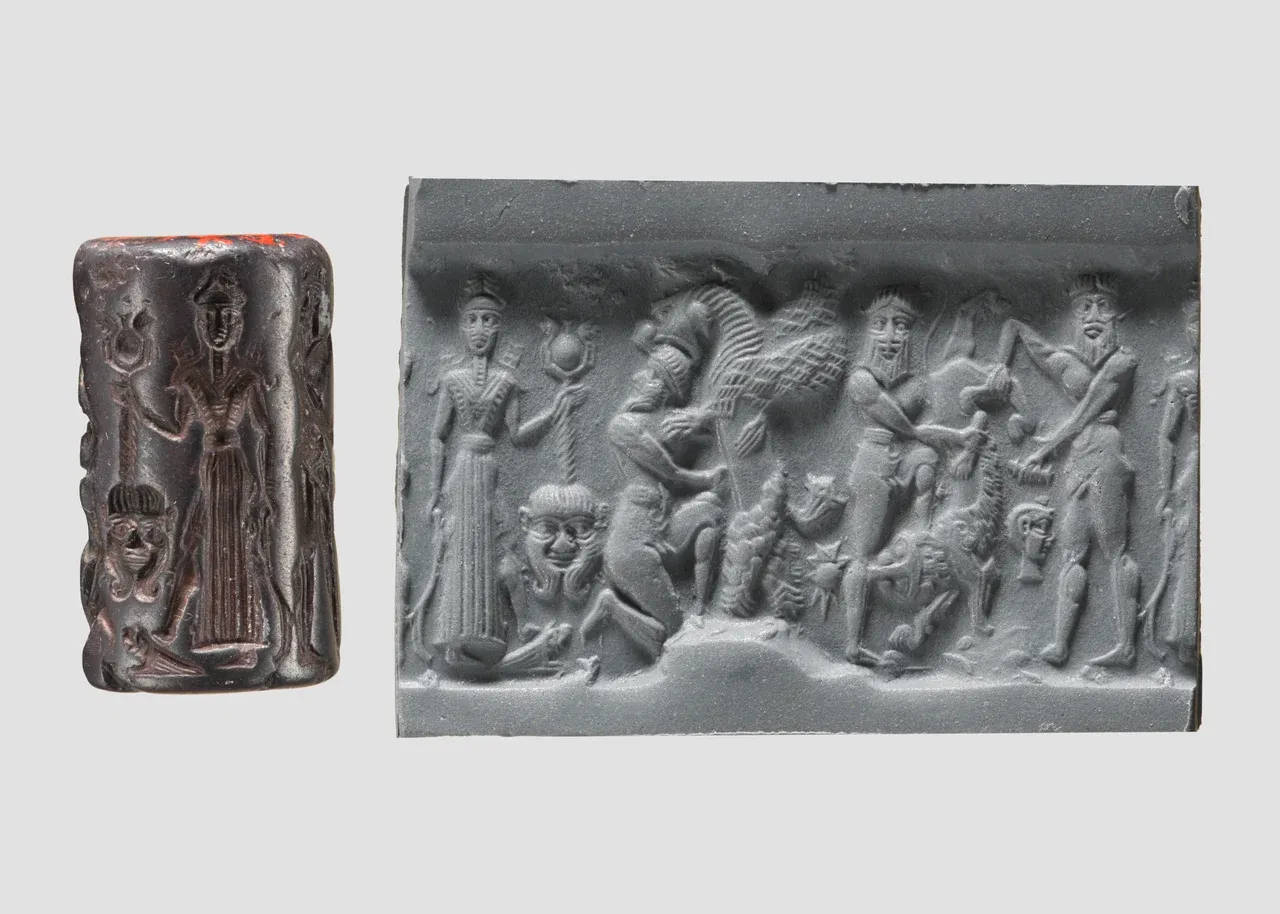
Plate I.5a. Heroic combat on a Babylonian cylinder seal, about 2000 to 1600 BCE. The ancient seal is shown beside a modern impression. The Met identifies the small frontal head as probably Humbaba. The fighting heroes cannot securely be named Gilgamesh and Enkidu; a familiar-looking scene is not proof of an episode. The Met, 1999.325.24. Gift of Nanette B. Kelekian, in memory of Charles Dikran and Beatrice Kelekian, 1999. Image: The Metropolitan Museum of Art, public domain. Object record and full image.
What the forest costs
Gilgamesh proposes an expedition to the Cedar Forest. Its guardian, Humbaba, has been placed there by Enlil. Enkidu knows enough to be afraid. Gilgamesh presses ahead. If human life must end, a great deed can at least make a name last.7
This is his first answer to death. He has not yet tried to defeat it in the body. He hopes to survive in what people say.
The forest deserves our attention before the fighting starts. The poem lingers over its trees and sounds. Birds call in the branches. Other creatures fill out the noise around Humbaba’s home. There is life here before the heroes arrive to take anything away.
In the struggle, the sun god Shamash sends winds that pin Humbaba in place. Beaten, the guardian begs for mercy. He offers to serve Gilgamesh and supply him with timber. Enkidu urges his friend to kill him before the gods can intervene.8
The frightened companion has become the voice against mercy.
They kill Humbaba and cut the cedars. One great piece will become a door for Enlil’s temple. The offering sits uneasily beside the death of Enlil’s own guardian. Even Enkidu remarks on the damage they have done to the forest and wonders how they will answer the god.9
We do not need to turn this into a modern environmental tract to notice the destruction. The poem notices it already. Nor does friendship make every shared act good. These two help each other overcome fear, then help each other go too far.
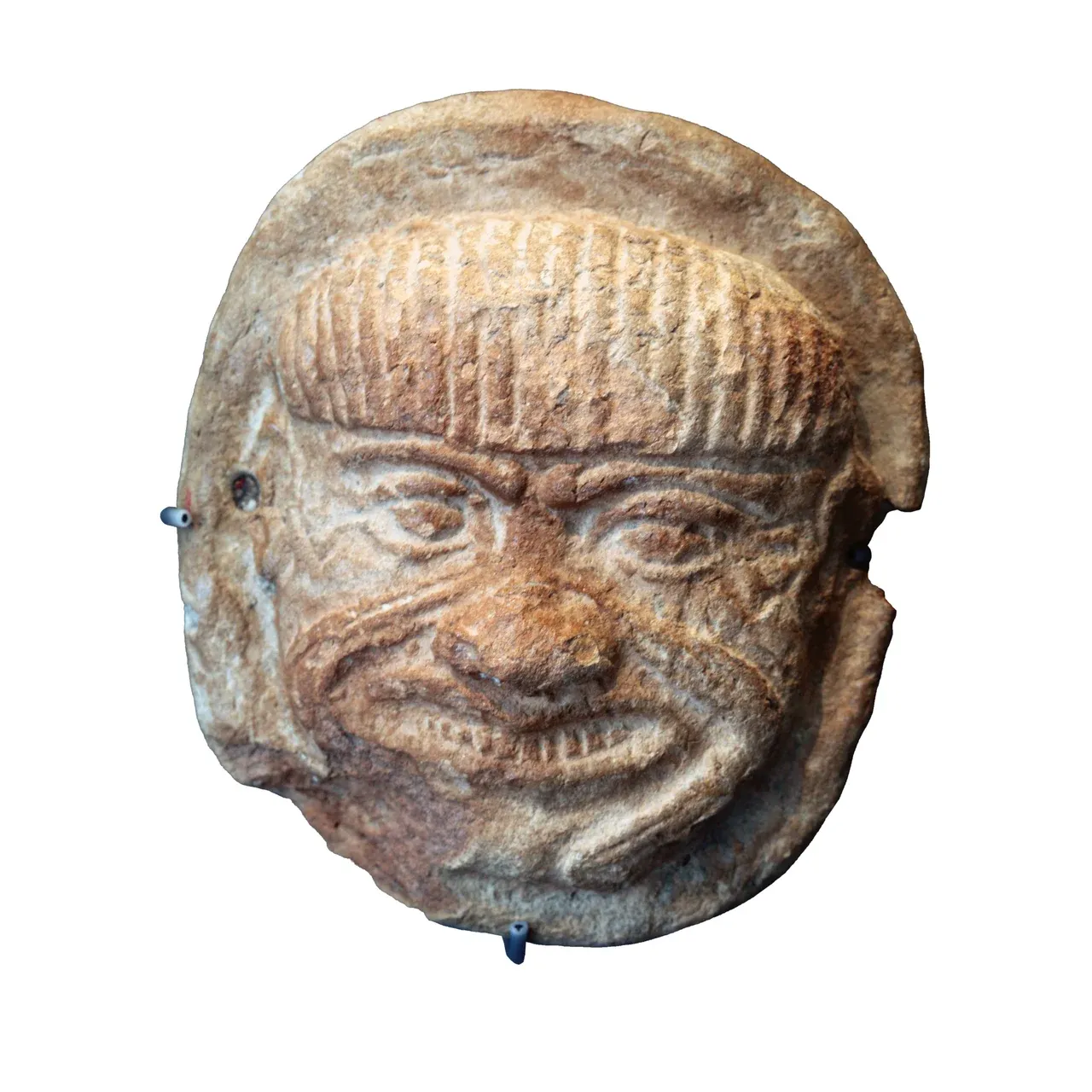
Plate I.5b. A clay face of Humbaba from the Isin-Larsa period, about 2004 to 1763 BCE. The face lets us meet the frightening guardian as an ancient maker pictured him. It does not depict his death. Louvre, AO 6778. Object record. Photograph by Rama, via Wikimedia Commons, CC BY-SA 3.0 France. Resized and converted to WebP; this image version uses the same licence.

The goddess and the bull
Back in Uruk, Gilgamesh washes and dresses. Ishtar sees him and offers marriage, wealth, and royal power. He answers with a list of former lovers whom she has hurt or changed. Among them is Dumuzi, whose mourning we met in the previous chapter.10
His refusal is also an insult. Ishtar obtains the Bull of Heaven from Anu and sends it against Uruk. People die before Gilgamesh and Enkidu bring it down together. Then Enkidu throws part of the dead animal towards the goddess and threatens her. The victory ends with a further act of contempt.11
The Ishtar of this episode is angry and dangerous. That is the part she plays here, not a complete account of a goddess worshipped across many cities and centuries. We should be as wary of reducing her to this scene as of calling Gilgamesh a good king because he can kill a bull.
For the friends, success has begun to feel like permission. Their next encounter with the gods will strip that confidence away.
Enkidu falls ill
Enkidu dreams of a divine council. The deaths of Humbaba and the Bull of Heaven have consequences. One of the companions must die. Enkidu is the one who will be lost. The passage is damaged in the Babylonian text; a related Hittite telling helps preserve the council’s judgement.12
He falls ill. Anger sends him back through the choices that brought him here. He curses the great cedar door. He curses the trapper and Shamhat, who drew him into human life. If he had stayed with the animals, he thinks, this fate would not have found him.
Shamash answers. He reminds Enkidu of the food, clothing, and friendship he has received. Gilgamesh loves him and will mourn him. Enkidu listens and changes the curse on Shamhat into a blessing.13
That change is easy to miss beside the larger adventures. It is one of the poem’s most generous moments. A dying man withdraws his blame from the woman who helped him live. The life he entered has brought suffering, but he can still recognise what it gave him.
He remains afraid. In another dream a terrifying figure carries him into the world of the dead. There he sees those who once wore crowns. Rank has not kept them out. The sick man imagines the place waiting for him while his body grows weaker.14
There is no last victory in battle. No feat of strength lets Gilgamesh take his friend’s place.
The friend who remains
The mourning spreads far beyond the room. Gilgamesh calls on the landscape, the animals, the people of Uruk, and those who knew Enkidu to grieve with him. He orders a rich image of his friend and prepares offerings. A king can summon craftsmen and spend treasure on the dead.15
He cannot make the body answer.
Later he tells others that he resisted burial until a maggot fell from Enkidu’s nose. The detail is terrible because it leaves no space for a heroic account of death. The body changes while Gilgamesh still wants the person to remain.16
His sorrow turns towards himself. If this happened to Enkidu, it will happen to him. The divine part of his ancestry offers no comfort strong enough to stop that thought.
So he leaves Uruk. The king who once wanted his name remembered now wants his body to keep living. He searches for Utnapishtim, the survivor of the great flood, whom the gods allowed to escape the ordinary human end.17
Notice the change in the kind of journey. The forest expedition had two companions making plans for glory. This one has a lonely man trying to get far enough away from a fact.
At the edge of the world
Gilgamesh reaches Mount Mashu, where scorpion beings guard the sun’s passage. He travels through a darkness so complete that he cannot look back and see where he has been. At last he emerges into a garden whose trees bear precious stones.18
The journey takes him outside the world a king can govern. Strength still gets him through dangers, but it cannot tell him where to go next. He has to ask.
At the shore he meets Siduri, the tavern-keeper. His worn body and strange appearance alarm her. She shuts her door. Gilgamesh threatens to break it down. Grief has changed him without making him gentle in every encounter.
He tells her about Enkidu. He will tell the story again to the boatman Urshanabi and to Utnapishtim. The repeated account slows the journey. Every new listener has to hear why the traveller looks as he does.19
An older, Old Babylonian version gives the tavern-keeper a famous piece of advice. She directs his attention to meals, clean clothes, a child holding his hand, and the pleasure of life with a wife. The gods have kept endless life for themselves. Human happiness must be found in the days available.20
That speech is not preserved in the same place in the Standard Babylonian poem. It belongs to an earlier telling. Read on its own terms, it offers a serious answer: the everyday things a frightened traveller passes by may be the life he is looking for. For someone still grieving, such advice may also arrive too soon.
With Urshanabi’s help, Gilgamesh crosses the dangerous waters and reaches the man he has come so far to find.
The survivor of the flood
Utnapishtim looks like an ordinary man. Gilgamesh had expected some visible sign of the difference between them. He asks how this man came to live beyond the human limit.
The answer is a story about a disaster.
The gods decided to send a flood. Ea warned Utnapishtim through a reed wall and told him to build a boat. He took people, animals, and the means of survival aboard. The storm destroyed the life outside. Even the gods were frightened by the violence they had unleashed.21
When the waters fell, survival did not settle the argument. Enlil was angry that anyone had escaped. Ea challenged the punishment of everyone together. The divine council was capable of bringing ruin without agreeing on what justice required.
At the end, Enlil granted Utnapishtim and his wife a life like the gods’ and placed them far away. Both received the gift. It was an exceptional decision after an exceptional disaster. Utnapishtim cannot give Gilgamesh a route through which any determined traveller can earn the same result.22
Gilgamesh has found a genuine exception to death. He has also found that the exception is of almost no practical use to him.
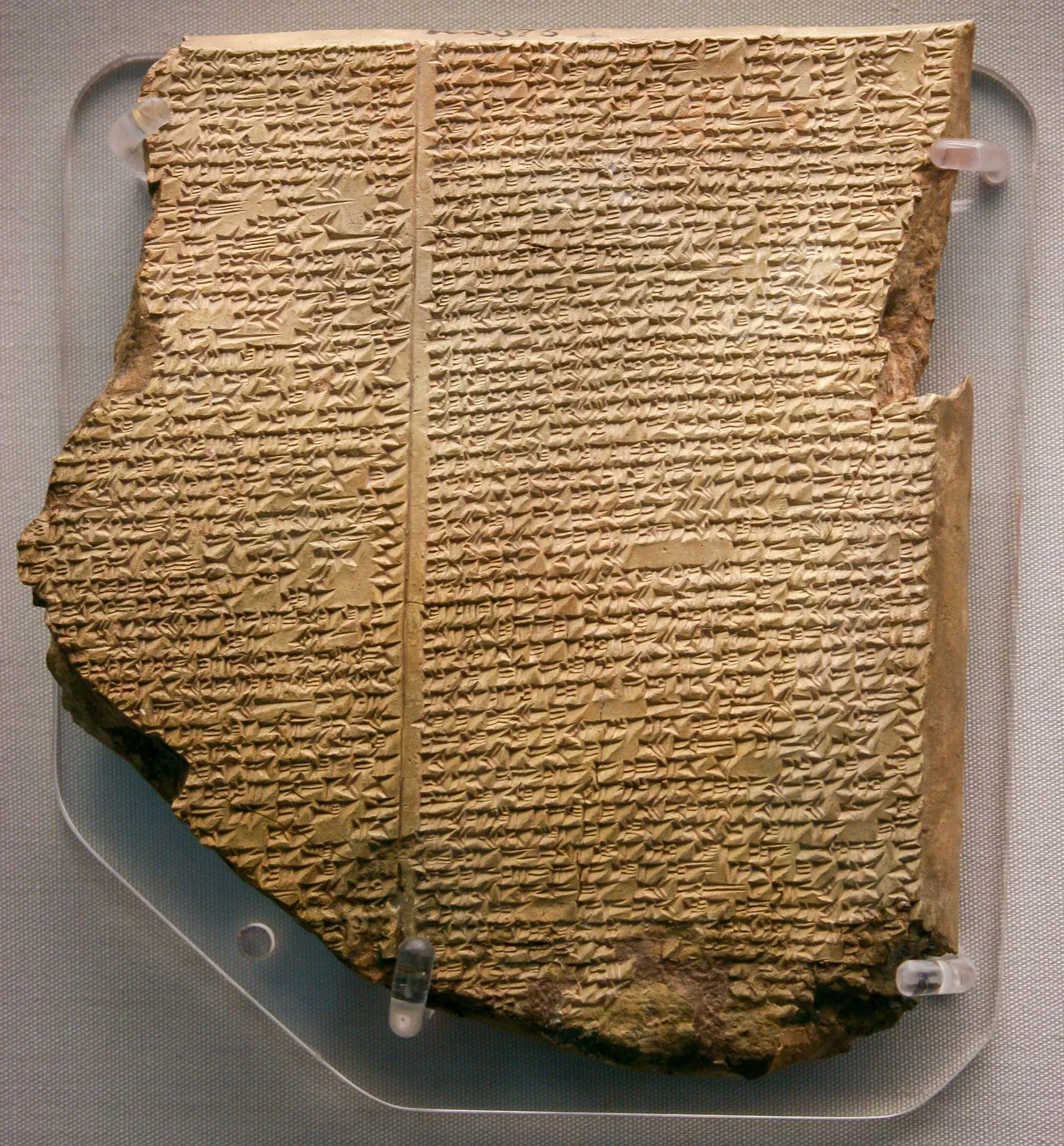
Plate I.5c. The Flood Tablet, a seventh-century BCE copy of part of Tablet XI of the epic, found at Nineveh in the library of Ashurbanipal. This is one ancient witness to the flood story, not a complete copy of the epic. British Museum, K.3375. Object record. Photograph by Mike Peel, via Wikimedia Commons, CC BY-SA 4.0. Resized and converted to WebP; this image version uses the same licence.

Bread beside a sleeping man
Utnapishtim sets a test. Can Gilgamesh stay awake for six days and seven nights?
He falls asleep almost at once.
While he sleeps, Utnapishtim’s wife bakes a loaf each day and sets it beside him. The days are also marked on the wall. When he wakes, Gilgamesh thinks his sleep has barely begun. The loaves show otherwise. Each has aged by a different amount; together they record the time his own awareness cannot account for.23
Bread has appeared at another turning point. Enkidu learned to eat it when he joined human life. Now it measures that life’s limits beside his exhausted friend.
The test does not come with a clear promise that success would make Gilgamesh immortal. Its force is simpler. He cannot keep even sleep away by wanting to. His body needs things his will cannot refuse.
Before he leaves, he is washed and given clothes fit for his return. The traveller can recover the appearance of a king. That recovery is within reach, even when the thing he came for is not.
The plant and the snake
Utnapishtim’s wife asks that their guest should not go home empty-handed. Her husband tells Gilgamesh of a thorny plant under the water. It can restore youth.
Gilgamesh ties weights to his feet, goes down, takes the plant, and returns to the surface. He plans to bring it to Uruk, try it on an old man, then eat it himself. For a moment there is something useful to carry home.24
The distinction matters: renewed youth is not the same promise as an end to death. Even this smaller hope would change the terms of growing old.
On the journey back, Gilgamesh stops to bathe. A snake takes the plant and sheds its skin as it leaves. He weeps. The thing he won through effort is gone during an ordinary pause for water and rest.25
The snake’s renewed skin makes the loss visible. Gilgamesh has brought back neither Enkidu nor a remedy he can use for himself. The poem does not arrange a last-minute reward to make his pain worthwhile.
Back at the wall
Gilgamesh and Urshanabi reach Uruk. The king asks the boatman to look at the wall and its brickwork. The closing passage returns us to the city shown at the opening.26
The wall was there before he left. The journey has changed what stands beside it: a man who has learned how little his strength can guarantee.
It is tempting to write a tidy final lesson for him. He accepts death, becomes a just king, and lives happily in service to his people. The poem does not supply that whole future. It gives us the return and the invitation to look. We should not claim more certainty about his healing than the ending allows.
There is also a twelfth tablet in the received series. It draws on a separate Sumerian story and begins with Enkidu alive again. He goes below to retrieve lost objects, and the story leads to an account of the dead. This is not a smooth next episode after the events we have followed. It preserves another tradition alongside them.27
A Sumerian poem about Gilgamesh’s own death gives him a place of authority in the underworld. That, too, is a different telling. His later standing among the dead should not be mistaken for the bodily immortality he fails to obtain here.
For the journey through Tablet XI, the wall is enough to bring us home. People can make a city that outlasts them. They can keep a friend’s name, care for a body, and tell a story again. None of those acts makes the loss small.
Gilgamesh has a city to return to, and a friend who will never walk through its gates with him again.
Sources and reading notes
This chapter is an original retelling and reading, not a translation. The main text is the Standard Babylonian epic in the electronic Babylonian Library, edited by Andrew R. George and revised with Geraldina Rozzi and Enrique Jiménez. Its continuing work includes fragments published after George’s 2003 edition. Tablet and line references below follow that online edition where given. Broken passages, older versions, and interpretation are identified rather than silently combined. The three photographs show ancient objects; none is presented as a portrait of a historical Gilgamesh.
Footnotes
-
Standard Babylonian Gilgamesh, Tablet VIII, lines 42 to 64, especially the heartbeat and covering of the face in lines 55 to 59. The opening here retells the action without quoting the modern translation. ↩
-
Andrew R. George, introduction to the Poem of Gilgamesh, electronic Babylonian Library. It distinguishes the Sumerian poems, Old Babylonian fragments, later transmission, and the traditional attribution to Sin-leqi-unninni. A royal tradition is not independent proof of a historical king’s deeds. ↩
-
Tablet I, lines 1 to 28 for the opening and the wall; 29 to 96 for the king’s qualities, divine ancestry, and the city’s complaints. The account of sexual coercion belongs to the poem. It does not establish a historical legal right over brides. ↩
-
Tablet I, the creation of Enkidu and the trapper episode following line 97. The wild man is already human; his entry into settled life should not be described as an animal literally becoming a person. ↩
-
Tablet I, lines 170 to 240, and Tablet II, especially lines 34 to 62. Shamhat’s profession does not justify calling her a temple priestess or treating the encounter as evidence of an institution of sacred prostitution. ↩
-
Tablet II, the wedding-house encounter around lines 100 to 115 and its fragmentary continuation. The reading here does not assign a certain winner to every stage of the damaged wrestling scene. ↩
-
Tablet II, lines 217 to 241, for Humbaba, Enlil’s charge, and the companions’ planning. The relationship between a short life and lasting fame also shapes the later debate over sparing Humbaba in Tablet V. ↩
-
Tablet V, lines 1 to 26 for the forest’s sounds and life; 159 to 204 for the winds, pleas, and Enkidu’s intervention. The current edition incorporates newly recovered material, so its line numbers can differ from older translations. ↩
-
Tablet V, especially lines 279 to 320 for the curse, killing, ruined forest, and cedar door. Reading the friends’ encouragement as morally dangerous is an interpretation grounded in their actions, not a claim that the poem states a modern environmental programme. ↩
-
Tablet VI, lines 1 to 79. Dumuzi appears among the lovers named in Gilgamesh’s refusal. This episode belongs to the epic’s portrayal of Ishtar, not a full account of her cult or character across Mesopotamian literature. ↩
-
Tablet VI, the Bull of Heaven episode, including Enkidu’s insult in lines 151 to 159. It is Enkidu who throws the animal’s haunch towards Ishtar. ↩
-
Tablet VII, opening dream and its damaged continuation. For the judgement preserved through the Hittite version, see Andrew George, The Epic of Gilgamesh, revised Penguin edition, 2003, Tablet VII and the Hittite material. The council scene should not be presented as a wholly intact Babylonian passage. ↩
-
Tablet VII, lines 37 to 161, for the cedar door, the curses, Shamash’s reply, and the blessing of Shamhat. The withdrawal of blame belongs to the story itself. ↩
-
Tablet VII, lines 165 to 208 for the dream of the dead, including former kings; the illness continues later in the tablet. The dream describes Enkidu’s fear before his death, not a successful journey from which he returns bodily. ↩
-
Tablet VIII, especially lines 1 to 100, followed by the elaborate funeral preparations. The public scale of the mourning is part of the epic’s treatment of kingship and friendship. ↩
-
Tablet X, lines 46 to 71. The account of delayed burial and the maggot occurs in Gilgamesh’s repeated explanation of his grief. Some wording in individual copies is restored from parallel passages. ↩
-
Tablet IX, lines 1 to 7. Utnapishtim’s name is also written Utanapishti or Ūta-napišti in scholarly editions. These spellings refer to the same flood survivor. ↩
-
Tablet IX, the guardians at Mashu and the journey through darkness, especially lines 37 to 45 and 75 to 175. These are the poem’s mythical places, not locations that can simply be plotted along a modern travel route. ↩
-
Tablet X, beginning with Siduri’s encounter and continuing through Urshanabi’s help and the meeting with Utnapishtim. The repeated grief speeches are a deliberate feature of the narrative, although their surviving wording is uneven. ↩
-
Old Babylonian Gilgamesh, the combined Berlin and London fragment often called the Meissner fragment, column iii, lines 1 to 14. Read the text and hear it in Akkadian in John Huehnergard’s recording at SOAS. The tavern-keeper is not named Siduri in this surviving older passage. The advice is paraphrased here, not quoted from a modern translation. ↩
-
Tablet XI, lines 1 to 163. A further text and recording of this passage are available at SOAS, read by Karl Hecker. This chapter follows the flood story within Gilgamesh rather than merging it with Atrahasis or Genesis. ↩
-
Tablet XI, lines 175 to 208. Ea’s objection follows Enlil’s anger. The gift of godlike life is extended to both Utnapishtim and his wife. ↩
-
Tablet XI, lines 209 to 270, for the sleep test, dated loaves, and preparations for departure. The account distinguishes the challenge from an explicit guarantee that passing it would confer immortality. ↩
-
Tablet XI, lines 273 to 300. The plant’s promise concerns renewed youth. Gilgamesh proposes to test it on an old man before using it himself. ↩
-
Tablet XI, lines 301 to 309. The snake takes the plant while Gilgamesh bathes, then sheds its skin. The poem gives no successful human trial of the plant. ↩
-
Tablet XI, lines 321 to 328, compared with Tablet I, lines 11 to 23. The repeated description supports reading the return as a frame for the journey. It does not narrate a new building project undertaken after the quest. ↩
-
Compare Tablet XII with the latter part of the Sumerian Gilgamesh, Enkidu and the nether world, ETCSL 1.8.1.4, particularly lines 166 to 303. The distinct Sumerian Death of Gilgamesh, ETCSL 1.8.1.3, addresses the king’s mortality and his standing below; see the Nibru version, segment E, and the Me-Turan version, segment F. These traditions are distinguished here rather than used to invent one continuous ending. ↩