Numina · Mesopotamian · I.1 The tablets
Chapter I.1
The tablets
Before we meet the gods, we meet the people who wrote them down. A chapter about clay, scribal schools, broken books, and the work of reading them again.
A small round tablet carries the name of a god six times. The name is Urash. There is no battle here, no creation of the world, no journey into the land of the dead. Someone was learning to write.
The tablet is about the width of a palm. It belongs to the Old Babylonian period, roughly the twentieth to sixteenth centuries BCE. Its surface preserves an ordinary act of practice: the same signs, tried again. We do not know the pupil’s name.1
This is a good place to begin a book of Mesopotamian myths. Before a god can speak to us across four thousand years, somebody has to learn the signs that carry the god’s name. Then somebody has to copy the story. The clay has to survive. A reader has to find it, recognise the language, and work out where a broken line belongs.
Between the ancient voice and our own reading, there are many hands.
A page made from earth
Clay made writing a physical craft. A scribe shaped a tablet and pressed signs into its surface while it was still workable. A cut reed could leave a short wedge, broad at one end and narrow at the other. Groups of these marks formed signs. The modern word cuneiform means wedge-shaped.2
The material mattered after the writing was finished, too. Many tablets were dried rather than deliberately baked. Some were fired in antiquity; others were heated in the destruction of a building. Museums also fired tablets as a conservation treatment in more recent times. A hard tablet does not, by itself, tell us which of these things happened.3
It is tempting to say that fire saved the books. That is too easy. A tablet can outlast a palace and still lose half its words. Even when the clay survives, its history may be hard to recover. Recent work on tablet minerals helps researchers investigate how an object was made and whether it was heated. The writing and the material can answer different questions.3
A missing corner is a loss with an exact shape. It may have held a name, a verb, or the reason a god changed their mind. On the printed page, the loss becomes a few dots. On the object, it is a piece of the world that has gone.
Before the stories, the accounts
Some of the earliest surviving writing from southern Mesopotamia comes from the late fourth millennium BCE. Uruk, in what is now southern Iraq, was a major centre. Much of this early material records goods and amounts. People were keeping track of grain, animals, labour, and deliveries. The earliest tablets give us offices at work before they give us long conversations between gods.2
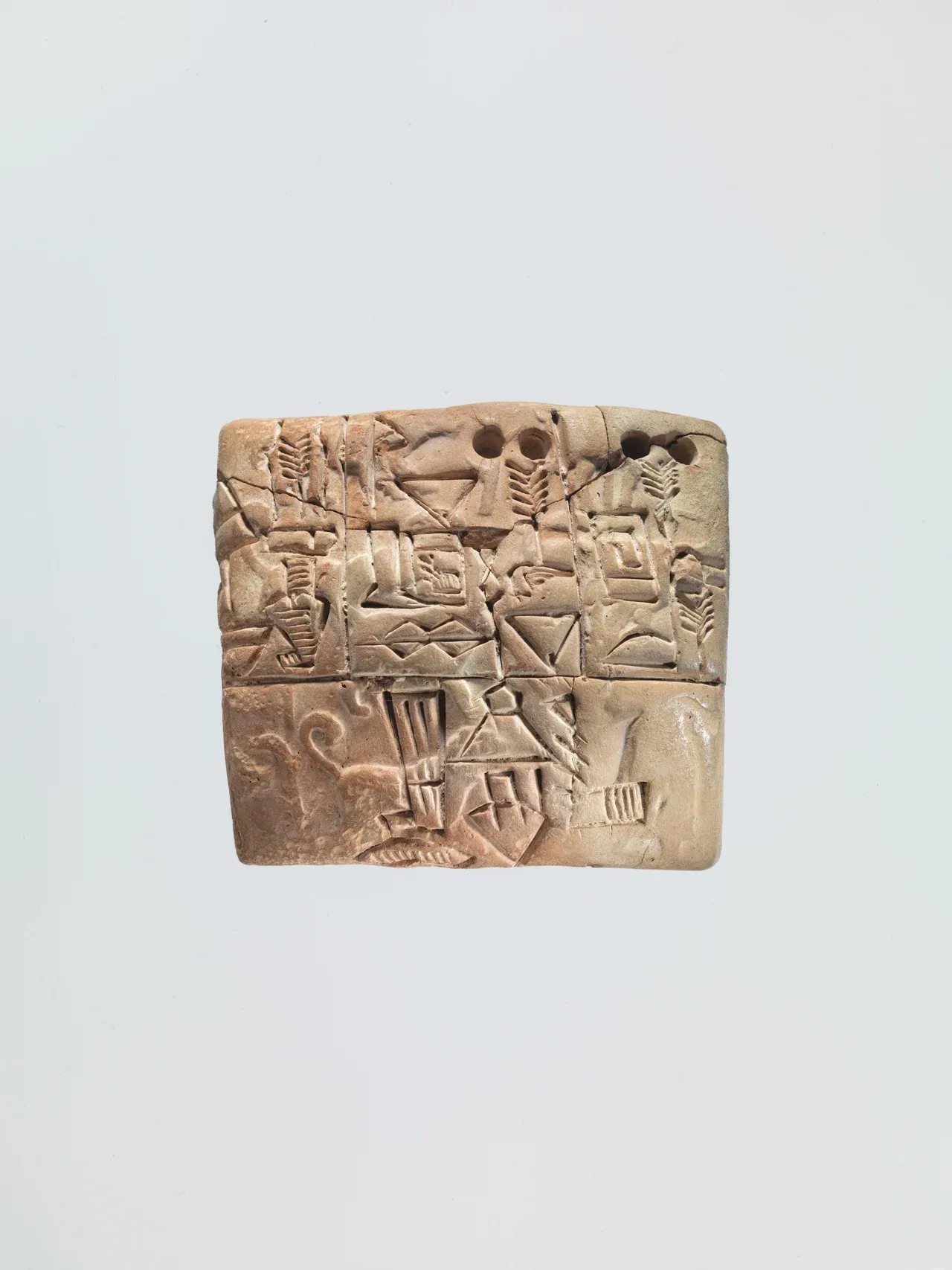
Plate I.1a. An account of barley distribution, about 3100 to 2900 BCE. The tablet is only 6 cm wide. Its compartments and number marks belong to the early history of writing. The Met, 1988.433.1. Purchase, Raymond and Beverly Sackler Gift, 1988. Image: The Metropolitan Museum of Art, public domain. Object record and full image.
Look at the tablet above. It is an account, not a page of myth. The museum identifies a record of barley distribution alongside impressions made by a cylinder seal. These early signs are called proto-cuneiform. Some are pictures or drawn shapes; others record numbers.4
Over time, signs could also stand for sounds. This opened ways to write names, grammar, and things that could not be shown by a simple picture. By the middle of the third millennium BCE, writing served many kinds of work, including literature.2
None of this dates the first spoken story. An early written account tells us that someone kept an account. It does not tell us what that person heard at home, sang at a festival, or believed about the river. The age of writing sets one limit on our evidence. It does not set a starting date for the human imagination.
One script, different languages
Cuneiform is a way of writing. Sumerian and Akkadian are languages. Keeping that distinction clear prevents a great deal of confusion.
Sumerian has no established relationship to another known language. Akkadian belongs to the Semitic language family. The script developed for Sumerian was adapted to write Akkadian, and later scribes could study both. Long after Sumerian ceased to be a spoken mother tongue, it remained a language of learned writing.5
Think of a modern alphabet used for several languages. Recognising the letters does not mean that you can read every sentence written with them. The comparison has limits, but it makes the first distinction clear.
There is a further difficulty. A cuneiform sign can have more than one reading. It may stand for a word in one place and a sound in another. The reader needs the language, the neighbouring signs, and knowledge of how scribes used them. Ancient word lists were part of that training. They were also part of the knowledge passed between generations.6
For us, a change of language is a reason to pay attention. A Sumerian poem and an Akkadian work may share a god or an episode without being the same composition. We should read each text before joining them into a single story.
The people who kept copying
The round tablet from the opening brings us back to the scale of a hand. On it, a sign marking a divine name comes before the sign read here as Urash. The pupil was learning a writing system in which the same sign could do different jobs.1
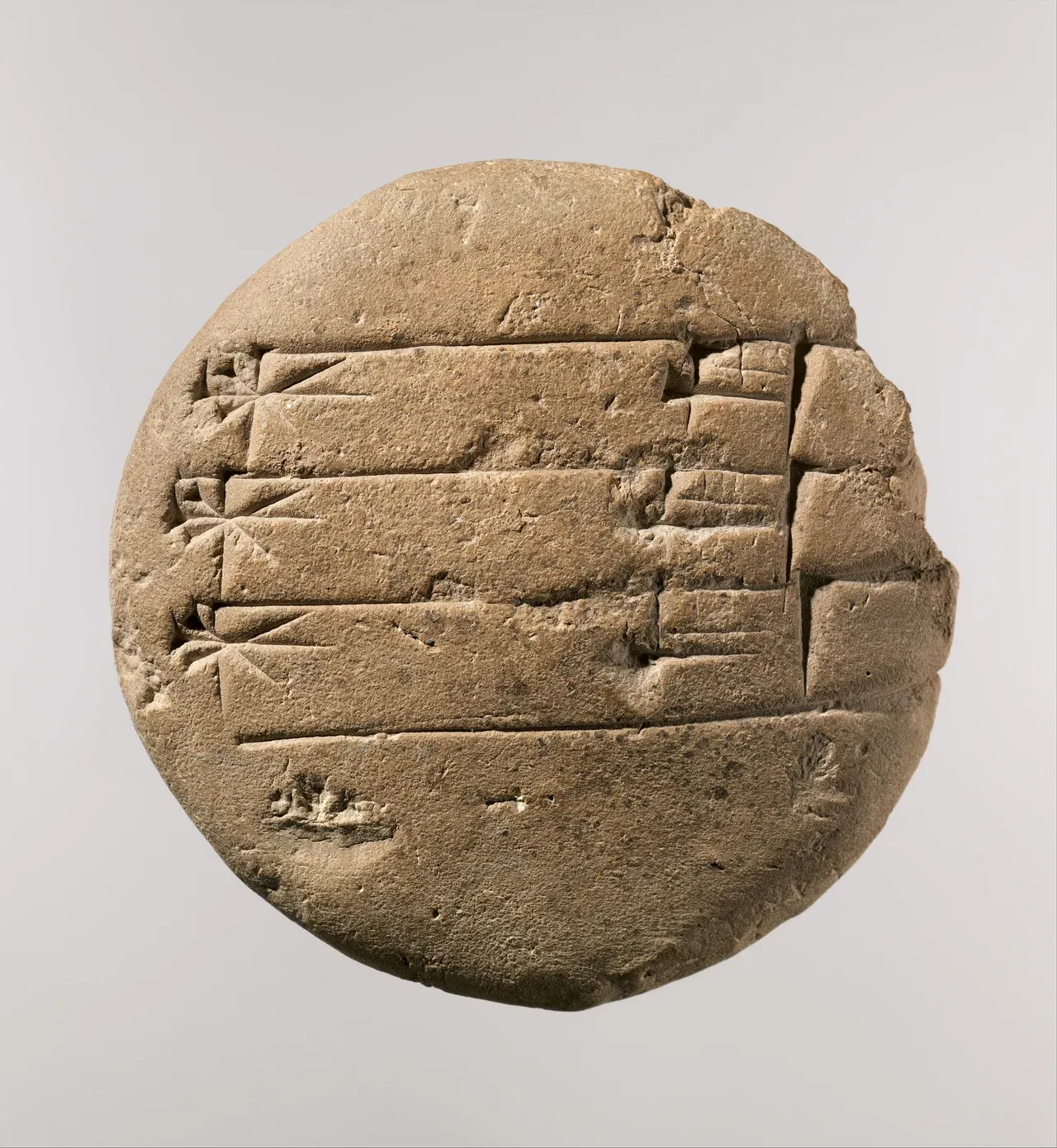
Plate I.1b. Urash’s name copied six times. Old Babylonian period, twentieth to sixteenth centuries BCE. The tablet is 7.6 cm across. The Met, 86.11.251. Purchase, 1886. Image: The Metropolitan Museum of Art, public domain. Object record and full image.
The Sumerian school is often called the eduba, or tablet house. The name can make us picture a grand public building. Excavation gives a more intimate example. At Nippur, a small house known to archaeologists as House F held a large body of school material. Eleanor Robson’s study connects the rooms and their tablets to the work of teaching. Some old exercises ended up in building material. Clay could also be soaked and used again.7
Learning involved repetition. On one common kind of school tablet, a teacher’s model and a student’s exercise share a surface. The other side can carry earlier material recalled for practice. Such objects let researchers study the order in which exercises were learned, rather than guessing a curriculum from the hardest texts alone.6
Literature belonged to this work. Many surviving manuscripts come from scribal education. Andrew George has stressed how strongly this shapes the evidence for Babylonian literary texts. A poem could have other uses, yet survive for us because students copied it.8
That changes the way we look at a familiar myth. Its survival does not give us a poll of ancient belief. It gives us, among other things, a record of what teachers chose and pupils practised. A widely copied poem may have been useful for learning. A story that nobody set as an exercise may have left much less behind.
The school preserved a great deal. It also helped decide what we would ever get the chance to read.
Three dates for one story
The phrase “a four-thousand-year-old story” can hide several different claims. We need to separate them.
The first date belongs to the physical object: when this copy was made. The second concerns the composition: when a work took the form we are trying to study. The third belongs to the events inside the story. A poem about the beginning of the world was still written at a particular time by people living long after that imagined beginning.
Gilgamesh makes the problem plain. There are separate Sumerian poems about the hero, then Akkadian texts with their own literary history. Old Babylonian copies already show a long narrative. Later manuscripts preserve the form usually called the Standard Babylonian epic. These are related bodies of evidence, not pages from one unchanged original.9
| Surviving evidence | Approximate date | What the date tells us |
|---|---|---|
| Early accounts from Uruk | Late fourth millennium BCE | Writing was in use. It does not date the first spoken myths. |
| Many school copies of Sumerian Gilgamesh poems | Eighteenth century BCE | These poems were being copied then. Some evidence is older. |
| Old Babylonian Gilgamesh manuscripts | Early second millennium BCE | An Akkadian narrative existed long before the copies at Nineveh. |
| The Flood Tablet from Nineveh | Seventh century BCE | This particular copy is Assyrian, not the first telling of the flood. |
The dates in this table are broad guides to surviving evidence.9, 10 They do not give us a chain of named authors. A late copy can preserve old words. It can also preserve revisions. Age alone does not tell us how much changed between copies.
This is why a careful edition names the manuscript as well as the work. The distinction can feel fussy until two versions disagree. Then it is the thing that allows us to understand the disagreement.
The king’s library
In the seventh century BCE, the Assyrian king Ashurbanipal assembled a large collection of learned texts at Nineveh, beside modern Mosul in northern Iraq. What we call his library was a working collection, shaped by the king and his scribes. Recent research on its tablets shows different stages of collecting and editing. Some texts were copied closely; others were put into new forms.11
Sometimes a tablet carries a note after the main text. Scholars call this a colophon. These notes can tell us about ownership and the care taken over copying. They also show how seriously knowledge could be guarded. One of Ashurbanipal’s formulas says that the tablet was checked by scholars and kept for royal use. It calls on Nabu, the divine scribe, to erase the name of anyone who erases the king’s name and substitutes their own.12
The threat makes possession part of the text. The tablet carries words about gods, and then calls on a god to protect the object itself. A copy could be a source of knowledge and a claim to authority at once.
Nineveh was destroyed in 612 BCE. The familiar picture of an intact library simply buried beneath a burning roof is incomplete. The British Museum’s recent project reports evidence that the collection was sifted, deliberately smashed, and scattered around the palaces. The fragments recovered by excavators therefore preserve the aftermath of handling and destruction, as well as the earlier work of collection.11
We should resist giving that destruction a happy ending because some tablets survived. We do not have a list of every work that vanished. The books we can read are evidence of survival; they cannot measure the full size of the loss.
How a broken text becomes a book
A modern edition often looks more complete than any one ancient tablet. That appearance takes work.
An editor first needs to identify what is actually visible. A photograph helps, but the writing is made of impressions in a surface. Examining the object and checking a hand copy can change a reading. The signs are then represented in modern characters, a step called transliteration. Working out their language and meaning leads towards a translation.13
There are two different ways another fragment can help. It might fit a broken edge of the same tablet. Or it might belong to a separate copy that preserves the damaged passage. A physical join repairs part of an object. A parallel copy supplies another witness to the wording. Those are different kinds of evidence.13
When an editor draws on several witnesses to present a continuous text, the result is a composite text. Oxford’s Electronic Text Corpus of Sumerian Literature makes such texts available alongside translations. Much of the literature it presents has been recovered from many broken tablets.14
The marks around the words matter. Square brackets in many editions show restored material where the tablet is damaged. An unreadable sign may be marked with an x. Other signs mark uncertain readings, omissions, or additions. Conventions differ, so the edition’s own guide should always come first.15
There is a practical difference between a word supplied from a clear parallel copy and a word suggested because it would fit the sentence. Both may sit inside an editor’s brackets. The notes explain the grounds for the choice.
An honest blank can tell us more than a confident sentence. It lets us know exactly where the evidence stops.
A goddess and an extra eight lines
We can watch this work in a real myth. Near the beginning of the Sumerian Inana’s Descent, the goddess leaves her sanctuaries before travelling to the underworld. In the Oxford edition, a note tells us that one manuscript adds eight lines to the list of places she leaves. Later, another note records a different version of her instructions to her minister.16
The extra lines are not a modern attempt to make the poem longer. They are evidence that its ancient copies differed. A translation that quietly blends them into one smooth account makes that fact harder to see.
Even the list of temples changes how we read the departure. Inana leaves places where she has standing and receives worship. The journey takes her away from a world that knows her rank. Read this way, the geography helps prepare us for the gates below, where that rank will fail to protect her. That is a reading of the poem, not proof of why an unnamed scribe added a particular line.
The distinction leaves the story open to thought without making every thought into an ancient fact.
The flood reaches a new audience
The most famous tablet from Nineveh belongs to the flood episode in Gilgamesh. The British Museum lists it as K.3375, a seventh-century BCE copy.10 The collection number matters: it points to a specific object, not to every surviving version of the episode.
In the Standard Babylonian epic’s eleventh tablet, Gilgamesh asks Uta-napishti how he gained life beyond the ordinary human span. Uta-napishti answers with the story of a flood. The gods decide on destruction. Ea gives a warning, a boat is built, and living beings are taken aboard. The account reaches Gilgamesh through a survivor speaking about his own past.17
This setting matters. The flood belongs inside a poem about a man who wants to escape death. Read on its own, the episode can seem like a loose tale of disaster. Read in the poem, it answers a desperate question about whether another person can cross the boundary that everyone else must face. A parallel with a later story is worth studying, but it should not make this literary setting disappear.
In 1872, George Smith announced his reading of the flood account. Its resemblance to the biblical flood drew enormous attention. That moment depended on earlier excavation at Nineveh and the work of people such as Hormuzd Rassam, an archaeologist from Mosul who had helped bring the Assyrian sites to light.18
Deciphering a passage in London and finding the object in Iraq were different parts of the recovery. Neither happened through the efforts of a single person working alone.
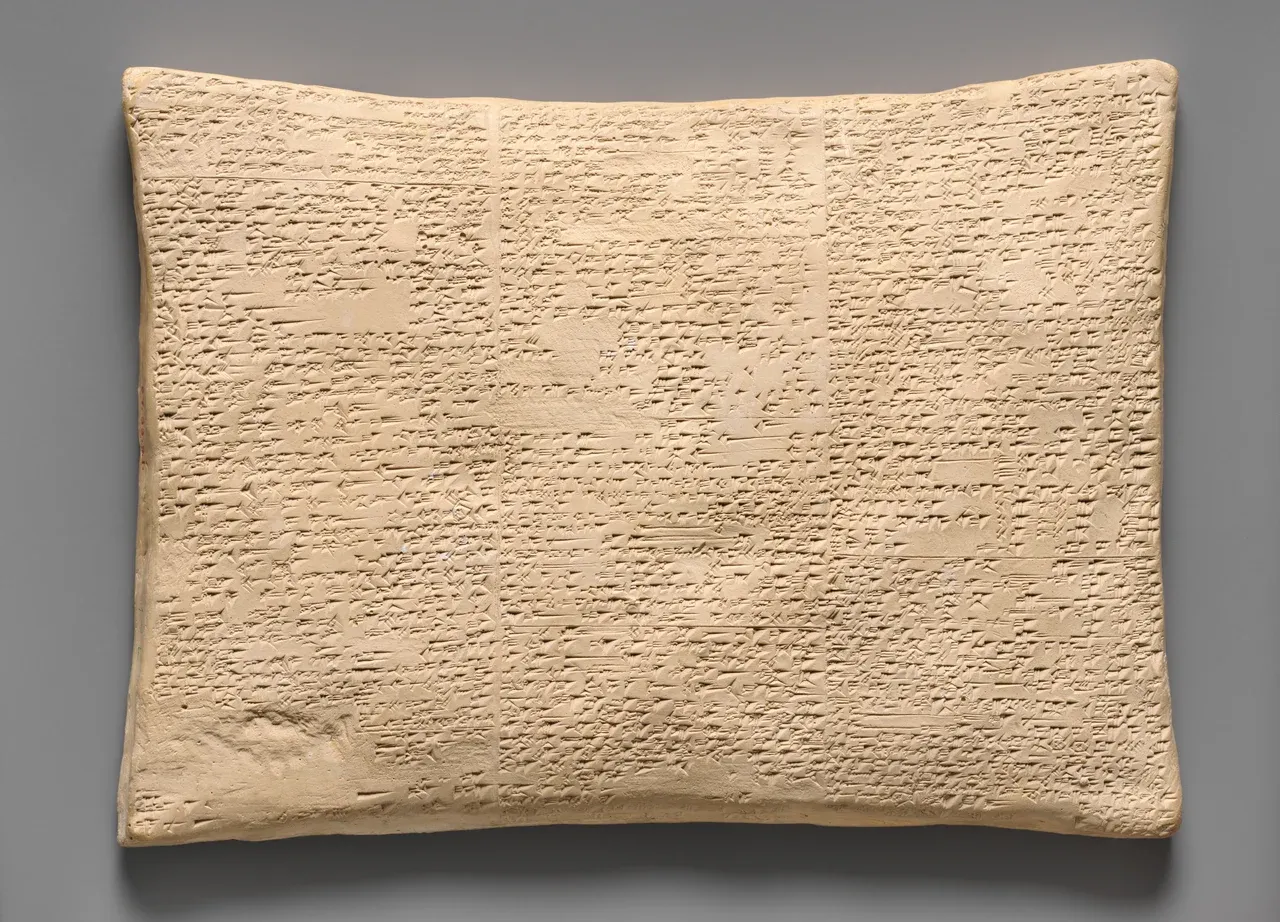
Plate I.1c. A nineteenth-century plaster reconstruction of the flood text. This is a modern teaching object, not an ancient tablet or a photograph of K.3375. It was cast from Paul Haupt’s reconstruction using several ancient fragments. The Met, 87.33.21. Gift of Henry G. Marquand, 1886-87. Image: The Metropolitan Museum of Art, public domain. Object record and full image.
The object above is a useful warning about appearances. It looks ancient, but the Met identifies it as a nineteenth-century plaster cast of a modern reconstruction. Paul Haupt built a clay model using several fragments as evidence. Copies made the text available to students who could not handle the originals.19
It belongs in the history of learning to read the tablets. Its complete shape should not persuade us that one equally complete ancient object was lifted from the ground. A museum caption, like an editor’s note, can change what we think we are seeing.
Reading with the gaps in view
Start with the story, but keep its source within reach. Notice whether you are reading a translation of a named text or a retelling that combines several versions. Check which language it comes from. Look at how the translator marks damaged passages. When a surprising claim turns on one word, follow the note.
We now have ways to do some of this without entering a museum study room. The Cuneiform Digital Library Initiative provides object records and digital access to tablets. Oxford’s corpus offers Sumerian texts and translations. The electronic Babylonian Library brings together editions and a searchable collection of fragments. These are working scholarly resources, so they should be read with their documentation and dates in view.20
The objects also have a modern history. A tablet without a recorded find place may still be readable, but we lose evidence about the room, building, and other objects around it. A photograph cannot restore that context.3 Nor does an object’s presence in a collection settle the history of how it arrived there. In 2021, the United States formally handed the Gilgamesh Dream Tablet back to Iraq after its illicit entry into the American market. It is a different object from the Nineveh Flood Tablet. Their shared hero does not make their histories interchangeable.21
The geography remains real. These stories come from places where people still live, and the tablets belong to the history of those places as well as to world literature.
Return, finally, to the small exercise with Urash’s name. We cannot turn its pupil into a character with a face, a voice, or a childhood we have invented. We can see the repeated signs. Someone learned them well enough to press them into clay. The movement ended thousands of years ago, but the marks remain available to another reader.
The next chapter begins before heaven and earth have names. Our way into that imagined world begins here, with a hand and a piece of clay.
Footnotes
-
The Metropolitan Museum of Art, Cuneiform tablet: school exercise, 86.11.251. The record identifies the divine name, its six repetitions, the date range, and the use of the signs. ↩ ↩2
-
Ira Spar, The Origins of Writing, The Metropolitan Museum of Art, 2004. A concise account of early record keeping and the development of cuneiform. ↩ ↩2 ↩3
-
Riccardo Cameli Manzo and colleagues, A synchrotron X-ray powder diffraction study of cuneiform clay artefacts, npj Heritage Science 13, 605 (2025). See the discussion of drying, ancient and modern firing, and the loss of archaeological context. ↩ ↩2 ↩3
-
The Metropolitan Museum of Art, Proto-Cuneiform tablet with seal impressions: administrative account of barley distribution, 1988.433.1. The museum dates the object to about 3100 to 2900 BCE and identifies its administrative use. ↩
-
Silvie Zamazalova, Sumerian, Nimrud: Materialities of Assyrian Knowledge Production, Oracc, 2019. On the language, its script, and its later scholarly use. ↩
-
Niek Veldhuis, Introduction to the Lexical Tradition, Digital Corpus of Cuneiform Lexical Texts, Oracc. See especially the Old Babylonian school material and the discussion of Type II tablets. ↩ ↩2
-
Eleanor Robson, The Tablet House: A Scribal School in Old Babylonian Nippur, Revue d’assyriologie et d’archéologie orientale 95 (2001), pp. 39-66. House F is a specific archaeological example, not a model for every Mesopotamian school. ↩
-
Andrew R. George, The Epic of Gilgamesh: thoughts on genre and meaning, in Gilgameš and the World of Assyria (2007), pp. 37-66. On the importance of educational copying to the surviving literary record. ↩
-
Andrew R. George, Shattered tablets and tangled threads: Editing Gilgamesh, then and now, Aramazd: Armenian Journal of Near Eastern Studies 3, no. 1 (2008), pp. 7-30. On the Sumerian poems, Akkadian versions, manuscripts, and the work of editing them. ↩ ↩2
-
The British Museum, The Flood Tablet, K.3375. The record identifies a Neo-Assyrian copy of Tablet XI from Kouyunjik, Nineveh, dated to the seventh century BCE. ↩ ↩2
-
The British Museum, What was Ashurbanipal’s Library?. The project describes the collection’s working character, stages of copying and editing, and evidence for its deliberate destruction and dispersal. ↩ ↩2
-
Gabriel McKee, Protective colophons, Institute for the Study of the Ancient World, New York University, 2026. The royal example discussed here is Ashurbanipal colophon B, no. 318 in Hermann Hunger’s collection. ↩
-
Oracc, Deciphering cuneiform tablets, Nimrud: Materialities of Assyrian Knowledge Production. For manuscript joins and parallel witnesses, see also George’s Shattered tablets and tangled threads, linked above. ↩ ↩2
-
University of Oxford, About the Electronic Text Corpus of Sumerian Literature. The corpus presents composite transliterations and translations rather than pretending that each work survives on one complete tablet. ↩
-
University of Oxford, ETCSL manual and display conventions. These explain the corpus’s notation. Other editions may use different conventions. ↩
-
University of Oxford, Inana’s descent to the nether world, ETCSL 1.4.1, especially the notes at lines 6-13 and 28-31. The reading of the departure offered here is an interpretation, distinct from the manuscript evidence recorded by the edition. ↩
-
SOAS, Epic of Gilgamesh, Standard Version, Tablet XI, lines 1-163. Akkadian read by Karl Hecker, with Andrew George’s translation reproduced by permission from his 2003 edition. The chapter paraphrases the episode rather than reproducing the translation. ↩
-
The British Museum, Middle East: history of the collection, and Sparking the imagination: the rediscovery of Assyria’s great lost city. These discuss Smith’s 1872 reading and Rassam’s part in the excavations. ↩
-
The Metropolitan Museum of Art, Cast of a cuneiform tablet inscribed with the story of the Flood, 87.33.21. The record dates the plaster object to the nineteenth century and explains Haupt’s reconstruction from several fragments. ↩
-
Cuneiform Digital Library Initiative; Electronic Text Corpus of Sumerian Literature; electronic Babylonian Library, LMU Munich. The Oxford project’s main funding ended in 2006; its online editions remain useful but should not be treated as the latest edition of every text. ↩
-
UNESCO, UNESCO celebrates US handover of 3,500-year-old Gilgamesh tablet to Iraq, 2021. Cited here for the modern return of the Dream Tablet, not for the date or language of the Nineveh Flood Tablet. ↩