Numina · Mesopotamian · I.3 The assembly of the gods
Chapter I.3
The assembly of the gods
A throne is not enough. Anu grants rank, Enlil gives commands, Enki assigns the work, and Marduk asks the gods to recognise his rule. Inside a divine order that is never quite as settled as it claims.
Before they give Marduk a kingdom, the gods sit down to eat.
They have heard the news about Tiamat. They know that the older gods have failed to face her. Now a younger god has offered to fight, provided they give him the right to command them. The gathering described in Enuma Elish has an urgent purpose. Yet there is time for food, beer, and a change of mood. Frightened gods become a company ready to name a king.1
In Before the world, we followed Marduk onto the battlefield. Stay at the table for a moment. His strength does not settle everything. Other gods must recognise his claim. Someone must speak, someone must agree, and the agreement must hold after the danger has passed.
This chapter follows that problem through several texts. It is not a single story assembled from their parts. A hymn to Enlil, a poem about Enki, and a Babylonian account of Marduk each have their own favourite. Read together, they let us hear different answers to the same question: who has the right to decide what happens next?
No fixed seating plan
A list of Mesopotamian gods can look reassuring. Each name gets a task: sky, wind, water, war. Learn the list and the world seems to fall into place.
Then the reading starts. Two gods can claim the same power. A goddess can cross several fields of life. A city can praise its own deity in terms that seem to leave no room for a superior. The arrangement changes with the text, the place, and the period. We are reading works produced across many centuries, not chapters from one ancient handbook.
Even the names require care. An is the Sumerian name usually paired with the Akkadian Anu. Enki is commonly identified with Ea. Enlil also appears as Ellil. These pairings help us follow the literature, but they do not make every account of a god identical.2
Keep four names to hand for this chapter:
| Name | A principal city | What to watch for here |
|---|---|---|
| An / Anu | Uruk | Rank, kingship, and the authority to grant power |
| Enlil / Ellil | Nippur | Binding commands, the ordering of life, and royal authority |
| Enki / Ea | Eridu | Fresh water, skilled knowledge, and the assignment of work |
| Marduk | Babylon | A claim to supreme rule that gathers older powers around it |
These are starting points, not job limits. Nor are the four a permanent committee with a fixed order of succession.3
The collective names are no tidier. Anunna, with Akkadian forms Anunnaku and Anunnaki, can refer to major gods or to the gods of a particular city. Some later uses connect the name with the underworld. It does not always describe the same membership. A text’s own setting matters more than a modern chart that assigns every god a permanent seat.4
Calling divinity an office is useful here. It directs our attention to responsibility and rank. But a god is not only an official. These beings have tempers, desires, family loyalties, and powers that no human office could contain. The stories become interesting when those things interfere with the orderly division of duties.
Anu and the right to rule
Anu is the sky god, but that description leaves out much of his importance. He can grant other gods their standing. He belongs to the older generation whose recognition makes a claim to power legitimate. His authority remains valuable even in texts where someone else takes the leading role.5
Watch how Inanna approaches him in the Sumerian poem Inana and Ebih. The mountain Ebih has failed to show her respect. She wants to destroy it. Before she attacks, she comes to An, makes an offering, and addresses him. He takes the place of honour in heaven.
Inanna begins by recalling what he has already given her. Her fearsome status and her weapons rest on his grants. She uses those earlier gifts to support a new demand. If she possesses such power, how can the mountain be allowed to ignore it?
An is not persuaded that the attack will succeed. He describes the mountain’s frightening strength and tells her she cannot overcome it. Inanna attacks anyway. She destroys its forests and breaks its resistance. The poem celebrates her victory.6
This is a difficult scene for anyone hoping to draw a simple chain of command. An has enough authority that Inanna seeks his hearing. He does not have the last practical word on what she does. The poem can honour his position and still let its heroine act against his warning.
It helps to notice what kind of work we are reading. A poem praising Inanna has reasons to show her exceeding expectations. That is different from a hymn devoted to Anu’s own greatness. The change of emphasis is part of the evidence, not a mistake we need to repair.
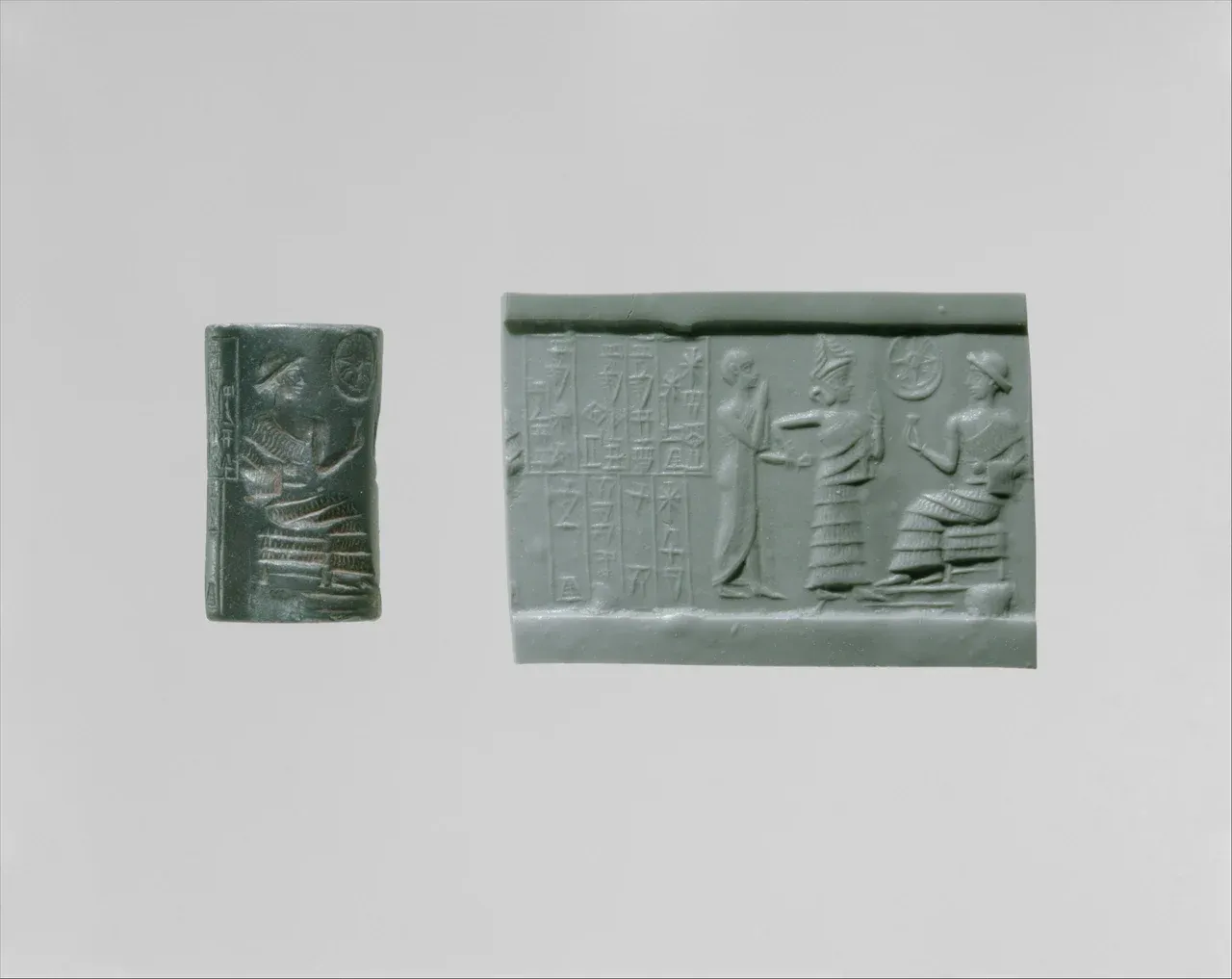
Plate I.3a. A presentation scene on a seal from about 2028 to 2004 BCE, shown with a modern impression. The Met identifies the seated figure as a deified king, probably Ibbi-Sin, rather than Anu or Enlil. A goddess leads a worshiper into his presence. This is evidence for how access and rank could be pictured, not an illustration of the assembly in a particular myth. The Met, 1988.380.2. Gift of Martin and Sarah Cherkasky, 1988. Image: The Metropolitan Museum of Art, public domain. Object record and full image.
Enlil gives the command
At Nippur, the great name is Enlil. His temple is the Ekur, the Mountain House. His power to grant kingship makes his favour matter far beyond the city itself. Scholars still debate parts of his name and original character. Reducing him to a god of wind is a poor guide to the range of his authority.7
The Sumerian hymn Enlil in the E-kur begins with his commands. They cannot be overturned. Other gods come before him and obey. His city is described as a place where wrong behaviour cannot endure.
Then the hymn widens its view. Without Enlil, cities would not be built. No king would be raised to power. Fish would not reproduce in the reedbeds. Crops would fail to grow. Human government and the renewal of life depend on the same divine will.8
We often separate these things. A king’s appointment belongs to politics; a field of barley belongs to farming. The hymn puts them together. It praises the power that allows an inhabited world to continue. Enlil’s command has consequences in a palace and in the mud beside a river.
That is why a decision about a king can be described as part of the ordering of the world. It is not merely a private favour to one ruler. The poem presents authority as something that makes other kinds of life possible.
There is a revealing detail near the end. Ninlil, Enlil’s consort, sits with him and gives counsel. The hymn describes them deciding destinies together. A short list headed only by Enlil would miss her presence beside the throne.9
None of this makes the hymn a neutral account of Nippur. A city praised as free of wrongdoing is an ideal city. It tells us what the poet wants Enlil’s home to mean, not that its human streets were without theft or cruelty. Praise is evidence for an ambition. It is not a report proving that the ambition was met.
Enki puts the world to work
Enki lives in the Abzu, the fresh waters beneath the earth. As Ea, he is closely linked with incantations and the knowledge used in healing and protection. His skill is practical. He knows how to make something work, how to remove a danger, and sometimes how to escape another god’s plan.10
In Enki and the world order, the world needs more than a roof of sky and a stretch of land. It needs water in the right places, grain in the fields, and people able to build houses. The poem follows Enki as he sets activities in order and places gods in charge of them.
Enbilulu receives responsibility for waterways. Enkimdu is assigned ditches and dykes. Grain comes under Ashnan. Kulla is associated with brickmaking; Mushdama with building. These tasks are close enough to touch, but they are not the same. Making bricks does not by itself produce a house that stands.11
The poem gives us a way to think about a field. Its crop depends on several acts of care, each with a divine name attached. Water must arrive. The boundaries must be known. Someone must plough. The grain must grow. Abundance is shared work before it becomes something a person can eat.
Enki’s authority is also shared, though he has plenty to say about his own greatness. Early in the poem he explains that Enlil placed powers in his hands. He speaks of deciding destinies alongside Enlil and overseeing justice beside An. His wide activity does not require the other great gods to disappear.12
This is a different account from Marduk cutting up Tiamat. Its interest is in how a working world is arranged. We lose that difference if we make all creation stories answer only the question of where matter came from. Here, a building plot without a builder would still be unfinished creation.
The details also keep the poem from becoming an abstract account of power. There are animals, boats, tools, and provisions for the gods. The divine order reaches down to the work of making and maintaining things. That is where people must live with it.
What a divine decision does
The phrase “decreeing destinies” can sound like a prediction. A god looks ahead, sees what will happen, and announces it.
Often these texts mean something more active. A deity grants a city prosperity, gives another god a duty, or raises someone to kingship. The speech helps establish the condition it names. Enki’s appointments are decisions about what the gods will do. Enlil’s favour gives a ruler the standing to rule.13
Our nearest everyday comparison is a judge delivering a verdict or an authority appointing someone to a post. The words do not just describe a situation. Spoken by the person entitled to say them, they change it. This is a comparison, not a claim that divine power was merely human law with larger consequences.
Now Marduk’s demand becomes easier to understand. He wants more than permission to fight Tiamat. He wants his future decisions to bind the gods who are listening. The point of the assembly is partly to establish whose words will count.
Its members are not equal citizens choosing a representative. We should not imagine ballot papers or a recorded majority. Enuma Elish narrates agreement, acclamation, and the granting of kingship. To call this a “vote” can be convenient shorthand, but it adds a procedure the poem does not describe.14
The resulting problem is quite sharp. If the gods have the standing to make Marduk their ruler, they already possess authority together. They use that authority to give him a command that none of them may undo. The poem lets a king’s supremacy grow out of a collective act.
Marduk takes the chair
Return to the banquet. Marduk is placed before the gods to receive kingship. They compare his command with Anu’s. Anu’s standing is the measure by which the new king’s power can be understood.
They test Marduk’s speech. In W. G. Lambert’s translation, he makes a constellation vanish and appear again. Then they acclaim him as king and give him the signs and weapons of rule. His word works before his weapon is put to its great test.15
After the battle and the building of Babylon, the gods gather again. The epic makes room for further acts of recognition. Anu honours Marduk’s bow. The gods swear an oath. They confirm his kingship and expect him to care for their sanctuaries and offerings.16
That last expectation matters. Supreme rule comes with the duty to keep the divine community provided for. The older gods have not simply ceased to exist. They have places, needs, and a claim on the new order.
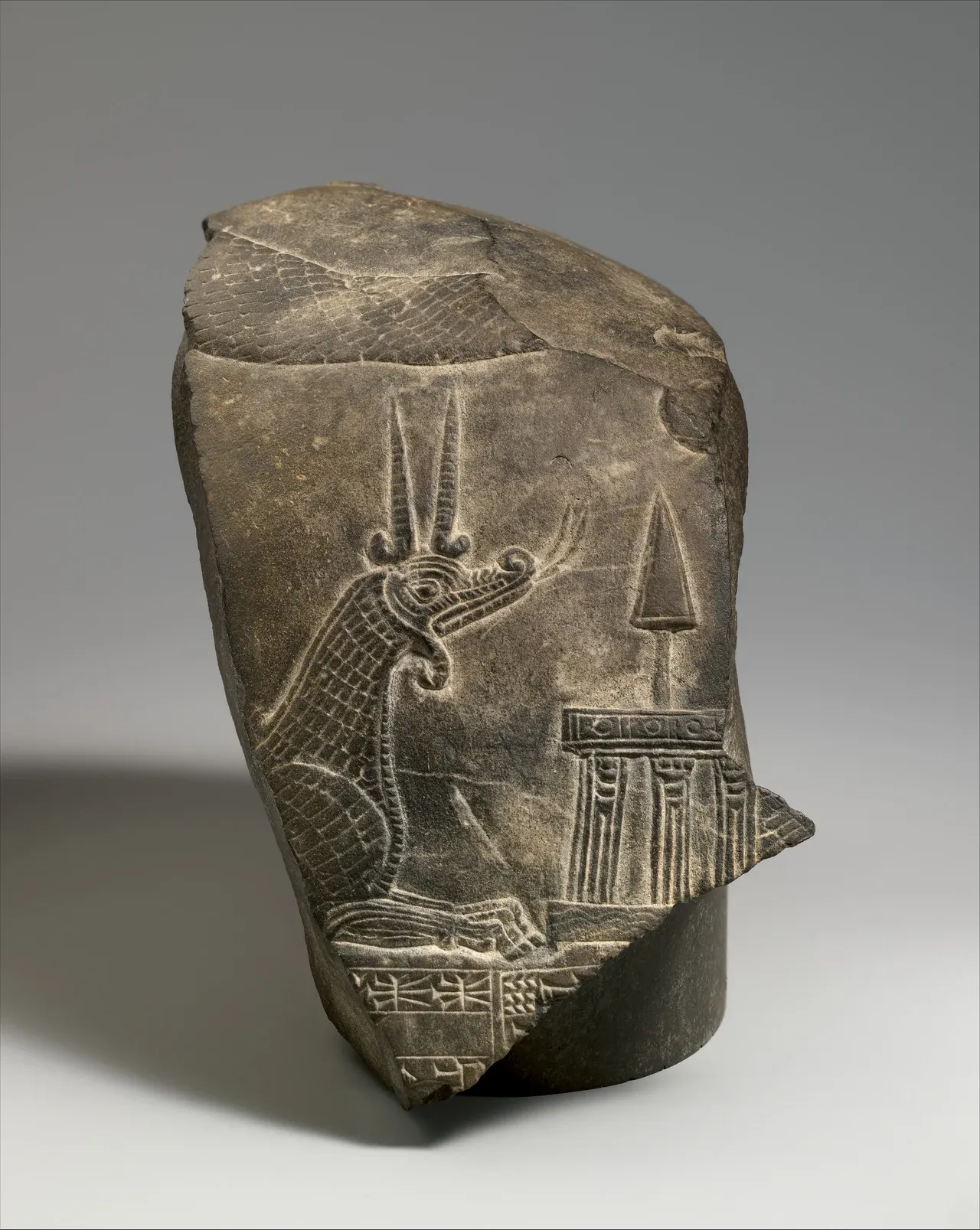
Plate I.3b. The kudurru fragment introduced in I.2, now read as an image of divine authority. Its dragon and spade emblem belong to Marduk’s imagery. Such monuments recorded and protected land grants; this is not a picture of his election or coronation. Babylonian, about 1156 to 1025 BCE. The Met, 1985.45. Rogers Fund, 1985. Image: The Metropolitan Museum of Art, public domain. Object record and full image.
The final names given to Marduk widen his role. The poem does not leave him as a specialist in killing one enemy. It makes his victory support a much larger claim over the activities of the gods. Near the end, Ea gives him his own name and responsibilities.17
In historical terms, Marduk’s rise belongs to the growing importance of Babylon. His earliest role is uncertain. He was not always the obvious head of the pantheon, and his later greatness should not be read backwards into every earlier text.18
Nor does a poem praising his supremacy tell us that devotion to other gods ended. Its argument depends on their recognition. Their names still carry weight; their acknowledgement helps make his claim powerful.
The assembly is therefore more than scenery around a hero. Remove it, and we have a strong god who wins a fight. Keep it, and we can see how the poem turns a victory into a right to govern.
A house for a god
In these stories, rank needs a place to live.
The Ekur belongs to Enlil at Nippur. Enki’s home is tied to Eridu and the Abzu. Marduk’s great sanctuary is Esagil at Babylon. A god’s city gives divine authority an address. It is a place where human beings can bring offerings and where a ruler can make a public claim to serve the deity.19
Temples were also places of care. Cult images were dressed and supplied with food and drink. They were treated as bearers of divine presence, not as decorative pictures. The work of worship involved materials and people, not only belief.20
This gives the creation epic’s ending a practical force. When Marduk is charged with maintaining the other gods’ sanctuaries, the poem is talking about something its audience could recognise. Someone must provide what a divine household requires. The feast in heaven has consequences for work on earth.
It would be too simple to dismiss all this as a disguise for politics. The stories do help justify authority. They also express hopes about food, security, successful work, and a world that will continue tomorrow. The same passage can support a ruler’s claim and speak to a farmer’s fear that the water will fail.
The poems do not separate those concerns as neatly as we might wish. Reading them well requires us to keep both in view.
The person waiting outside
So far, most of the speakers have been gods. Human beings generally meet the order they establish from the other side: waiting for a favourable decision, making an offering, or asking for help.
The seal shown earlier gives that distance a shape. A worshiper does not simply take the seated figure’s place. A goddess leads him forward. The scene is arranged around an approach and a difference in rank. The museum identifies the recipient as a deified king, which makes this an especially clear meeting of royal and sacred authority.21
Another object offers a quieter view. The small figure below was found at Tell Asmar, ancient Eshnunna. His hands are joined. His eyes remain open. He represents a worshiper, not one of the great gods whose names we have been following.
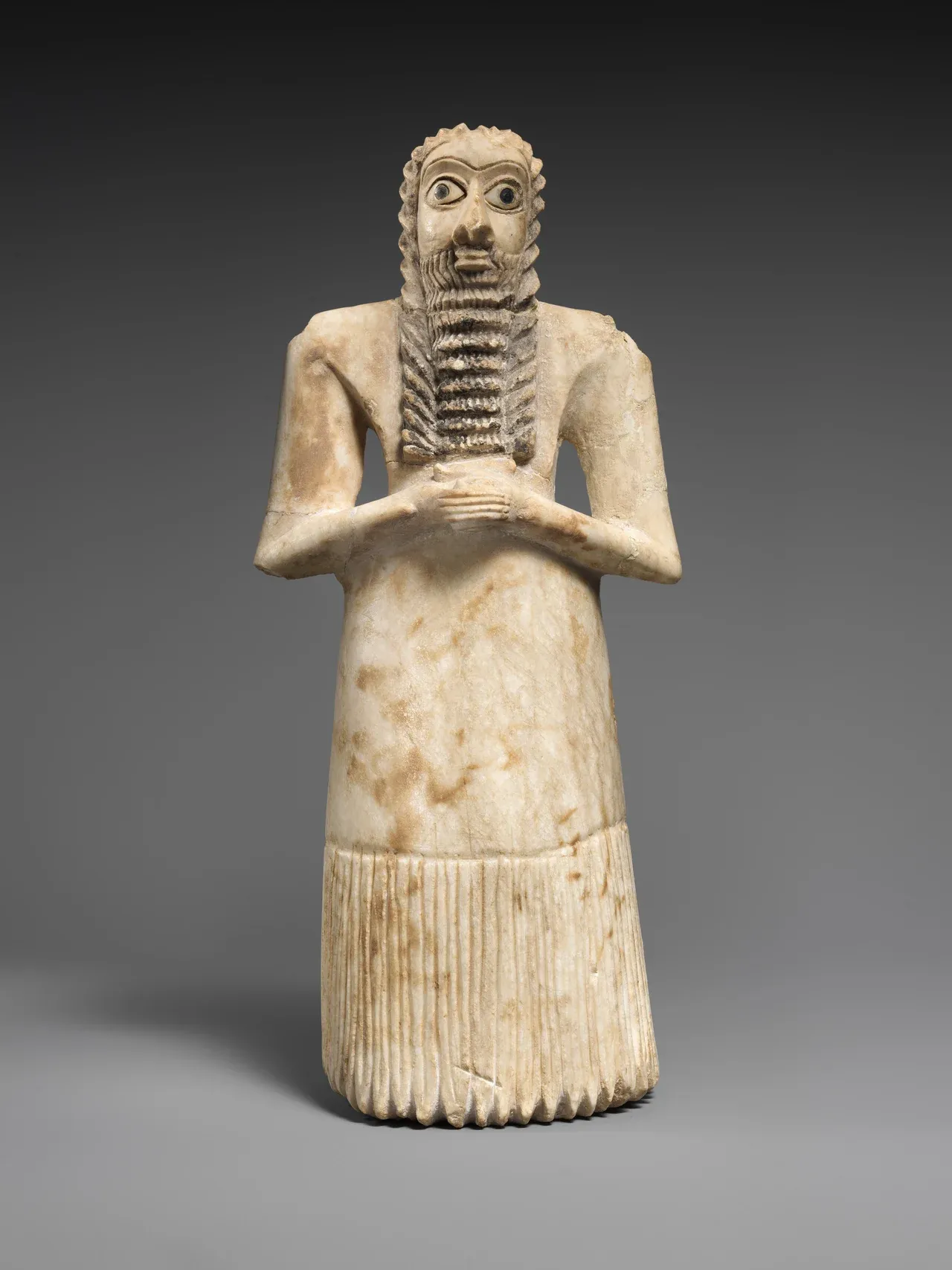
Plate I.3c. A standing male worshiper from Tell Asmar, about 2900 to 2600 BCE. Only 29.5 cm high, the figure was placed in a temple to remain in prayer for the person it represented. It is not a portrait of Anu, Enlil, or Enki. The Met, 40.156. Fletcher Fund, 1940. Image: The Metropolitan Museum of Art, public domain. Object record and full image.
The Met describes this statue as a continuing presence in prayer on behalf of its owner. We do not know that person’s private thoughts. The posture cannot tell us precisely what was asked. It does show the care given to remaining before the divine presence.22
A chapter about power needs that small figure. The assembly decides destinies, but most people do not sit in it. They must find ways to be heard by those who do.
Someone has been left out
There is one more voice to hear before we leave Enki’s ordered world.
Near the end of Enki and the world order, Inanna complains. Other goddesses have received their duties. The birth goddess has the instruments of her work. Nisaba has the measuring tools and the task of writing. Inanna wants to know where her own responsibilities are. She brings the complaint directly to Enki.23
He does not answer by saying she should be content without a place. He insists that she already has powers, and begins to describe them. His response ranges through dress and weaving to the violence of battle. The ending is damaged, so we cannot turn it into a perfectly preserved settlement between the two.24
Even so, her complaint changes the sound of the poem. We have watched Enki distribute tasks with great confidence. Now someone challenges the distribution. The orderly list has not satisfied everyone whose life it is meant to arrange.
Notice, too, the terms of the protest. Inanna asks for a function. She wants her power acknowledged through something she has the right to do. The office is not empty ceremony. It is a recognised share in the running of the world.
We will meet her at greater length in the next chapter. For now, leave her here, before Enki, refusing to let the list close without her name.
Footnotes
-
Enuma Elish III.125-138. The assembly hears the danger, gathers, eats, drinks, and determines Marduk’s destiny. See W. G. Lambert’s translation, hosted by Maricopa Open Digital Press. The chapter offers an original retelling and interpretation, not a quotation of that translation. ↩
-
The entries for An/Anu, Enki/Ea, and Enlil/Ellil, Ancient Mesopotamian Gods and Goddesses, Oracc, document these names and their changing uses. Spellings in this chapter are simplified; Oxford’s translations often use Inana, Nibru, and Eridug for Inanna, Nippur, and Eridu. ↩
-
Ira Spar, Mesopotamian Deities, The Metropolitan Museum of Art, 2009; Nicole Brisch, Marduk, Oracc. The table selects prominent associations, not exclusive places of worship. ↩
-
Nicole Brisch, Anunna (Anunnaku, Anunnaki), Oracc. The entry stresses changes of meaning, uncertain membership, and uses referring to individual cities. ↩
-
An/Anu, Oracc, especially the discussion of his authority, grants of status, and continuing prestige. ↩
-
Inana and Ebih, ETCSL 1.3.2, University of Oxford: lines 25-52 for the grievance, 59-111 for the approach and request, 112-130 for An’s answer, and 131-183 for the attack and praise. The discussion keeps this Sumerian poem separate from the Babylonian creation epic. ↩
-
Adam Stone, Enlil/Ellil, Oracc. See the sections on functions, the disputed reading and meaning of the name, and the Ekur at Nippur. ↩
-
Enlil in the E-kur (Enlil A), ETCSL 4.05.1, University of Oxford: lines 1-43 for command, city, and temple; 84-92 for royal favour; 109-155 for the dependence of human and natural life on Enlil. ↩
-
Enlil in the E-kur, lines 156-166, gives Ninlil counsel, a place beside Enlil, and a part in determining destinies. This is evidence from this hymn, not a claim that every text assigns her the same position. ↩
-
Enki/Ea, Oracc, on the Abzu and the god’s connections with wisdom, incantation, and practical arts. ↩
-
Enki and the world order, ETCSL 1.1.3, University of Oxford: lines 267-273 for Enbilulu; 318-325 for Enkimdu; 326-334 for Ashnan, written Acnan in this edition; 335-348 for Kulla and Mushdama, written Mucdama. The ancient assignments are retold here in new prose. ↩
-
Enki and the world order, lines 38-47 and 61-85. Enki’s own account places his authority in relation to both An and Enlil. This is not a universal divine genealogy or a modern administrative chart. ↩
-
Compare Enki and the world order, lines 192-218 and 267-380, with Enlil in the E-kur, lines 84-92. The comparison with an appointment or verdict is an interpretive aid, not a translation of an ancient definition of destiny. ↩
-
Enuma Elish IV.1-34. Lambert reads a constellation in the test of Marduk’s command. Some older translations read a garment. The textual difference was discussed in I.2; neither object should be silently treated as the only reading ever proposed. ↩
-
Enuma Elish VI.69-110, particularly the assembly, the bow, the oath, and the charge to maintain the gods’ sanctuaries. The epic narrates recognition both before and after the battle. ↩
-
Enuma Elish VI.121-166 and VII, especially VII.137-142 for Ea’s name and commands. For the critical edition, see W. G. Lambert, Babylonian Creation Myths, Eisenbrauns, 2013. ↩
-
Nicole Brisch, Marduk, Oracc, on uncertain origins, the connection with Babylon, and the growth of his prominence. The historical process should not be reduced to the moment of enthronement inside the poem. ↩
-
Enlil in the E-kur, lines 35-55; Enki and the world order, lines 1-16 and 89-122; Enuma Elish VI.47-80. These are literary accounts of divine dwellings, read here alongside the city associations in Spar’s Mesopotamian Deities. ↩
-
Spar, Mesopotamian Deities, on the care of divine images and their role as bearers of divine presence. Practices varied with time and place; this paragraph is an outline, not a complete account of temple ritual. ↩
-
The Metropolitan Museum of Art, cylinder seal 1988.380.2. The museum identifies the worshiper, probably Ilum-bani, through the inscription, and reads the recipient as a deified king, apparently Ibbi-Sin. The modern impression is a display aid, not a second ancient object. ↩
-
The Metropolitan Museum of Art, Standing male worshiper, 40.156, from the Square Temple at Tell Asmar. The museum explains the figure as praying continually on its owner’s behalf; its interpretation of that function does not disclose the owner’s individual prayer. ↩
-
Enki and the world order, lines 387-423. Inanna names several goddesses and their functions, including the birth goddess in lines 395-402 and Nisaba in lines 412-417. This complaint belongs to the poem’s narrative, not to a surviving legal record. ↩
-
Enki and the world order, lines 424-472. The final passage contains missing or unclear lines. The chapter does not supply an invented resolution. ↩
Sources
- Read the ancient poem: Enlil in the E-kur, ETCSL 4.05.1, University of Oxford
- Read the ancient poem: Enki and the world order, ETCSL 1.1.3, University of Oxford
- Compare the creation epic: Enuma Elish, W. G. Lambert's translation, Maricopa Open Digital Press
- Explore the gods: Ancient Mesopotamian Gods and Goddesses, Oracc