Numina · Hindu · III.2 Vishnu, Shiva, Devi
Chapter III.2
Vishnu, Shiva, Devi
In the oldest hymns two of them are minor and the third has no single name. A thousand years later everything turns around them. How did the centre move, and what became of the gods who had held it?
A piece of dark stone from Kashmir, not quite fifteen centimetres high, shows three gods standing in a row. It was carved in the eighth or ninth century. The Met names them as Brahma, Shiva and Vishnu, and points out something found only in Kashmir: each of the three is given three faces.1
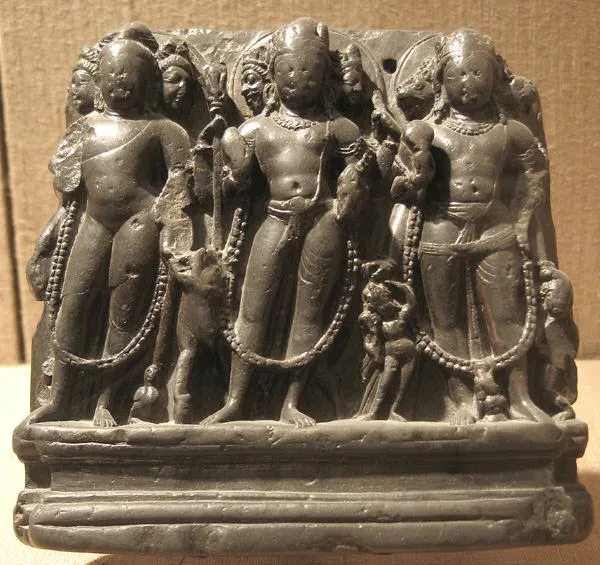
Plate III.2a. The Brahmanical triad: Brahma, Shiva and Vishnu, eighth to ninth century CE, stone, 14.6 centimetres high, from Kashmir. The three-faced form of all three gods is peculiar to that region. The carving shows that the three were being set side by side by this date. It does not show that they were worshipped as a set, and the Goddess is absent. The museum’s only photograph is a small one. The Met, 1985.85. Purchase, Lita Annenberg Hazen Charitable Trust Gift, in honor of Cynthia and Leon Polsky, 1985. Image: The Metropolitan Museum of Art, public domain. Object record and full image.
This is the picture many people carry of the Hindu gods: a creator, a preserver and a destroyer. It is a real picture, and this chapter starts from it. But it misleads in three ways. One of the three, Brahma, has almost no temples of his own.2 The other two are each far more to their worshippers than a single task. And the deity who would complete most Hindus’ own short list is not in the row at all. She is the Goddess.3
So the title of this chapter names a different three: Vishnu, Shiva, and Devi, which is simply the word for goddess. The last chapter described a religion of fire and hymns in which none of them stood at the centre. This one asks how the centre moved, and what happened to the gods who had been there first.
The chapter has four pages. This page is the map. Each of the three has a page of their own: Vishnu, Shiva and Devi.
Where they stood in the Veda
Start by counting. The Rigveda has 1,028 hymns, and Arthur Macdonell tallied how many are addressed to each god. Indra has at least 250. Agni has about 200, and Soma more than 100.4
Then look for the gods of this chapter. Vishnu, Macdonell says, is by this measure a deity of the fourth rank, invoked less often than three minor solar gods, one of whom has about eight hymns. Rudra, the earlier form of Shiva, has three or four. As for goddesses, the only one who receives whole hymns with any frequency is Ushas, the dawn, with about twenty.4
Diagram 1. Hymns addressed to each deity in the Rigveda, from the figures in Macdonell’s history of 1900. Drawn for this book. Macdonell gives no number for Vishnu, only his rank below Pushan, so that bar is an upper limit. The two future great gods are at the bottom.
They are not absent, and what the hymns say of them matters for everything later. Vishnu is the god who takes three strides across the whole universe. Rudra is feared: an archer whose arrows the poets dread, and who is also begged for his medicines. And there is one remarkable hymn in which Speech herself, a goddess, declares that she upholds all the other gods.5 Each of these is taken up on its own page.
Stephanie Jamison and Michael Witzel, the guides of the last chapter, state the position carefully. The two great gods of later Hinduism are not at all prominent in the Veda, though they do appear there. How they rose is, in their words, rather controversial.6
When the centre moved
No text announces the change. It has to be read from dates.
Vidya Dehejia gives the broad one. Hinduism in a form comparable to its present-day expression, she writes, emerged at about the start of the common era, with an emphasis on the supremacy of the god Vishnu, the god Shiva, and the goddess Shakti, whose name means power. She describes two strands that came together. One runs back to the Vedas. The other drew on beliefs among other peoples of the subcontinent, especially faith in the power of a mother goddess.3
Objects narrow it down. In the second century BCE a Greek ambassador set up a stone pillar in central India as a standard of Garuda, the bird of Vishnu, and called himself by a title usually taken to mean a devotee of that god.7 Lakshmi, the goddess of fortune, appears in sculpture bathed by two elephants from the first century BCE, which makes her one of the earliest goddesses who can be recognised in southern Asia.8 By the fifth century CE shafts of stone carved with the face of Shiva were spreading across north India,9 and a three-faced Shiva seven metres high was being cut into the rock of an island near Mumbai.10 In about the same period a poem was composed in which the Goddess defeats a demon whom the other gods could not.11
Diagram 2. Dated landmarks used in this chapter. Drawn for this book; each entry is footnoted where it appears in the text of the four pages. The dates are those of surviving evidence or of scholars’ estimates. They are not the dates at which the beliefs began.
A caution belongs with that list. Every date on it is the date of a surviving object or of a scholar’s estimate. The worship itself may be older than its first stone.
From the fire to the image
The change was not only in which gods mattered. It was in what worship was.
The religion of the last chapter needed no building and, as far as anyone can tell, no image. Its gods were called to a fire.12 The religion of this chapter is full of images, and it houses them. Dehejia describes the Hindu temple as dedicated to the glory of a deity whose image stands in the inner sanctum, with other aspects of the same deity carved in niches on the outer walls: the incarnations of Vishnu on a temple of Vishnu, the feats of Shiva on a temple of Shiva, the battles of the Goddess on hers.3
Images need to be told apart, and a whole vocabulary grew up to do it. Each deity has things held in the hands, and an animal to ride. Vishnu carries a discus and a conch and rides the great bird Garuda. Shiva carries a trident and rides a bull. The Goddess rides a lion.13 The pages that follow read these signs one by one.
The texts changed their idea of an offering too. In the Bhagavad Gita, the god Krishna, whom his worshippers know as Vishnu, says that he is the enjoyer as well as the lord of all sacrifices. Then he lowers the price of one. Anyone who offers him, with devotion, a leaf, flower, fruit, water, will find it accepted.14 No priest is required, and no costly ritual. The word for that devotion is bhakti.
Three in a row
Now return to the row of three gods. The idea behind it has a name, trimurti, three forms, and a classic statement. It comes from the Vishnu Purana, in H. H. Wilson’s translation of 1840:
Thus the one only god … takes the designation of Brahmá, Vishńu, and Śiva, accordingly as he creates, preserves, or destroys.15
Read the sentence again and notice who the one only god is. This is the Purana of Vishnu. The verses just before it say that it is Vishnu who becomes Brahma in order to create, and Vishnu who takes the form of Rudra to swallow the universe at the end.15 The three are not partners here. They are three roles of one god, and that god is the book’s own.
The other side did the same. At Elephanta, the island near Mumbai, the entrance to the main cave is dominated by a bust with three faces. It looks like a trimurti. UNESCO’s description calls it Sadashiva and explains that the three faces are three aspects of Shiva: creator, preserver and destroyer are all him.10 The stone from Kashmir at the head of this page goes furthest of all. It gives three faces to each of the three.1
So the formula of three gods was never neutral ground. The Encyclopaedia Britannica sums up the scholarly view: the doctrine was an attempt to reconcile different approaches to the divine, it was known by the fourth or fifth century CE, and it passes over the fact that Vishnu is not merely a preserver and Shiva not merely a destroyer. It also notes how unequal the three are. Vishnu and Shiva are worshipped everywhere. Very few temples are dedicated to Brahma.2
One body, two gods
Sculptors found another way to say that two great gods are one.
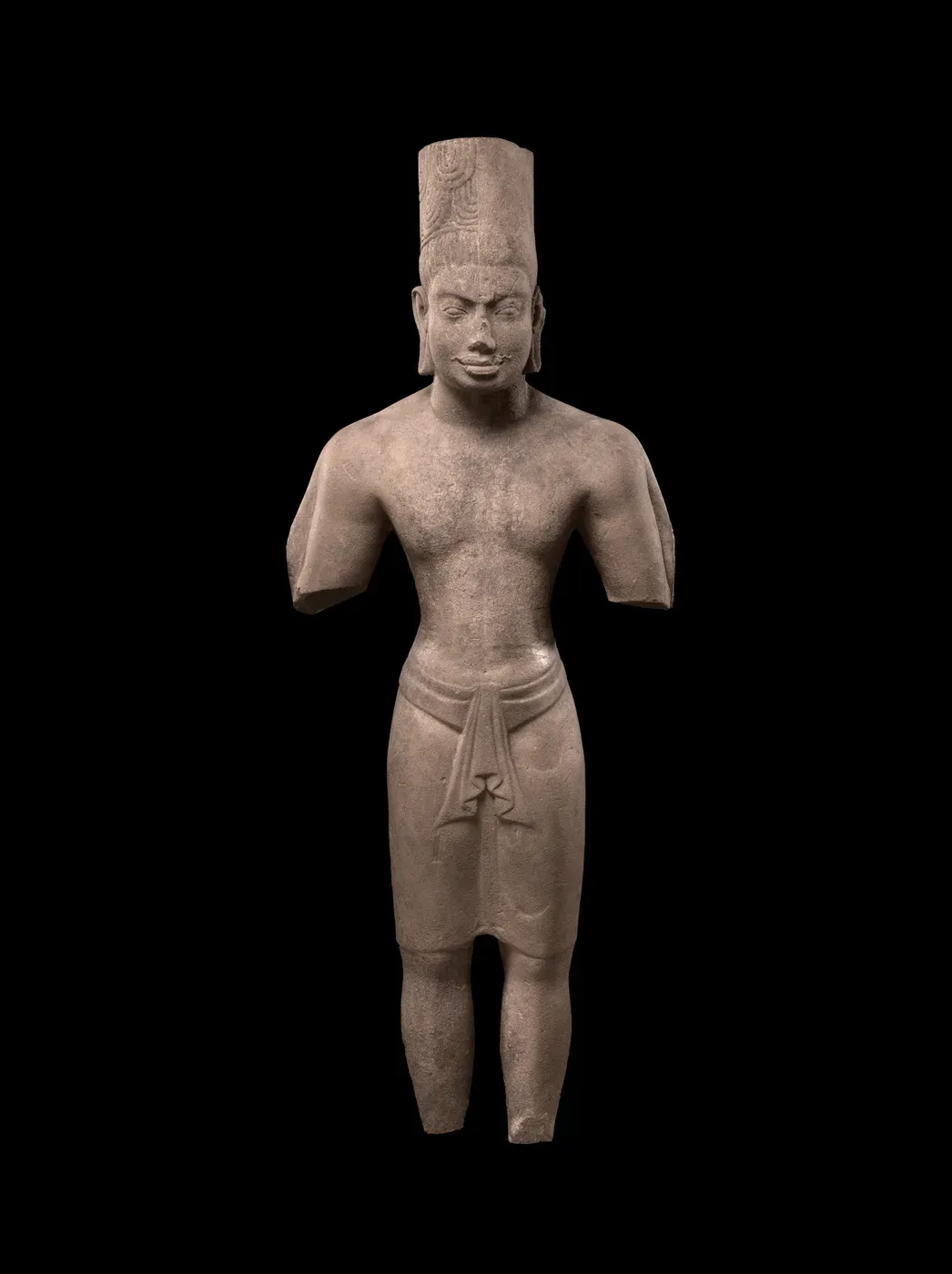
Plate III.2b. Harihara, late seventh to early eighth century CE, sandstone, 90 centimetres high, from Cambodia or Vietnam. The right half of the figure is Shiva and the left half Vishnu. With the arms lost, the only marks left are in the headdress, which is divided down the middle, and half of a third eye on Shiva’s side. The figure is evidence for Khmer practice in one century. The museum notes that the form was popular there mainly in the seventh. The Met, 1977.241. Purchase, Laurance S. Rockefeller Gift and Anonymous Gift, 1977. Image: The Metropolitan Museum of Art, public domain. Object record and full image.
Hari is a name of Vishnu and Hara a name of Shiva. In a Harihara image the body is split down the middle, Shiva on the right and Vishnu on the left. In Indian examples, the Met notes, the two halves are given different casts of face. In this Khmer one the face is single, and the division shows only in the headdress and in half of an eye.16
The same was done with Shiva and the Goddess, in a figure that is male on one side and female on the other.17 These images do not explain a doctrine. They show two deities sharing one body, which is an old way of saying that the two are not rivals.
Dehejia offers a modern Hindu image for the same thought. One may view the Infinite, she writes, as a diamond of innumerable facets. One facet or another draws each believer, and to worship that facet is not to deny the rest.3
Each one is the whole
There is a harder version of the same idea, and the texts state it without embarrassment. Each tradition says that its own deity is not one of the three but all of everything.
We have heard the Vishnu Purana. Here are the other two, both in old public-domain translations.
An Upanishad devoted to Shiva under his older name: there is one Rudra only, they do not allow a second.18
The Goddess, answering a demon who jeers that she fights with the help of others: Alone verily am I in the world here; what other goddess is there besides me?19
These three sentences cannot all be true in the way a census is true. They were not meant that way. Those who follow Vishnu are called Vaishnavas, those who follow Shiva are Shaivas, and those who follow the Goddess as supreme power, shakti, are Shaktas. Each tradition has room for the others’ gods, as forms or servants or kin of its own. The introduction to this book put it in one phrase: the same god is many gods.
| Vishnu | Shiva | Devi | |
|---|---|---|---|
| In the Rigveda | a few hymns; three strides | Rudra; three or four hymns | Speech’s one hymn; the dawn |
| Held in the hand | discus, conch | trident | the weapons of all the gods |
| Rides | Garuda, a great bird | a bull | a lion |
| Followers | Vaishnavas | Shaivas | Shaktas |
| Read on | Vishnu | Shiva | Devi |
What became of the old gods
The subtitle of this chapter promises an answer to one more question. Indra had a quarter of the Rigveda. Where did he go?
He was not thrown out. None of them were. The most visible answer is that they were given posts.
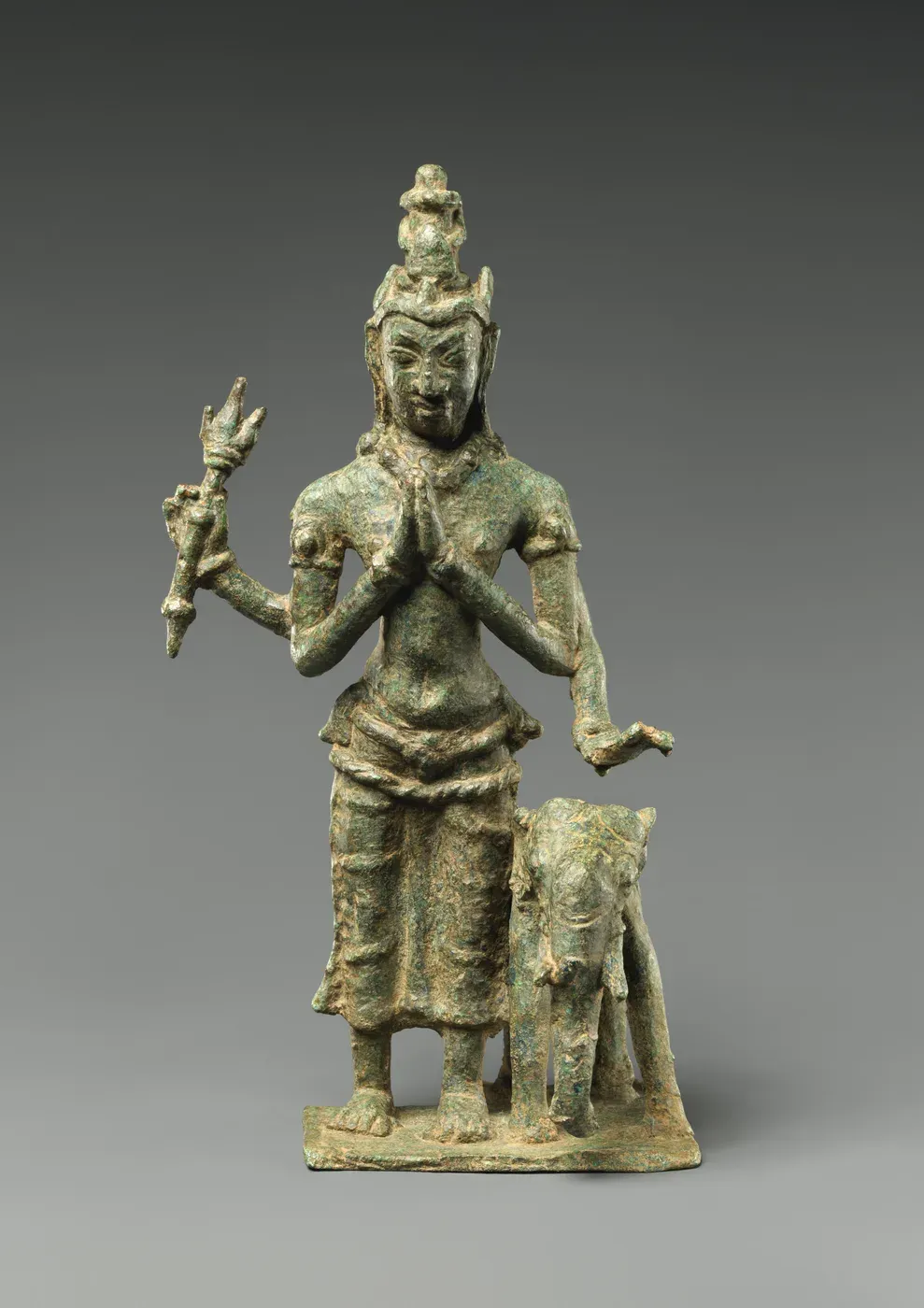
Plate III.2c. Indra, lord of the gods, as regent of the east, ninth century CE, bronze, 22.9 centimetres high, from Sri Lanka. He holds the thunderbolt, and his elephant stands beside him. This figure comes from a Buddhist setting, where the four guardians protect the Buddha’s teaching. It is evidence for how far the old king of the gods travelled and for the rank he kept. The Met, 2005.468.2. Gift of Guardian of the Flame Collection, 2005. Image: The Metropolitan Museum of Art, public domain. Object record and full image.
The gods of the Veda became the guardians of the directions, the lokapalas. In the Hindu list Indra governs the east, Yama the south, Varuna the west, and Kubera the north.20 The slayer of Vritra still holds his thunderbolt, and rides an elephant, but his task is to stand at one side of the world and keep watch. Buddhists had guardians of the directions too, and a Buddhist set cast in Sri Lanka kept Indra in the east.21
Diagram 3. The four guardians of the directions in the Hindu list, as given by the Encyclopaedia Britannica. Drawn for this book. Longer lists of eight exist; only the four attested in the sources read for this chapter are shown.
Others were absorbed into the sky. Soma, the pressed drink of the last chapter, became in later literature a regular name of the moon, which the gods are said to drink until it wanes.22 Agni did not need to be moved, because he was still the fire. An iconography manual, Dehejia remarks, lets a viewer pick him out on a temple wall by his mount, the ram.13
And they were kept as witnesses to the greatness of the new centre. Three stories do this, and each is told on a later page. In an Upanishad, Agni and the wind god boast of their strength and then fail to burn or lift a single straw, and it is a goddess, Uma, who explains to Indra what power they had met.23 In the story of Daksha’s sacrifice, the gods attend a great Vedic rite to which Shiva has not been invited, and see it wrecked. In the poem of the Goddess, the gods are beaten and driven from heaven, and their only remedy is to pour their own energies together and hand over their weapons: Indra’s thunderbolt, Agni’s spear, Varuna’s conch.24
In every one of these the old gods survive. They are present, named and respected. They are simply no longer enough.
One thing was kept more carefully than any god, and that was the Veda itself. The Vishnu Purana identifies Vishnu with the four Vedas by name.25 The claim is typical. The new traditions did not present themselves as a replacement for the old scripture. They presented themselves as what it had meant all along.
Reading the next three pages
Three things are worth holding on to.
First, the evidence changes kind. The last chapter had words and no pictures. From here on there are objects that can be dated, and the plates begin to carry real weight.
Second, the sources are partisan, and say so. A Purana of Vishnu will make Shiva a form of Vishnu. A hymn to the Goddess will make both of them her instruments. This book reports each in its own voice and does not rule between them.
Third, the translations quoted are old. Wilson worked in 1840 and the others between 1879 and 1904. They are used because they are in the public domain, and some carry the prejudices of their time, which the notes point out.
Look once more at the stone from Kashmir. Three gods stand in a row, and each has been given the faces of the others’ powers. The sculptor could not show them as simply three. And the one who is missing from the row has a page to herself.
Footnotes
-
The Metropolitan Museum of Art, The Brahmanical Triad: Brahma, Shiva, Vishnu, 1985.85. The record describes Brahma with three heads shown and a fourth assumed, Shiva with wrathful and feminine aspects to either side, and Vishnu with his lion and boar forms, and names the attendants: a goose, a bull calf, and the personifications of Vishnu’s weapons. ↩ ↩2
-
Encyclopaedia Britannica, “Trimurti”, revised 2026. For the definition, the date by which the idea was known (the poem Kumarasambhava of Kalidasa, about the fourth to fifth century CE), the scholarly assessment, and the scarcity of temples to Brahma. ↩ ↩2
-
Vidya Dehejia, “Hinduism and Hindu Art”, Heilbrunn Timeline of Art History, The Metropolitan Museum of Art (2007). For the date and character of the change, the two strands, the temple and its niches, and the image of the diamond. ↩ ↩2 ↩3 ↩4
-
Arthur A. Macdonell, A History of Sanskrit Literature (London, 1900), chapters III and IV. He gives 1,028 hymns in all, Indra at least 250, Agni about 200, Soma over 100, Ushas some twenty, Pushan some eight, and Rudra “three or four”. For Vishnu he gives a rank, below Surya, Savitri and Pushan, and no figure. ↩ ↩2
-
Ralph T. H. Griffith, The Hymns of the Rigveda (1896), 1.154 for Vishnu, 2.33 for Rudra, and 10.125 for Speech (Vac). A public-domain translation, which a modern survey calls outmoded; it is used for the content of each hymn. ↩
-
Stephanie W. Jamison and Michael Witzel, “Vedic Hinduism” (1992, circulated 2003), 56. ↩
-
Impart Encyclopedia of Art, “Pillar of Heliodorus” (2022). The article notes that some scholars think the word the ambassador uses of himself could also describe a follower of the Buddha. See the page on Vishnu. ↩
-
The Metropolitan Museum of Art, Gaja Lakshmi, Goddess of Fortune, 1993.194. ↩
-
The Metropolitan Museum of Art, Linga with Face of Shiva (Ekamukhalinga), 1989.150. The record says the form rose to prominence in north India during the fifth century. ↩
-
UNESCO World Heritage Centre, Elephanta Caves. The description dates the caves to about the mid-fifth to sixth centuries CE and gives the height of the bust as seven metres. ↩ ↩2
-
F. Eden Pargiter, The Markandeya Purana (Calcutta, 1904), introduction. Pargiter assigns the Devi Mahatmya to the sixth or perhaps the fifth century CE. See the page on Devi. ↩
-
Jamison and Witzel, “Vedic Hinduism”, 3. They write that nothing is known of the visual side of Vedic religion. ↩
-
Vidya Dehejia, “Recognizing the Gods”, Heilbrunn Timeline of Art History, The Metropolitan Museum of Art (2007). ↩ ↩2
-
Kashinath Trimbak Telang, The Bhagavadgita, Sacred Books of the East 8 (Oxford, 1882), chapter 9, 84 to 85. A public-domain translation. The poem is part of the Mahabharata, which is the subject of the next chapter. ↩
-
H. H. Wilson, The Vishnu Purana (London, 1840), book 1, chapter 2, 19 to 20. A public-domain translation. The words omitted from the quotation are a name of Vishnu, Janarddana. Wilson’s spelling is kept inside the quotation only. ↩ ↩2
-
The Metropolitan Museum of Art, Harihara, 1977.241. ↩
-
The Metropolitan Museum of Art holds examples, among them The Half-Male, Half-Female Form of Shiva (Shiva Ardhanarishvara), 2015.500.4.27, Cambodia, about 921 to 945 CE. Only its title and date are relied on here. ↩
-
F. Max Müller, The Upanishads, part 2, Sacred Books of the East 15 (Oxford, 1884), Shvetashvatara Upanishad 3.2, 244. ↩
-
Pargiter, The Markandeya Purana, canto 90. Pargiter prints “what other goddess” with the second word supplied by him. ↩
-
Encyclopaedia Britannica, “Lokapala”. ↩
-
The Metropolitan Museum of Art, Indra, Lord of the Gods: Regent of the East, 2005.468.2. The museum holds a companion Varuna, regent of the west, from the same set. ↩
-
Macdonell, A History of Sanskrit Literature, chapter IV, on Soma. ↩
-
F. Max Müller, The Upanishads, part 1, Sacred Books of the East 1 (Oxford, 1879), Kena Upanishad, sections 3 and 4, 149 to 151. ↩
-
Pargiter, The Markandeya Purana, canto 82. The stories of Daksha and of the Goddess are told, with their sources, on the pages for Shiva and Devi. ↩
-
Wilson, The Vishnu Purana, book 1, chapter 22, 159. ↩
Sources
- Read the overview: Vidya Dehejia, Hinduism and Hindu Art, Heilbrunn Timeline of Art History, The Metropolitan Museum of Art
- Learn the signs: Vidya Dehejia, Recognizing the Gods, Heilbrunn Timeline of Art History, The Metropolitan Museum of Art
- Read a Purana: H. H. Wilson, The Vishnu Purana (1840), Internet Sacred Text Archive
- Read the scholarship: Stephanie Jamison and Michael Witzel, Vedic Hinduism (1992), archived from Harvard University
- Visit the monument: Elephanta Caves, UNESCO World Heritage Centre
- Examine the object: The Brahmanical Triad, 1985.85, The Metropolitan Museum of Art