Numina · Hindu · III.1 The Vedas
Chapter III.1
The Vedas
The oldest dated copy of India's oldest text was written in 1464. The hymns in it are some three thousand years older, and they are still recited. This book begins with a scripture that was kept in memory.
In the manuscript library of the Bhandarkar Oriental Research Institute at Pune there are thirty manuscripts of the Rigveda. Twenty-nine are written on paper, in the Devanagari script. One, from Kashmir, is on birch bark, in the older Sharada script. In 2007 UNESCO entered the whole group in its Memory of the World Register.1
The oldest of the thirty that carries a date is numbered 5/1882-83. It was written in 1464 CE.1 The hymns it contains are roughly three thousand years older than that.2
Nothing has gone missing from the record. This gap is the first thing to understand about the Vedas. They were composed without writing, and for about two thousand years they were kept without it. They are still recited from memory now.
So this book cannot start, as the Egyptian one did, with an object in a case. It starts with a text that lived in trained voices. This chapter asks how that was done, how old the text is, and what its oldest hymns are about. Four powers will keep returning: fire, storm, oath, and a pressed drink.
One note on tense. The tradition described here was never interrupted, and where it is alive this chapter speaks of it in the present.
Heard, not written
The Indian tradition has its own name for texts of this kind. They are shruti, hearing: revealed to the first seers, the rishis, and passed on by ear. Texts with human authors belong to a second class, smriti, remembrance.3
Stephanie Jamison and Michael Witzel, whose survey is the main guide in this chapter, state the historical side of the same fact. Both the composition and the transmission of the Vedic texts were completely oral for the whole Vedic period and for a considerable time after it, until at least about 1000 CE. The texts survive because particular priestly schools, called shakhas or branches, made it their work to preserve them.4
How do you keep a long text unchanged without writing it down? The schools built checks into the recitation itself. Arthur Macdonell described them in 1900. First the continuous text is broken into separate words, the pada text. Then comes the step text, in which the words are recited in overlapping pairs: the first with the second, the second with the third. In the woven text each pair is said forwards, backwards and forwards again. The most intricate pattern adds a third word: the pair forwards and backwards, then all three forwards, backwards and forwards. Macdonell presents each pattern as one more safeguard against any change to the text.5
UNESCO lists the result as living heritage. Its entry on Vedic chanting describes practitioners who are taught from childhood, and a recitation that depends on tonal accents, an exact pronunciation of each sound, and set combinations of words. It adds a warning. Of more than a thousand branches of Vedic recitation, thirteen survive, and four schools, in Maharashtra, Kerala, Karnataka and Odisha, are under imminent threat.6
One small custom shows how the reciters think of their text. Before a hymn is recited, the name of its poet is spoken. Jamison and Witzel explain that this keeps his memory alive, and that the daily recitation is understood as food for the ancient seers.7
Four collections
There are four Vedas. UNESCO’s entry gives the plainest summary. The Rig Veda is an anthology of sacred hymns. The Sama Veda sets hymns from it and from other sources to music. The Yajur Veda holds the prayers and formulas that priests use in sacrifice. The Atharva Veda holds incantations and spells.6
Each Veda in turn has layers, which scholars list in rough order of age. The collection of verses comes first. After it come prose works that explain the ritual, then more secret speculation on it, and finally the Upanishads, which carry that speculation furthest. All of these count as shruti.3
The oldest of the four is the Rigveda, and the rest of this chapter stays with it. Macdonell counts 1,028 hymns, arranged in ten books. Six of the ten, the second to the seventh, are each the work of one family of poets, and were probably handed down inside those families before anyone combined them. The ninth book is different in kind: every hymn in it is addressed to a single power, Soma.8
Jamison and Witzel add that the hymns were composed by a number of bards and bardic families over several hundred years at the least, and that the text has reached us through essentially one school, that of a scholar named Shakalya. It was he who made the word-by-word analysis on which the recitation patterns rest.9
The manuscripts at Pune belong to the last stage of this history. Sixteen of the thirty contain the commentary of Sayana, written in the fourteenth century, and five contain the word-by-word text. When Max Müller printed the Rigveda with that commentary in the nineteenth century, one of the manuscripts he used was from this collection.19
How old?
There are two answers, and they are not answers to the same question.
For the tradition, the hymns have no date of composition, because they were not composed. They were heard.3
For historians, the hymns were made by poets, and the problem is that nothing fixes when. Jamison and Witzel say it is difficult to set even imprecise limits. They suggest 1500 to 500 BCE as convenient outer dates for the whole Vedic period. For the Rigveda itself they reason from what the text knows. It does not know the cities of the Indus civilisation, which had gone by about 1900 BCE, and mentions only ruins. Iron, which reached north India around 1100 BCE, is first mentioned in a later Veda. So the Rigveda falls somewhere in the long stretch between.2
One document from outside India helps. An agreement between the Hittites and the kingdom of Mitanni, made about 1380 BCE far to the west, names Varuna, Mitra, Indra and the Nasatyas, all of them gods of the Rigveda.2
Other sources round the figure differently. UNESCO says the Vedas were composed over 3,500 years ago; the Met, on one of its labels, says about 1500 BCE.610 None of these is a measurement. They are estimates from language and from silence.
The hymns also have relatives. Jamison and Witzel point to the oldest texts of Zoroastrian Iran, written in a closely related language. There too a fire stands at the centre of worship, the most valued offering is an invigorating drink, and one of the gods has the same name: Mitra in the Veda, Mithra in Iran.11
A religion without pictures
Here is the difficulty for a book that likes to begin with objects. Jamison and Witzel put it bluntly. Our knowledge of Vedic religion is entirely verbal. Nothing is known of how it looked, if it had images at all beyond the performance of the rites.4
The three plates in this chapter are therefore late. The earliest was made more than a thousand years after the hymns it is set beside. Each shows how a later age gave a body to a god whom the poets had only addressed.
The words themselves are not easy evidence either. A hymn is spoken to a god who already knows his own deeds, by a poet whose audience knows them too. So nothing is explained. Jamison and Witzel call the hymns deliberately allusive and obscure, and quote a scholar’s test: take a famous ode to joy, replace the word joy, and ask a stranger to guess what the poem is about.12
Nor do the gods form a system. Some are plainly forces of nature, their names ordinary nouns. Some are abstractions. Some belong to ethics, and some to the ritual itself. What is striking about the Vedic gods, the survey says, is the lack of any overarching organisation.12
With that warning, here are four of them.
Fire
The Rigveda opens with a hymn to Agni. In Griffith’s old translation its first words are I laud Agni, the chosen Priest.13
Agni is the Sanskrit word for fire, and the god is the fire: above all the fire of the ritual. Jamison and Witzel make a point about him that is easy to miss. Agni is one of the few gods who are actually present and visible on the offering ground.14 The worshipper does not imagine him. He is burning in front of the priest.
His work follows from that. Whatever is placed in the fire is carried by it to the other gods, and the same opening hymn asks him to bring the gods here in return.137 He is the messenger in both directions. That is why so much of the collection is addressed to him: about two hundred hymns, by Macdonell’s count, more than to any god but one.15
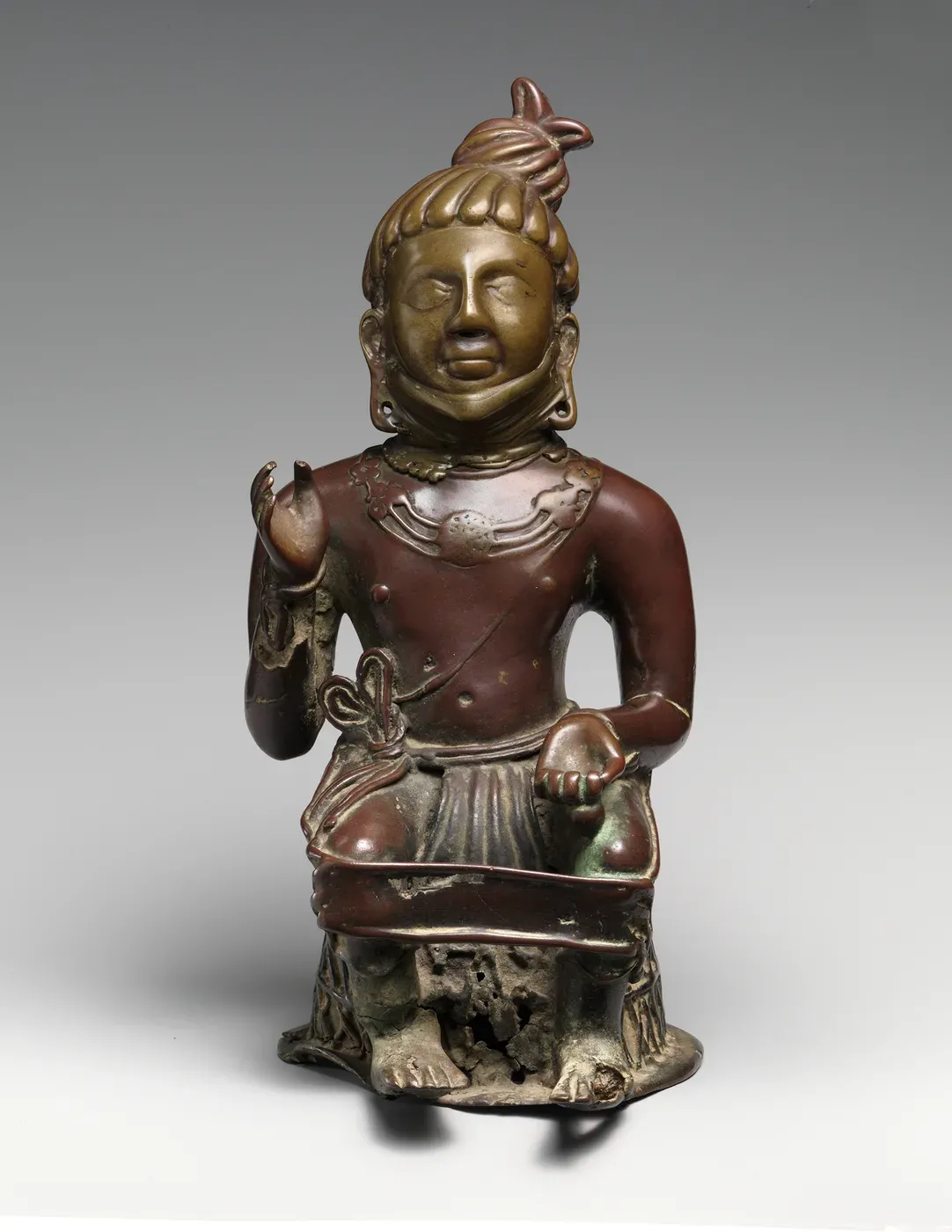
Plate III.1a. Seated figure, about the third century CE, bronze, from Kaushambi in Uttar Pradesh. The museum’s own title offers three identities: an ascetic, a deified king, or Agni. He has the hair and jewellery of a king or of Agni, but holds the flask of an ascetic. Even if he is the god of fire, he was cast well over a thousand years after the hymns, and they describe no such image. The Met, 1984.499. Gift of Frank Weinstein, 1984. Image: The Metropolitan Museum of Art, public domain. Object record and full image.
The Met calls this bronze rare and enigmatic, and declines to choose among its three readings.16 It is here because it is honest about the problem. A god whose body was a flame did not need a statue, and when statues came, it was not obvious what he should look like.
Storm
The god with the most hymns is Indra: at least two hundred and fifty, nearly a quarter of the collection.15
Jamison and Witzel call him the most vividly realised of the Vedic gods. He is a warrior, and unlike the gods of the last section he has stories. The one told most often is his fight with Vritra.1417
A hymn in the first book tells it. Indra drinks soma. He takes up the thunderbolt that the craftsman god has made for him. He strikes Vritra, whom Griffith calls the Dragon and who lies on the mountain holding back the waters. The enemy falls like a tree to the axe, and the rivers run over his body to the sea.18
What is this story about? Scholars once read it as weather: the storm breaks, the clouds open, the rain comes. Jamison and Witzel report that more recent studies treat it as an act of creation, in which the world’s waters are set free for the first time.17 Both readings are still in print, and the hymn itself does not settle the matter.
Indra is not simply admirable. The survey describes him as the hero and also the villain of many episodes, in which he shows overwhelming strength and, less creditably, a talent for trickery.17
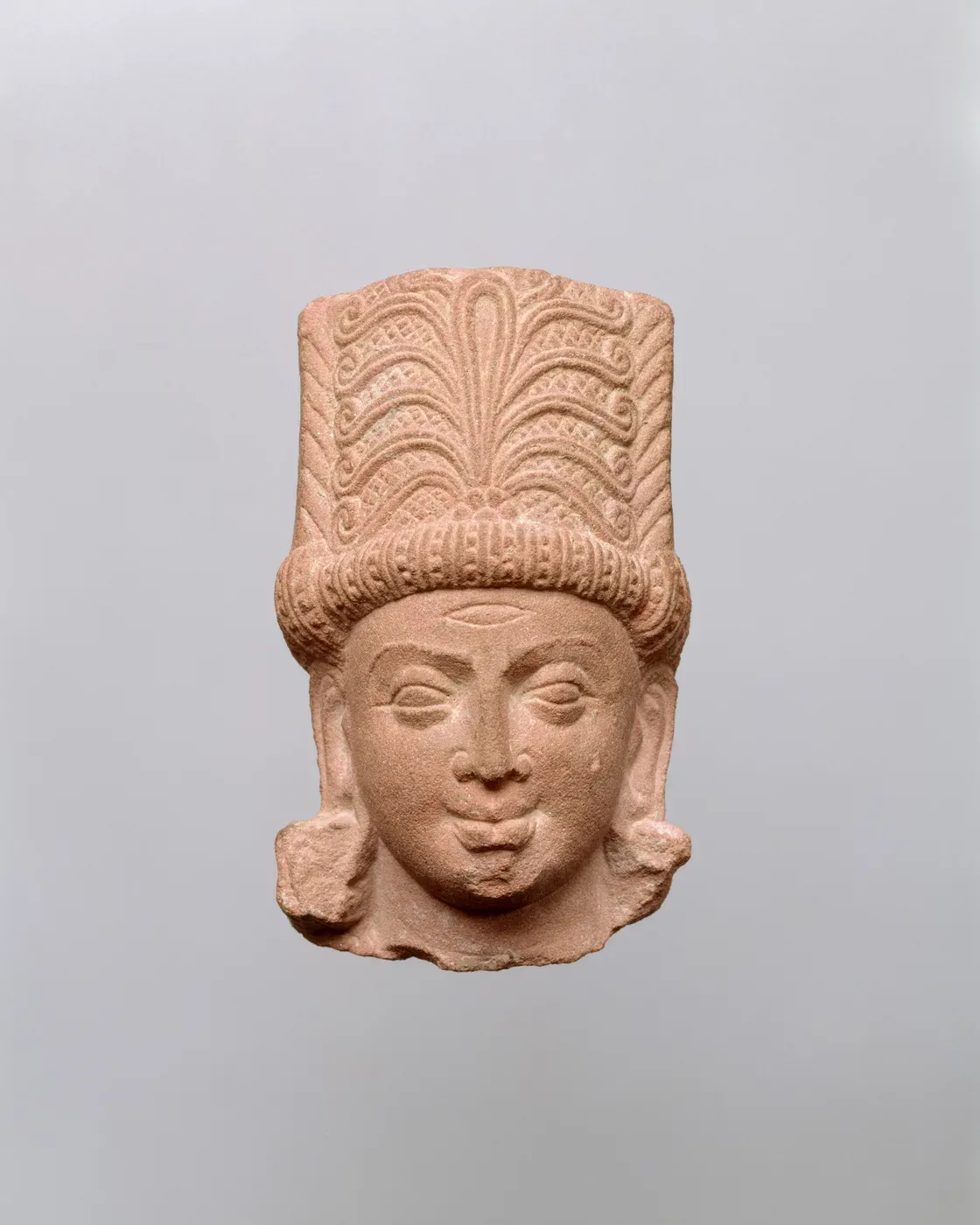
Plate III.1b. Head of a standing Indra, about the second century CE, sandstone, from Mathura or Ahicchatra in Uttar Pradesh. The pedestal, not shown, is inscribed with his name as king of the gods; the crown and the third eye on the forehead also mark him. The museum notes that by this time the Vedic god had been taken into Buddhism. The head is evidence for that later career, not for how the poets of the Rigveda saw him. The Met, 1987.218.12a, b. Samuel Eilenberg Collection, Ex Coll.: Columbia University, Purchase, Rogers Fund, 1987. Image: The Metropolitan Museum of Art, public domain. Object record and full image.
The Met’s note on this figure lists the parts Indra came to play in Buddhist tradition: a witness to the birth of the Buddha, an attendant and protector, the ruler of a heaven.19 The slayer of Vritra had become part of another religion’s court. It is a first sign of something this book will meet often. Gods here are rarely discarded. They are given new work.
Oath
A third group of gods has almost no stories at all.
Varuna and his constant partner Mitra belong to a family called the Adityas. Jamison and Witzel describe Varuna as a stern but just king, and they describe the whole group as figures: gods with roles and qualities, and very little narrative.1420
What they stand for has been argued over for more than a century, and the argument is instructive. Scholars of Macdonell’s generation assumed that every god must be a piece of nature, and made Mitra the sun and Varuna the sky, or the moon. In 1907 Antoine Meillet proposed something else. Mitra, he said, is the god of the contract: not a natural force but a social one. Later scholars followed him in different directions. One saw Varuna as the god of oaths, another as true speech. A study of 1981 redefined the three chief Adityas as the gods of alliances, of commandments and of customs: three kinds of bond that hold people together.20
The hymns show what such a god was like to live under. In one, a poet named Vasishtha believes that Varuna is angry with him and does not know why. He asks the wise, and they only confirm it. He asks to be freed from his own offences and from those of his fathers, as a calf is loosed from its cord. And he offers an excuse that reads very humanly in Griffith’s version. It was not his own will that betrayed him, but thoughtlessness, wine, dice, or anger.21
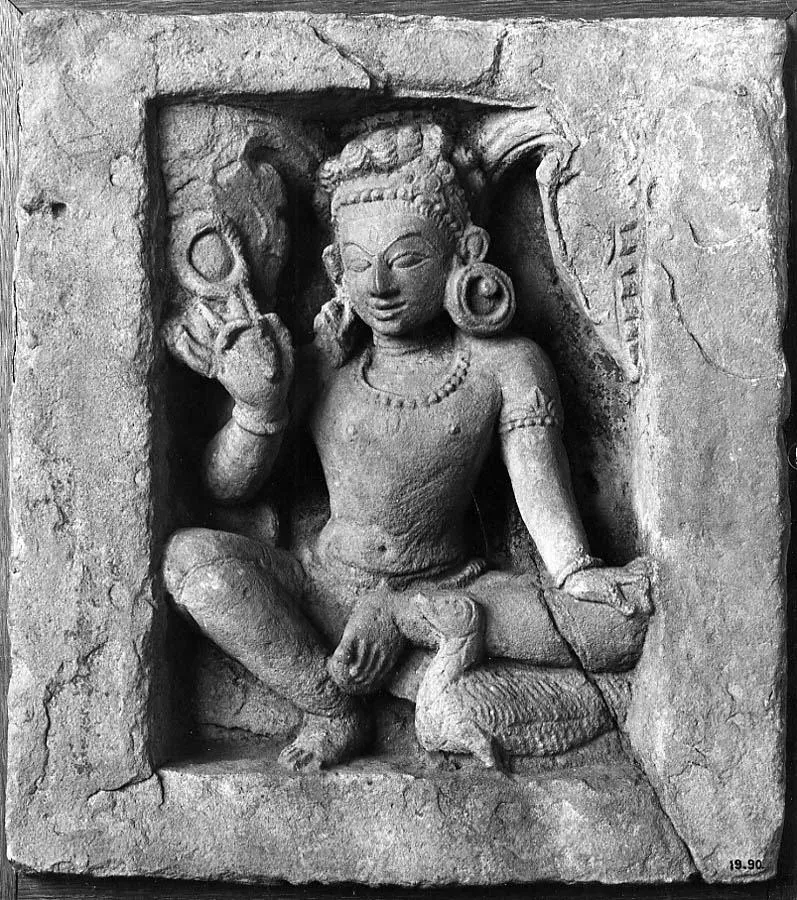
Plate III.1c. Varuna holding a noose and riding a swan, sixth to eighth century CE, sandstone. The identification is the museum’s title; its record adds no description and no findspot beyond India, and the photograph is an old black-and-white one. The relief was carved some two thousand years after the hymns. The Met, 19.90. Rogers Fund, 1919. Image: The Metropolitan Museum of Art, public domain. Object record and full image.
Behind these gods stands a word that will not translate. It is written rita in plain letters. Jamison and Witzel call it very difficult and controversial. It is commonly rendered as cosmic order, and it has also been argued to mean simply truth. Their own account is that it is truth as something active, a force that makes things work: Varuna lets the rivers flow by it. They compare it to a later and better-known word that is just as hard to translate, dharma.22
A reader coming from the Egyptian book may hear an echo of Ma’at, which was also a truth that had to be done. The comparison is this book’s own and is offered with caution. No source cited here makes it.
The pressed drink
The fourth power is the strangest, because it is at once a god, a plant and a liquid.
Soma, in the survey’s words, is the deified soma drink, and also the plant it is made from.14 What plant that was is still debated.11 Like Agni, Soma was present at the rite, in a form that could be seen and handled.
The whole ninth book of the Rigveda accompanies its preparation. Macdonell summarises the process the hymns describe. The stalks are pounded with stones. The juice runs through a strainer of sheep’s wool into wooden vats. It is mixed with water and with milk, and offered to the gods.23 The poets turn each step into images. The ten fingers that press the stalks become ten sisters. The juice rushing into the vat becomes a bull among the herd.
The gods need it. Without drinking soma, Indra could not have killed Vritra.14 And people drink it too. A hymn in the eighth book speaks in the voice of someone who has: We have drunk Soma and become immortal.24
There is no plate for this section. The hymns describe a plant and a drink, not a figure.
All four powers meet in a single act. A fire is lit, the drink is pressed and poured, hymns are sung, and the gods are asked for something. Jamison and Witzel name the principle with a formula from the ritual texts: give me, I give you. The hymns are not disinterested praise. Most of them contain plain requests for the goods of this world, and the offering is one move in an exchange that is meant to go on for ever.7
That exchange also explains why there are so many hymns. The gods, the poets say more than once, are best pleased by the newest one.7
A hymn that is not sure
Among the last hymns added to the collection is one that asks where everything came from.3
It begins before the world. There was then neither the existent nor the non-existent, no air and no sky; neither death nor anything deathless. There was darkness hidden in darkness, and one thing that breathed by its own nature. Desire arose in it, and that was the first seed.25
Then the poet stops and questions his own account. Who really knows? he asks. The gods cannot say, since the Gods are later than this world’s production. Perhaps the one who looks down on it from the highest heaven knows. The hymn’s final words, in Griffith’s translation, are or perhaps he knows not.25
It is worth pausing on what this is. A hymn inside a scripture guarded as carefully as this one ends on a doubt, and the doubt was memorised and handed on with the same care as everything else. Generations of reciters have kept that last clause exactly, syllable by syllable.
What changed, and what did not stop
It would be wrong to read the Rigveda as a description of the Hinduism of temples and images. Jamison and Witzel warn that even the phrase Vedic Hinduism is a contradiction in terms. Vedic religion, they write, is at least as different from later Hindu religion as the religion of ancient Israel is from later Christianity. It is its predecessor, with many surprising continuities.4
The clearest difference is in who matters. The two great gods of later Hinduism, Vishnu and Shiva, are present in the Rigveda but not prominent. Shiva appears under an older name, Rudra.14 Indra, with his two hundred and fifty hymns, will not keep his place. The next chapter follows that change.
But the old religion did not end when the centre moved, and this is the point at which the past tense fails. The survey, written in 1992, reports that the simpler fire rites were still performed reasonably often in various parts of India and Nepal, and cites a list of some 550 people who had maintained the solemn rites over the previous hundred years. The soma ritual was regularly performed only in certain districts of Andhra, Tamil Nadu and Kerala. In 1975 one of the rarer and more complicated rites, the building of a great fire altar, was performed in Kerala and filmed. And in temples of south India, reciters went through their school’s whole Veda aloud, one lesson a day.26
Those reports are now more than thirty years old. UNESCO’s entry, quoted earlier, is the more recent witness, and it is worried: thirteen branches out of more than a thousand.6
Return to the manuscript at Pune, the one dated 1464. In most traditions the oldest manuscript is the nearest we can come to the original. Here it is a latecomer. The older copy of the Rigveda is not on paper or birch bark. It is recited, and it has to be learned again in every generation.
Footnotes
-
UNESCO, Rigveda, Memory of the World Register, inscribed 2007, and the nomination form, “Rigvedasamhita, Rigvedasamhita-Padapatha and Rigvedasamhitabhashya”, reference 2006-58, sections 1 and 3.1. The form gives the number of manuscripts, their materials and scripts, the oldest dated manuscript (No. 5/1882-83, 1464 AD), the birch-bark manuscript from Kashmir (No. 5/1875-76), the sixteen with Sayana’s commentary and the five with the word-by-word text, and the use of one of them by Max Müller. ↩ ↩2 ↩3
-
Stephanie W. Jamison and Michael Witzel, “Vedic Hinduism” (written 1992, circulated by the authors from Harvard University in 2003), 2 with notes 1 and 2, and 6 with note 8. They place the composition of the Rigveda between about 1900 and 1100 BCE and add that the text mostly reflects five or six generations near the end of that span. Measured from 1464 CE, that is between about 2,550 and 3,350 years. The authors note that the survey stands as written in 1992 and needs updating. ↩ ↩2 ↩3
-
Jamison and Witzel, “Vedic Hinduism”, 5. For shruti and smriti (written śruti and smṛti by scholars), the layers of each Veda, and the lateness of the tenth book of the Rigveda. ↩ ↩2 ↩3 ↩4
-
Jamison and Witzel, “Vedic Hinduism”, 3 with notes 4 and 5. For oral composition and transmission, the schools, the remark that knowledge of Vedic religion is entirely verbal, and the comparison between Vedic and later Hindu religion. ↩ ↩2 ↩3
-
Arthur A. Macdonell, A History of Sanskrit Literature (London, 1900), chapter III. He names the patterns Pada-patha, Krama-patha, Jata-patha and Ghana-patha. A public-domain work, paraphrased here. Macdonell is more than a century old and is used in this chapter only for the arrangement of the text, the recitation patterns and counts of hymns. ↩
-
UNESCO, Tradition of Vedic chanting, Representative List of the Intangible Cultural Heritage of Humanity, inscribed 2008, originally proclaimed 2003. The entry writes Orissa, the former spelling of Odisha. ↩ ↩2 ↩3 ↩4
-
Jamison and Witzel, “Vedic Hinduism”, 63 to 65. For the formula dehi me dadāmi te, which they cite from the Taittiriya Samhita, the prayers for worldly goods, fire as the carrier of offerings, the naming of the poet before recitation, and the gods’ pleasure in the newest hymn. ↩ ↩2 ↩3 ↩4
-
Macdonell, A History of Sanskrit Literature, chapter III. The count is 1,017 hymns, or 1,028 with eleven supplementary ones. ↩
-
Jamison and Witzel, “Vedic Hinduism”, 6. For the bardic families, the school of Shakalya (Śākalya) and his word-by-word text, Sayana’s commentary of the fourteenth century, and Max Müller’s edition of 1849 to 1874. ↩ ↩2
-
The Metropolitan Museum of Art, The Sun God Surya(?) in His Chariot with Wives and Attendants, 2003.457, an ivory of the second or first century BCE, whose label dates the Vedic hymns to “about 1500 B.C.” ↩
-
Jamison and Witzel, “Vedic Hinduism”, 30. They note that the Vedic word soma and the Avestan haoma are historically the same word, and that the identity of the drink is still debated. ↩ ↩2
-
Jamison and Witzel, “Vedic Hinduism”, 53 to 54. The test with the ode is credited there to the scholar Paul Thieme. ↩ ↩2
-
Ralph T. H. Griffith, The Hymns of the Rigveda (second edition, 1896), book 1, hymn 1, verses 1, 2 and 4. A public-domain translation, quoted only in short phrases. Jamison and Witzel describe Griffith’s version as outmoded and unsatisfactory; it is used here for the shape of each hymn, not as the exact sense of the Sanskrit. A complete modern English translation, by Jamison and Joel Brereton (2014), is in copyright and was not used. ↩ ↩2
-
Jamison and Witzel, “Vedic Hinduism”, 54 to 56. For Agni, Indra, Soma, the Adityas, and the place of Vishnu and of Shiva as Rudra. ↩ ↩2 ↩3 ↩4 ↩5 ↩6
-
Macdonell, A History of Sanskrit Literature, chapter IV. He gives Indra at least 250 hymns, Agni about 200 and Soma over 100. ↩ ↩2
-
The Metropolitan Museum of Art, Seated Ascetic, Deified King, Agni (The God of Fire), 1984.499. The record relates the figure in style to sculptures from Kaushambi. ↩
-
Griffith, The Hymns of the Rigveda, book 1, hymn 32, verses 1 to 8. Griffith writes the maker of the thunderbolt as Tvashtar. ↩
-
The Metropolitan Museum of Art, Standing Indra, 1987.218.12a, b. The record’s main photograph shows the head; the figure survives in two pieces. ↩
-
Jamison and Witzel, “Vedic Hinduism”, 57 to 58, summarising Bergaigne, Macdonell, Oldenberg and Hillebrandt on the older view, Meillet (1907), Lüders, Thieme, and Brereton (1981). ↩ ↩2
-
Griffith, The Hymns of the Rigveda, book 7, hymn 86, verses 2 to 6. ↩
-
Jamison and Witzel, “Vedic Hinduism”, 67. The word is written ṛta by scholars. ↩
-
Macdonell, A History of Sanskrit Literature, chapter IV, on Soma. ↩
-
Griffith, The Hymns of the Rigveda, book 8, hymn 48, verse 3. ↩
-
Griffith, The Hymns of the Rigveda, book 10, hymn 129. Verses 1 to 4 are paraphrased; the two phrases quoted are from verses 6 and 7. ↩ ↩2
-
Jamison and Witzel, “Vedic Hinduism”, 51. The list of those who maintained the rites is credited there to Kashikar and Parpola, and the 1975 performance and its film to Frits Staal. ↩
Sources
- Examine the manuscripts: Rigveda, Memory of the World Register, UNESCO
- Hear the living tradition: Tradition of Vedic chanting, Intangible Cultural Heritage, UNESCO
- Read the scholarship: Stephanie Jamison and Michael Witzel, Vedic Hinduism (1992), archived from Harvard University
- Read the hymns: Ralph T. H. Griffith, The Hymns of the Rigveda (1896), Internet Sacred Text Archive
- Read an early history: Arthur A. Macdonell, A History of Sanskrit Literature (1900), Project Gutenberg