Numina · Hindu · III.2 Vishnu, Shiva, Devi
Chapter III.2
Devi
The gods are beaten, and to save themselves they pour their powers into one figure and hand her their weapons. Then she tells a demon that she is alone in the world. This page is about the Goddess and her many names.
Eight arms spread from the shoulders of a woman carved in grey stone. The slab comes from Bihar in eastern India and was made in the second half of the ninth century. One hand swings a broad sword above her head. Others hold a discus, a shield, a bow and a noose, and draw an arrow from a quiver on her back. With the last pair she seizes a small man by the hair and drives a trident into him. He is climbing out of the neck of a buffalo whose head lies cut off at her feet.1
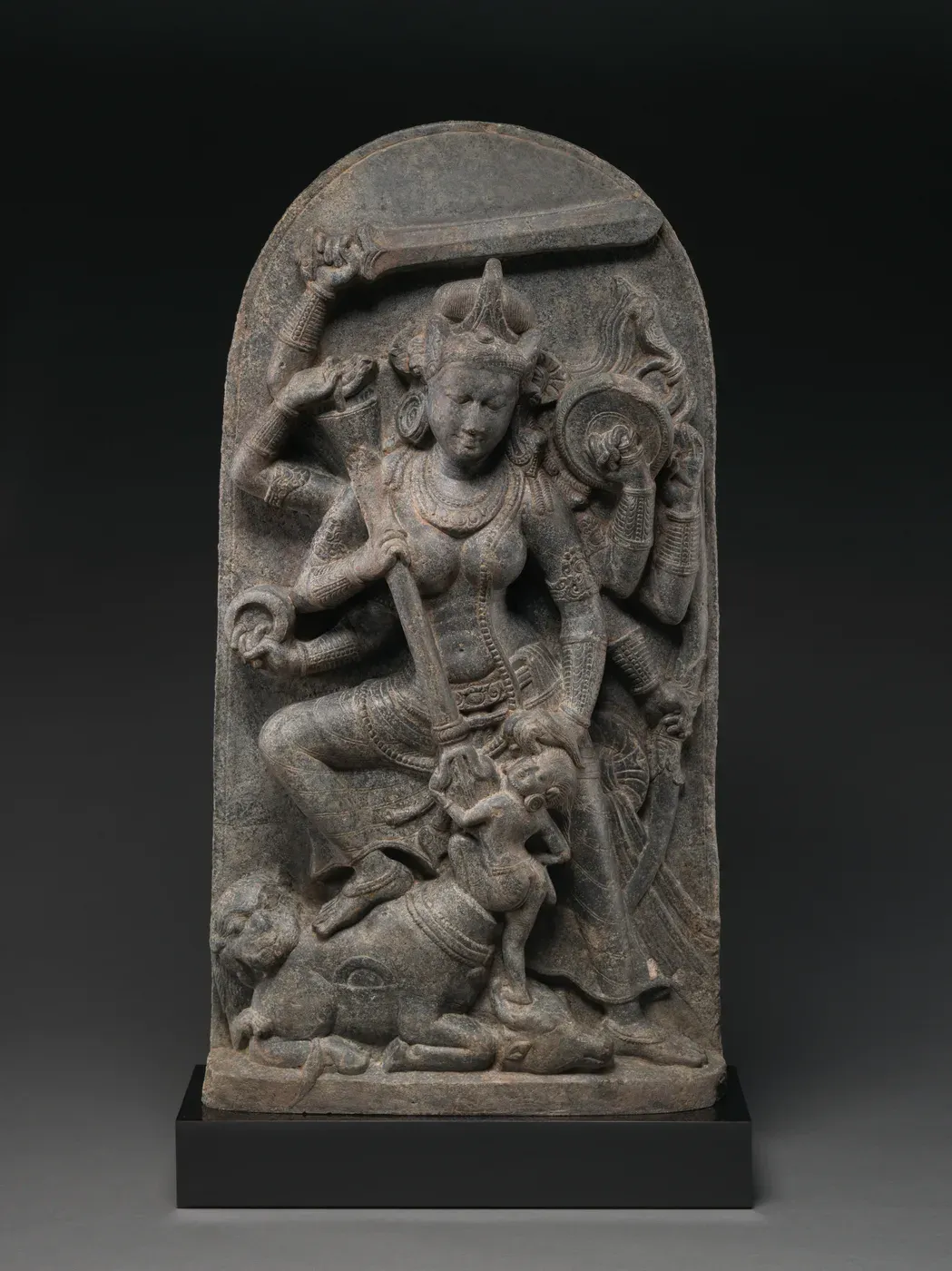
Plate III.2l. The goddess Durga slaying the demon Mahisha, second half of the ninth century CE, schist, from Bihar, probably the Gaya district. The museum reads each weapon from the text this page describes: the discus is Vishnu’s and the trident Shiva’s. The slab shows how one region carved the scene some centuries after the poem. It is not an illustration made alongside it. The Met, 2016.650. Purchase, Blanca and Sunil Hirani Gift, in honor of Sunita and Gordhan Hirani, and other donors, 2016. Image: The Metropolitan Museum of Art, public domain. Object record and full image.
The Met’s record explains what the weapons are. They were lent to her by the assembly of the male gods, who could not, singly, defeat this demon.1 The sword and the trident and the discus are theirs. The victory is hers.
That is the whole problem of the Goddess in one image. Is she the sum of what the gods gave her, or are they parts of her? The text that tells this story gives both answers, and this page follows it before turning to where she came from and how many names she has.
The poem that tells it
The story is told in a poem called the Devi Mahatmya, the greatness of the Goddess. It survives as thirteen cantos inside a much longer work, the Markandeya Purana.2
F. Eden Pargiter, who translated the Purana in 1904, judged that the poem was complete in itself and had been added to the Purana later. He dated it to the sixth or perhaps the fifth century CE. He also recorded one fixed point: a manuscript of the poem in the royal library of Nepal, written in an old script and dated 993 CE.3
Pargiter needs the kind of warning this book has given about other old translators. His English is serviceable and is quoted below because it is in the public domain. His opinions are another matter. He admired the poem’s hymns, called its battles absurd and debased, and supposed that its goddess had been borrowed from what he called the rude tribes of central India.3 That is the voice of 1904 and is not repeated here as fact.
He did record one thing of lasting value about its use. In his day, he wrote, the poem was the textbook of the goddess’s worshippers throughout northern India and Bengal, especially at the great festival of Durga Puja.3
Made from the gods
The second of its stories begins with a defeat. For a hundred years the gods, led by Indra, fight the demons, led by Mahisha. The gods lose. Mahisha takes heaven, and they are driven out.4
They go to Vishnu and Shiva and tell them what has happened. At the news a great energy bursts from the mouths of Vishnu, Shiva and Brahma, and from the bodies of Indra and all the other gods. The lights flow together into one blaze like a burning mountain. In Pargiter’s words, that energy, gathering into one became a female.4
The poem then says exactly which god’s energy formed which part of her, and which weapon each one gave.
| The god | What his energy formed | What he gave her |
|---|---|---|
| Shiva | her face | a trident |
| Vishnu | her arms | a discus |
| Yama, god of death | her hair | a rod |
| Indra | her waist | a thunderbolt, and a bell |
| Varuna | her legs | a conch |
| Agni | her three eyes | a spear |
| Vayu, the wind | her ears | a bow and a full quiver |
| Brahma | her feet | a water-pot |
| The Sun | her toes | his rays, on her skin |
The list in the poem is longer than this table.4 Even at this length it shows something about the last chapter. Every great god of the Rigveda is here. Indra brings the thunderbolt with which he killed Vritra. Agni and Varuna and the wind are present. But they are present as donors. The powers that once ran the world one by one are gathered into a single figure, and she is not one of them.
The battle fills two cantos. At the end Mahisha is in the form of a buffalo. She leaps on him and pins his neck with her foot. He begins to come out of the buffalo’s mouth in his own form, and when he is half out she strikes off his head with her great sword.5 That is the moment the sculptor in Bihar carved.
Alone
If the poem ended there, the Goddess would be a weapon the gods built. It does not end there.
In its third story two demon brothers defeat the gods again. The Goddess fights, and this time other goddesses fight beside her, each one the power of a male god in female form: the power of Brahma, of Vishnu, of Indra with thunderbolt in hand.6 When one brother is dead the other taunts her. She is proud, he says, but she is fighting with the strength of others.
Her answer is the centre of the poem:
Alone verily am I in the world here; what other goddess is there besides me?7
And the other goddesses, who, she says, have their power from her, enter her body and disappear. She stands alone and kills him.7
Put the two stories side by side. In the second the gods make her out of themselves. In the third she takes back into herself everything that looked separate. The poem does not choose. The word for what she is, in the tradition that worships her as supreme, is shakti: power.8 The goddesses who join her in battle are called the energies of the gods.6 On this reading the claim of the poem is that energy is not something the gods own. It is her.
She makes one more statement before the poem closes. Whenever trouble arises from the demons, she says, she will come again and destroy them.9
Kali
One moment in the third story produced the most startling of her forms.
Demon generals come to seize her. Her face, the poem says, grows dark as ink with anger. From her frowning forehead another goddess springs out: Kali, of terrible countenance, carrying a sword and a noose and a staff topped with a skull, and wearing a garland of skulls. She destroys the army.10
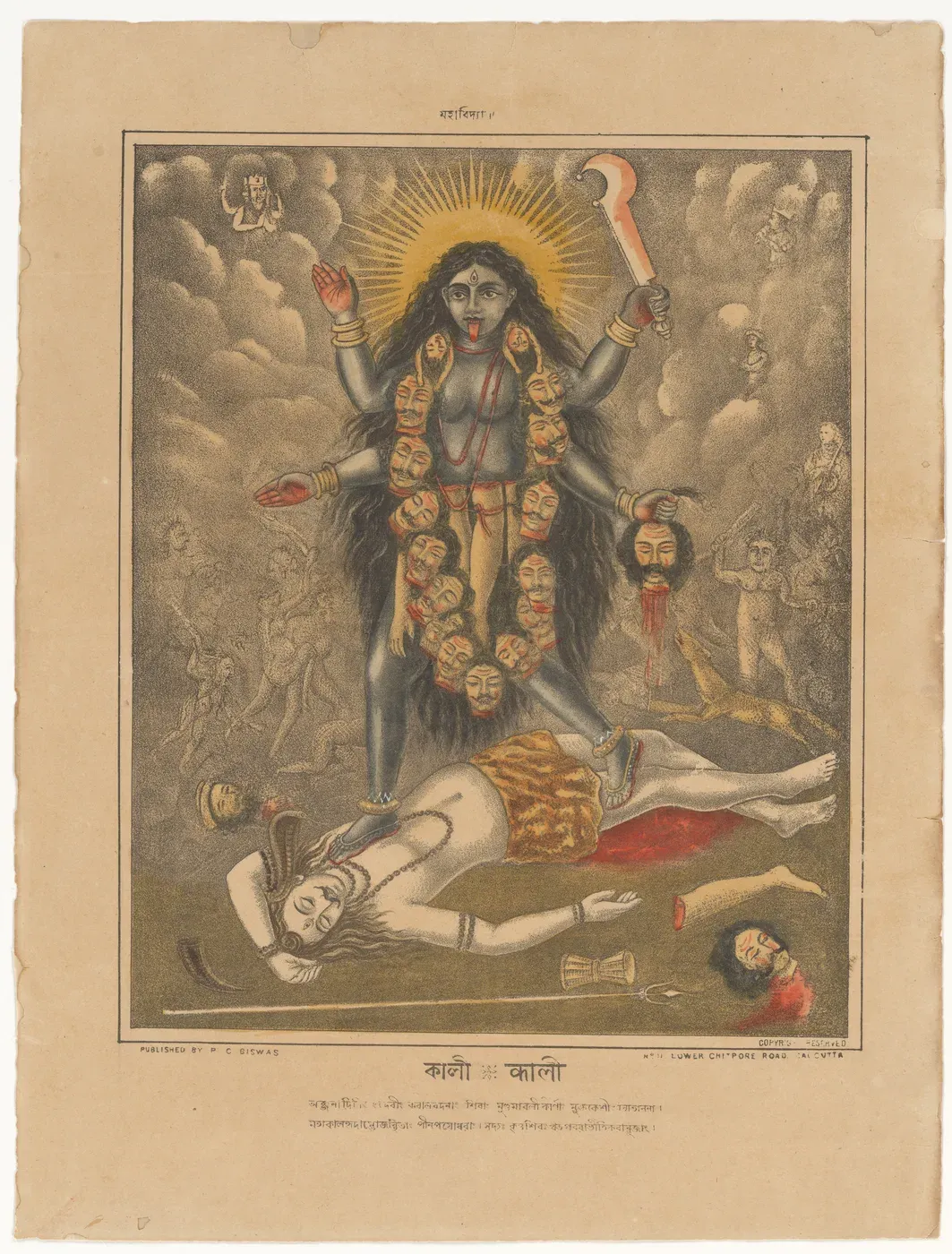
Plate III.2m. The goddess Kali, about 1880 to 1885, lithograph with hand colouring, printed in Calcutta. She stands on Shiva, who lies in a cremation ground; Brahma and Vishnu watch from the clouds. This is a printed devotional picture of the nineteenth century. It shows Kali as Bengal worshipped her then, more than a thousand years after the poem. The Met, 2021.195. Purchase, Robert and Bobbie Falk Philanthropic Fund Gift, 2021. Image: The Metropolitan Museum of Art, public domain. Object record and full image.
An image like this is easy to misread, and has been. The Met’s note on the print says so directly: Kali’s blood-stained form came to embody everything that Europeans in India most feared, and misunderstood, in Hindu society.11 Pargiter’s remarks about barbarous practices are an example from the same years.
The same note explains how her worshippers see her. She is the supreme embodiment of female power, a form of Parvati, the loving wife of Shiva, and she is especially worshipped in Bengal. She has power over time and is called the destroyer of time. In the print she is young and beautiful. The two greatest male gods appear small in the clouds, as witnesses to what she can do.11
Look at who is under her feet. It is Shiva, her husband. The print reverses the usual order of a god with his consort beside him. Here power stands, and the god lies still beneath it.
Before the poem
Where did she come from? The honest answer is that nobody can trace it fully.
The Rigveda has few goddesses of any weight. The dawn, Ushas, has about twenty hymns, and Arthur Macdonell calls her almost the only female deity to whom whole hymns are addressed.12
But one late hymn stands out. Its speaker is Speech herself, and she talks in a way no other Vedic voice does. I am the Queen, she says in Griffith’s translation. She holds up Varuna and Mitra, Indra and Agni. She makes whom she loves mighty. She bends the bow for Rudra. She has spread through earth and heaven, and breathes like the wind while she holds all existence together.13 A reader who comes to this hymn after the Devi Mahatmya will find the resemblance hard to miss. It would be too much to call it the same goddess. It is the same kind of claim, made many centuries earlier.
An Upanishad adds a small scene. The gods have won a victory and think it their own. A mysterious being appears before them. Agni is sent to find out what it is, and cannot burn a straw that it sets before him. The wind cannot lift it. When Indra approaches, the being vanishes, and in its place he finds a woman, highly adorned, named Uma, daughter of the Himalaya. It is she who tells him what the gods had met: the absolute, by whose power alone they had won.14 Uma is also a name of Shiva’s wife.15
Vidya Dehejia points to a source outside the Veda altogether. One of the strands that formed Hinduism, she writes, was the belief among other peoples of the subcontinent in the power of a mother goddess.8 That belief left no early texts, which is why it cannot be dated. What can be dated is stone. One of the earliest goddesses who can be recognised in the art of southern Asia is the one in the next section.
Many names
The Goddess is one, and she is also a number of distinct figures whom people worship separately. Three of them matter most for this chapter.
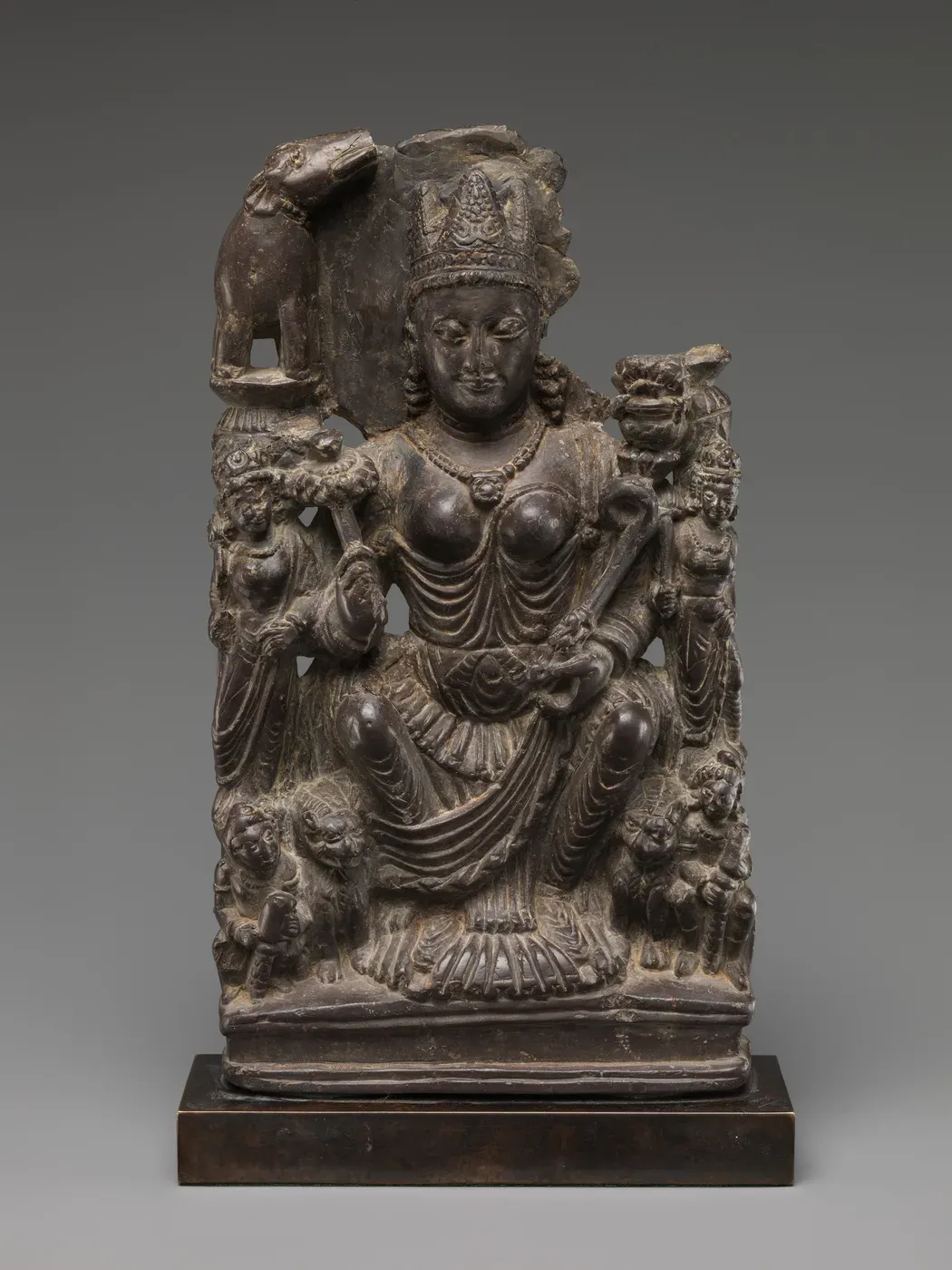
Plate III.2n. Gaja Lakshmi, goddess of fortune, sixth century CE, stone, 25.1 centimetres high, from Kashmir. Two elephants bathe her with water; one survives. She holds a lotus and a lotus cornucopia, and small donor figures pour out riches at her sides. The museum notes that this way of showing her first appears in the first century BCE. This example is some six hundred years later than that. The Met, 1993.194. Purchase, Mrs. Arthur Hays Sulzberger Gift and funds from various donors, 1993. Image: The Metropolitan Museum of Art, public domain. Object record and full image.
Lakshmi is fortune. The Vishnu page told how she rose from the ocean on a lotus and was bathed by the elephants of the sky before she went to Vishnu’s side. That bathing is what this carving shows, and the Met notes that it is among the very earliest goddess images that can be identified at all.16 She is Vishnu’s consort, and she is also worshipped for herself by anyone who hopes to prosper.
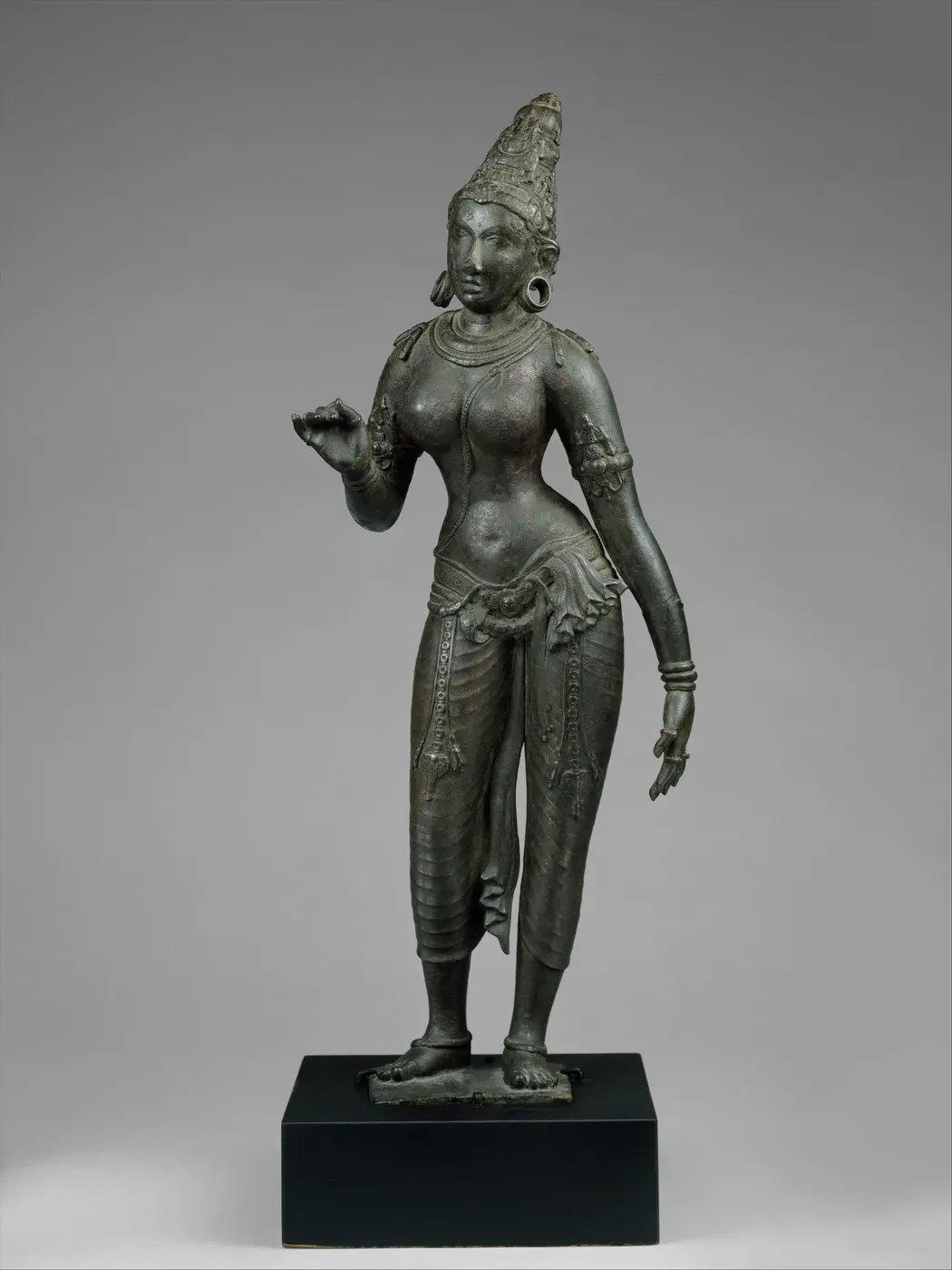
Plate III.2o. Standing Parvati, about the first quarter of the tenth century CE, copper alloy, 69.5 centimetres high, from Tamil Nadu. The museum calls it one of the finest Chola images of the goddess outside India. She is shown without weapons. The record does not say which temple it was made for. The Met, 57.51.3. Bequest of Cora Timken Burnett, 1956. Image: The Metropolitan Museum of Art, public domain. Object record and full image.
Parvati is the daughter of the mountain and the wife of Shiva, and the mother of Ganesha. Dehejia insists that she is a major deity in her own right, and gives the link that ties this page together: it is Parvati who, as Durga, kills the demons the other gods cannot control.17 The graceful figure in this bronze and the eight-armed warrior at the top of the page are the same goddess.
Kali we have met. The Met’s note calls her, too, a manifestation of Parvati.11
So the gentlest and the most terrible of these forms are one person, and her worshippers know it. Dehejia’s essay names the goddess at the centre of Hinduism simply as Shakti, power.8 The names are the many ways that power is met: as luck, as a mother, as a wife, as a rescuer, as the end of all things.
There is one more way she is shown, mentioned on the overview page. In some images Shiva’s body is male on the right side and female on the left.18 After reading the Devi Mahatmya it is hard to see the female half as an attachment.
The goddess comes home
The Goddess does come back every year, in clay.
Each September or October the city of Kolkata gives ten days to the festival of Durga. UNESCO placed it on its list of the intangible heritage of humanity in 2021, and its description is worth following step by step. For months beforehand, small workshops model images of Durga and her family in unfired clay taken from the Ganga. Worship begins on a day when the eyes are painted on, which is what brings the goddess to life in the clay. On the tenth day the images are carried back to the river the clay came from and immersed.19
UNESCO says the festival also means a homecoming, a seasonal return to one’s roots. And it reports something about the crowds. During those days, divisions of class, religion and ethnicity collapse as people walk through the city to look at the images together.19
Go back to the stone from Bihar. Its Durga carries eight weapons, and none of them is her own. The text behind it says that the gods are real, that their gifts are real, and that she is nevertheless alone in the world. Eleven centuries later the same figure is made of river clay every autumn and given back to the river.
This is the last of the four pages on the three who became the centre. The next chapter turns to the two great stories in which their world is told: the Ramayana and the Mahabharata.
Footnotes
-
The Metropolitan Museum of Art, Goddess Durga Slaying the Demon Mahisha, 2016.650. The record describes each of the eight hands, identifies the discus as Vishnu’s and the trident as Shiva’s, and says the weapons were lent by the male gods “following the Devi Mahatmya text”. The full credit line names further donors. ↩ ↩2
-
F. Eden Pargiter, The Markandeya Purana, Bibliotheca Indica (Calcutta, 1904), cantos 81 to 93. Pargiter’s introduction counts the poem proper from canto 82. The standard modern study and translation is Thomas B. Coburn, Encountering the Goddess (1991), which is in copyright and was not consulted. ↩
-
Pargiter, The Markandeya Purana, introduction. The text read for this page is a scanned copy with imperfect character recognition; the date of the Nepalese manuscript appears in it as 993 A.D. ↩ ↩2 ↩3
-
Pargiter, The Markandeya Purana, canto 82. A public-domain translation, quoted in short phrases. The table gives nine of the gods named there; the full passage also lists the Moon, the Earth, the Vasus, Kubera, the Prajapati and others, and several further weapons and ornaments. In this canto the giver of the discus is named as Krishna. ↩ ↩2 ↩3
-
Pargiter, The Markandeya Purana, canto 83. ↩
-
Pargiter, The Markandeya Purana, canto 88, where the goddesses are called the energies of the several gods. ↩ ↩2
-
Pargiter, The Markandeya Purana, canto 90. The word “goddess” in the quotation is supplied by Pargiter. ↩ ↩2
-
Vidya Dehejia, “Hinduism and Hindu Art”, Heilbrunn Timeline of Art History, The Metropolitan Museum of Art (2007). ↩ ↩2 ↩3
-
Pargiter, The Markandeya Purana, canto 91. ↩
-
Pargiter, The Markandeya Purana, canto 87. In the poem she is rewarded with the further name Chamunda. ↩
-
The Metropolitan Museum of Art, Goddess Kali, 2021.195. ↩ ↩2 ↩3
-
Arthur A. Macdonell, A History of Sanskrit Literature (London, 1900), chapter IV. ↩
-
Ralph T. H. Griffith, The Hymns of the Rigveda (1896), book 10, hymn 125. A public-domain translation, quoted in one phrase. The hymn is in the tenth book, which is the latest part of the collection. ↩
-
F. Max Müller, The Upanishads, part 1, Sacred Books of the East 1 (Oxford, 1879), Kena Upanishad, sections 3 and 4, 149 to 151. Müller writes “Umâ, the daughter of Himavat” and calls the absolute Brahman, which is not the god Brahma. ↩
-
H. H. Wilson, “Sacrifice of Daksha”, in The Vishnu Purana (London, 1840), 64 and 68, where Shiva’s wife speaks as Uma and he is called the lord of Uma. The story is told on the page for Shiva. ↩
-
The Metropolitan Museum of Art, Gaja Lakshmi, Goddess of Fortune, 1993.194. ↩
-
Vidya Dehejia, “Recognizing the Gods”, Heilbrunn Timeline of Art History, The Metropolitan Museum of Art (2007). ↩
-
The Metropolitan Museum of Art, The Half-Male, Half-Female Form of Shiva (Shiva Ardhanarishvara), 2015.500.4.27. Only the title is relied on. ↩
-
UNESCO, Durga Puja in Kolkata, Representative List of the Intangible Cultural Heritage of Humanity, inscribed 2021. ↩ ↩2
Sources
- Read her text: F. Eden Pargiter, The Markandeya Purana, cantos 81 to 93 (1904), Internet Archive
- Read the hymn: Rigveda 10.125, translated by Ralph T. H. Griffith (1896), Internet Sacred Text Archive
- See the festival: Durga Puja in Kolkata, Intangible Cultural Heritage, UNESCO
- Read the overview: Vidya Dehejia, Recognizing the Gods, Heilbrunn Timeline of Art History, The Metropolitan Museum of Art
- Examine the sculpture: Goddess Durga Slaying the Demon Mahisha, 2016.650, The Metropolitan Museum of Art