Numina · Hindu · III.2 Vishnu, Shiva, Devi
Chapter III.2
Shiva
The Rigveda fears him and asks him to stay away. A later story has him shut out of the gods' own sacrifice. This page follows the outsider who became, for his worshippers, the one God, and reads his best-known forms.
A shaft of dark stone thirty-five centimetres high, rounded at the top, stands on a square base. It was carved in Kashmir in the seventh century. From one side of the shaft a face looks out: a calm young man with a third eye in his forehead, heavy rings in his ears, and his hair drawn up in loops with a crescent moon set in it.1
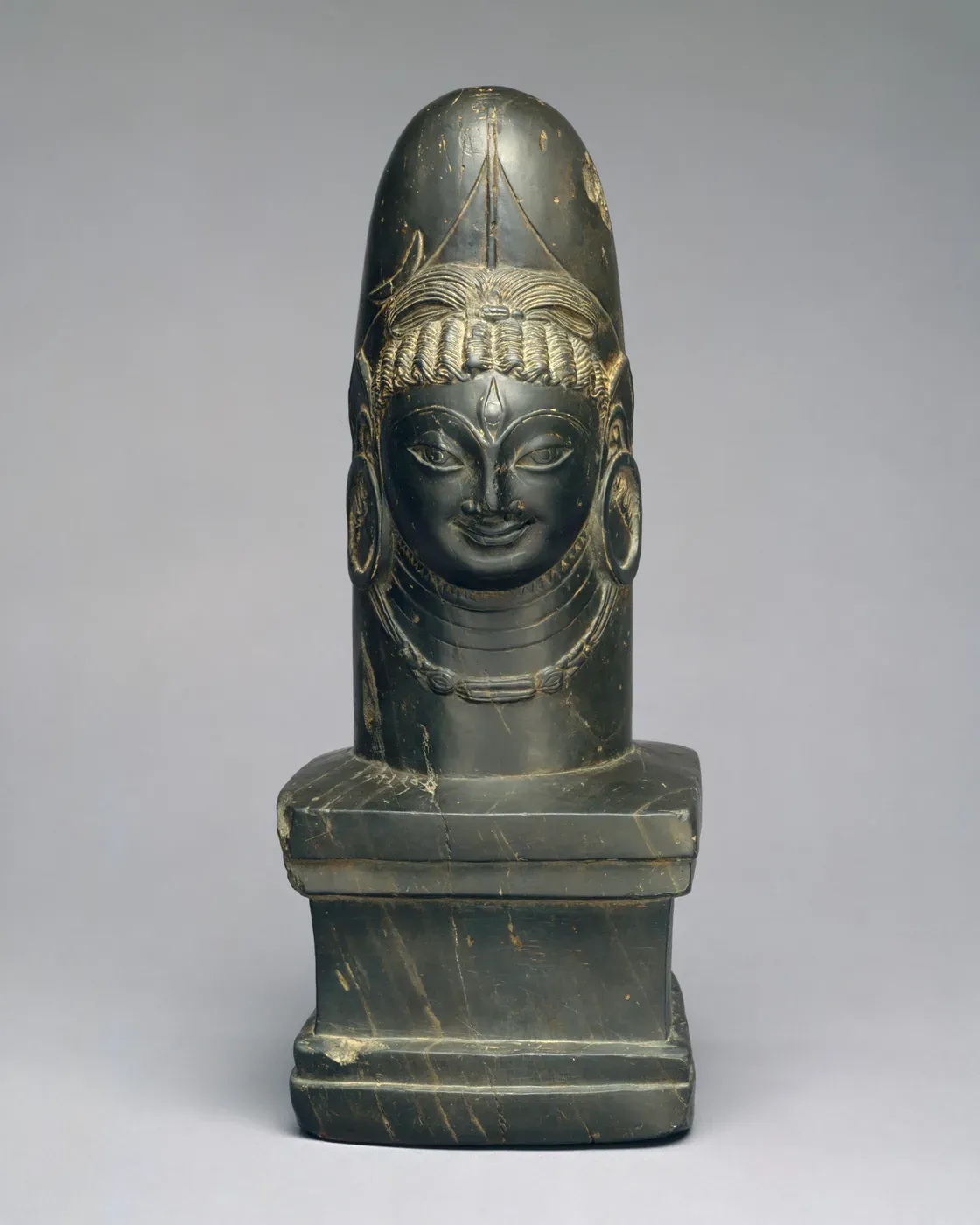
Plate III.2h. Linga with the face of Shiva, seventh century CE, stone, 35.5 centimetres high, from Kashmir. The shaft is the sign of the god; the face shows him emerging from it in human form. The museum dates the rise of such face-lingas in north India to the fifth century. It cannot tell us how old the worship of the plain shaft is. The Met, 1989.150. Purchase, Friends of Asian Art Gifts, 1989. Image: The Metropolitan Museum of Art, public domain. Object record and full image.
This object is called a linga. It is the form of Shiva that stands in the inner chapel of his temples, as it does at Elephanta.2 The Met’s title for a plain example gives the idea in three words: it is his aniconic symbol, a sign that is not a portrait.3 Here the sculptor has done something that looks like a contradiction. He has carved a sign that is not a picture, and then let the god’s face come through it.
That double nature is a good place to start. Almost everything about Shiva comes in pairs that should not fit: the terror and the healer, the hermit and the husband, the destroyer who dances. This page takes them in the order the evidence gives them.
The god they asked to stay away
In the Rigveda his name is Rudra, and the poets are afraid of him.
He has only three or four hymns, by Arthur Macdonell’s count. They do not praise great deeds, as Indra’s hymns do. They ask him not to do harm.4 One of them, in Griffith’s translation, calls him tawny and fierce, an archer who slays like a dread beast of the forest. The poet begs that his missile will turn aside, that his great anger will pass by, that he will spare the singer’s children and horses.5
The same hymn turns to him as a doctor. I hear thee famed as best of all physicians, the poet says, and asks for his medicines and for a life of a hundred winters.5 Fear and need are in the same verses. The one who is dreaded is the one who heals.
Even his name was handled with care. Shiva began as a word applied to Rudra, meaning auspicious or kindly. Macdonell calls it a euphemism that became his regular name.4 Stephanie Jamison and Michael Witzel are more direct: it was a replacement for a name too dangerous to say, and the texts sometimes avoid even that and speak only of that god.6
One Rudra only
A later text speaks of the same god in a completely different voice.
The Shvetashvatara Upanishad belongs to the last layer of the Veda, the layer of speculation about what lies behind the ritual. In Max Müller’s translation it says: there is one Rudra only, they do not allow a second. He rules all the worlds by his powers. He stands behind every person. Having created all the worlds, he is their protector, and he rolls them up again at the end of time.7
The old fear has not gone. The next verses speak to him as a dweller in the mountains, ask him to look on the worshipper with the form of his that is auspicious, not terrible, and beg him not to loose the arrow in his hand: Do not hurt man or beast!7 But the archer on the edge of the settled world is now also the one God, present, the text says, in the faces and the hearts of all beings.
Nothing in the surviving texts explains how the one became the other. Jamison and Witzel call the rise of both great gods controversial.6 What the texts do preserve is a story about his admission.
The uninvited guest
A patriarch named Daksha holds a great sacrifice. It is a rite of the old kind, with every god invited and a share of the offering set aside for each. All of them come, with Indra at their head. One god has been left out.
H. H. Wilson translated a version of the story in 1840. In it Shiva’s wife sees the gods go by and asks him why he is not going too. He answers plainly. It is an old arrangement among the gods, he says, that in all sacrifices no portion should be assigned to me.8
At the sacrifice itself a sage objects, and tells Daksha that a rite which ignores the greatest god cannot be completed. Daksha replies that he knows the eleven Rudras of the old hymns and no other Mahadeva, and makes his offering to Vishnu instead.8
It is the goddess who cannot bear the insult. Out of her displeasure a being of terrible power comes into existence, Virabhadra, and Shiva gives him one instruction: Spoil the sacrifice of Daksha. The altars are overturned and the posts uprooted. The sacrifice itself tries to flee in the shape of a deer, and is beheaded. The gods are bound. Virabhadra tells them that the anger of Rudra is better than the blessings of other gods.8
Then it ends, and not in revenge. Daksha submits and sits in meditation. Shiva appears from the ruined altar, smiling, and says that he is pleased. He grants that the wasted offerings shall not have been prepared in vain, and Daksha praises him by his eight thousand names.8
It is hard to imagine a clearer account of this chapter’s subject. The Vedic sacrifice is the old religion. The god left without a share is the one the Rigveda asked to keep his distance. The story does not have him replace the sacrifice. It has him break in, and be acknowledged, and restore it.
Wilson read the legend as the memory of a struggle between the followers of Shiva and of Vishnu.8 That is one scholar’s guess from 1840 and should be taken as such. He was on firmer ground in noticing how much sculptors loved the scene. It is carved at Elephanta.
The sign and the face
Return to the linga. The Met’s note on the stone from Kashmir calls Shiva emerging in human form from the shaft a celebrated representation that rose to prominence in north India during the fifth century. It also states plainly what the shaft is. The incised lines on it, the record says, mark it as phallic.1
That needs saying without embarrassment and without making too much of it. The form is what it is. In worship it is the god’s sign, and the same word is used for a plain shaft of stone with no carving at all.3
At Elephanta, on an island near Mumbai, the two are set in one building. The caves were cut between about the middle of the fifth century and the sixth. A chapel for the linga stands inside the main cave, with large reliefs of the god’s deeds around it, and the entrance is dominated by the seven-metre bust with three faces that the overview page described.2
Reading his body
When Shiva is shown as a whole figure, Vidya Dehejia lists what to look for. He carries a trident. A serpent is often thrown around him like a scarf. His hair is matted and piled high, with a skull and the crescent moon in it. A third eye in his forehead stands for his all-seeing nature. His mount is a bull.9
Nothing in this list is royal. Vishnu wears a crown and jewels. Shiva wears what a wandering ascetic wears, and Dehejia describes him in those terms: the great practitioner of yoga, who sat in meditation for ages.9
The three faces at Elephanta are a way of showing the pairs in one image. UNESCO’s description gives each a name and a character: a fierce face on one side, a calm one in the middle, and on the other side one that it identifies with the feminine, with Uma.2 Dehejia gives the general rule for such heads: the central face shows the god’s essential character, and the flanking ones his fierce and his blissful aspects.10
The dancer
One form of Shiva is known around the world.
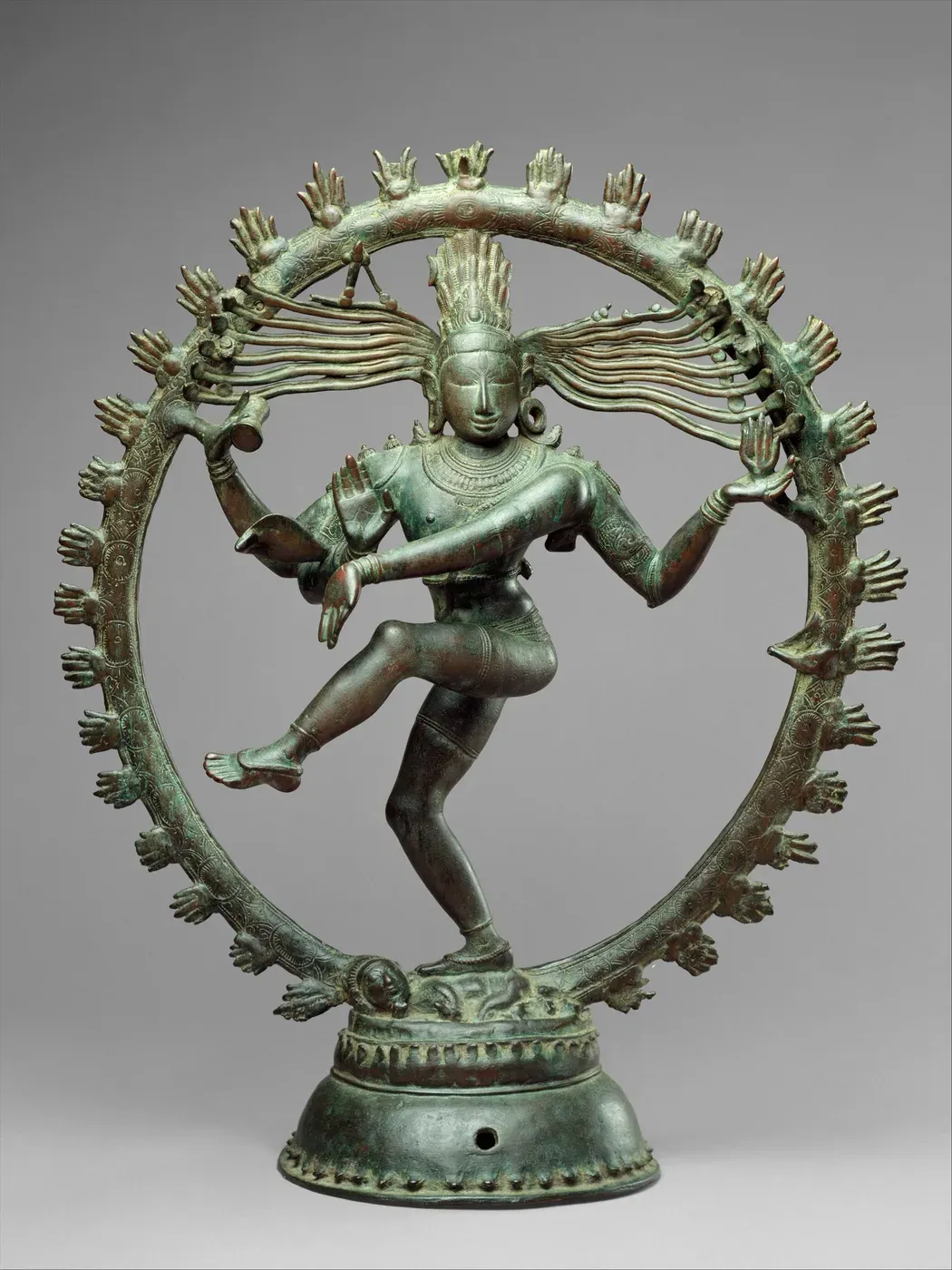
Plate III.2i. Shiva as Lord of Dance (Nataraja), about the late eleventh century CE, copper alloy, 68.3 centimetres high, from Tamil Nadu. The form appeared in sculpture as early as the fifth century and took this shape under the Chola kings. The record does not name the temple this bronze came from. The Met, 1987.80.1. Gift of R. H. Ellsworth Ltd., in honor of Susan Dillon, 1987. Image: The Metropolitan Museum of Art, public domain. Object record and full image.
The Met calls the image a brilliant invention, because it puts all of Shiva’s roles into one figure: creator, preserver and destroyer at once.11 Each part can be read.
| Part of the image | What the museum says it means |
|---|---|
| The drum in the upper right hand | the first sound of creation |
| The flame in the upper left hand | the fire that will destroy the universe |
| The lower right hand, palm out | the gesture that takes away fear |
| The small figure under his foot | illusion, which leads people astray |
| The hand pointing to the raised foot | refuge for the troubled soul |
| The ring of flames | the edge of the cosmos |
Notice that this single figure does by himself what the row of three gods was supposed to share out. Creation is in one hand and destruction in the other, and the same god protects with a third. It is the claim of the Upanishad again, made in bronze.
Notice also what kind of destroyer this is. The fire is in his hand, but his face is calm, and the hand nearest the worshipper says do not be afraid.
A hermit with a household
The ascetic has a family, and the tradition enjoys the contradiction.
Dehejia tells the turning point in a sentence. Shiva spent ages in meditation until he opened his eyes, saw the goddess Parvati, and fell in love with her. The texts call her the daughter of the mountain king.8 They have two sons: Ganesha, who has the head of an elephant and removes obstacles, and Skanda, a young warrior who rides a peacock.9
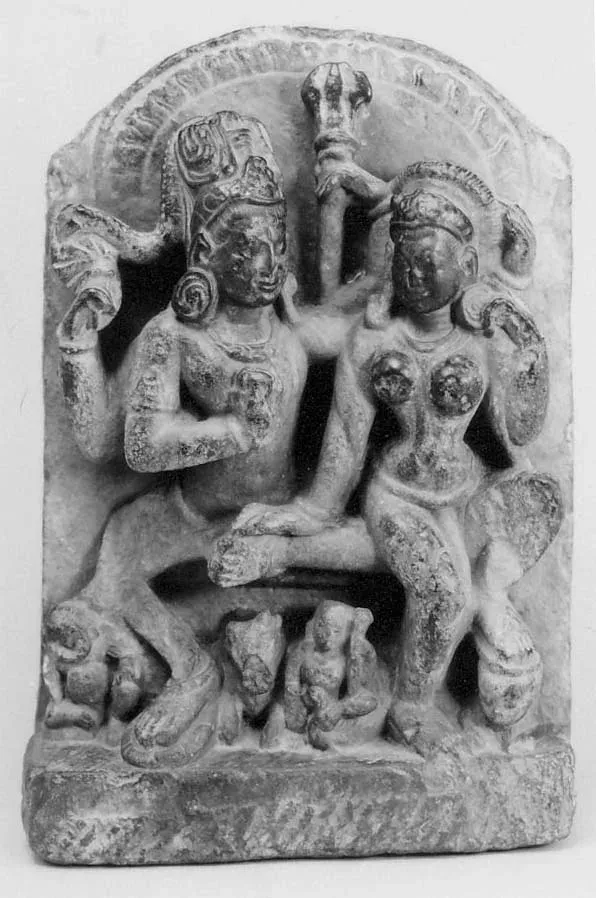
Plate III.2j. Shiva seated with Parvati (Uma-Maheshvara), late ninth to early tenth century CE, stone, 29.5 centimetres high, from Almora in north India. The museum’s record gives the title and nothing more, and its only photograph is a small black-and-white one. The small figures at the couple’s feet are not identified there. The Met, 1978.541. Gift of Bette-Ann and William Spielman, 1978. Image: The Metropolitan Museum of Art, public domain. Object record and full image.
The Met holds other images of the couple seated together from Nepal. They show a different god from the archer of the hymn: at home, at ease, with his wife beside him. In the Daksha story it is she who acts when he is slighted.
Sometimes the two are not shown side by side but as one body, male on the right and female on the left.12 The page for Devi takes up what that says about her.
The woman who sang to him
Gods in this chapter are not only described. They are loved, and some of the people who loved them are remembered by name.
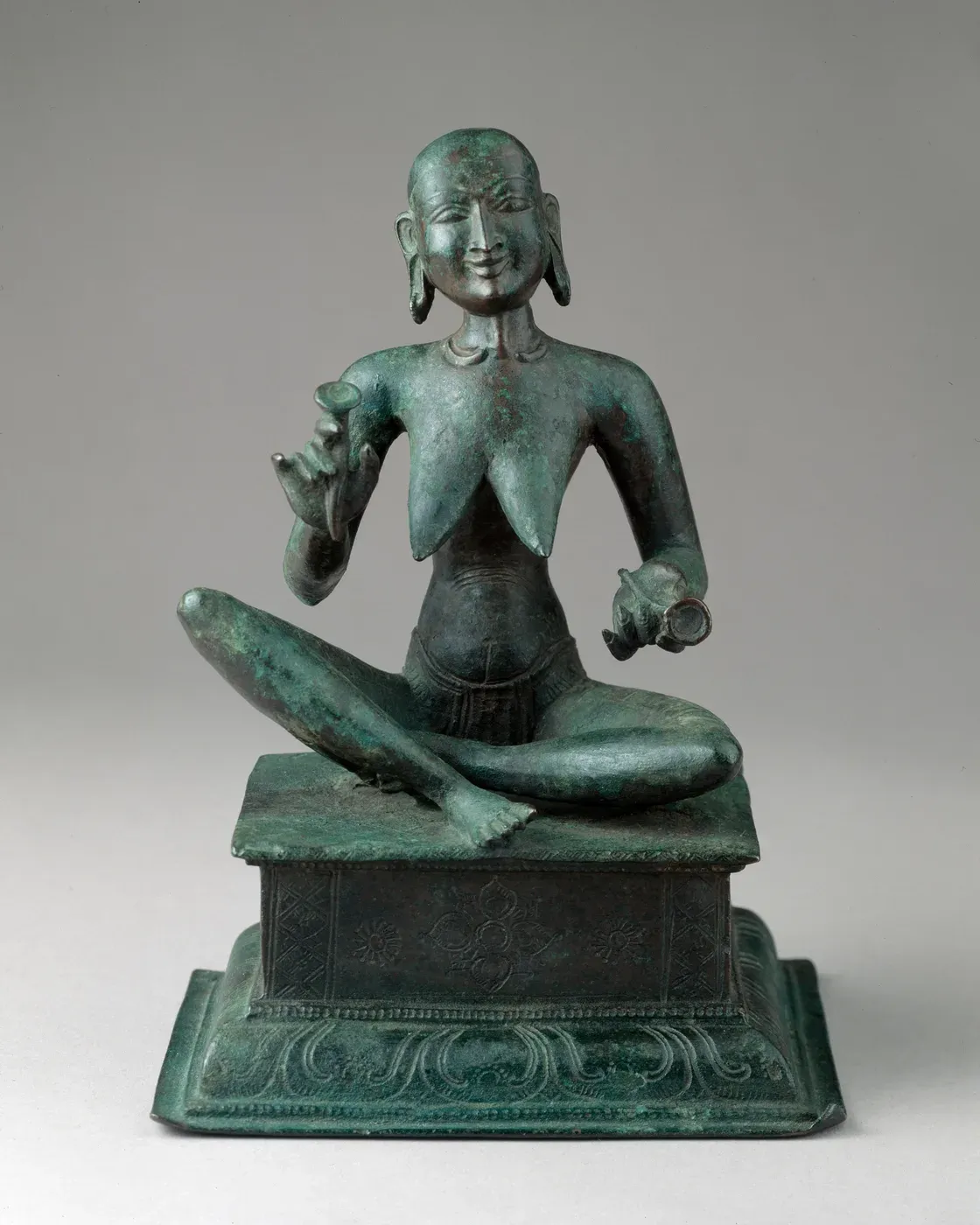
Plate III.2k. Karaikkal Ammaiyar, Shaiva saint, about the late thirteenth century CE, copper alloy, 23.2 centimetres high, from Tamil Nadu. She holds a pair of cymbals and is shown singing. The bronze was made some seven hundred years after she is said to have lived, and is a portrait of a saint as later devotion pictured her, not a likeness. The Met, 1982.220.11. Purchase, Edward J. Gallagher Jr. Bequest, 1982. Image: The Metropolitan Museum of Art, public domain. Object record and full image.
Karaikkal Ammaiyar was a poet of the sixth century in the Tamil south. The Met’s record tells her story as her tradition does. She asked Shiva to free her from everything that tied her to the world, and above all from her famous beauty. He granted it and turned her into a withered old woman, and she spent the rest of her life, delighted, composing hymns to him. Her hymns celebrate his fondness for cremation grounds and his wild dance.13
She is not the only saint remembered in bronze: the same museum holds a figure of the child saint Sambandar.9 And the Vishnu page ended on the same note from the other side: a god who can be reached by a leaf and an honest heart. This is what bhakti looked like in practice. A woman sings in her own language, with a pair of cymbals, to a god she speaks to directly.
Go back to the stone from Kashmir. The shaft is a sign with no features, and it could stand for a god as far from human as the one the Rigveda feared. The face that comes out of it is smiling. Shiva’s worshippers have kept both, and have never thought they had to choose.
Footnotes
-
The Metropolitan Museum of Art, Linga with Face of Shiva (Ekamukhalinga), 1989.150. The record describes the third eye, the ear ornaments, the double-looped hair with its crescent moon, and the incised lines of the shaft, and dates the rise of the form. ↩ ↩2
-
UNESCO World Heritage Centre, Elephanta Caves. The description names the bust Sadashiva and its three aspects, dates the caves, and mentions the fifteen large reliefs around the linga chapel of the main cave. ↩ ↩2 ↩3
-
The Metropolitan Museum of Art, Linga, Shiva’s Aniconic Symbol, 1987.425, Kashmir, eighth century or earlier. Only the title and date are relied on. The sources read for this page do not say when the plain shaft was first worshipped. ↩ ↩2
-
Arthur A. Macdonell, A History of Sanskrit Literature (London, 1900), chapter IV. ↩ ↩2
-
Ralph T. H. Griffith, The Hymns of the Rigveda (1896), book 2, hymn 33, verses 1, 2, 4, 11 and 14. A public-domain translation, quoted in short phrases. ↩ ↩2
-
Stephanie W. Jamison and Michael Witzel, “Vedic Hinduism” (1992, circulated 2003), 56. ↩ ↩2
-
F. Max Müller, The Upanishads, part 2, Sacred Books of the East 15 (Oxford, 1884), Shvetashvatara Upanishad, third chapter, verses 2, 5, 6 and 11, at 244 to 246. A public-domain translation. Verse 11 uses the word Siva of him. ↩ ↩2
-
H. H. Wilson, “Sacrifice of Daksha (from the Vayu Purana)”, in The Vishnu Purana (London, 1840), 61 to 69, with his notes. A public-domain translation. Wilson inserted this version from another Purana because the Vishnu Purana itself only alludes to the story; he notes that other Puranas tell it differently and at greater length. His reading of the legend as a sectarian struggle is in his first footnote. ↩ ↩2 ↩3 ↩4 ↩5 ↩6
-
Vidya Dehejia, “Recognizing the Gods”, Heilbrunn Timeline of Art History, The Metropolitan Museum of Art (2007). The essay’s list of works includes the Child Saint Sambandar, Tamil Nadu, late eleventh century. ↩ ↩2 ↩3 ↩4
-
Vidya Dehejia, “Hinduism and Hindu Art”, Heilbrunn Timeline of Art History, The Metropolitan Museum of Art (2007). ↩
-
The Metropolitan Museum of Art, Shiva as Lord of Dance (Nataraja), 1987.80.1, description and audio guide. The reading of the ring of fire is from the audio guide. ↩
-
The Metropolitan Museum of Art, The Half-Male, Half-Female Form of Shiva (Shiva Ardhanarishvara), 2015.500.4.27. Only the title is relied on. ↩
-
The Metropolitan Museum of Art, Karaikkal Ammaiyar, Shaiva Saint, 1982.220.11. The full credit line continues: in memory of his father, Edward Joseph Gallagher, his mother, Ann Hay Gallagher, and his son, Edward Joseph Gallagher III. ↩
Sources
- Read the hymn: Rigveda 2.33, translated by Ralph T. H. Griffith (1896), Internet Sacred Text Archive
- Read the Upanishad: F. Max Müller, Shvetashvatara Upanishad, Sacred Books of the East 15 (1884), Internet Sacred Text Archive
- Read the story: H. H. Wilson, Sacrifice of Daksha, in The Vishnu Purana (1840), Internet Sacred Text Archive
- Visit the monument: Elephanta Caves, UNESCO World Heritage Centre
- Examine the bronze: Shiva as Lord of Dance (Nataraja), 1987.80.1, The Metropolitan Museum of Art