Numina · Hindu · III.2 Vishnu, Shiva, Devi
Chapter III.2
Vishnu
In the Rigveda he is a minor god known for one thing: he crosses the universe in three steps. This page follows how the strider became the one who holds the world together, and how to read him when you see him.
At Besnagar in central India, where two rivers meet, a sandstone pillar six and a half metres tall still stands in the open. It was set up in the second century BCE. When archaeologists examined it in 1877 its lower part was hidden under thick layers of red pigment, a sign that it had long been an object of local devotion. Under the pigment were two inscriptions.1
The first names the man who raised the pillar. He was Heliodorus, an ambassador sent by a Greek king of the north-west to the court of an Indian one. It calls the pillar a Garuda standard, after the bird that carries Vishnu. And it calls Heliodorus a Bhagavata, a word usually taken to mean a devotee of Vishnu.1
That reading is not quite certain. The encyclopaedia that describes the pillar notes that followers of the Buddha used a similar title, and some scholars have argued the word could mean that.1 But the bird on the pillar and the remains of a Vishnu shrine nearby point the usual way. If they are right, one of the earliest dated witnesses to the worship of Vishnu is a foreigner.
People in the village call the pillar Khambh Baba, the pillar saint, and it is still occasionally worshipped.1
Three steps
Vishnu is in the Rigveda, but only just. Arthur Macdonell ranks him among the deities of the fourth rank, with fewer hymns than three other gods of the sun.2
What the hymns do say about him is always the same thing. In Griffith’s translation, he is the one who measured out the regions of the earth, thrice setting down his footstep, widely striding. All living creatures have their home inside those three paces. He alone holds up the threefold world. And his third and highest step is a place people long to reach, because a spring of honey is there.3
Diagram 4. The three strides of Vishnu as the Rigveda describes them. Drawn for this book from hymn 1.154 and from Macdonell’s summary. The hymn does not say what the first two steps cover; the labels claim no more than it does.
What are the three steps? Macdonell, writing in 1900, was sure. They are the course of the sun through the three divisions of the universe, and Vishnu was at first the sun in motion.2 The modern survey used in the last chapter warns against exactly this habit of his generation, which felt obliged to end every discussion of a god by declaring that he must be the sun or the sky.4 The hymn itself says only that he strode, and that the strides were for the good of those who live within them.
One thing in Macdonell’s account does matter for what came next. Later Vedic texts tell a story in which Vishnu takes the form of a dwarf to win the earth back from the demons, and covers it in three strides. Macdonell sees in this the root of the later teaching that Vishnu descends to earth in one form after another for the good of the world.2 Those descents have a chapter of their own further on.
The one who lies on the water
By the time of the Puranas the strider has become the ground of everything.
The Vishnu Purana describes what happens at the end of each immense age of the world. The universe is swallowed up and becomes a single ocean. On that ocean, in Wilson’s translation, the Supreme reposes upon his mighty serpent couch amidst the deep. After a time he wakes, and the world is made again.5
This is the other great picture of Vishnu, and it is the opposite of the first. In the Veda he is all motion, three steps and done. In the Purana he is utterly still, asleep on a serpent, while everything that will ever exist waits inside him.
Reading his hands
How do you know that a figure is Vishnu? Vidya Dehejia gives the short rule. He holds a war discus and a conch-shell trumpet. He wears a tall crown and rich jewellery. And unlike most Indian gods, who stand with a sway, he stands perfectly straight.6
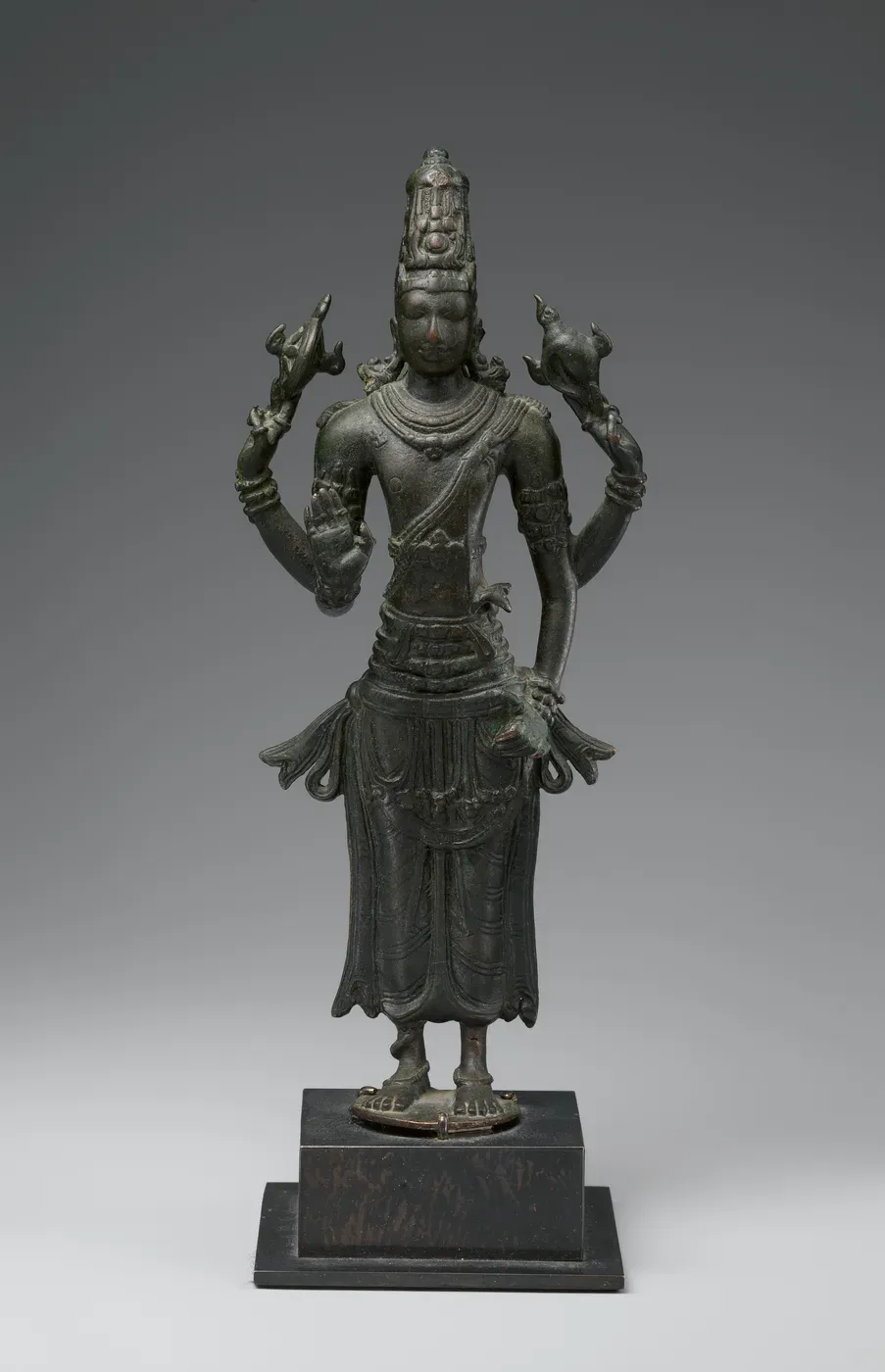
Plate III.2d. Vishnu, first half of the ninth century CE, copper alloy, 21.6 centimetres high, from Tamil Nadu. The upper hands hold the discus and the conch. The museum connects the figure with the last stable reigns of the Pallava kings and with the beginning of processional images in south Indian worship. No findspot or temple is recorded for it. The Met, 2015.147. Purchase, The Vincent Astor Foundation and other donors, in honor of John Guy, 2015. Image: The Metropolitan Museum of Art, public domain. Object record and full image.
The Met describes this small bronze as Vishnu displaying the symbols of his authority as a divine monarch.7 That is the plain meaning of the objects in his hands. They are a king’s weapons and a king’s trumpet.
The Vishnu Purana gives them a second meaning. A pupil asks how Vishnu can be said to carry the whole world, and the teacher answers that every ornament and weapon on the god’s body is a part of the universe in another form.8
| What he bears | What the Vishnu Purana says it is |
|---|---|
| The jewel he wears | the pure soul of the world |
| The mace | intellect |
| The conch and the bow | the sense of self, in its two divisions |
| The discus | the mind, whose thoughts fly faster than the wind |
| The arrows | the faculties of action and of perception |
| The sword | wisdom, sometimes hidden in the scabbard of ignorance |
The table follows Wilson’s wording closely, and Wilson’s terms for the parts of the mind are those of 1840.8 The point survives the translation. A worshipper looking at the image is meant to see not a warrior with his kit, but everything that exists, arranged on one body.
The conch has a life outside his hand as well.9
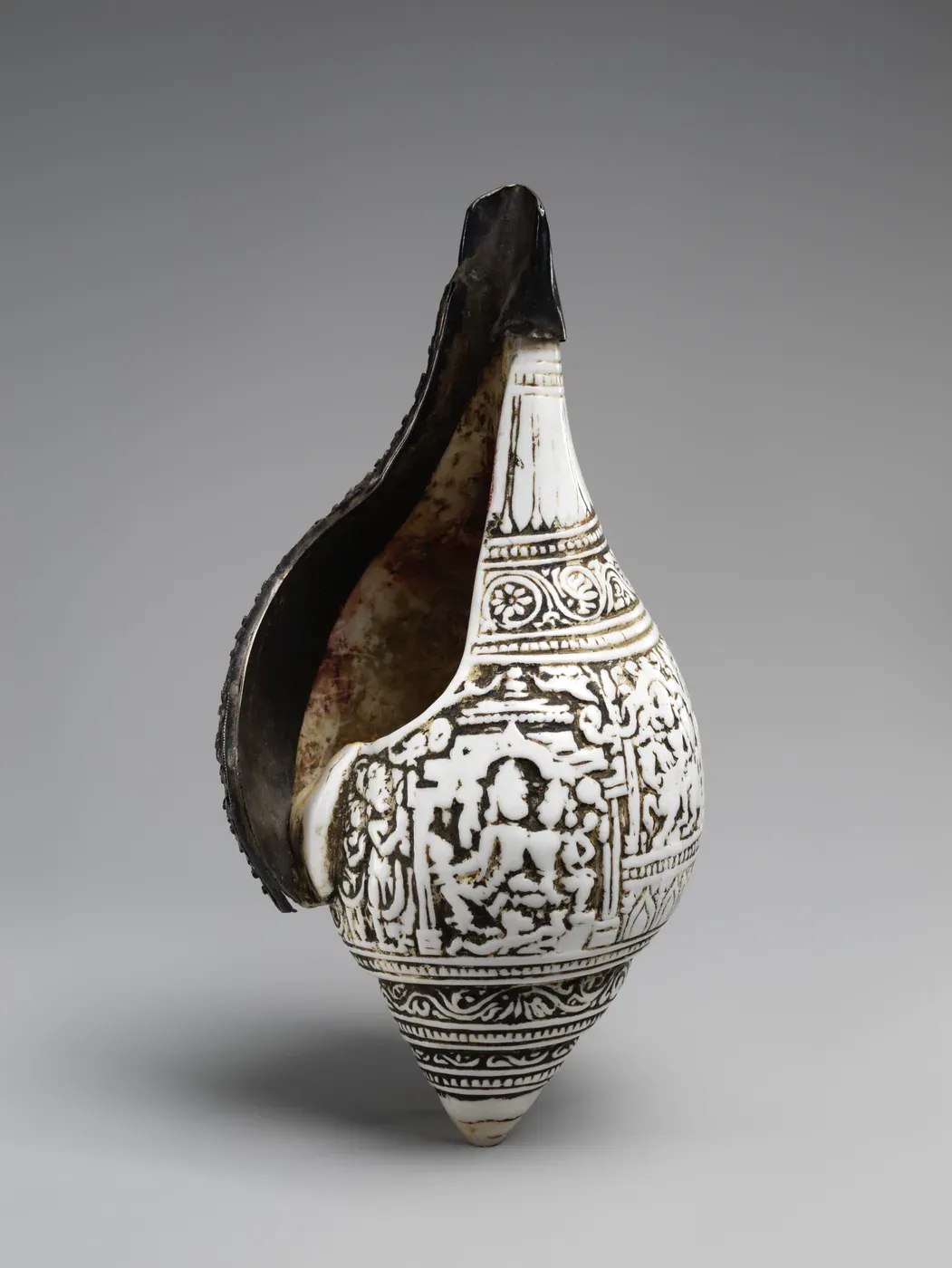
Plate III.2e. Carved conch with Lakshmi-Narayana, eleventh to twelfth century CE, shell with silver additions, 20.5 centimetres high, from Bengal or Bangladesh. The medallion shows Narayana, which the museum explains as a form of Vishnu, seated in a pavilion with Lakshmi. The object is itself a conch, the thing Vishnu carries. The museum’s record does not say how it was used, and this caption does not guess. The Met, 1986.501.6. Gift of Evelyn Kossak, The Kronos Collections, 1986. Image: The Metropolitan Museum of Art, public domain. Object record and full image.
Lakshmi
Vishnu is seldom alone. Dehejia notes that he is often accompanied by his consort Lakshmi, the goddess of fortune.6
The Vishnu Purana tells how she came to him. The gods and their rivals churn the ocean of milk for the drink of immortality, and wonderful things rise out of it one after another. Then, in Wilson’s words, seated on a full-blown lotus, the goddess rises from the waves. The elephants of the sky pour water over her from golden vases. Bathed and adorned, and with all the gods watching, she goes to Vishnu and rests upon his breast.10
The scene with the elephants is one of the oldest in Indian art. Lakshmi bathed by two elephants appears in sculpture from the first century BCE, long before any surviving copy of this text.11 She is treated more fully on the page for Devi, because she is also a goddess in her own right.
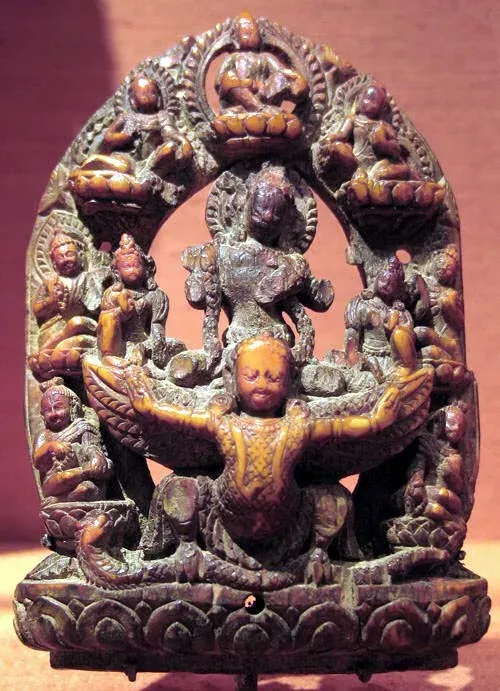
Plate III.2f. Vishnu on Garuda, fifteenth century CE, ivory, 14.9 centimetres high, from the Kathmandu Valley in Nepal. Garuda grips snakes in his talons and carries Vishnu, with a consort on each outspread wing. The museum names the two as Sarasvati and Lakshmi. The museum’s only photograph is a small one. The Met, 1991.437. Gift of Mr. and Mrs. Alexander Polsky, 1991. Image: The Metropolitan Museum of Art, public domain. Object record and full image.
The plaque also shows the last of his usual companions. Every major deity has an animal that carries them, and Vishnu’s is Garuda, a great bird like an eagle.6 It is Garuda’s name that Heliodorus gave to his pillar.
The form that contains everything
The most ambitious images of Vishnu try to show the claim of the Purana directly: that all forms are his.
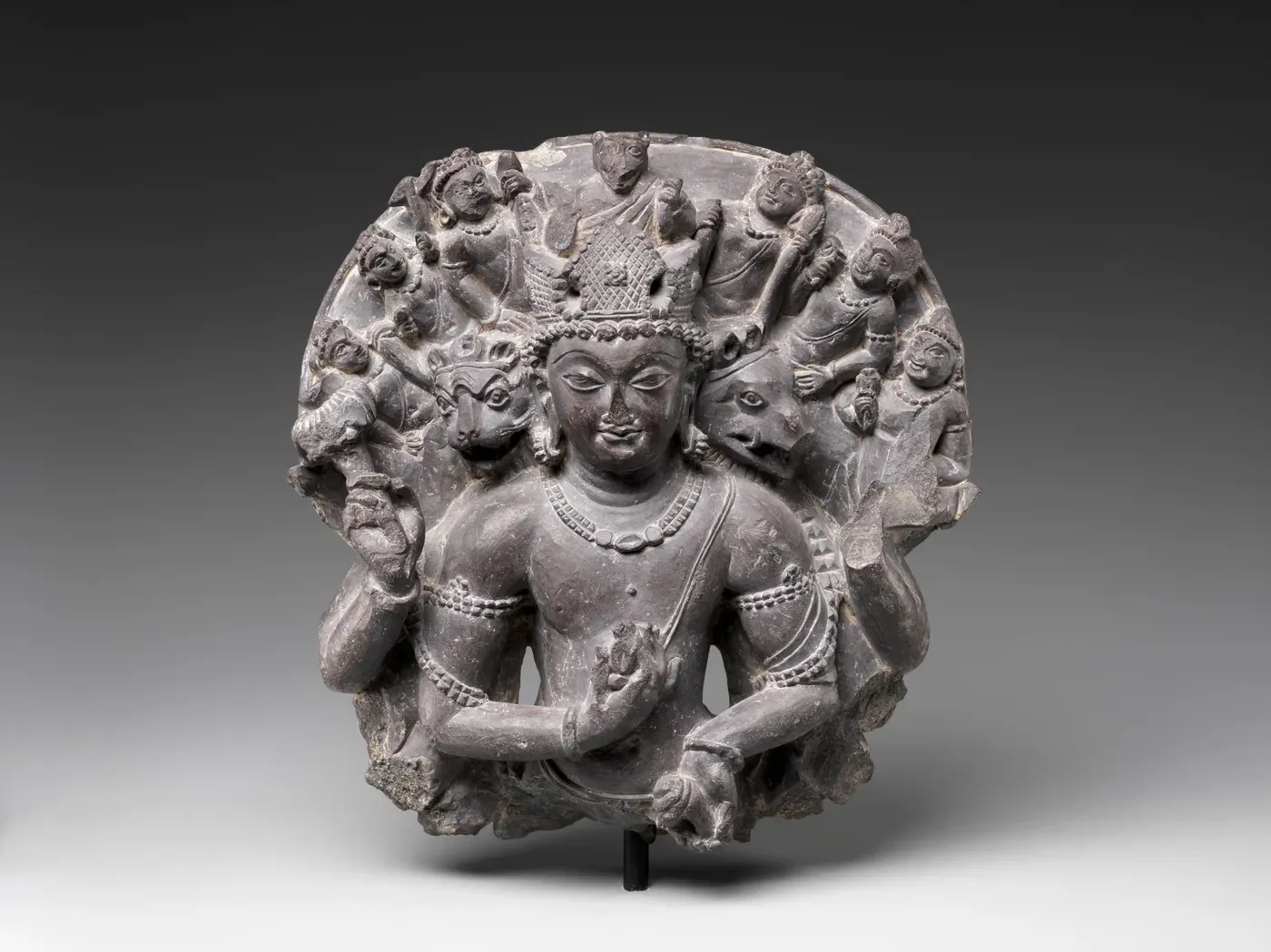
Plate III.2g. Vishvarupa Vishnu, sixth century CE, stone, 17.8 centimetres high, from Kashmir. The museum describes the god as supreme Lord with ten arms and three faces, attended by his lion and boar forms and by many others. The lower part is lost. The small figures in the halo are not individually identified in the record. The Met, 1986.506.15. Gift of Cynthia Hazen Polsky, 1986. Image: The Metropolitan Museum of Art, public domain. Object record and full image.
Vishvarupa means having all forms. In this small carving from Kashmir the sculptor gives Vishnu a lion’s head on one side and a boar’s on the other, which are two of the shapes he takes in his descents, and fills the halo behind him with more beings than can be counted at this size.12
The text says the same in words. Vishnu, the Purana declares, exists in manifold forms, as gods, men and animals; his shape is all visible things, and he is also without shape or form.8 The contradiction is deliberate. An image with ten arms and three faces is one way of drawing something that has every form and none.
A god for a king, and for anyone
Two kinds of people appear around Vishnu in the evidence on this page.
One is the ruler. The bronze from Tamil Nadu shows him as a divine monarch, and the museum ties it to the reigns of particular kings.7 A god whose business is to hold the world steady is a natural patron for someone whose business is to hold a kingdom steady.
The other is anyone at all. The pillar at Besnagar was raised by a foreign envoy. And in the Bhagavad Gita, the best known of the texts in which Vishnu speaks, he sets the cost of approaching him as low as it can go. In Telang’s translation: Whoever with devotion offers me leaf, flower, fruit, water, he accepts it.13
Compare that with the last chapter. The Vedic rites described there grew ever more elaborate, expensive and specialised.14 This asks for a leaf and an honest heart. The older rites did not disappear, but the weight of the religion had moved to something every person could do.
What is kept for later
This page has left out the stories for which Vishnu is best loved, and that is on purpose.
Dehejia lists what belongs to him: a theory of ten incarnations, of which nine are past and the tenth is still to come, and among them the two most popular, Rama, the prince of the Ramayana, and Krishna, the cowherd and the teacher of the Gita.6 The two epics are the subject of the next chapter, and the idea of descent has the chapter after that.
What this page has tried to show is the figure who stands behind them. He appears first as a few lines in the Rigveda about a god who took three steps, and then as a sleeper on the water with the universe inside him. The pillar at Besnagar has stood for some twenty-one centuries, and it is still, now and then, worshipped.
Footnotes
-
Impart Encyclopedia of Art, “Pillar of Heliodorus” (first published 2022). For the height, the site at the meeting of the rivers Bes and Betwa in present-day Vidisha, the examination by Alexander Cunningham and others in 1877, the two inscriptions in Brahmi script, the names of the two kings (Antialcidas and Bhagabhadra), the Garuda standard, the shrine nearby, the alternative reading of Bhagavata, and the local name. The article dates the pillar to the early second century BCE; other accounts place it later in that century, so only the century is given here. ↩ ↩2 ↩3 ↩4
-
Arthur A. Macdonell, A History of Sanskrit Literature (London, 1900), chapter IV. ↩ ↩2 ↩3
-
Ralph T. H. Griffith, The Hymns of the Rigveda (1896), book 1, hymn 154, verses 1 to 5. A public-domain translation, quoted in one phrase. Griffith has “the well of meath” in the highest footstep; Macdonell renders the same line “a spring of nectar”. ↩
-
Stephanie W. Jamison and Michael Witzel, “Vedic Hinduism” (1992, circulated 2003), 52, where Macdonell’s Vedic Mythology is named among the works affected. ↩
-
H. H. Wilson, The Vishnu Purana (London, 1840), book 1, chapter 2, 19. A public-domain translation, quoted in short phrases throughout this page. ↩
-
Vidya Dehejia, “Recognizing the Gods”, Heilbrunn Timeline of Art History, The Metropolitan Museum of Art (2007). For the discus and conch, the crown, the upright stance (samabhanga), Lakshmi, Garuda, and the ten incarnations. ↩ ↩2 ↩3 ↩4
-
The Metropolitan Museum of Art, Vishnu, 2015.147. The record names the kings Dantivarman and Nandivarman. The full credit line is: Purchase, The Vincent Astor Foundation, Cynthia Hazen Polsky, Jeff Soref, Vijay K. Anand, M.D., Nanda Anand, Maya Anand, and Rohit Anand, and Edward and Catharine LaPuma Gifts, Director’s Fund, and Tommy Yang Guo Gift, in honor of John Guy, 2015. ↩ ↩2
-
Wilson, The Vishnu Purana, book 1, chapter 22, 157 to 159. Wilson names the jewel Kaustubha and translates the principle borne as conch and bow as “egotism” (ahankara). ↩ ↩2 ↩3
-
The Metropolitan Museum of Art, Carved Conch with Lakshmi-Narayana, 1986.501.6. ↩
-
Wilson, The Vishnu Purana, book 1, chapter 9, 76. Wilson calls her Sri as well as Lakshmi. ↩
-
The Metropolitan Museum of Art, Gaja Lakshmi, Goddess of Fortune, 1993.194, shown as a plate on the page for Devi. ↩
-
The Metropolitan Museum of Art, Vishvarupa Vishnu, 1986.506.15. The translation of the name is the usual one and is not given in the record. ↩
-
Kashinath Trimbak Telang, The Bhagavadgita, Sacred Books of the East 8 (Oxford, 1882), chapter 9, 85. The speaker is Krishna. ↩
-
Jamison and Witzel, “Vedic Hinduism”, 4. ↩
Sources
- Read the hymn: Rigveda 1.154, translated by Ralph T. H. Griffith (1896), Internet Sacred Text Archive
- Read his Purana: H. H. Wilson, The Vishnu Purana (1840), Internet Sacred Text Archive
- Visit the pillar: Pillar of Heliodorus, Impart Encyclopedia of Art
- Learn the signs: Vidya Dehejia, Recognizing the Gods, Heilbrunn Timeline of Art History, The Metropolitan Museum of Art
- Examine the bronze: Vishnu, 2015.147, The Metropolitan Museum of Art