Numina · Egyptian · II.2 The first time
Chapter II.2
The first time
Water without an edge, no ground to stand on, and a god who comes into being by himself. Egypt told the beginning of the world many times, in different cities and different words, and kept every version.
A Theban priest named Nesmin owned a long papyrus roll. Its colophon dates it to 305 BCE. Most of what it holds is ritual: songs for Isis and Nephthys, the bringing in of the god Sokar, and a book for overthrowing Apep, the serpent who threatens the sun.1
In the middle of the spells against Apep, the creator speaks. Before he came into being, he says, there was no sky and no earth. He raised himself out of the inert water. And there he met the first difficulty of the world: he found no place on which he could stand.2
Every Egyptian account of the beginning has to answer that difficulty. Where does the first ground come from, and how does one become many? Egypt answered more than once, in different texts written for different purposes, as the last chapter led us to expect.
Egyptologists often name the answers after cities: Heliopolis, Memphis, Hermopolis and Thebes. The names are useful, but they can mislead. The evidence rarely tells us where or when an idea first took shape, and the accounts were not rival creeds. As we shall see, a single hymn could hold all of them at once.3
Before there was anything
Start before the beginning. How do you describe what existed when nothing yet existed?
One answer names what was missing. A group of eight beings, four male and female pairs, stands for the state before creation. UCL’s overview gives the pairs as they appear in the earliest surviving reference to them, a funerary text known as Coffin Text 76:4
- Nun and Nunet, from a word for a watery expanse: no solid ground.
- Heh and Hehet, from a word for unending time: no measure of time.
- Kek and Keket, from the word for darkness: no light.
- Tenem and Tenemet, from a word for wandering: no direction.
In later versions Amun and Amunet, from the word for hidden, take the place of the last pair. The absence becomes an absence of sight.4
Each name is a quality of the known world, turned inside out: water without a shore, time without a count, dark, and aimlessness. The Eight are not monsters to be defeated. They are a way of describing nothing without pretending that nothing is simple.
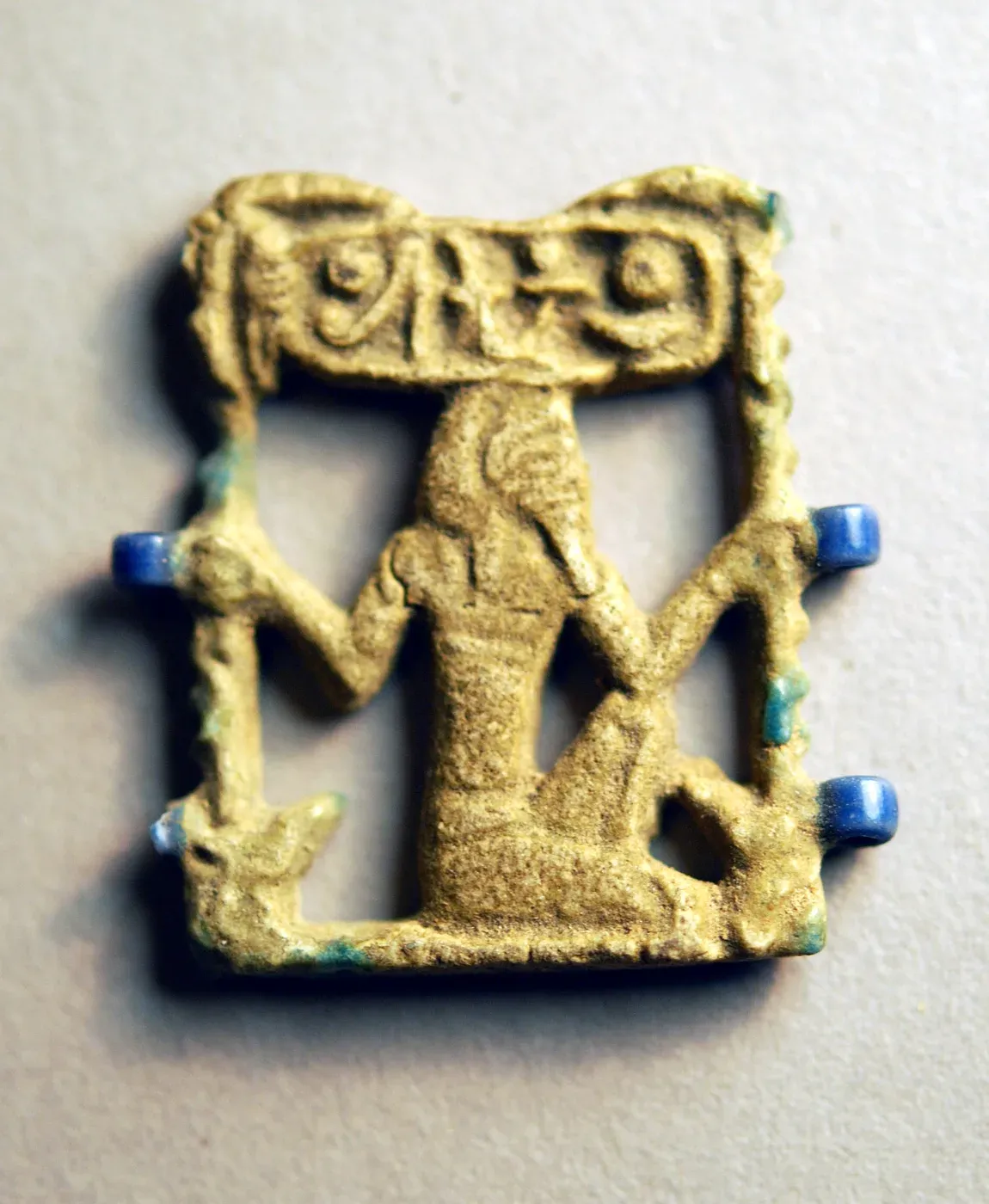
Plate II.2a. A faience amulet from the tomb of Amenhotep III in the Valley of the Kings, about 1386 to 1347 BCE. The kneeling god beneath the king’s name is Heh, whose name is the word for unending time. He is not shown here as one of the Eight; one pair of the Eight carries the same word. The Met, 26.7.1086. Purchase, Edward S. Harkness Gift, 1926. Image: The Metropolitan Museum of Art, public domain. Object record and full image.
Egyptologists often call the Eight the Ogdoad and place them at Hermopolis. The city’s Egyptian name, Khemenu, means Eight. Its main god was Thoth, whom the Greeks equated with Hermes, hence the Greek name.4 The Louvre’s account of this tradition has Thoth coordinating the work of the four couples, whose efforts produce the sun, appearing as a child inside a shining lotus.5
UCL raises two objections to the usual label, Hermopolitan theology. It is not known where or when the references to the Eight developed. And they are not one creation myth to be set against others, but an early stage in the story of creation, which continues with the emergence of the sun god.4 Borges Pires makes the same point: the Ogdoad is often misunderstood as automatically linked to Hermopolis.6
Ground out of water
In the Nile valley the beginning had a model that came back every year. The river flooded in late summer. In the autumn the fields emerged again, coated in black mud. UCL suggests that this repeated experience supplied the main images through which Egyptians expressed the mystery of creation.7
Three of those images recur:
- A heron alights on the first dry ground. Its Egyptian name, bnw, may be the origin of the Greek phoenix.
- A lotus flower rises out of the water. From the New Kingdom onward this image is assigned to Nefertem, god of scented oils.
- The mound itself offers the first sacred ground. Temples are said to stand on the primeval mound of the first time of creation.7
That phrase, the first time, is sp tpy in Egyptian. It names the moment when creation was set in motion. It is less ancient than it sounds. Borges Pires, following Susanne Bickel, notes that the expression seems to be absent from both the Pyramid Texts and the Coffin Texts.8 It belongs to later religious writing, and we shall see what that writing did with it.
Atum, the complete one
The principal creator in Egyptian religion is the sun god. His name Ra means sun, but he is also regularly called Atum, from a word meaning complete. UCL reads the name as all matter concentrated in the creator before creation emerged. Creation, on this view, is not making something from nothing. It is the undivided All gradually separating into distinct things.7
The Louvre summarises the account associated with Heliopolis, Atum’s city. Atum becomes aware of his existence within Nun, acquires movement, and wishes to rest. A primeval mound emerges; he climbs onto it and organises the universe from there. The Louvre notes that these texts survive in funerary anthologies such as the Coffin Texts and the Book of the Dead.5
Then the creator has to become more than one. The earliest surviving texts are frank about how. Pyramid Text 527, in James Allen’s translation as quoted by Borges Pires, says that Atum came into being in Heliopolis and produced the twins Shu and Tefnut from his own body, by his own hand, with no partner.9
The twins are a pair of opposites. Shu’s name is related to a word for being dry; Tefnut’s to a rare word that UCL connects with moisture. The Coffin Texts also equate Shu with life and Tefnut with Ma’at, what is right, the subject of a later chapter.7
From the twins come Geb, the earth, and Nut, the sky. Shu separates them, and from Geb and Nut come Osiris, Seth, Isis and Nephthys.10 Egyptian texts often refer to groups of gods as a Nine; Egyptologists use the Greek form, Ennead. UCL notes that the rituals mentioning the Nine do not list them by name, so any list of nine is a reconstruction.10
Human beings receive almost no separate attention. UCL knows of no Egyptian composition describing the creation of humankind. People are already there early in the story, and in some accounts they come from the sun god’s tears: the Egyptian word for people sounds like the word for weeping.10
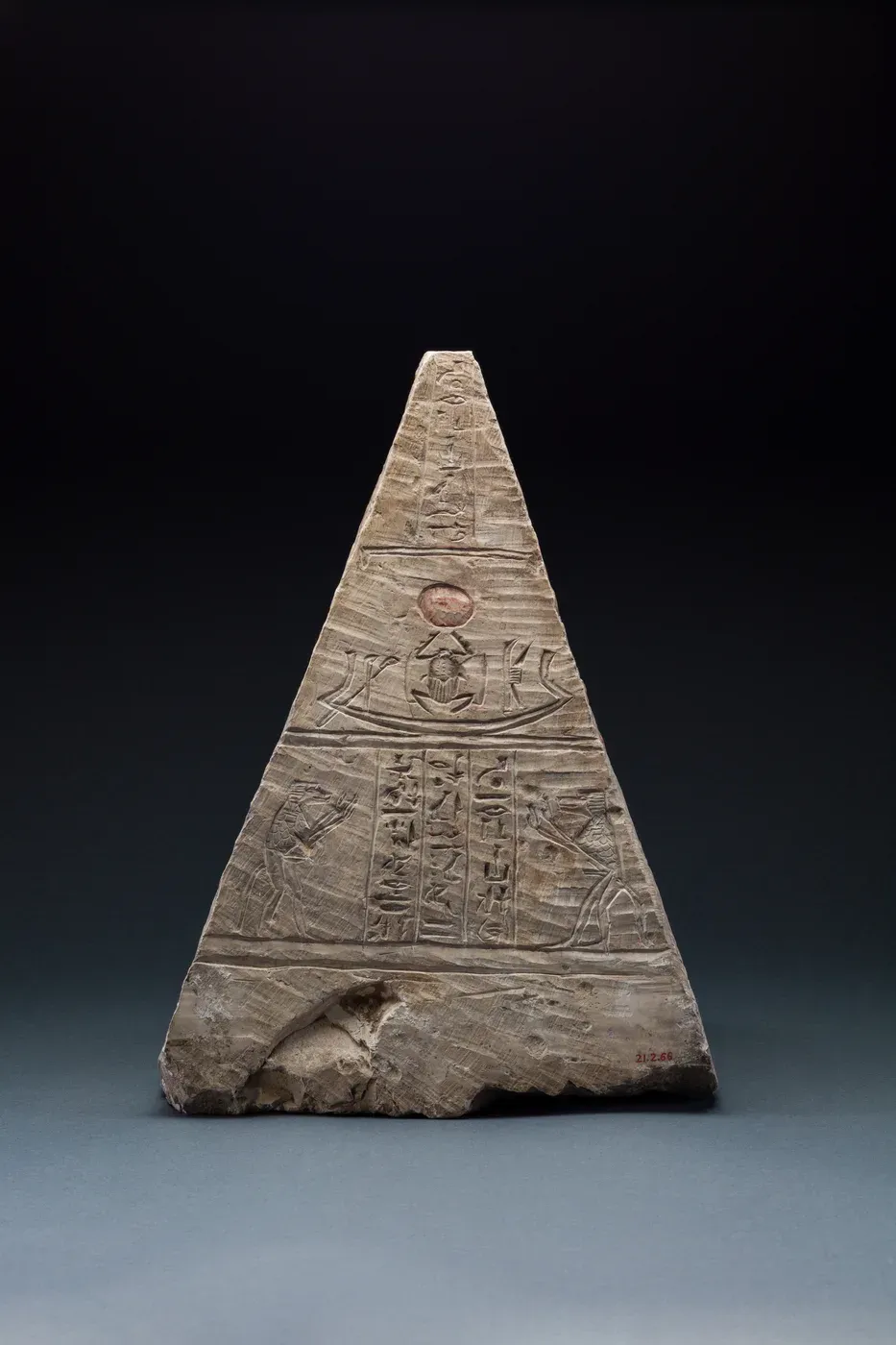
Plate II.2b. Pyramidion of Iufaa, 664 to 525 BCE, probably from Abydos. On this face the sun rises in its boat, balanced on the front legs of a scarab beetle, the god Khepri. This is not a creation text: the pyramidion once topped a memorial chapel for a priest of Osiris, and its other faces show the sun on the horizon and the god Anubis. The Met, 21.2.66. Rogers Fund, 1921. Image: The Metropolitan Museum of Art, public domain. Object record and full image.
The scarab on Iufaa’s pyramidion carries the idea in a single sign. The beetle was kheperer in Egyptian. The rising sun was Kheperi, and the verb for to become or come into being was kheper. The same beetle hieroglyph spelled all of these words.1112 The god of the morning sun is, by his name, the god who comes into being.
One papyrus, two beginnings
Return to Nesmin’s papyrus. The creator’s account appears in it twice. A shorter version stands among the spells against Apep, and a longer one follows a little further on. Budge, who first published the papyrus, could not tell whether the scribe had two copies and inserted both, or copied the short version and added to it as he went.13
The speaker comes into being in the form of Khepera, Budge’s spelling of Khepri. He works by his heart, which Budge also translates as will, and lays the foundations of things by Ma’at. In the longer version he gives himself being by speaking his own name.2
The two versions are not tidy about how the twins began. In one passage the creator speaks of the time before he had emitted Shu and spat out Tefnut; in another he unites with his own hand and sends them forth from himself, and from being one god I became three. Both are kept, and so is a third detail: men and women spring from the tears of his Eye.2
Budge’s translation is more than a century old, and modern translations differ in their wording. Read it as a guide to the structure of the account, not as the exact phrasing of the Egyptian.2
The setting matters as much as the words. Budge describes the book of overthrowing Apep as spells recited so that nothing, animate or inanimate, could prevent the sun from rising in the morning. The creation account has no mention of Apep. Budge’s explanation was that the whole account was itself regarded as a powerful spell.13 Whatever its original purpose, in Nesmin’s roll the story of how the world began sits inside the work of making the next day begin.
Ptah: the heart and the tongue
The account associated with Memphis credits a different god. It survives on the Shabaka Stone, a stone slab in the British Museum, and the museum calls it the only surviving copy of what Egyptologists know as the Memphite Theology.14
The stone dates from the reign of Shabaka, a Kushite king of the twenty-fifth dynasty, around 710 BCE. It was set up in the temple of Ptah at Memphis and later reused as a millstone, which ground away much of its text. As the previous chapter noted, the inscription claims to copy an ancient, worm-eaten document. The museum’s curators treat that claim as a rhetorical device, and it is now generally accepted that the text in its present form was composed in Shabaka’s own time.14
Whether the ideas are older is still disputed. The museum’s description suggests a text perhaps first composed in the New Kingdom; its curators’ notes record scholarly dates for the content from the nineteenth dynasty to the twenty-fifth.14
According to the curators, the Memphite account sought to give Ptah, the patron god of the city, a prior claim over Atum of Heliopolis. It does so by crediting Ptah with creating the other gods, and through them, indirectly, the world. Atum is not erased. He is placed after Ptah.14
The museum’s transcript of the text describes how. Ptah gave life to all the gods through the heart and through the tongue. The senses report to the heart, which brings understanding forth; the tongue repeats what the heart has devised. Every divine word, every hieroglyph, every trade and art came from that command. Then, the text says, Ptah was satisfied.15
UCL describes Ptah as creation by transformation: the shaping of existing material, whether metal and stone in craft or speech in words.16 Ptah also appears as a primordial creator in his own right. A hymn in the Great Harris Papyrus, from the reign of Ramesses III, greets Ptah as Tatenen, father of the gods, the great god of the First Time, who made the sky as a creation of his heart.17
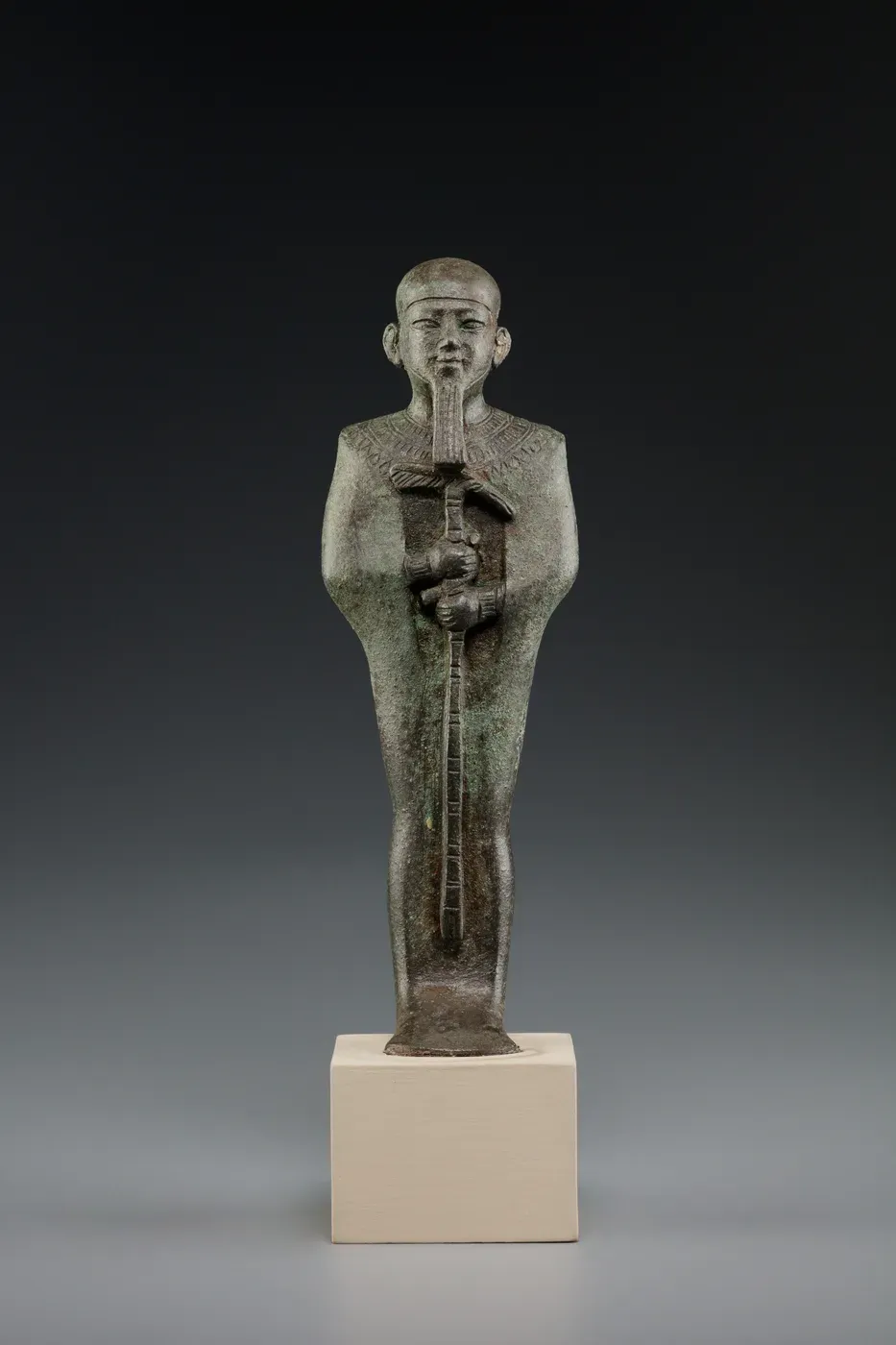
Plate II.2c. Ptah, about 721 to 650 BCE or somewhat later. The Met dates this copper-alloy figure by its style to the Kushite and early Saite period, the age of the Shabaka Stone. It carries no text about creation. The Met, 45.4.1. Gift of David Dows, 1945. Image: The Metropolitan Museum of Art, public domain. Object record and full image.
Amun, who keeps them all
Amun’s name means the hidden one. The Met’s record notes that he came into prominence at the beginning of the Middle Kingdom, and from the New Kingdom onward was arguably the most important god in Egypt. As a creator he is most often Amun-Re, joined with the sun god. His main sanctuary was the temple complex at Karnak, at Thebes.18
Papyrus Leiden I 350 holds a collection of hymns to him, probably composed in the second half of the reign of Ramesses II. Its sections are numbered like chapters, and each number puns on the words that open or close its section.19 Read in Borges Pires’s translations, they show what Thebes did with every other account in this chapter.
Chapter 100 calls the god the one who inaugurated existence at the First Time.19 Chapter 80 makes the Eight his first manifestation: he hid himself as Amun at the head of the gods, then came into being as Tatenen, whom these hymns identify with Ptah, to bring the primordial gods to birth. Another passage calls the Eight another of his existences, has those primordial gods bring Ra to birth, and says he completed himself with Atum. A damaged line appears to mention Shu and Tefnut spat out.20
Then chapter 300 sums it up. All gods are three, Amun, Ra and Ptah, with no equal; he hides his name as Amun, he is Ra in the face, and his body is Ptah. Borges Pires reads this as one god with many aspects, not three separate gods.19
The Eight of Hermopolis, Atum of Heliopolis, Ptah of Memphis: none of them is refuted. Each is taken up as a form of the one hidden god. The Theban hymn does not choose between the earlier accounts. It keeps all of them.
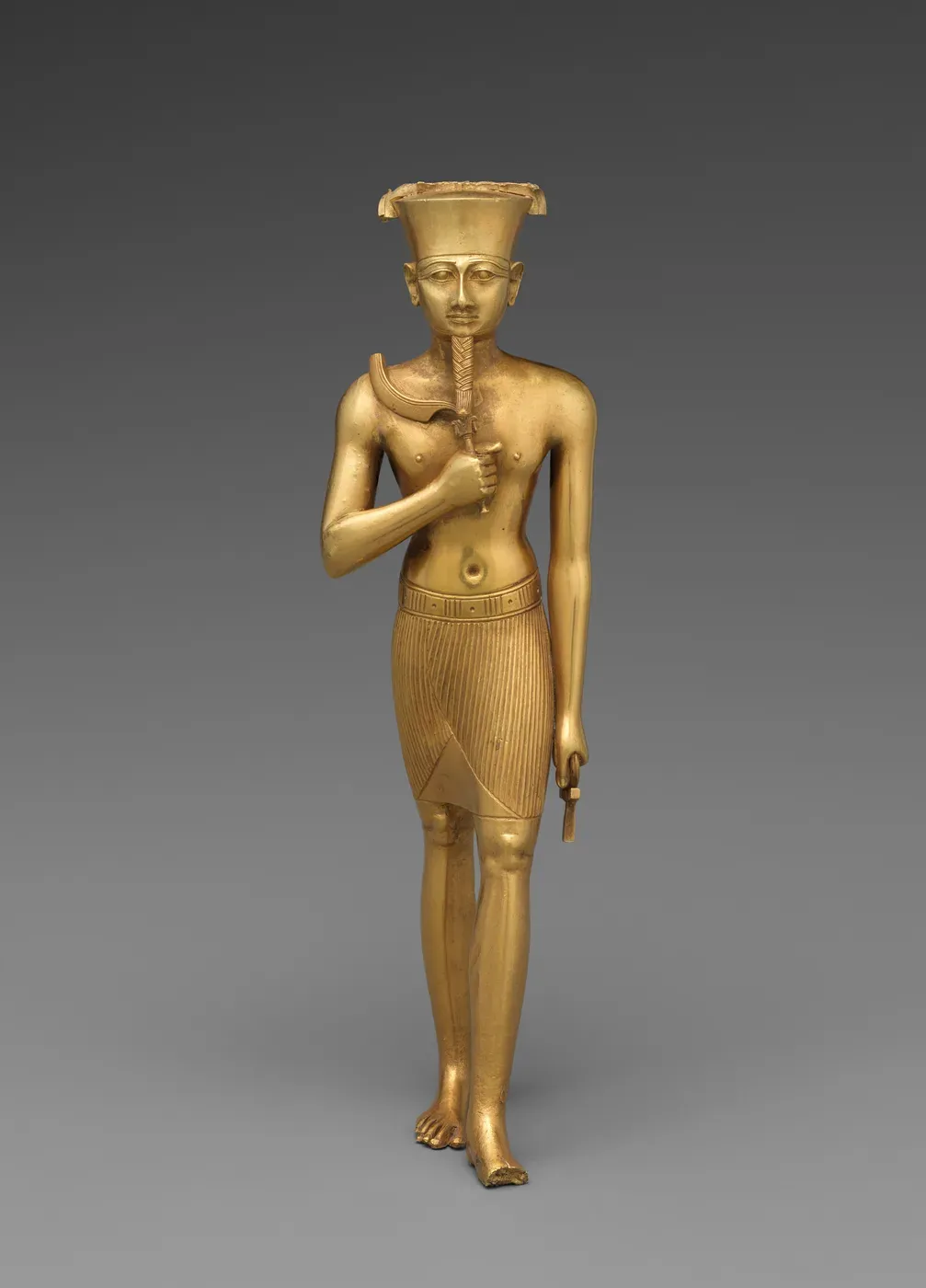
Plate II.2d. Statuette of Amun, about 945 to 721 BCE, cast in solid gold and reportedly found at Karnak. The flat-topped crown once held two tall gold feathers. For the Egyptians, the museum notes, gold was associated with the sun, and the skin of gods was supposed to be gold. The Met, 26.7.1412. Purchase, Edward S. Harkness Gift, 1926. Image: The Metropolitan Museum of Art, public domain. Object record and full image.
Every morning, the first time
There is no single Egyptian narrative that combines all these motifs. UCL warns that our summaries of them may be a modern, non-Egyptian way of answering the question of creation. The Egyptian response seems to have been less to tell stories than to express relations between divine forces in groups, which Jan Assmann has called constellations.3
Nor was the first time only in the past. In New Kingdom sun hymns, Borges Pires notes, scholars disagree over whether the creation is described as a single event or a continuing one. Sp tpy may occasionally designate the repetition of creation in the daily appearance of the sun.21
Look again at the face of Iufaa’s pyramidion. The sun is lifted into its boat on the legs of the beetle whose name means coming into being. Look again at Nesmin’s roll, where the account of the world’s beginning sits among spells to make sure the sun rises. On these monuments, the beginning was not a lost origin to be recovered. It was something that had to keep happening.
Creation divides the All into earth and sky and the first family of gods. The next chapter follows that family into its first crime: Osiris, murdered by his brother Set.
Footnotes
-
The British Museum, The Bremner-Rhind Papyrus, EA10188,13. The record identifies the roll as the Papyrus of Nesmin, gives a date of 305 BCE according to its colophon and a findspot at Thebes, and lists its contents: the Songs of Isis and Nephthys (columns 1 to 17), the Ritual of Bringing in Sokar (18 to 21), and the Book of Overthrowing Apep (22 to 32). It cites translations by R. O. Faulkner and by Mark Smith, Traversing Eternity (2009). ↩
-
E. A. Wallis Budge, Legends of the Gods: The Egyptian Texts (London, 1912), “The History of Creation”, versions A and B. A public-domain translation, quoted only in short phrases and otherwise paraphrased. Budge read the colophon’s date as 311 BC; the museum’s record now gives 305 BCE. ↩ ↩2 ↩3 ↩4
-
UCL, Gods and goddesses in Ancient Egypt: creation, Digital Egypt for Universities, section “On ‘myth’”. On the absence of a single narrative, the modern character of summaries, and Assmann’s term. ↩ ↩2
-
UCL, creation, section “Before creation”. The four pairs and their meanings, Coffin Text 76 as the earliest surviving reference, the later replacement by Amun and Amunet, the city Khemenu, and the two objections to the label Hermopolitan theology. ↩ ↩2 ↩3 ↩4
-
Musée du Louvre, “‘The first time’: the creation of the world”, in the exhibition The Gates of Heaven (2009). For Atum within Nun and the primeval mound, the funerary anthologies that preserve the account, Ptah’s ordering by mind and voice, and Thoth with the four couples and the sun as a child in a lotus. ↩ ↩2
-
Guilherme Borges Pires, “Of Creator and Creation: Some Observations on the Cosmogonical Conceptions in the Stela of Suty and Hor (BM EA826), Papyrus Leiden I 350, and the Hymn to Ptah of the ‘Great Harris Papyrus’ (BM EA9999, 44)”, Trabajos de Egiptología 11 (2020): 263 to 284, at 276 to 277 and note 90, citing Bickel (1994) and Zivie-Coche (2009). ↩
-
UCL, creation, introduction and section “The creator emerges”. On the flood as the source of creation imagery; the heron, the lotus and the mound; Ra and Atum; and Shu and Tefnut, including their equation with life and Ma’at in the Coffin Texts. ↩ ↩2 ↩3 ↩4
-
Borges Pires, “Of Creator and Creation”, 268, note 29, citing Bickel (1994): 56 to 59. ↩
-
Borges Pires, “Of Creator and Creation”, 270, note 44, quoting Pyramid Text 527 in the translation of James P. Allen, The Ancient Egyptian Pyramid Texts (2005): 164. Paraphrased here. ↩
-
UCL, creation, section “From Ra to Osiris and Horus”. On Geb and Nut and their separation by Shu, the children of Geb and Nut, the Nine and the absence of a list of names, and humankind from the tears of the sun god. ↩ ↩2 ↩3
-
The Metropolitan Museum of Art, Pyramidion of Iufaa, 21.2.66. The record describes all four faces, including the rising sun on the front legs of a scarab, the god Khepri, and identifies Iufaa as a priest of Osiris at Abydos. ↩
-
The Metropolitan Museum of Art, Scarab of Wah, 40.3.11. The record explains kheperer, Kheperi and kheper, and the single beetle hieroglyph that spelled them. ↩
-
Budge, Legends of the Gods, introduction. He places the shorter version at column 26, line 21 to column 27, line 6, and the longer at column 28, line 20 to column 29, line 6, and describes the book of overthrowing Apep as spells recited against obstacles to the sun’s rising. His explanation of why the creation account appears there is his own suggestion. ↩ ↩2
-
The British Museum, The Shabaka Stone, EA498, description and curator’s comments. On the date, the setting in the temple of Ptah, the reuse as a millstone, the claim to copy a worm-eaten original, the modern dating of the text and the dispute over its content, and Ptah’s prior claim over Atum. The curators’ further suggestion, that Shabaka was seeking the support of Memphis and its priesthood, is offered there as probable, not certain. ↩ ↩2 ↩3 ↩4
-
The British Museum, Shabaka Stone transcript, from the exhibition Hieroglyphs: unlocking ancient Egypt (2022 to 2023). Quoted in one phrase and otherwise paraphrased. ↩
-
Borges Pires, “Of Creator and Creation”, 272, translating the hymn to Ptah in the Great Harris Papyrus, BM EA9999, 44, which he dates towards the end of the reign of Ramesses III. ↩
-
The Metropolitan Museum of Art, Statuette of Amun, 26.7.1412. The record gives Amun’s name as “the hidden one”, his rise to prominence, his identification as Amun-Re, Karnak as his main sanctuary, and the statuette’s reported findspot and material. ↩
-
Borges Pires, “Of Creator and Creation”, 264 and 267 to 269, on the date and structure of Papyrus Leiden I 350 and chapters 100 and 300. The short phrases quoted are from his translations. ↩ ↩2 ↩3
-
Borges Pires, “Of Creator and Creation”, 276 to 277, chapter 80 and the related passages from columns III and IV of the papyrus, including the fragmentary line he reads as a possible allusion to Shu and Tefnut. ↩
-
Borges Pires, “Of Creator and Creation”, 274, citing Assmann on creation as a continuing process and Bickel (1994) on sp tpy. ↩
Sources
- Explore the overview: Gods and goddesses in Ancient Egypt: creation, Digital Egypt for Universities, UCL
- Examine the Memphite text: the Shabaka Stone, EA498, The British Museum
- Read the scholarship: Guilherme Borges Pires, Of Creator and Creation, Trabajos de Egiptología 11 (2020)
- Read an early translation: E. A. Wallis Budge, Legends of the Gods (1912), Project Gutenberg