Numina · Egyptian · II.3 Osiris and Set
Chapter II.3
Osiris and Set
A king is killed by his brother, and the Egyptian texts are oddly reluctant to say how. The story has to be put together from spells, laments, a hymn, a lawsuit and a Greek who wrote it down last.
A limestone stela a little over a metre tall stands in the Louvre. It was made in the eighteenth dynasty, between 1550 and 1295 BCE, for a man named Imenmes, chief of the flocks of Amun. In its curved top, offerings are presented to him, his wife and one of his sons, and six more of the couple’s children kneel beneath. Below the family run twenty-eight lines of text, and they begin with a hymn to Osiris.1
The hymn praises Osiris in city after city. It calls him the eldest of his brothers and the heir of the earth god. Then, without a word of warning, his sister Isis is searching for him. She flies over the land crying out and does not come down until she has found him. She makes an heir from him and nurses the child in a place nobody knows. The child grows strong, and the gods give him his father’s office.2
Something is missing. The hymn never says how Osiris died. In Budge’s translation the killer is not named once.2
The Louvre calls this stela rare testimony, and explains why. Allusions to Osiris are countless, but few sources from the time of the pharaohs recount his whole legend. That was left to Greek authors, much later.1
So this chapter cannot simply tell the story. It has to show where each part of it comes from, and to notice which parts the Egyptian texts preferred not to write down.
A god with a biography
Begin with the outline, as Mark Smith assembles it from Egyptian sources. Osiris is the eldest child of Geb, the earth, and Nut, the sky. He marries his sister Isis and succeeds his father as king of Egypt. His brother murders him. Isis searches for the body and finds it, and it is made whole again by mummification. With her spells she rouses him enough to conceive a son, Horus. She raises the child in secret in the marshes of the Delta, out of his uncle’s reach. When Horus is grown he takes his father’s case to the gods. The killer is judged, Horus is acclaimed king, and Osiris becomes ruler of the underworld and of everyone in it.3
The brother’s name is written Set or Seth in English. This book’s chapter list uses Set; most of the scholarship cited below uses Seth. Greek writers called him Typhon.4
Smith is careful about what this outline is. He calls it a composite, put together from sources of different dates and from different parts of the country. No Egyptian wrote it out in this form.3
Even so, the outline is unusual. Smith observes that Osiris is one of the few Egyptian gods of whom even the sketch of a biography can be written. Other gods mattered for what they were: the sun, the sky, the flood. Osiris mattered for what had happened to him.3
The details vary even at this level. Smith gives one widespread tradition in which Osiris was born at Thebes on the first of the five extra days at the end of the year, and he notes that other accounts give a different day, place and parentage.3 UCL’s overview has the sky and earth win those five days from Thoth, the god who reckons time, and the four children are born on them.5
Nor is it known when the story took shape. UCL points out that in the earliest dynasties Horus and Set are already prominent as a pair of opposites, but without Isis, Ra or Osiris. The family story we are about to follow may be an amalgam of episodes that formed during the third millennium BCE.6
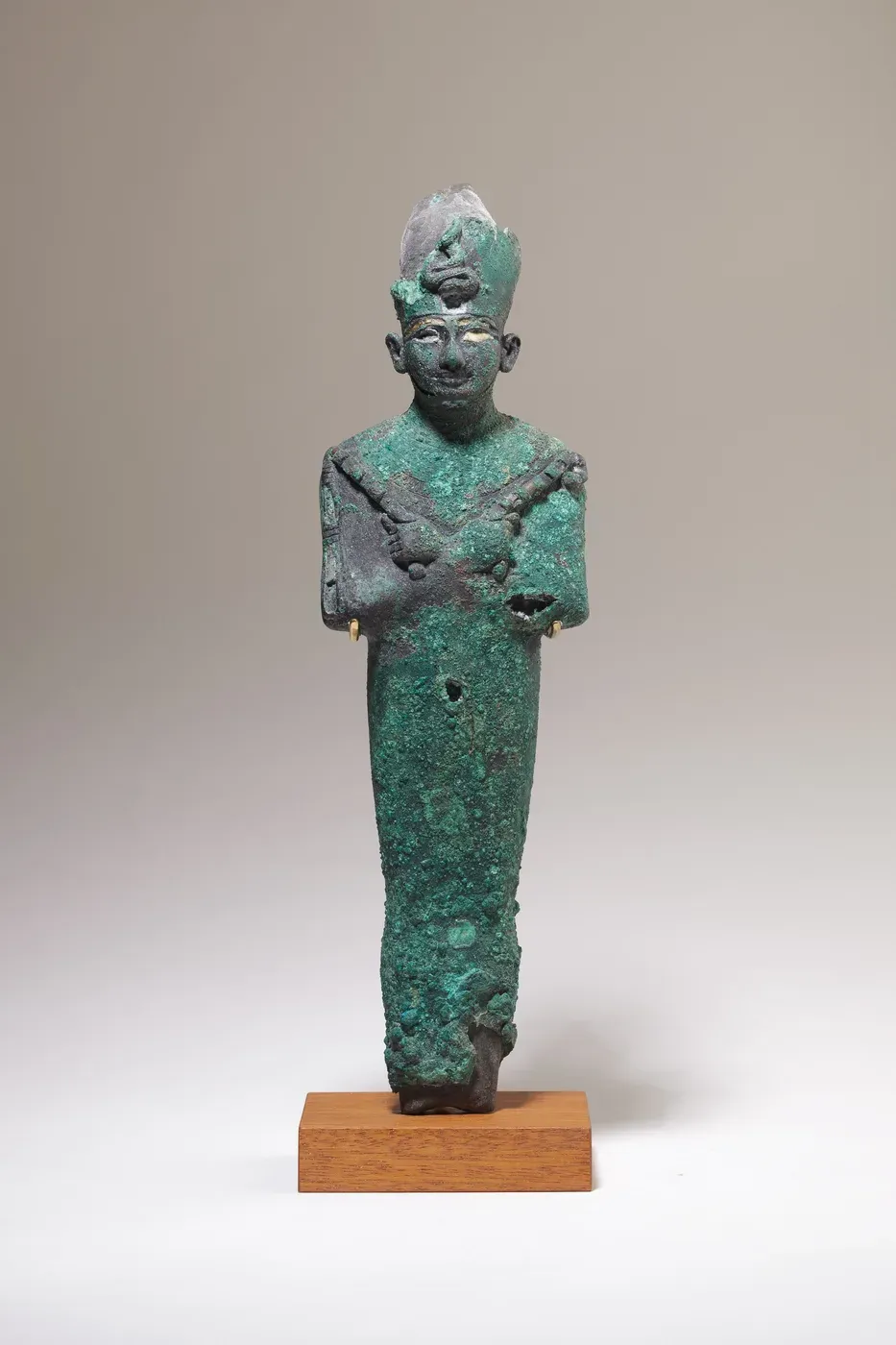
Plate II.3a. Osiris, about 1080 to 664 BCE, copper alloy. The wrapped body, the sceptres and the white crown are what identify him. The figure shows the god as he was after the story ended: bound like a mummy and still a king. It tells none of the story, and it was cast more than a thousand years after the earliest texts quoted in this chapter. The Met, 41.6.4. Gift of Elisha Dyer, in memory of George R. Dyer, 1941. Image: The Metropolitan Museum of Art, public domain. Object record and full image.
The Met’s record notes that these three features, the wrapped body, the sceptres and the white crown, appear on innumerable statuettes of the first millennium BCE.7 The image hardly changes. The texts are a different matter.
Struck down in Nedit
The oldest evidence is in the Pyramid Texts, cut into royal tombs from the twenty-fourth century BCE, as the first chapter described. They do not tell the story. They use it.
One utterance, numbered 532 by modern editors, has Isis and Nephthys arrive as two birds, one of them a kite. They find Osiris after his brother Set had felled him to the earth in a place called Nedit. They keep his body from decay.8
That is nearly all the murder we are given: one clause, in the past tense, inside a sentence about finding him. The spell does not say what weapon was used, or why.
Another utterance, 477, remembers a trial. The gods confront Set in the house of the prince at Heliopolis, because he struck Osiris to the ground. Set first denies it. Then he says that Osiris defied him, and that Osiris came too near to him. The spell turns those two excuses into the origins of divine names, and moves on to raise Osiris to his feet between Isis and Nephthys.9
So the earliest surviving source already knows a version in which the killer pleads his own case. Smith notes that in some sources Set justified the act as self-defence.10
A third pair of utterances, 366 and 367, has the two sisters heal Osiris. Isis comes to him, and Horus is conceived, the son who avenges his father. Then Horus is said to have collected his father’s limbs and put him together.11 Here the mending is the son’s work, not the wife’s. The Pyramid Texts do not settle who did what.
Two cautions belong here. The translation used is Samuel Mercer’s of 1952, which is in the public domain but has been superseded; it is a guide to what each spell contains, not to exact wording.8 And these are spells for a dead king. Where an editor prints Osiris N., the tomb had the king’s own name. The murder is mentioned because the king, like Osiris, has fallen and must be raised.
That may be why the death is so brief. A spell meant to raise a body has little reason to dwell on how it fell. This is an inference from what the texts were for, not something an Egyptian source says.
The place name lasted. About two thousand years after Unas, a healing stela that we shall meet below still appeals to the sun god to remember the cry which came from the bank of Netit, Budge’s spelling of Nedit.12
The search
Return to the hymn on the stela of Imenmes. What the Pyramid Texts give in a clause, the hymn gives at length, and it is all about Isis.
She protects her brother and drives his enemies away. She is skilled of tongue, and her spells do not fail. Then she goes seeking for him untiringly. She circles the earth as a bird, wailing, and does not alight until she finds him. She makes light with her feathers and air with her wings. She raises the helpless limbs of the god whose heart was at rest, takes his essence, and makes an heir.2
Look at the phrase for his condition. His heart is at rest; his limbs are helpless. In this translation the hymn describes a dead god without using the word.
Laments in the voices of the two sisters were copied on papyrus as well. The roll of Nesmin, where the last chapter began, opens with seventeen columns of songs of Isis and Nephthys before it reaches the spells against Apep.13
Notice what the search does not achieve. Osiris is not brought back to the throne. In UCL’s summary, Isis revives the body enough to conceive a child, and then the transfigured Osiris withdraws to the underworld to rule the dead.5 Smith puts the same point another way. A relationship that began before either of them was born continued after one of them had died.3
The dead king stays dead. What is rescued is the succession.
The child in the marshes
The hymn says that Isis suckled her child in solitude, and none knew where his place was.2 Other sources name the place: the marshes of Khemmis in the Delta.3
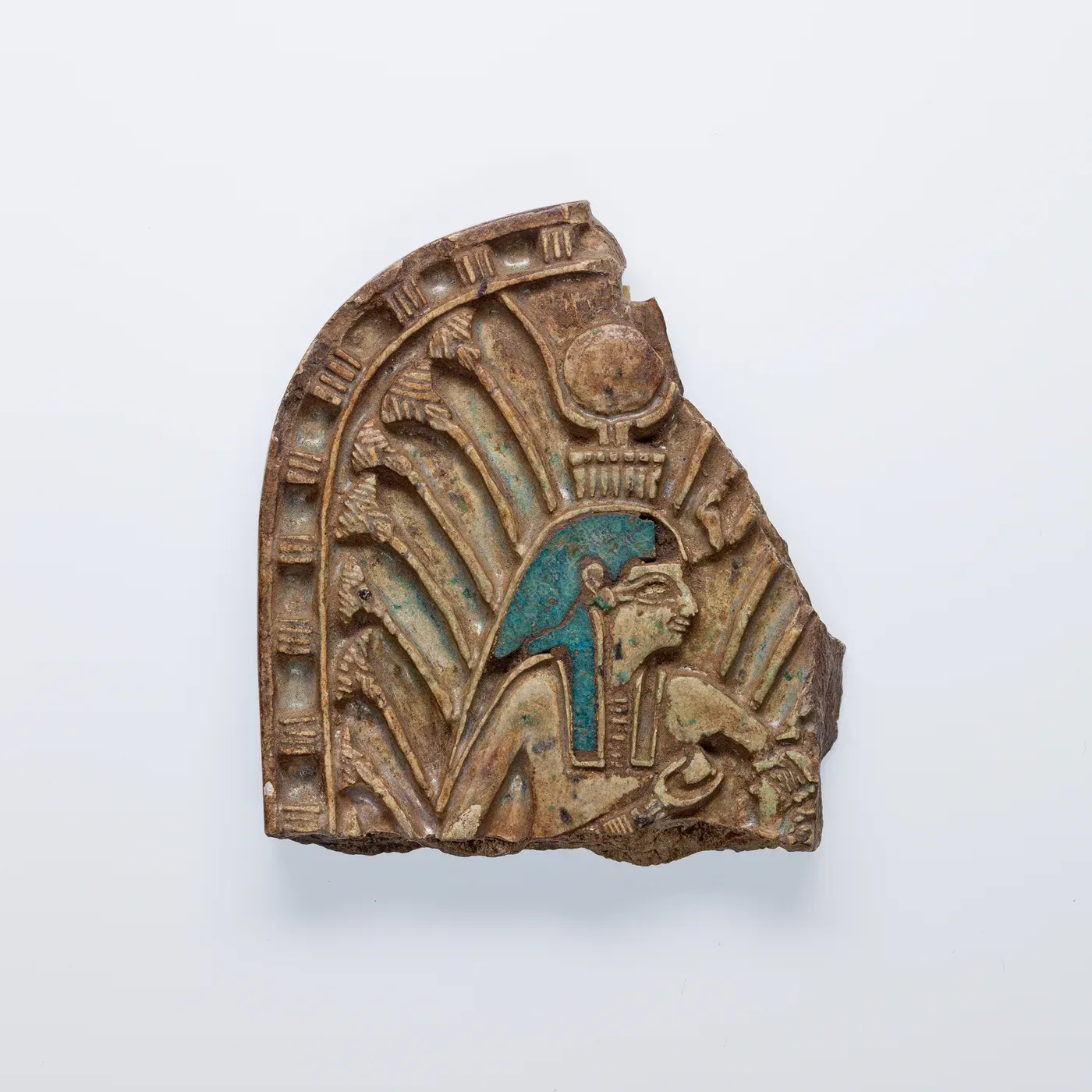
Plate II.3b. Isis nursing Horus in the marshes, about 1080 to 664 BCE, glazed steatite, five centimetres high. The papyrus stalks are the hiding place. The fragment comes from a small object, perhaps the top of a necklace counterweight or the lid of a box; the museum does not know which, and nothing is recorded of where it was found. The Met, 30.8.239. Theodore M. Davis Collection, Bequest of Theodore M. Davis, 1915. Image: The Metropolitan Museum of Art, public domain. Object record and full image.
The Met’s record explains the scene. Isis is hiding the baby from his uncle, who wants to kill him because he is the heir of Osiris. Images of this kind became newly prominent in the early first millennium BCE, when the myths of the Delta, especially those about goddesses and their sons, were being explored and elaborated.14
The marsh was not safe. The fullest account of what happened there is on another object, and it was written for a practical purpose.
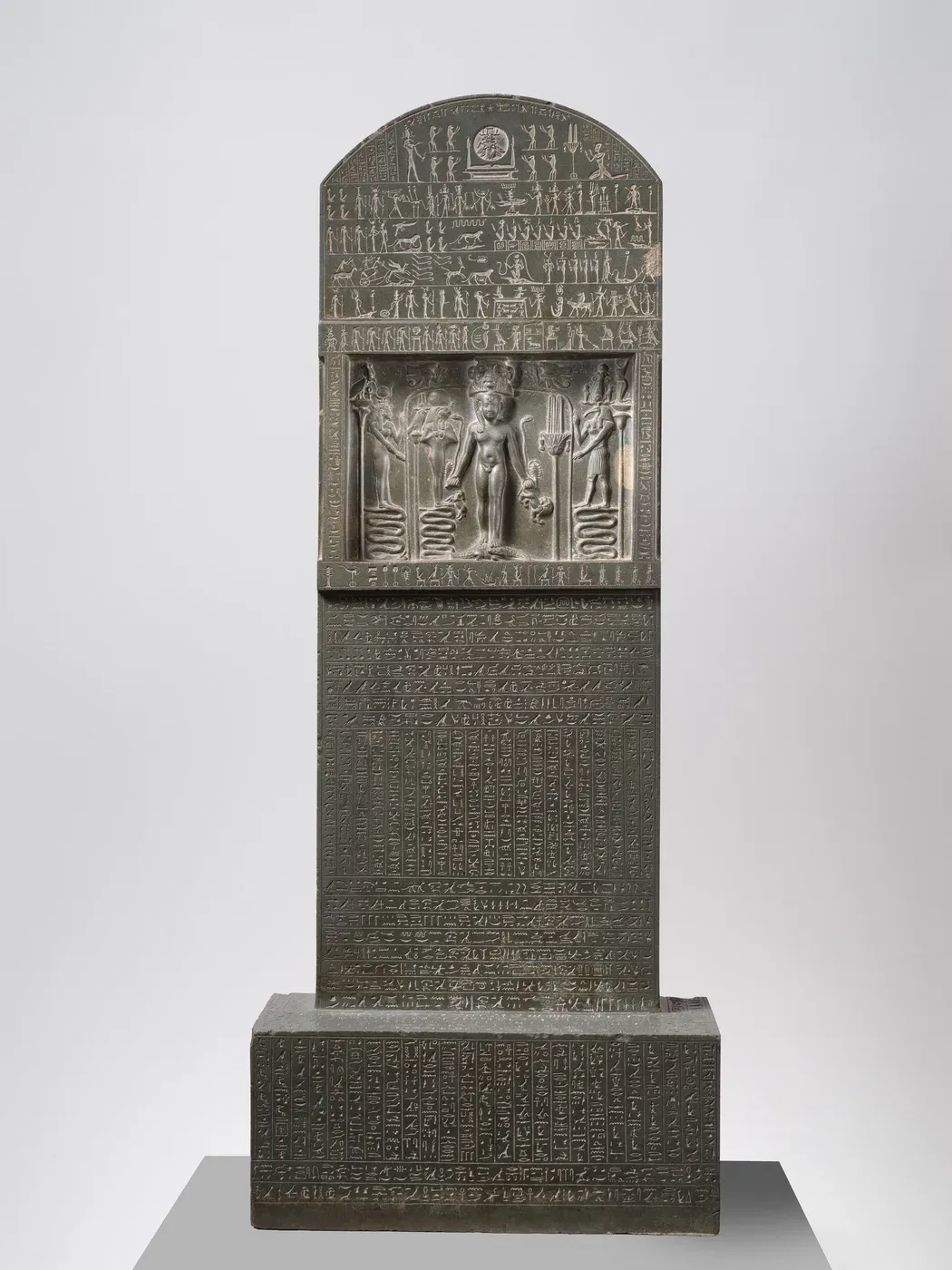
Plate II.3c. Magical stela with Horus the child, 360 to 343 BCE, in the reign of Nectanebo II. The child in the panel is Horus, standing on two crocodiles, with Isis at the left and ibis-headed Thoth at the right. The story of his poisoning is cut around the base. The stela was not made to record a myth: it was set up so that sufferers could be healed by its words. It was found at Alexandria and probably first stood at Heliopolis. The Met, 50.85. Fletcher Fund, 1950. Image: The Metropolitan Museum of Art, public domain. Object record and full image.
According to the Met, the stela was commissioned by a priest named Esatum and set up in the public part of a temple. Its lower half carries thirteen spells against venomous bites and wounds. A victim could recite them, or drink water that had been poured over the words and images.15
On the stela Isis speaks. While she and Horus were hiding in the marshes, she says, the child fell ill. In despair she cried out to the boat of the sun, and the sun disk stopped opposite her. Thoth came down from the boat and cured the child with a list of spells, each ending with the same phrase: and the protection of the afflicted as well.15
That closing phrase is the reason the story is there. The museum calls the cure of Horus a mythic precedent. What Thoth did for the child, the words can do for a patient.15
Budge published a translation of the stela in 1912, and his account differs from the museum’s on several points. He dated it to an earlier king and named a different owner. He says the child was stung by a scorpion that Set had sent, though he introduces this with it seems. He also records that the stone was dug up in Alexandria in 1828. This chapter follows the museum on the date and the owner.12
Once again the story survives because it was useful. The stela tells how Horus nearly died because people needed to be cured of scorpion stings.
A lawsuit among the gods
Horus grows up, and the quarrel goes to court. The longest Egyptian account of it is on a papyrus from Thebes, written under the Ramesside kings and now in the Chester Beatty collection in Dublin. Scholars call the composition The Contendings of Horus and Seth.5
Marcelo Campagno summarises its plot. Horus and Set appear before the Nine, the company of gods, presided over by the sun god. The court has to decide whether the kingship of the murdered Osiris belongs to his young son or to his brother, whose chief quality is his strength.16
The murder itself happens before the tale begins. Campagno notes that the first conflict, between Osiris and Set, is only implicit in the text.17 A New Kingdom storyteller, like the hymn and the Pyramid Texts before him, starts after the death.
The case will not end. The court leans towards Horus, and Set rejects each attempt to crown him. The hearings are broken up by contests of strength and by tricks, in which Isis fights hard for her son. A ferryman is beaten for carrying her to the Island in the Midst against the court’s direct order. After a contest of hippopotami, Horus turns on his own mother and cuts off her head, and the court fails even to punish him.1618
In the end Osiris himself intervenes. From the underworld he demands that his son succeed him. After an exchange of letters with the sun god, the Nine recognise Horus. Set is taken prisoner, and Horus is made king of Egypt.16 UCL adds that in some versions Set is given the deserts as his own domain.5
What kind of text is this? Scholars disagree. Campagno quotes one view that it fits every test for a myth, and another that it is not myth in literary form but a work of fiction. His own reading is that it is a literary version of the myth, with non-canonical material and plays on words added.17
He also makes a point about the court. The Nine cannot enforce a verdict. They negotiate, give way and reopen the case, as a village council does when neither party will compromise. Only in the last scene do they act like a state, with a prisoner and a sentence. The papyrus belonged to a family of scribes at Deir el-Medina, the workmen’s village at Thebes, and its composition has been linked to the accession of Ramesses V.18
One wound from this quarrel became one of Egypt’s most popular amulets. In Egyptian mythology, the Met’s record says, the eye of Horus was injured or stolen by Set and restored by Thoth. The healed eye is the wedjat, the one that is sound.19 The Pyramid Texts already have Horus give his eye to his father.11
Set is not the devil
It would be easy to read Set as simply evil. The Egyptian evidence does not allow it.
UCL describes him as the god of disruptive power. He had a temple of his own at Naqada in Upper Egypt. In one province he and Horus were worshipped side by side, as if, UCL suggests, Horus was needed there to balance and contain him.20
Kings claimed him. The oldest royal title shows the falcon of Horus perched on a palace front, with the king’s name inside. A ruler of the second dynasty, Peribsen, put the animal of Set there instead. Khasekhemwy, who reigned shortly after, put both.21
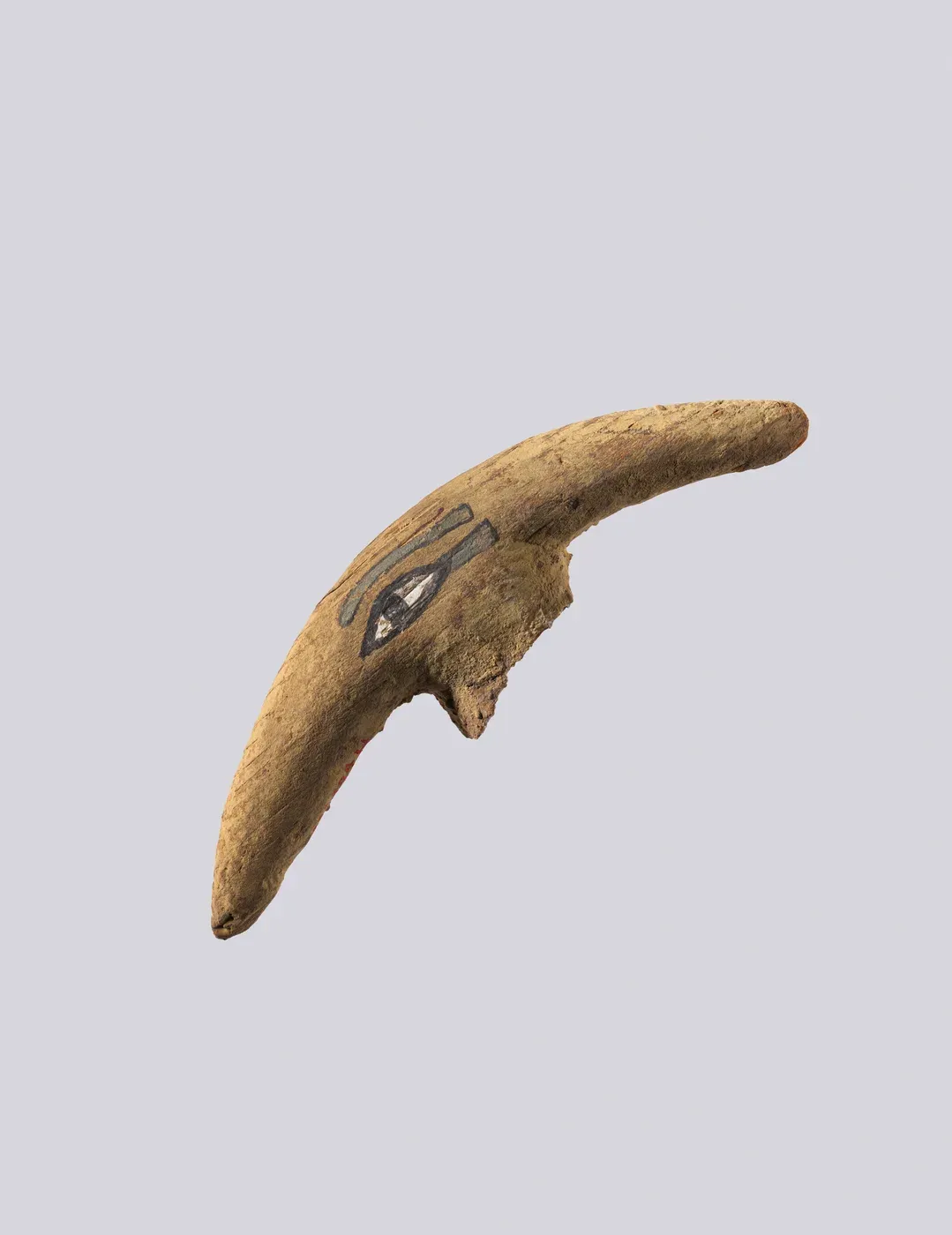
Plate II.3d. Head of a staff of the kind called a was, about 1859 to 1813 BCE, wood, from the tomb of Senwosretankh at Deir el-Bahri. The long curved muzzle is that of an animal, and it has often been linked to the animal of Set. The museum treats that link as one proposal among several. The object is not an image of the god and comes from a burial, not from one of his temples. The Met, 25.3.284h. Rogers Fund, 1925. Image: The Metropolitan Museum of Art, public domain. Object record and full image.
The staff in the plate shows how thoroughly he was woven into ordinary religion. The Met’s record sets out the debate. Some scholars link the was to the animal of Set and point to a gigantic example found in his temple at Ombos. Others think the god’s image derived from the staff. Yet others give it a different origin altogether. What is not in doubt is its meaning: the hieroglyph of this staff wrote the word dominion, and other gods are shown carrying it.22
There were even versions of the story in which the fault lay with Osiris. Smith records the claim of self-defence, and another tradition in which Set took revenge because Osiris had an affair with his wife, Nephthys. The child of that affair was Anubis, who is sometimes called the eldest son of Osiris.10
None of this makes the killing less of a crime in the texts quoted above. The Pyramid Texts meet Set’s excuses with a threat from the gods. But the murderer remains a god, with a temple, a province, a place in a king’s titles, and in some accounts a case of his own.
Plutarch tells it straight through
The fullest continuous account that survives was written by a Greek. Plutarch addressed his essay Isis and Osiris to a woman named Clea, well over a thousand years after the stela of Imenmes was carved.23
His version begins with the birth. The Sun curses the mother of the gods, whom Plutarch calls Rhea, so that she cannot give birth in any month or year. Hermes, the Greek name for Thoth, plays draughts with the Moon and wins enough light to make five extra days. Osiris is born on the first, and a voice announces the Lord of All.23
Then the plot. Typhon gathers seventy-two conspirators. He secretly measures his brother and has a beautiful chest made to fit. At a feast he promises it to whoever lies in it exactly. Osiris lies down. The conspirators slam the lid, seal it with lead and send it down the river to the sea. Plutarch gives the date as the seventeenth of the month Athyr, in the twenty-eighth year of the reign of Osiris, or, some said, of his life.23
The chest drifts across the sea to Byblos, where a heather bush grows around it into a tree. The local king cuts the tree for a pillar. Isis traces it, becomes nurse to the queen’s child, reveals herself and takes the chest home. Typhon, hunting by moonlight, finds it. He cuts the body into fourteen pieces and scatters them. Isis sails the marshes in a papyrus boat and recovers all but one. The male member has been eaten by three kinds of fish. She makes a replacement.23
Osiris then returns from the other world to train Horus for battle. Horus wins. Isis lets the bound Typhon go, and Horus in fury tears the crown from her head. Typhon challenges the legitimacy of Horus before the gods and loses.23
Some of this matches the Egyptian sources closely. Smith cites Egyptian evidence that Osiris died at twenty-eight, that he and Isis were lovers in the womb, and that he fathered Anubis on Nephthys. All three details are in Plutarch.310 The quarrel between Horus and his mother recalls the beheading in the Chester Beatty papyrus.18
Other parts have no counterpart in the Egyptian sources used in this chapter. None of them mentions Byblos, the chest or the seventy-two.
Greek writers did not agree with each other either. Diodorus of Sicily, writing earlier than Plutarch, says Typhon cut the body into twenty-six pieces and gave one to each accomplice. A note in the Loeb edition records a manuscript that reads sixteen. In Diodorus, Isis moulds a figure of wax and spices around each piece and tells each group of priests, under oath, that they alone have the real burial. That, he says, is why every district believes Osiris lies in its own soil.24
The rival tombs were real. At Abydos, by the Middle Kingdom, one of the royal tombs of the first dynasty was regarded as the burial place of Osiris, and a procession went out to it from the temple each year.25 Diodorus reports that the strongest oath in southern Egypt was sworn by Osiris who lieth in Philae, far up the river.24 One of the fish was honoured too: the Met holds a finely detailed metal figure of the lepidotus, a fish sacred to the Egyptians and linked to the story of the dismemberment.26
Plutarch himself warned Clea how to take his narrative. She must not think, he writes, that any of these tales actually happened in the way they are told.23 The continuous story that many modern retellings follow is his, and it was written by an outsider with his own purpose.
What the story was for
Why did this story matter more than any other? Smith’s answer starts from how the Egyptians thought about a person.
A person, on this account, had a bodily self and a social self. Both depended on being connected: limbs to a body, an individual to a community. Death broke both connections at once. It was a kind of dismemberment, of the body and of the person’s place among others.27
Osiris was the model for reversing both. Mummification restored his body. The verdict against Set restored his standing among the gods. Smith, following Jan Assmann, calls the second moral mummification, and adds that the first could equally be called bodily justification. His death was an injustice; to obtain justice was to regain life.27
This is why the dead were given his name. Funerary texts speak of the Osiris of a person. Smith argues that this did not mean the dead person became the god. It meant joining his following, as one of his worshippers in the underworld. Women acquired an Osiris as readily as men.27
The story also explained the king. With the kingship of Horus, UCL writes, creation reached its present stage: a Horus king on earth, the sun ruling the sky, and Osiris ruling the dead below.5 The oldest royal title, as we saw, names the king as Horus.21
And it was tied to growth. Late in Egyptian history, figures of Osiris were made and filled with grain. The Met’s record notes that the grain could sprout, and so the figures symbolised new life.28
Look again at the stela of Imenmes. A herdsman’s family kneels under a hymn about another family. The hymn passes over the killing in silence and spends its words on the search, the child and the verdict. That is the balance of the Egyptian sources as a whole. The crime is rarely described, but nearly every source is concerned with what was done to repair it.
The hymn ends when the gods give the sovereignty to the one whose it is by right.2 The next chapter asks what the Egyptians meant by right. Their word for it was Ma’at.
Footnotes
-
Musée du Louvre, “Hymn of Imenmes, chief of Amun’s flocks”, inventory C 286, in the exhibition The Gates of Heaven (2009). The notice gives the date, material, height of 1.06 m, the family scene, the twenty-eight lines, and the remark that few pharaonic sources recount the whole legend. Older books spell the owner’s name Amenmose or Amenmes; the museum’s spelling is used here. ↩ ↩2
-
E. A. Wallis Budge, Legends of the Gods: The Egyptian Texts (London, 1912), “A Hymn to Osiris and a Legend of the Origin of Horus”, with his introduction, “Legend of the Birth of Horus”. A public-domain translation, quoted only in short phrases and otherwise paraphrased. In it the opponent appears as “the Seba Fiend”, “thy enemy” and “thy Adversary”; the name Set occurs only in Budge’s own notes. Budge located the stela in the Bibliothèque Nationale in Paris; the Louvre now lists it as C 286. His wording is more than a century old and should not be taken as the exact sense of the Egyptian. ↩ ↩2 ↩3 ↩4 ↩5
-
Mark Smith, “Osiris and the Deceased”, UCLA Encyclopedia of Egyptology (2008), 1 to 2. For the outline of the god’s life, the statement that it is a composite, the variant traditions of his birth, the age of twenty-eight (citing Quack 2004), the relationship with Isis before birth, the marshes of Khemmis, and the observation that Osiris is one of the few gods with a biography. ↩ ↩2 ↩3 ↩4 ↩5 ↩6 ↩7
-
The book’s chapter list for this tradition uses “Set”. UCL, Smith and Campagno use “Seth”. For Typhon, see Plutarch and Diodorus, cited below. ↩
-
UCL, Gods and goddesses in Ancient Egypt: creation, Digital Egypt for Universities, section “The children of Geb and Nut”. For the five extra days won from Thoth, Isis reviving the body enough to conceive, the withdrawal of Osiris to the underworld, the Ramesside papyrus from Thebes now in the Chester Beatty collection, the deserts given to Seth in some versions, and the Horus king on earth. The same paragraph names Tefnet as the mother of the four children; the section’s own heading, and Smith, give Nut. ↩ ↩2 ↩3 ↩4 ↩5
-
The Metropolitan Museum of Art, Osiris, 41.6.4. The record dates the figure by the style of its face and gives no findspot beyond Egypt. ↩
-
Samuel A. B. Mercer, The Pyramid Texts in Translation and Commentary (New York, 1952), Utterance 532, sections 1255 to 1258. Mercer writes the place name Ndi.t. The Internet Sacred Text Archive reports that the copyright was not renewed. The standard translations are now those of R. O. Faulkner (1969) and James P. Allen (2005); Mercer is quoted here in one short phrase and otherwise paraphrased. ↩ ↩2
-
Mercer, The Pyramid Texts, Utterance 477, sections 956 to 961. Paraphrased. ↩
-
Smith, “Osiris and the Deceased”, 2, citing Mathieu (1998) on an episode of the trial of Seth at Heliopolis, and Spiegelberg (1902) and Von Lieven (2006) on the affair with Nephthys. The title of Von Lieven’s article translates as “Seth is in the right, Osiris is in the wrong!” ↩ ↩2 ↩3
-
Mercer, The Pyramid Texts, Utterances 366 and 367, sections 626 to 635. For the sisters healing Osiris, the conception of Horus “who avenges his father”, Horus giving his eye, and Horus collecting the limbs. ↩ ↩2
-
Budge, Legends of the Gods, introduction, section on the Metternich Stele. He assigns it to Nectanebus I, names its owner as Ankh-Psemthek, and reports its discovery in 1828 during the building of a cistern in a Franciscan monastery at Alexandria. He glosses Netit as a place near Abydos where Isis found the body. The museum’s record, followed here, gives the reign of Nectanebo II and the priest Esatum. ↩ ↩2
-
The British Museum, The Bremner-Rhind Papyrus, EA10188,13. The record lists the Songs of Isis and Nephthys in columns 1 to 17. ↩
-
The Metropolitan Museum of Art, Isis nursing Horus in the marshes, 30.8.239. The record gives the height as 5 cm, describes the scene and its place in the Delta mythologies of the Third Intermediate Period, and offers the two possibilities for the original object. Its geography field says only “From Egypt”. ↩
-
The Metropolitan Museum of Art, Magical Stela with Horus the Child, 50.85. For the reign and date, the priest Esatum, the thirteen spells, the use of water, the speech of Isis, the cure by Thoth, the phrase “mythic precedent”, and the geography: from Alexandria, probably originally from the temple of the Mnevis bulls at Heliopolis. The two phrases quoted are the museum’s translation. The stela is often called the Metternich Stela. ↩ ↩2 ↩3
-
Marcelo Campagno, “Two observations on the tales of The Contendings of Horus and Seth and Truth and Falsehood”, Trabajos de Egiptología 4 (2005): 19 to 30, at 20. The papyrus is Chester Beatty I. The Chester Beatty Library’s online record sits behind an automated visitor check and was not consulted. ↩ ↩2 ↩3
-
Campagno, “Two observations”, 21 to 23 and note 13, quoting Oden (1979) and Junge (1994), and drawing on Assmann and Loprieno for the idea of a literary realisation of a myth. ↩ ↩2
-
Campagno, “Two observations”, 21 and 24 to 25, with notes 5 to 7. For the beheading of Isis after the contest of the hippopotami, the ferryman Anty, the court’s inability to impose a verdict, the comparison with village justice, the archive of a family of scribes at Deir el-Medina, and the dating to the accession of Ramesses V, which he attributes to Verhoeven (1996). ↩ ↩2 ↩3
-
The Metropolitan Museum of Art, Wedjat Eye Amulet, 23.2.68. ↩
-
UCL, Gods and goddesses in Ancient Egypt, entries for Seth and Horus. The province where the two were balanced is Shashotep, the eleventh of Upper Egypt. ↩
-
UCL, The Horus name, Digital Egypt for Universities. ↩ ↩2
-
The Metropolitan Museum of Art, Head of a was scepter, 25.3.284h. The record gives the findspot as the tomb of Senwosretankh (MMA 211) in the Priests’ Cemetery at Deir el-Bahri, excavated by the museum in 1921 to 1922, and summarises the competing explanations of the staff. Ombos is the Greek name of the town beside Naqada. ↩
-
Plutarch, Isis and Osiris, translated by Frank Cole Babbitt, in Moralia, volume V, Loeb Classical Library (1936), sections 11 to 19. The LacusCurtius transcription states that the text is in the public domain. Quoted in two short phrases and otherwise paraphrased. Section 18 names the fish as the lepidotus, the sea-bream and the pike. ↩ ↩2 ↩3 ↩4 ↩5 ↩6
-
Diodorus Siculus, Library of History, book 1, chapters 21 and 22, translated by C. H. Oldfather, Loeb Classical Library (1933), with the editor’s note on the manuscript reading “sixteen”. ↩ ↩2
-
UCL, Abydos, Digital Egypt for Universities. The page also records that the earlier god of Abydos, Khentyamentiu, had been identified with Osiris by the First Intermediate Period. ↩
-
The Metropolitan Museum of Art, Lepidotus fish, 10.130.1347. ↩
-
Smith, “Osiris and the Deceased”, 2 to 4, drawing on Jan Assmann, Tod und Jenseits im alten Ägypten (2001), and on Smith’s own “Osiris NN or Osiris of NN?” (2006). Smith notes that many books say the dead became Osiris, and argues against it. ↩ ↩2 ↩3
-
The Metropolitan Museum of Art, Mask and Foot Cover of “Corn Mummy”, 44.6.1, dated 400 to 250 BCE. ↩
Sources
- Read the scholarship: Mark Smith, Osiris and the Deceased, UCLA Encyclopedia of Egyptology
- Examine the stela: Magical Stela with Horus the Child, 50.85, The Metropolitan Museum of Art
- Read the scholarship: Marcelo Campagno, Two observations on the tales of The Contendings of Horus and Seth and Truth and Falsehood, Trabajos de Egiptología 4 (2005)
- Read the Greek account: Plutarch, Isis and Osiris, Loeb Classical Library (1936), LacusCurtius
- Read an early translation: E. A. Wallis Budge, Legends of the Gods (1912), Project Gutenberg