Numina · Egyptian · II.1 Pyramid, coffin, papyrus
Chapter II.1
Pyramid, coffin, papyrus
Words cut into a king's tomb, painted around a body, and rolled inside a wooden god. Before reading Egypt's myths, we need to know what its books were made to do.
Inside a hollow wooden figure of Osiris lay a roll of papyrus. It belonged to Nauny, a singer in the service of Amun-Re, buried at Thebes around 1050 BCE. Unrolled, it stretches more than five metres. Among its painted scenes, Nauny stands beside a balance on which her heart is weighed.1
The roll was made for someone with a name.
That is easy to forget when we open a modern book of Egyptian mythology. We meet a cast of gods and expect their stories to explain a whole civilisation. But many of the texts that preserve those gods had a more immediate task. They were meant to help a particular dead person survive. They addressed a body, called upon a god, or supplied words for a dangerous encounter. Their first concern was not to make the mythology easy for us to follow.
So we begin with the objects that carry the writing. A wall, a coffin and a roll ask us to read in different ways. They also remind us how much a printed translation leaves out.
Three names, overlapping collections
The Pyramid Texts, Coffin Texts and Book of the Dead are names for collections. No ancient writer sat down and composed all three. Nor did Egypt move neatly from one to the next, throwing away the old texts as soon as new ones appeared.23
Here is a starting map. These dates describe important surviving evidence, not a precise birthday for every belief.
Pyramid Texts. Royal pyramids at Saqqara, beginning with Unas in the late Fifth Dynasty, in the twenty-fourth century BCE. Some compositions continued in later tombs and on other surfaces.
Coffin Texts. Especially Middle Kingdom coffins and burial chambers, in the early second millennium BCE. The collection includes inherited material as well as other compositions.
Book of the Dead. Early evidence in the seventeenth dynasty, followed by numerous papyrus copies from the New Kingdom onward. Its spells also appear on linen, walls and funerary objects.
These dates follow UCL’s introductions to the collections. The boundaries are useful for study, but they are not sealed divisions in Egyptian religious life.234
Words inside a pyramid
The earliest surviving extensive collection called the Pyramid Texts is inside the pyramid of Unas at Saqqara. He was the last king of the Fifth Dynasty. Later kings and some queens also had texts inscribed in their pyramids. This is a particular group of monuments, not a description of every Egyptian pyramid.52
An inscription in a burial chamber has a different audience from a story read aloud for pleasure. The words address the dead and the powers on whom the dead depend. Their placement makes the chamber part of their meaning. Taking them off the walls and putting them in a continuous printed sequence is already an act of interpretation.
A fragment from Pepy’s pyramid in the Petrie Museum gives a small example. The king’s name appears four times. The surviving formulae concern his ascent to heaven and his supply of food and drink. These needs belong together: reaching a divine destination does not remove the need to be sustained there.6
Such passages make a practical demand upon the gods. The person for whom they work must be recognised, admitted and fed. A reader looking only for an account of how the universe began will miss much of what these texts are doing.
The date of Unas’s inscription also needs care. It tells us when this surviving writing was made. It cannot, on its own, tell us when every formula was first spoken. The first surviving copy and the first use of a text are different things.
A coffin that looks out
Move forward to the Middle Kingdom. Texts now surround many non-royal owners on the inner surfaces of their coffins. Egyptologists group a large body of this material under the name Coffin Texts. Some passages draw upon the Pyramid Texts. Others broaden the surviving record. Later funerary compositions will draw on this material in turn.3
The body lies within the writing. Reading a translation removes that physical relationship. It gives us sentences in an order, but not the experience of a wooden enclosure whose surfaces have been prepared for one dead person.
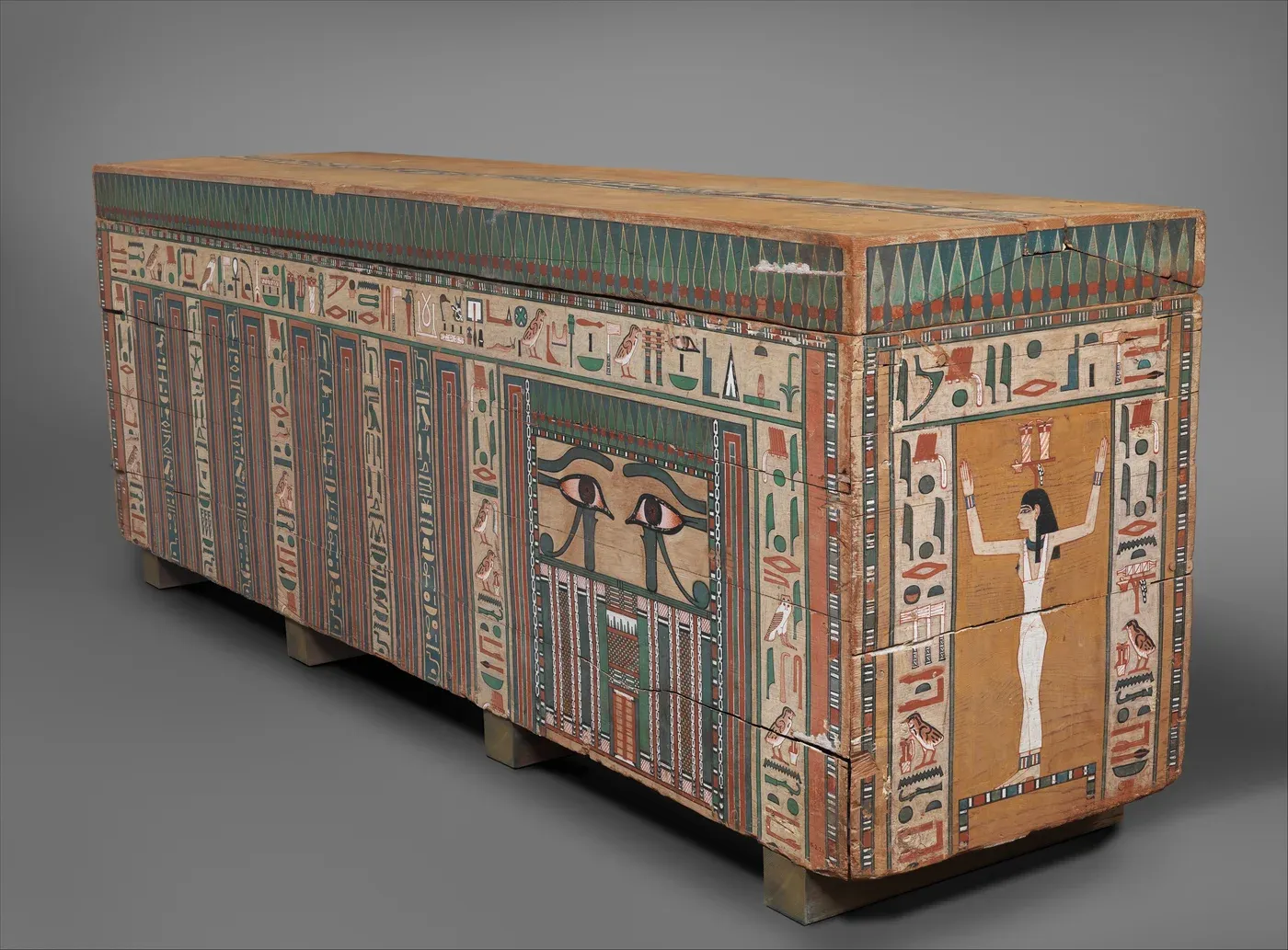
Plate II.1a. The coffin of Khnumnakht, about 1850 to 1750 BCE, probably from Meir. This view shows the painted exterior, not a transcription of the Coffin Texts. The Met, 15.2.2a, b. Rogers Fund, 1915. Image: The Metropolitan Museum of Art, public domain. Object record and full image.
Look at the eyes on Khnumnakht’s coffin. They sit above a painted doorway. The museum explains that this panel faced east, towards sunrise, with the mummy’s face behind it. The exterior inscriptions call upon deities including Osiris and Anubis. Decoration, writing and the position of the body work together.7
Some coffins from Deir el-Bersha also preserve material known as the Book of Two Ways. Parts of that composition later appear in Book of the Dead spell 136. We can follow particular passages across collections, rather than merely saying that a later book resembles an earlier one.8
Who could hope to live again?
There is a familiar account of this change. First, it says, only the king could enjoy a full afterlife. Then royal power weakened and other people gained the same hope. This has often been called the democratization of the afterlife.
The evidence does not support that simple progression. Mark Smith’s study points to Old Kingdom evidence for non-royal people receiving ritual recitations and expecting to become effective spirits among the gods. In the tomb of Kagemni, for example, a priest is shown reading from a roll for the dead man’s benefit.9
The appearance of more writing on coffins cannot prove that the people inside them had previously been excluded from life after death. It may tell us about changes in how ritual was recorded and displayed.
Nor does non-royal mean available to everyone. An inscribed coffin required resources. The people most visible in this evidence are not a fair sample of everyone who lived beside the Nile.9
We need to leave room for people whose hopes have not survived in costly objects. A missing inscription is not a record of what its owner did not believe.
A book made from a plant
Papyrus introduces another kind of surface. Its sheets were made from the pale inner tissue of the papyrus stalk, arranged in two layers at right angles. Sheets could be joined into a roll. The crossing fibres are still part of what we see when we look closely at a manuscript.10
The general structure is clear, but the complete ancient manufacturing process was not documented for us. Modern experiments and examination of surviving sheets help fill that gap. We should not mistake a modern demonstration for a witnessed ancient procedure.
Scribes wrote with black and red ink, while illustrations could use a wider range of colours. The material could hold an image and a passage beside one another, then roll up into a small space. Age, burial conditions and later conservation have all affected the appearance of the sheets we now read.10
Book of the Dead is the conventional modern name for a body of funerary formulae associated with going out by day. A surviving manuscript usually contains a selection. It is not an incomplete copy simply because it lacks spells found in another person’s roll.11
Early manuscripts vary greatly. A more regular sequence became established in the Late Period. The familiar chapter numbers belong to modern scholarship, not to a numbering system shared by all ancient scribes. They help us compare manuscripts, but they should not make us imagine one fixed book behind every copy.12
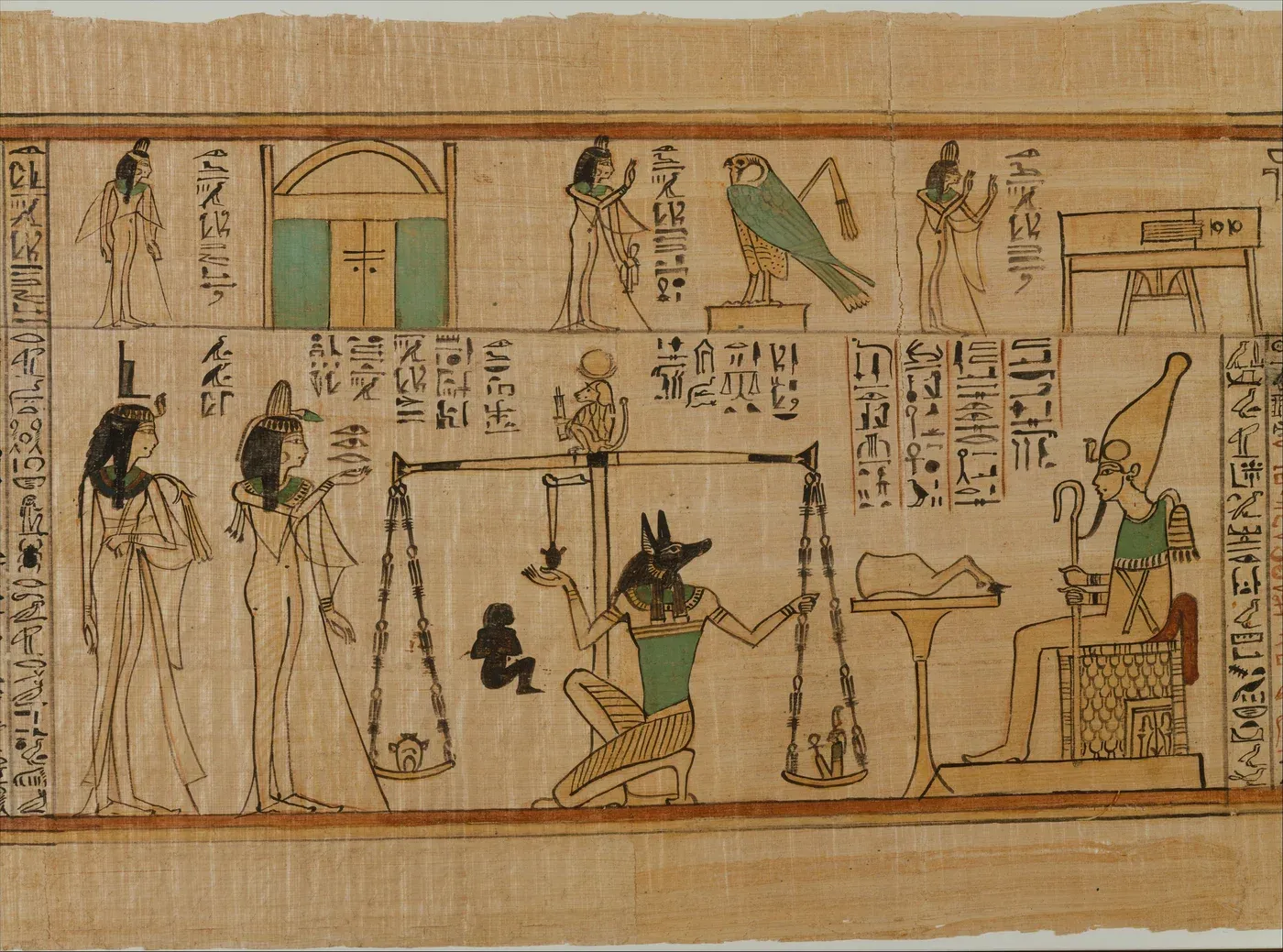
Plate II.1b. A detail of Nauny’s papyrus, about 1050 BCE, showing the judgment scene associated with spell 125. The complete roll was found inside an Osiris figure in her burial at Deir el-Bahri. The Met, 30.3.31. Rogers Fund, 1930. Image: The Metropolitan Museum of Art, public domain. Object record and full image.
Nauny’s heart is balanced against a small figure of Ma’at. Osiris presides; Anubis attends the scales. The image presents a favourable judgment. It belongs to the work of securing her future, rather than reporting an event that an artist watched.1
We cannot simply assume that each owner chose every spell personally. UCL’s discussion notes the absence of explicit accounts of commissioning these manuscripts. The finished roll survives more readily than the conversation that arranged it.11
What a spell asks someone to do
The word spell can make these texts sound like mysterious words with no practical setting. Consider a particular case instead.
Book of the Dead spell 100, in UCL’s translation from the papyrus of Nu, links the deceased with the company of the sun god. Its instructions specify an image on fresh papyrus, a preparation involving green pigment, and placement at the dead person’s breast. Speech, an image, a material and a location belong to the same operation.13
In an edition, the person’s name may be replaced by N. The ancient manuscript could name the individual in full. That small editorial shortcut lets us compare versions, but it also makes the text feel less personal than the object was.13
Another formula, spell 105, concerns the nourishment of the person’s ka. UCL’s version includes an address to the ka and references to purification with natron and incense. A religious term can remain unfamiliar while the concern is plain: the dead person must continue to receive what sustains them.14
These are useful questions to bring to any passage: who speaks, whose name appears, what has to be done, and what outcome is sought? They often explain more than a list of gods alone.
A text that keeps more than one answer
Egyptian religious writing sometimes includes its own interpretation. Book of the Dead spell 17 offers an unusually clear example. Its earlier form is known as Coffin Text 335. Statements identifying the deceased with divine beings are followed by explanations, and some passages preserve alternative explanations.15
One passage connects yesterday with Osiris and tomorrow with Ra. Elsewhere, a divine identification can receive more than one reading. The text does not always discard one answer so that another can stand alone.
Here is a composition in which more than one interpretation was worth preserving. Calling that carelessness would miss what the scribes kept.
There is another caution. The UCL text is a modern presentation based on Naville’s edition of several sources. It does not reproduce one perfect ancient roll containing everything we see on the webpage. When we read an edition, we need to know whether we are reading one manuscript or material assembled from several.15
The old words stay in use
A burial chamber makes the overlap between collections visible. Sobekmose served as a treasury official under Amenhotep III. His chamber at el-Rizeiqat dates to the fourteenth century BCE. Its inscriptions include selections from the Book of the Dead alongside a composition classified as Pyramid Text utterance 32.16
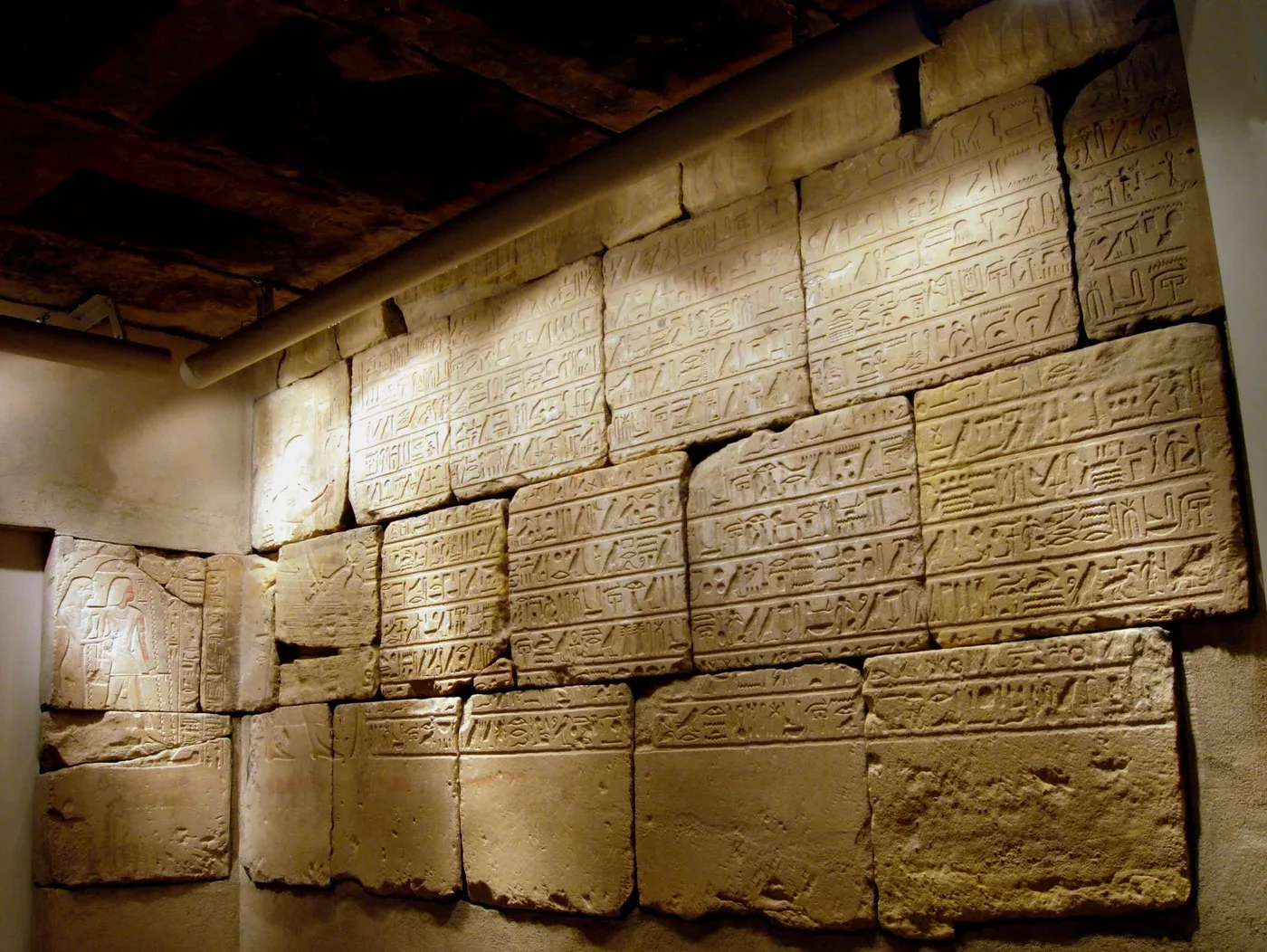
Plate II.1c. Parts of Sobekmose’s burial chamber installed at The Met, about 1386 to 1347 BCE. This is a New Kingdom official’s chamber, not the pyramid of Unas. Other walls are in the Museum of Fine Arts, Boston. The Met, 08.201.4. Rogers Fund, 1908. Image: The Metropolitan Museum of Art, public domain. Object record and full image.
The old classification remains useful to us, but it did not prevent an Egyptian owner from using old and newer material in the same burial. Neither did the name Book of the Dead confine its contents to papyrus. Here, funerary words were cut into stone.16
Our three materials therefore give us a route through the evidence, not a law that the evidence must obey.
Reading what survives
There are further steps between a burial and a book on our shelf. Fragments may have to be brought back into sequence. A damaged sign must be distinguished from a sign a scribe actually wrote. An object without a secure findspot cannot tell us as much about its original setting as one recorded carefully during excavation.
The papyrus of Hepres in the Petrie Museum shows this work in practice. Its fragments, of uncertain provenance, were the subject of a conservation project in 2000 to 2002 that sought to recover their arrangement. The manuscript belongs to the eighteenth dynasty, around 1400 BCE. Its ancient date and its modern reconstruction are two parts of its history.17
Even an ancient statement about a text’s age needs examination. The Shabaka Stone claims to preserve damaged older writing. The British Museum’s record treats that account cautiously. What the inscription says about its source is evidence to assess, not a date we can accept without question. Its Memphite creation account gives Ptah a central role in bringing things into existence through speech.18
That distinction will matter in the next chapter, when we meet Egypt’s accounts of creation. We will need to ask which text preserves each account and what that text was for. A statement in a funerary spell and a statement honouring a city’s god do not necessarily answer the same question.
For now, look again at the eyes painted on Khnumnakht’s coffin. They face outwards. The box closes around a body, but someone has taken care to paint a way of looking beyond it.
Footnotes
-
The Metropolitan Museum of Art, Nauny’s papyrus, 30.3.31. Object record and commentary. ↩ ↩2
-
UCL, Pyramid Texts, Digital Egypt for Universities. For the corpus, its royal settings, and the continued use of its compositions in later periods. ↩ ↩2 ↩3
-
UCL, Coffin Texts, Digital Egypt for Universities. On the collection’s main settings and its relationship to earlier and later funerary compositions. ↩ ↩2 ↩3
-
UCL, Book of the Dead, Digital Egypt for Universities. On early witnesses and the range of surfaces carrying these compositions. ↩
-
UCL, Unas, Digital Egypt for Universities. Identifies the king as the last ruler of the Fifth Dynasty and his pyramid as the first with Pyramid Texts. Absolute dates vary between chronologies; the chapter uses a broad century rather than an exact reign. ↩
-
UCL, A pyramid text, Petrie Museum. The fragment includes parts of Pyramid Texts 627B, 302 and 655. It is a different object from the later burial chamber illustrated here. ↩
-
The Metropolitan Museum of Art, Coffin of Khnumnakht, 15.2.2a, b. The record explains the eye panel, doorway, orientation and exterior inscriptions. The museum does not supply a biography beyond the owner’s name; none is invented here. ↩
-
UCL, Book of the Dead, chapter 136. Gives specific correspondences with Coffin Texts and discusses the earlier Book of Two Ways from coffins at Bersha. ↩
-
Mark Smith, Democratization of the Afterlife, UCLA Encyclopedia of Egyptology (2009). See the Old Kingdom evidence and Kagemni example. ↩ ↩2
-
Rebecca Capua, Papyrus-Making in Egypt, The Metropolitan Museum of Art (2015). On the structure of sheets, ink, joining rolls, uncertainty about parts of manufacture, and changes caused by age and conservation. ↩ ↩2
-
UCL, Background information on the Book of the Dead. On selections, variation, and the limits of our evidence for commissioning manuscripts. ↩ ↩2
-
UCL, The Book of the Dead: chapters in modern numerical order. Explains the modern reference numbers and their relation to the more regular later arrangements. ↩
-
UCL, Book of the Dead, chapter 100. Translation and transliteration from the papyrus of Nu, British Museum EA 10477. The instructions are paraphrased, not quoted as a new translation from Egyptian. ↩ ↩2
-
UCL, Book of the Dead, chapter 105. Translation from the papyrus of Nu and discussion of the formula’s purpose. ↩
-
UCL, Book of the Dead, chapter 17, introduction and sections 2 and 3. Paraphrased here, not presented as a new translation. ↩ ↩2
-
The Metropolitan Museum of Art, Burial chamber of Sobekmose, 08.201.4. The record identifies Book of the Dead selections and Pyramid Text utterance 32 in the chamber’s inscriptions, and notes that the surviving walls are divided between New York and Boston. ↩ ↩2
-
UCL, An early manuscript: the Book of the Dead of Hepres. On the eighteenth-dynasty fragments, uncertain provenance, and the project to recover their sequence. ↩
-
The British Museum, The Shabaka Stone, EA498. The record distinguishes the inscription’s account of an older source from modern assessments of the text’s date. For Ptah’s creative thought and speech, see also the museum’s Shabaka Stone transcript. ↩
Sources
- Explore the sources: Pyramid Texts, Digital Egypt for Universities, UCL
- Read an ancient composition: Book of the Dead, chapter 17, UCL
- Read the scholarship: Mark Smith, Democratization of the Afterlife, UCLA Encyclopedia of Egyptology
- Examine a manuscript: Nauny's Book of the Dead, The Metropolitan Museum of Art