Numina · Egyptian · II.4 Ma'at
Chapter II.4
Ma'at
A king holds a small goddess on his palm and offers her to the gods. She is what is right: less a state the world was in than a thing that a ruler, an official and a dead person each had to do.
In 1913 a flake of limestone came out of the Valley of the Kings. It is about fifteen centimetres across, and someone has drawn on it in ink. A king in a tall crown stretches out one hand. On his open palm sits a very small figure with a feather on her head.1
The Met dates the drawing to the reign of Ramesses IX, about 1137 to 1118 BCE, and attributes it to a chief draftsman named Amenhotep. The museum’s title says what the king is doing: he is offering Maat. On the other side of the flake the same king offers a pot.1
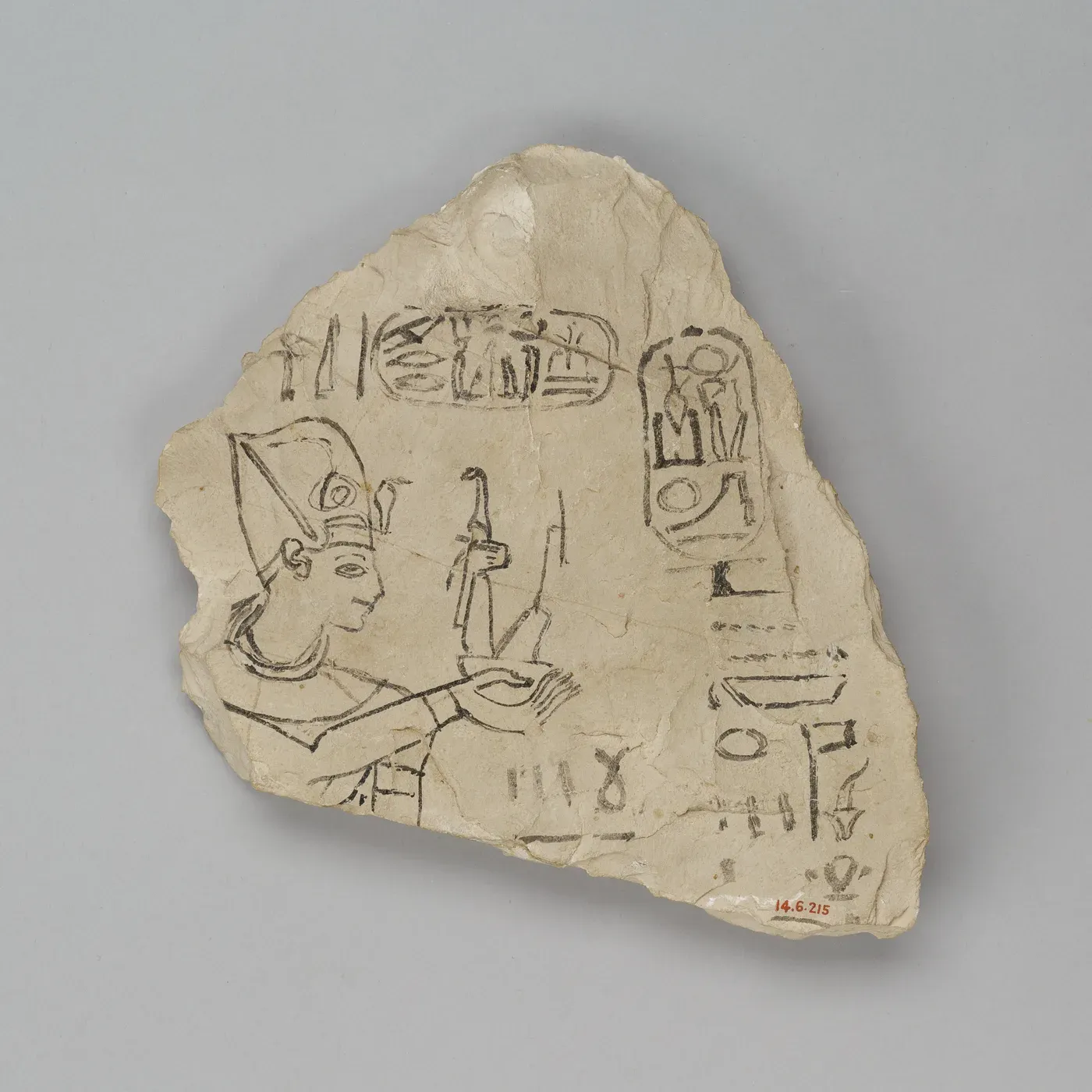
Plate II.4a. Ostracon with Ramesses IX offering Ma’at, about 1137 to 1118 BCE, limestone and ink, from the Valley of the Kings. This is a sketch on a stone chip, not a finished temple scene, and the museum does not say which of several purposes it served. The attribution to the draftsman Amenhotep is the museum’s. The Met, 14.6.215. Gift of Theodore M. Davis, 1914. Image: The Metropolitan Museum of Art, public domain. Object record and full image.
The little figure is a goddess, and her name is also a common noun. The last chapter ended on that noun. The hymn to Osiris gave the throne to the one whose it was by right, and we asked what the Egyptians meant by right.
This chapter follows the word through four settings: the temple, where a king holds it out to a god; the office, where an official claims to have done it; a story, in which a poor man demands it; and the hall where the dead are examined on it.
A word with no single translation
No English word covers Ma’at. The scholars cited in this chapter each choose differently. Emily Teeter calls her the goddess of truth, and the principles she stands for a world order established at the beginning of time. Nikolaos Lazaridis gives justice and cosmic order for the goddess, and justice, truth and balance for the noun. UCL’s translators write simply What is Right.234
Sandra Lippert adds a warning for anyone who settles on justice. Only a comparatively small part of Ma’at concerns what we would call legal justice. The word covers much more.5
We have met it twice already. In the papyrus of Nesmin, the creator says he laid the foundations of things by Ma’at. And the Coffin Texts equate the creator’s first daughter with Ma’at, as they equate her brother with life.6 Right, on this view, is as old as the world and was part of how it was made.
As a goddess, Ma’at is the daughter of the sun god and an essential aspect of him. Several gods bear the title Lord of Ma’at, among them Ptah as creator and Thoth.3
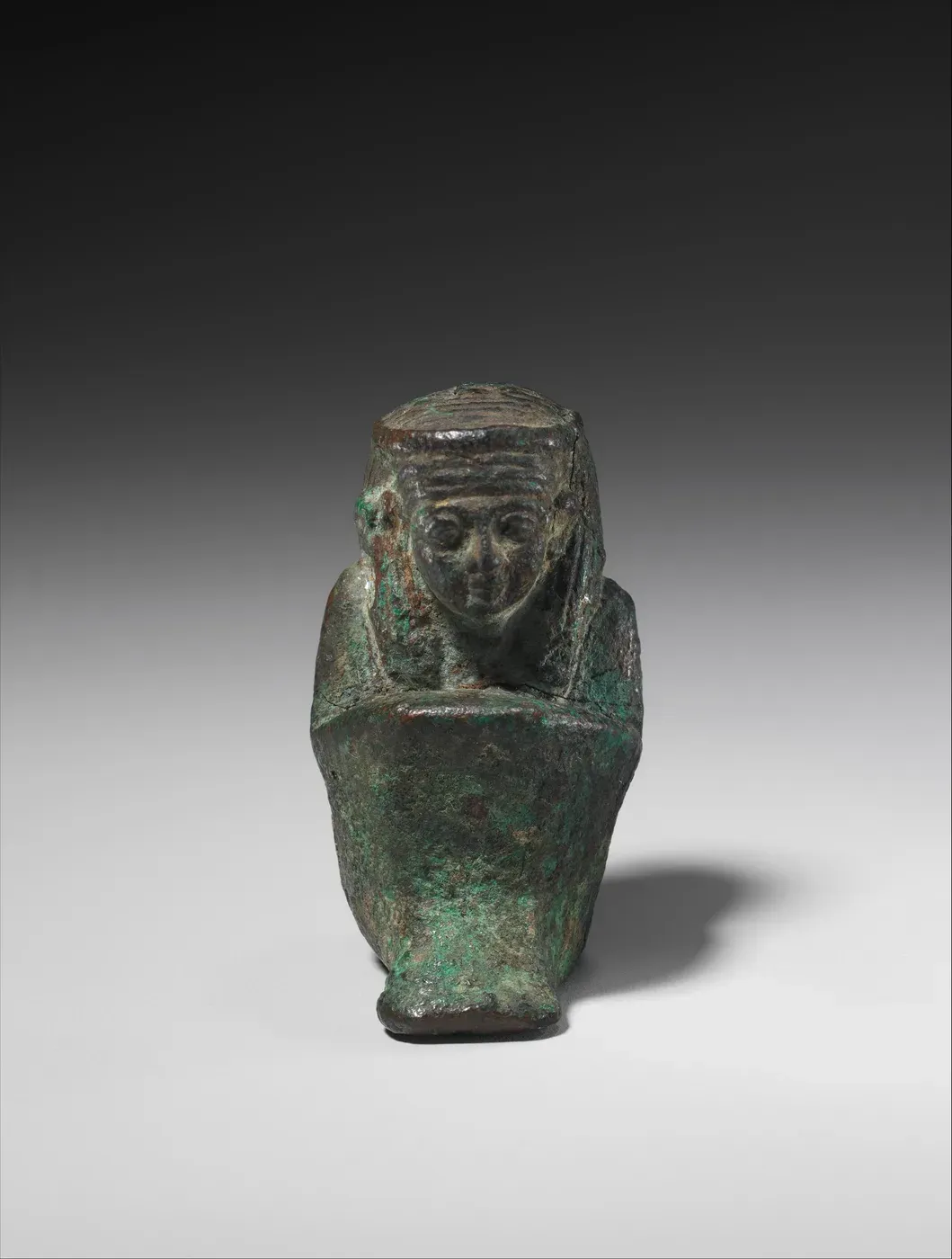
Plate II.4b. Ma’at, about 1080 to 332 BCE, copper alloy with traces of gilding, 3.3 centimetres high. She sits on the ground with her knees drawn up, the pose of the figure on the king’s palm in Plate II.4a. The feather that named her is lost; the museum infers it from traces on the head. Nothing is recorded of where the figure was found or what it was part of. The Met, 10.130.1302. Gift of Helen Miller Gould, 1910. Image: The Metropolitan Museum of Art, public domain. Object record and full image.
The Met’s record for this figure describes her as the goddess of truth and justice and the embodiment of an ideal world in equilibrium. She wears an ostrich feather, which signifies her name. Small figures like this one often sat in front of an ibis, the bird of Thoth, god of writing and wisdom.7
The word has opposites. The chief one is isfet, which Lazaridis glosses as sin or wrongdoing, and UCL as What is Wrong. Close to it is gereg, a lie.34
Notice what kind of opposites these are. Each names something a person does. That will matter, because in text after text Ma’at too is something done.
What a king is for
There is no ancient Egyptian treatise on kingship. But UCL points to one religious composition, first attested in the New Kingdom, that states the king’s functions in Egyptian terms. Ra has placed the king on earth, it says, for a list of purposes. He is to judge between people and to content the gods. He is to bring about what is right and to destroy what is wrong. He is to make offerings to the gods and to the blessed dead.4
The pair at the centre of the list is Ma’at and isfet. The king does not simply live under an order that exists. He makes it happen, and he removes its opposite.
UCL attaches a caution to this text. It calls the definition ethical and ritual, and for that reason partial. Beneath the phrase about right and wrong lie the economic and military sides of rule. An inscription of Amenemhat II, which UCL summarises line by line, records events at court in sequence. Its entries include offerings to temples. They also include mining expeditions, foreign delegations arriving with goods, and an army sent to destroy two foreign places that came back with 1,554 captives.4
Teeter records the same idea in pictures. On temple gateways the king strikes down Egypt’s enemies, and in such scenes the defeated enemy can be shown holding a feather of Ma’at as a sign of submission.2 Destroying what is wrong could mean that.
Kings put the word into their names. Teeter traces this back to Snefru, who was lord of Ma’at in two of his names. Hatshepsut’s throne name was Maatkare, and Seti I’s was Menmaatre. In the Ramesside period nearly every king took a throne name compounded with Ma’at.28
The word marked what a king repaired as well as what he was. The Restoration Stela of Tutankhamun, Teeter notes, says that the king restored Ma’at in a land that had been in confusion under his predecessor.2
Offering what is right
Now return to the gesture on the ostracon. Teeter’s book is the fullest study of it, and its findings are more exact than one might expect.
The idea of presenting Ma’at appears in texts as early as the Middle Kingdom. As a picture it appears first under Thutmose III, in his Festival Hall at Karnak, in a part of the building dated after his twenty-fourth year. It is carved most often on the walls of Ramesside temples, and only rarely in the royal tombs of that age.9
With few exceptions, the one who offers is the reigning king. Teeter reads that restriction as the point. The ritual shows the king’s willingness to uphold the order set at the beginning of time, and it works as a sign of his legitimacy. She observes that he is most often shown in the blue crown, which carried the same connotation.10 The king on the ostracon wears that crown.1
Why would a god want this offering? The texts call Ma’at the food of the gods and say the gods live on her. Teeter describes the presentation as a supreme offering, in which all other offerings are contained. Scenes can even show the king holding jars while the caption says he is giving Ma’at.10
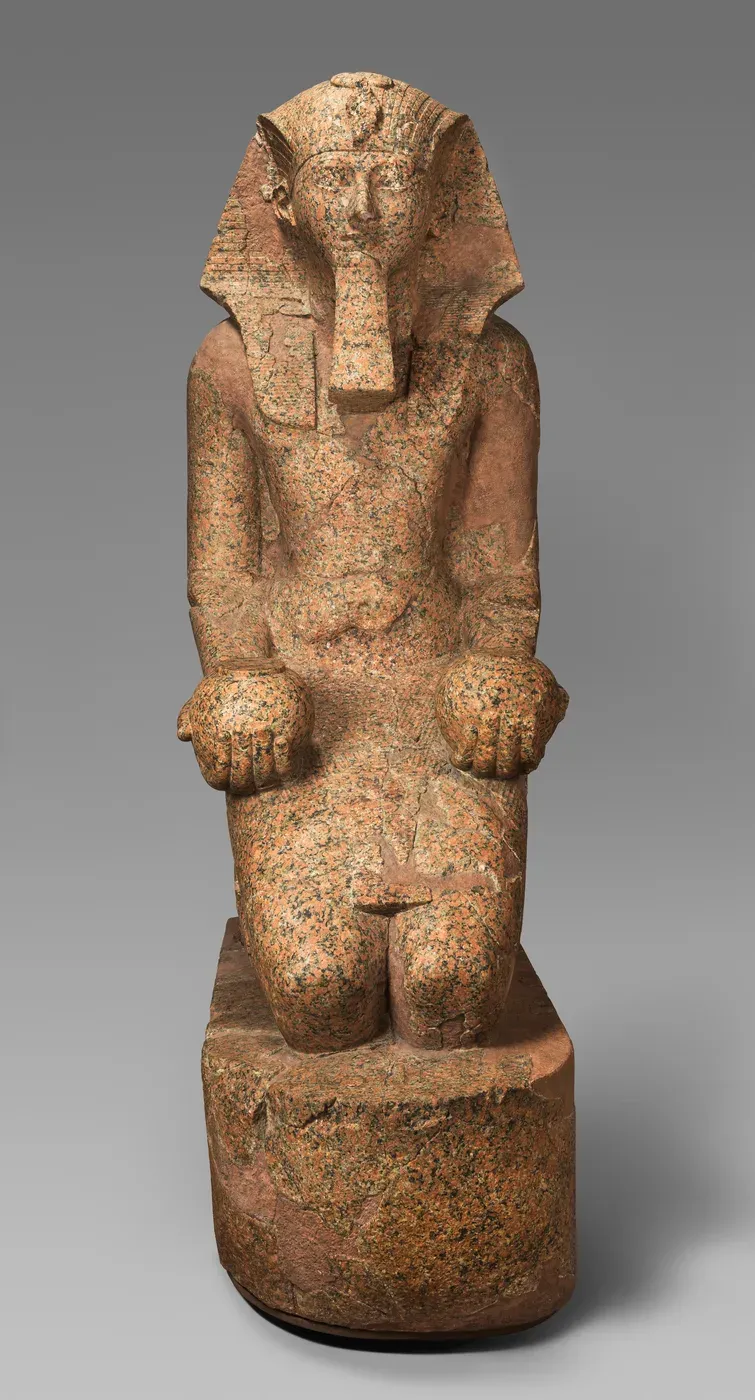
Plate II.4c. Large kneeling statue of Hatshepsut, about 1473 to 1458 BCE, granite, more than two and a half metres high, from her temple at Deir el-Bahri. She holds two jars. It is the inscription, not the pose, that says she is offering Ma’at to Amun. The statue was found in fragments, and the gaps are filled with tinted modern plaster. The Met, 29.3.1. Rogers Fund, 1929. Image: The Metropolitan Museum of Art, public domain. Object record and full image.
The statue in the plate is a case of exactly that. No picture of the ritual survives from Hatshepsut’s reign. But Teeter cites a statue of her from Deir el-Bahri that holds jars and names her as the one who offers Ma’at to Amun, and concludes that the rite was performed in her time.9 The Met reads its statue the same way: by this offering Hatshepsut affirms that Ma’at is the guiding principle of her reign.11
Under Seti I a new version appears. The king holds out his own name, written so that it can be read as Ma’at, and the caption calls the name Ma’at. Teeter takes this as a claim that the king, as king, is imbued with what he offers.910
Two details complicate the tidy picture, and both are worth keeping.
The first concerns the reign of Akhenaten. Teeter notes that the traditional view expected little of this ritual in his time. She found the reverse. The scene is more common in his early years than in any other part of the eighteenth dynasty: thirty examples, all but one from his buildings at Karnak.9
The second concerns our ostracon. Ramesses IX is one of the very few Ramesside kings with no Ma’at anywhere in his names.2 On the limestone flake he holds her out all the same. A king did not need the word in his name to be shown performing the act.
Doing right in an office
A king held out Ma’at to a god. Those below him were told to do Ma’at for the king, because it is what the king loves.2
Lazaridis sets out what kind of evidence we have. No standard moral code survives from Egypt. Moral principles appear instead in tomb biographies, in the teachings that scholars call wisdom literature, in funerary books, and in stories. He calls the result practical ethics: observations and warnings drawn from working life, with no theory of why the good is good.12
The best-known teaching is put in the mouth of Ptahhotep, vizier to King Isesi. UCL dates its composition to the twelfth dynasty; the two earliest surviving copies are of the late Middle Kingdom. The old vizier asks leave to retire and to train his son as his successor.13
One of his maxims is addressed to anyone who will lead others. It tells him to seek every chance to be effective, until his conduct is without fault. Then it gives the reason. What is right is great and lasting. It has not been overturned since the time of Osiris. Those who pass over the laws are punished, and although the small-minded may seize riches, crime has never brought its gains safely to land.13
Since the time of Osiris. The teaching dates the rule of right from the events of the last chapter. Ma’at is what survived the murder and was upheld in the verdict.
Another maxim calls greed a disease that sets parents and kin against each other, and says that the man who endures is the one whose guideline is right. A third says that making right secure is the life of one’s children.13
Tomb biographies make the same claims in the first person.
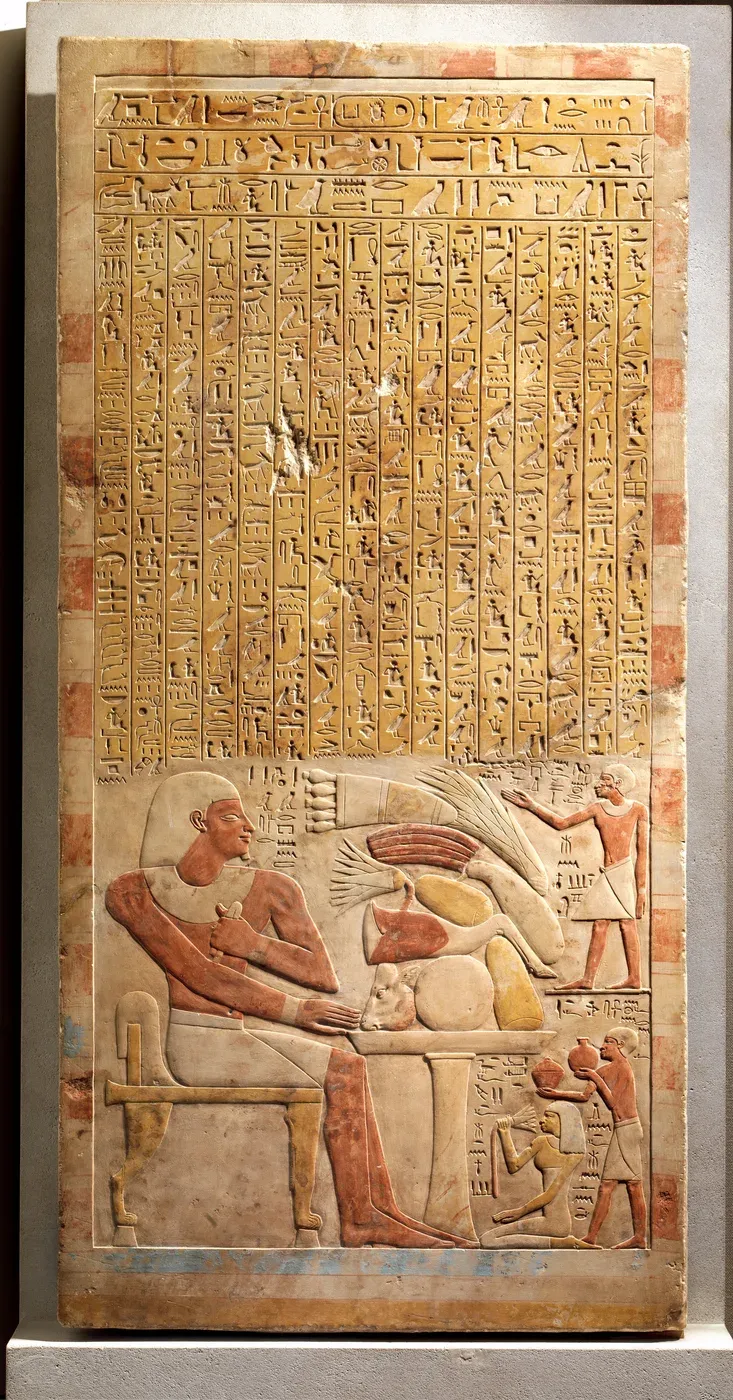
Plate II.4d. Stela of the steward Mentuwoser, about 1944 BCE, limestone with paint, probably from Abydos. The columns of text above the offering scene are his account of himself. They are evidence for what an official wished to be remembered for, not for how he behaved. The Met, 12.184. Gift of Edward S. Harkness, 1912. Image: The Metropolitan Museum of Art, public domain. Object record and full image.
Mentuwoser was a steward under Senwosret I. His stela is dated to that king’s seventeenth year and was a gift from him. In the museum’s translation, Mentuwoser says he was a father to the orphan and a helper of widows. No one went to sleep hungry in his domain. He kept no one from the ferry. He cut down no man weaker than himself. He was a proper judge, who showed no favour to the party able to pay.14
The text ends by turning to its audience. Those who hear it, Mentuwoser says, will have to say that it is true, and their children will tell their own children: It is true; there is no lie in it. The museum’s transliteration shows the two words he chose. True is maa, the root of Ma’at. Lie is gereg.14
How far should such a text be believed? Lazaridis notes that biographies describe their owners in glowing terms, and that all our sources come from the same small, literate class. They show what that class thought a good man was. They cannot show how many lived up to it.12
No judges, no code
If Ma’at was right conduct, where was it enforced? Not where we would look.
UCL’s survey of Egyptian law begins with two absences. There were no judges and no courts in our sense: officials heard cases as part of their ordinary work, and no one is known whose only job was to judge. And no legal code survives. Society ran on royal decrees and on precedents from earlier cases.15
The nearest thing to a manual is the text called the Duties of the Vizier, copied in the tombs of four viziers at Thebes. It opens with the vizier at a hearing: seated on a particular stool, a staff at his arm, thirty rolls laid out before him, his scribes in their places. Petitioners are heard one after another, in order of rank.16
Justice appears here as a procedure in an office. The link to the goddess was worn on the body. The Met notes that high officials are sometimes shown with a small figure of Ma’at hung around the neck, to signify that their conduct is just. Lippert reports that such pendants are well attested on statues from the twenty-sixth dynasty onward, and that examples in lapis lazuli have been found.717
The peasant who answered back
One Egyptian story is about what happens when an official fails.
A papyrus in the British Museum, written in the twelfth dynasty and found at Thebes, preserves the opening of the Tale of the Eloquent Peasant. The museum’s curators summarise the plot. A peasant named Khunanup is tricked and robbed by a greedy landowner who wants his donkeys. He takes his case to the high steward. The steward is so struck by the peasant’s way with words that he makes him plead again and again, so that the speeches can be written down and shown to the king. Only after much suffering is Khunanup given justice.18
It is an uncomfortable story. The man in the right is kept waiting for the entertainment of the men who could help him. Lazaridis singles it out as a work in which ethical principles, and the institutions tied to them, such as the judicial system, are questioned. Their authority, he concludes, was not beyond challenge.12
Egyptian writers could also imagine the principle failing altogether. Lazaridis describes a whole genre of laments: vivid pictures of a land in which every moral rule is trampled and every normal way reversed.12 To value Ma’at was to know what its absence would look like.
The dead person’s list
The longest Egyptian list of right and wrong was written for the dead.
Chapter 125 of the Book of the Dead is spoken on arrival at a hall named for Ma’at in the dual: UCL renders it the broad hall of the Two Goddesses of What is Right. No written copy is older than the New Kingdom.19
The speaker begins by telling the god of the hall that he has brought him what is right and removed what is wrong.19 Those are the two duties that the kingship text gave to the king. Here they are claimed by an ordinary dead person.
Then come the denials. In the copy made for a man named Nu, the speaker has not robbed the orphan, caused hunger, or killed. He has not shortened the measure or added weight to the pan of the scales. He has not taken milk from the mouths of children, or held back water in its season. Many of the rest concern the gods’ property: their offerings, their cattle, their birds and fish.19
A second list follows, addressed to forty-two assessors, one denial for each. The speaker has not stolen, lied, slandered, or been deaf to words of truth. He has not raised his voice.20
Martin Stadler treats these lists, together with the teachings and the biographies, as a main source for Egyptian ethical standards. A life lived by them, he writes, was a life lived according to Ma’at. He adds that the set of denials stayed remarkably stable for more than fifteen hundred years.21
Where did the form come from? UCL and Stadler both mention a proposal that it derives from oaths of purity sworn by priests entering temple service. Stadler is careful: the surviving oaths are of Roman date, and the borrowing may have gone the other way. UCL notes that affirmations of righteousness appear on earlier monuments, one of them a twelfth-dynasty stela from Abydos.2021 Mentuwoser’s stela, also from Abydos, belongs to that older habit.
And how seriously should the list be taken as a guide to daily life? Lazaridis gives both sides. It was standardised and widely used, which suggests an established code. But it was used only in a funerary setting, and may have had a ritual purpose there.12 The first chapter of this book made a similar point. A funerary text is made to work for its owner.
Did Ma’at decline?
One disagreement among scholars should be reported, because it shows how much depends on which sources one reads.
Jan Assmann has argued that the meaning of Ma’at changed in the later New Kingdom. On his account, as Teeter summarises it, people came to rely directly on the will of a god. A good life no longer guaranteed a good outcome, and Ma’at faded as an ethical standard. He traces the change to the reign of Akhenaten and its aftermath.22
Teeter disagrees. Assmann’s evidence is mostly hymns, letters and teachings. The temple walls, she argues, tell a different story. Scenes of the king offering Ma’at become more numerous in exactly this period, not fewer. The king’s posture before the god does not grow humbler. And the new offering of the royal name as Ma’at suggests confidence. She finds nothing in the reliefs to suggest that Ma’at had ceased to matter.22
Lazaridis stands between them. Piety does seem to become a more important measure of a person from the New Kingdom on, and later teachings mention the gods far more often. But Ma’at remained a vital part of religion, kingship and the sense of right throughout Egyptian history. He warns that the apparent rise in piety may partly reflect what happens to have been excavated.23
The question is open. The hymns and the temple walls were made for different purposes, and each side of the argument rests on one of them.
Look again at the flake of limestone. The Met lists what such sketches were for: practising a figure, drafting a composition, copying a scene, and sometimes serving as an image for devotion.1 Whichever this one was, a draftsman drew the king’s hand and the goddess sitting on it, in the form used on the walls of royal tombs and temples.
That is the sense of the word this chapter has followed. In the temple, the office, the story and the hall of the dead, Ma’at is something to be done or offered, and each text names the person responsible for doing it.
One instrument has been left for the next chapter. In the hall of the two Ma’ats stands a balance. A feather lies in one pan, and a heart in the other.21 To reach it, the dead must first travel where the sun goes at night.
Footnotes
-
The Metropolitan Museum of Art, Ostracon depicting Ramesses IX offering Maat, attributed to the chief draftsman Amenhotep, 14.6.215. The record gives the dimensions as 15 by 14.5 cm, the findspot as the Valley of the Kings, Davis excavations, 1913, and describes both sides: the king offering Maat in the blue crown, and offering a pot in a double feathered crown. It also lists the uses of figural ostraca. Teeter catalogues the piece as scene D4 and described it in 1997 as unpublished. ↩ ↩2 ↩3 ↩4
-
Emily Teeter, The Presentation of Maat: Ritual and Legitimacy in Ancient Egypt, Studies in Ancient Oriental Civilization 57 (Chicago: Oriental Institute, 1997), 1 to 2 with notes 9 and 10. For her gloss of Maat, the names of Snefru, the Ramesside throne names and the exceptions (among them Ramesses IX), the Restoration Stela of Tutankhamun, the enemy holding a feather, and the advice she quotes from an Old Kingdom text to do and speak Maat for the king. ↩ ↩2 ↩3 ↩4 ↩5 ↩6
-
Nikolaos Lazaridis, “Ethics”, version 2, UCLA Encyclopedia of Egyptology (2024), 2, section “Ethics and Maat”. For the meanings of the word, isfet and gereg, the goddess as daughter and aspect of the sun god, and the epithet “Lord of Maat”. ↩ ↩2 ↩3
-
UCL, What does a king have to do in ancient Egypt?, Digital Egypt for Universities. The page translates the passage after Assmann (1970), comments on what it conceals, and summarises the annals inscription of Amenemhat II from Memphis; the captives are in its item 20. The passage is paraphrased here. ↩ ↩2 ↩3 ↩4
-
Sandra Lippert, “Law (Definitions and Codification)”, UCLA Encyclopedia of Egyptology (2012), 1 to 2. ↩
-
See the chapter on creation and its notes: Budge’s translation of the creation account in the papyrus of Nesmin, and UCL’s creation page on Shu and Tefnut in the Coffin Texts. ↩
-
The Metropolitan Museum of Art, Maat, 10.130.1302. The record gives the height as 3.3 cm, infers the lost feather from traces on the head, describes compositions in which such figures sit before an ibis, and mentions officials wearing a Maat figure. ↩ ↩2
-
UCL, Digital Egypt for Universities, entries for Hatshepsut and Sety I, which list the throne names Maatkare and Menmaatre. ↩
-
Teeter, The Presentation of Maat, 7 to 9 and 81. For the first depictions under Thutmose III, the statue and inscription of Hatshepsut, the thirty examples from the early reign of Akhenaten, the earlier textual references, the offering of the royal name from Seti I, and where the scene is most often carved. ↩ ↩2 ↩3 ↩4
-
Teeter, The Presentation of Maat, 1 and 82 to 83. For the king as donor, legitimacy, the blue crown, Maat as food of the gods, the supreme offering, and scenes in which jars are offered under a caption naming Maat. Her suggestion that Thutmose III introduced the scene to assert his right to rule against the memory of Hatshepsut is offered there as a possibility. ↩ ↩2 ↩3
-
The Metropolitan Museum of Art, Large Kneeling Statue of Hatshepsut, 29.3.1. The record gives the height as 261.5 cm, the findspot as the Senenmut Quarry at Deir el-Bahri, excavated by the museum in 1927 to 1928, and explains the reconstruction with plaster. Teeter does not give a museum number for the statue she cites, so the two are not identified with each other here. ↩
-
Lazaridis, “Ethics”, 1 to 4, sections “Sources” and “Methodological Problems”. For the absence of a standard code, practical ethics, the kinds of source, the Eloquent Peasant, the laments, the two readings of chapter 125, and the limits of evidence from a scribal class. ↩ ↩2 ↩3 ↩4 ↩5
-
UCL, Teaching of Ptahhotep, Digital Egypt for Universities, introduction and sections 8, 22 and 45, translated from Papyrus Prisse. Paraphrased here, not quoted. ↩ ↩2 ↩3
-
The Metropolitan Museum of Art, Stela of the Steward Mentuwoser, 12.184, description and translation. One sentence is quoted from the museum’s translation; the rest is paraphrased. The record dates the stela to year 17 of Senwosret I and says it was presented by the king. The date of about 1944 BCE is the record’s; the museum’s audio guide says about 1955. ↩ ↩2
-
UCL, Law in ancient Egypt, Digital Egypt for Universities. ↩
-
UCL, Duties of the vizier and its translation, sections 1 and 2. The best-preserved copy is in the tomb of Rekhmira. UCL reports that the date of composition is disputed, between the late Middle Kingdom and the early eighteenth dynasty. ↩
-
Sandra Lippert, “Law Courts”, UCLA Encyclopedia of Egyptology (2012), 12, citing Grdseloff (1940) and Möller (1920). ↩
-
The British Museum, Papyrus Butler, EA10274, description and curator’s comments. The papyrus holds forty lines from the introductory part of the tale. The record cites the translation in R. B. Parkinson, The Tale of Sinuhe and Other Ancient Egyptian Poems (Oxford World’s Classics, 1999), which was not consulted for this chapter; nothing is quoted from the tale. ↩
-
UCL, Book of the Dead, chapter 125A, from the papyrus of Nu, British Museum EA 10477. Paraphrased. ↩ ↩2 ↩3
-
UCL, Book of the Dead, chapter 125B, from the papyrus of Maiherperi, with the introduction on temple oaths and earlier affirmations of righteousness. UCL notes that manuscripts vary in the order and even the number of declarations. ↩ ↩2
-
Martin A. Stadler, “Judgment after Death (Negative Confession)”, UCLA Encyclopedia of Egyptology (2008), 1 to 3. For the lists as a source for ethics, their stability, the priestly oaths and the uncertainty about which came first, and the balance on which the heart is weighed against a feather. ↩ ↩2 ↩3
-
Teeter, The Presentation of Maat, 3 and 83 to 87. Assmann’s position is given here only as Teeter reports it; his own studies, chiefly Ma’at: Gerechtigkeit und Unsterblichkeit im alten Ägypten (1990), were not consulted. ↩ ↩2
-
Lazaridis, “Ethics”, 4, section “Historical Development”. ↩
Sources
- Read the scholarship: Emily Teeter, The Presentation of Maat, Oriental Institute of the University of Chicago (1997)
- Read the scholarship: Nikolaos Lazaridis, Ethics, UCLA Encyclopedia of Egyptology (2024)
- Read an ancient teaching: Teaching of Ptahhotep, Digital Egypt for Universities, UCL
- Read the declaration: Book of the Dead, chapter 125, Digital Egypt for Universities, UCL
- Examine the ostracon: Ramesses IX offering Maat, 14.6.215, The Metropolitan Museum of Art