Numina · Egyptian · II.5 The night and the Duat
Chapter II.5
The night and the Duat
Every evening the sun goes down into the country of the dead, and every morning it comes out new. Egypt mapped that country hour by hour, and then asked what a dead person would have to do to come out as well.
Between the legs of a mummy at Deir el-Bahri, the Met’s excavators found a papyrus rolled into a tight scroll. The mummy was that of Henettawy, daughter of Isetemkheb, a wealthy woman buried in a family tomb around 990 to 970 BCE. Unrolled, her papyrus is 139 centimetres long and is drawn in black and red ink.1
The left end is blank. The rest holds one scene in three bands. In the middle band a boat carries a row of standing figures and a small shrine. Ahead of it a black hawk sits on the back of a serpent, and a second boat carries a long snake. In the band above, a beetle pushes an oval. In the band below, bodies float in water drawn as zigzag lines.
The museum identifies the scene as the tenth hour of the night, from a composition called the Amduat. It suggests that the scribe meant to add one or more further hours in the empty space, and never did.1
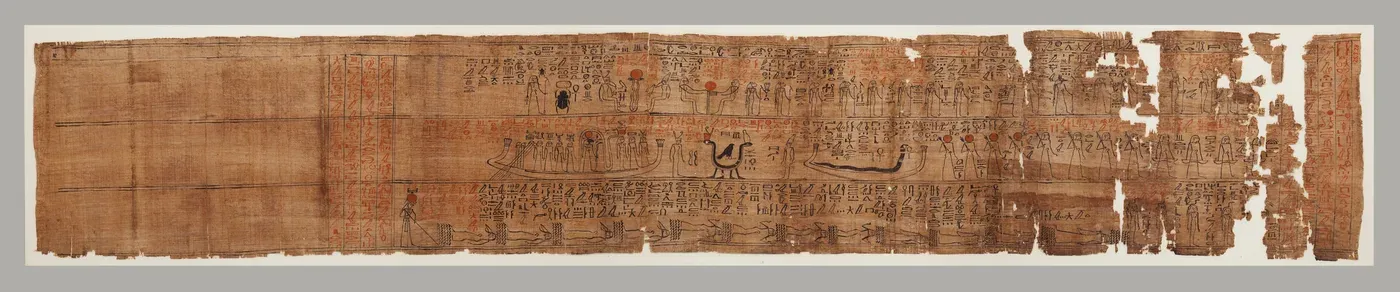
Plate II.5a. Amduat papyrus of Henettawy, daughter of Isetemkheb, about 990 to 970 BCE, papyrus and ink, found between the legs of her mummy at Deir el-Bahri. It holds one hour of the twelve, the tenth. The whole roll is shown here, so its figures are very small; the museum’s record has the full-size image. The Met, 25.3.28. Rogers Fund, 1925. Image: The Metropolitan Museum of Art, public domain. Object record and full image.
Why would a woman be buried with one hour of the night laid on her body? The answer needs two journeys. One is the sun’s, and it is made every night. The other is made once, by each dead person, and it ends at a pair of scales. This last chapter of the Egyptian book follows both, and then asks what became of those who failed.
The country under the day
The Egyptian name of the place is the Duat. The Met glosses it as the netherworld. Budge, whose translation of 1905 is the main guide in this chapter, wrote the name Tuat and described it as the country the sun god crosses during the hours of the night, which is also the realm of the dead.12
We have already been told who rules it. When Horus became king, the world reached its present arrangement: a king on earth, the sun travelling in his boat through the day and night skies, and Osiris ruling the dead below.3 The Duat is where the second and third of these meet.
It should not be called hell, and Budge himself said so. He objected to the titles Book of Hades and Book of Hell that earlier scholars had given to one of the compositions about it, and to the idea that the place lay beneath our feet in a lower hemisphere.2 The sun passes through it and the blessed dead live in it, as well as the condemned.
Egypt also kept another picture of the night, in which the sky goddess Nut gives birth to the sun each morning. The two pictures were not treated as rivals. Budge’s twelfth hour calls her the womb of the morning, and on the sarcophagus shown below the box carries the journey by boat while the lid carries Nut.45
A book made for kings
The composition on Henettawy’s papyrus is known by two Egyptian words, am duat, what is in the Duat.2 It is a book of pictures with captions. According to the Met, it appeared first in the royal tombs of the New Kingdom, and its annotated scenes represent the twelve hours of the night.1
How early it began is still argued. Limestone slabs carved with hours of the Amduat were found in two tombs in the Valley of the Kings, numbered KV 38 and KV 20, and scholars have disagreed about which reign they belong to. A current project at Göttingen, which conserved the slabs, argues that all of them come from the tomb of Thutmose I and are the oldest royal version, earlier than the copy in the tomb of Thutmose III.6
Budge, writing in 1905, knew the oldest copies from the tombs of Thutmose III, Amenhotep II and Amenhotep III. The fullest, he says, is on the walls of the tomb of Seti I, which has eleven of the twelve hours.2 UCL describes that tomb as the longest in the valley, decorated throughout with scenes taken mainly from the books of the underworld.7
Then the book moved. Budge traces the sequence: first the walls of tombs, then stone sarcophagi and wooden coffins, then rolls of papyrus. On papyrus, he observes, one usually finds only the last four hours, from the ninth to the twelfth.2 Henettawy’s tenth hour fits that habit.
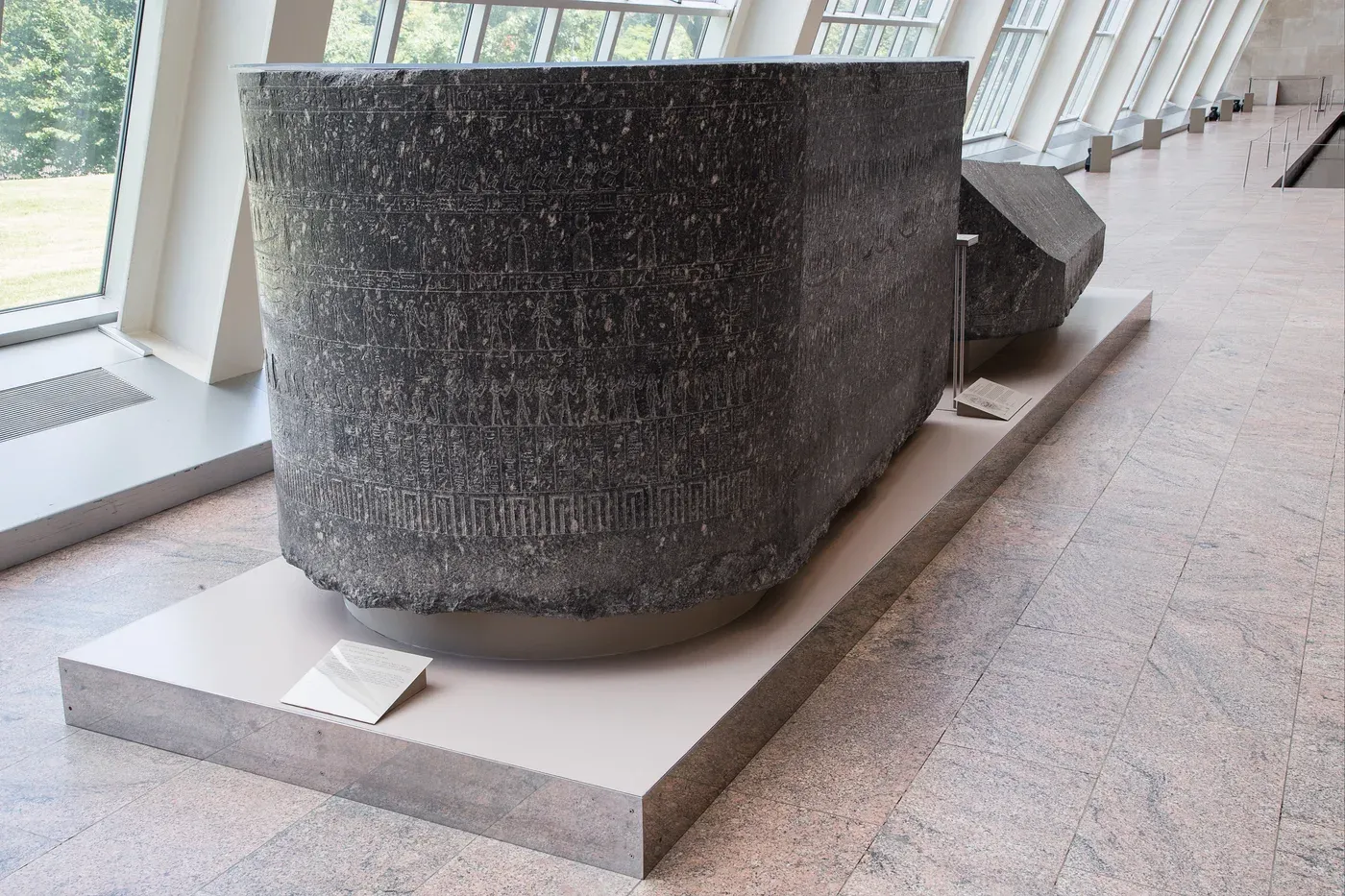
Plate II.5b. Sarcophagus of Wereshnefer, 380 to 300 BCE, granodiorite, nearly three metres long, from his tomb at Saqqara. This is the rounded head end, where the first hour of the night begins; the bands of small figures are hours of the Amduat. The carving is shallow, and the hours cannot be read from this photograph. The Met, 14.7.1a, b. Gift of Edward S. Harkness, 1914. Image: The Metropolitan Museum of Art, public domain. Object record and full image.
Wereshnefer was a priest, not a king, and he lived more than a thousand years after the texts on his sarcophagus were composed for royalty. The Met’s record explains the plan. The box stands for the netherworld. Hours one to seven run around the outside, starting at the head, and hours nine to twelve are inside; the eighth was left out. In the middle band of each hour the sun god stands in a shrine on his night boat, with the beings of that region above and below him. The lid is the day sky.5
A word on Budge is needed before we follow him. His translation is in the public domain, which is why it can be quoted. But his readings of Egyptian names are out of date, and his explanations are his own: he thought the Amduat was written by priests of Amun to assert their god’s supremacy over the dead.2 He is used below for what the scenes contain, and the museum records are used to check him.
Twelve hours
Each hour is a region with a name, a gate and a goddess of its own.8 The sun passes through them standing in a boat, but he does not arrive as the sun of the day. Budge calls the traveller Afu-Ra, the flesh of Ra, and speaks of him as the dead Sun-god, journeying in a mummified form.4 What goes down in the west is a body.
By the fifth hour the boat is being towed through the land of Sokar, a region walled with sand and lying in thick darkness, where heads show above a lake of boiling water.9
The sixth hour is the turning point. In Budge’s account the dead god lies on the back of a five-headed serpent and draws towards himself the beetle of Khepri, the sign of coming into being that we met in the chapter on creation.10 The Met puts the event in other words: in the deepest hour Ra joins with Osiris, king of the dead, so that he can be reborn in the morning.1
Jiří Janák explains what that joining meant. New Kingdom texts present it as a union of two parts of one being: Ra as the ba, the mobile and manifest part, and Osiris as the corpse.11 The first chapter quoted a line from the Book of the Dead that set yesterday beside Osiris and tomorrow beside Ra. The sixth hour is where yesterday and tomorrow touch.
Danger follows at once. In the seventh hour there is not enough water to float the boat, and the way is blocked by Apep, the serpent, stretched on a sandbank that the text makes four hundred and fifty cubits long. Isis speaks her words of power. The serpent is fettered at head and tail and pinned to the ground with knives, and the boat passes.8
We have met this enemy before. The papyrus of Nesmin, where the chapter on creation began, held a whole book of spells for overthrowing him so that the sun could rise. Rita Lucarelli notes that Apep stands apart from every other dangerous being of the netherworld. As the cosmic enemy of the sun god, he belongs to neither the gods nor the demons.12
Then comes Henettawy’s hour. In the tenth, Budge says, the boat is neither towed nor rowed. A hawk rides on a serpent before it, and gods armed with arrows, javelins and bows go ahead as an escort. A beetle pushes an oval of sand, which Budge reads as the seed of new life entering the dead god’s body. And in a row of lakes, beings are plunging, swimming and floating, while Horus leans on a staff and promises them that their limbs will not perish and their flesh will not decay.13
Budge admits he cannot say who the beings in the water are.13 The Met says only that in this hour the inhabitants of the Duat begin to prepare for sunrise.1 Either way, these appear to be the figures lying in the zigzag water at the bottom of Henettawy’s roll.
The twelfth hour is called, in Budge’s words, the uttermost limit of thick darkness. Twelve servants take the tow-rope and draw the boat through the body of an enormous serpent, in at the tail and out at the mouth. Inside it the god becomes Khepri. Twelve goddesses tow him up into the sky, and Shu, the air, receives him. The mummified form in which he travelled is left behind, lying against the wall that divides the Duat from this world.4
The chapter on creation ended by saying that the first time had to keep happening. The Amduat describes how it was thought to happen each night.
Gates, and the names of their keepers
The Amduat was not the only map. A second composition, first attested in the tomb of King Horemheb, covers the same night journey and is known as the Book of Gates. Budge preferred that name because a series of gates is what most distinguishes it.214
Martin Stadler points to one thing the Book of Gates contains: the judgment hall of Osiris. In this book the judging of the dead is tied to the sun’s journey. The sun god himself is vindicated on the way, and that provides a model for the dead person.14
Gates need keepers. Lucarelli describes a whole class of beings whose work is to guard the gates and regions of the realm of the dead. They are aggressive because they are protecting their own ground, and they can be well disposed to anyone who knows their names and how to face them. That is why the texts describe them so precisely, often with an animal’s head and a knife in the hand: the dead person has to recognise them.12
The last chapter showed the same rule at the door of the judgment hall. The dead person begins by telling the god that he knows his name, and the names of the forty-two who sit with him. In the Duat, to know a name is to have the means of passing.
This is the practical reason for carrying the book. Budge quotes the promise attached to the sixth hour: whoever knows this path, and the names and forms of those on it, will share in the offerings.10
The heart on the scale
The second journey ends in a hall.
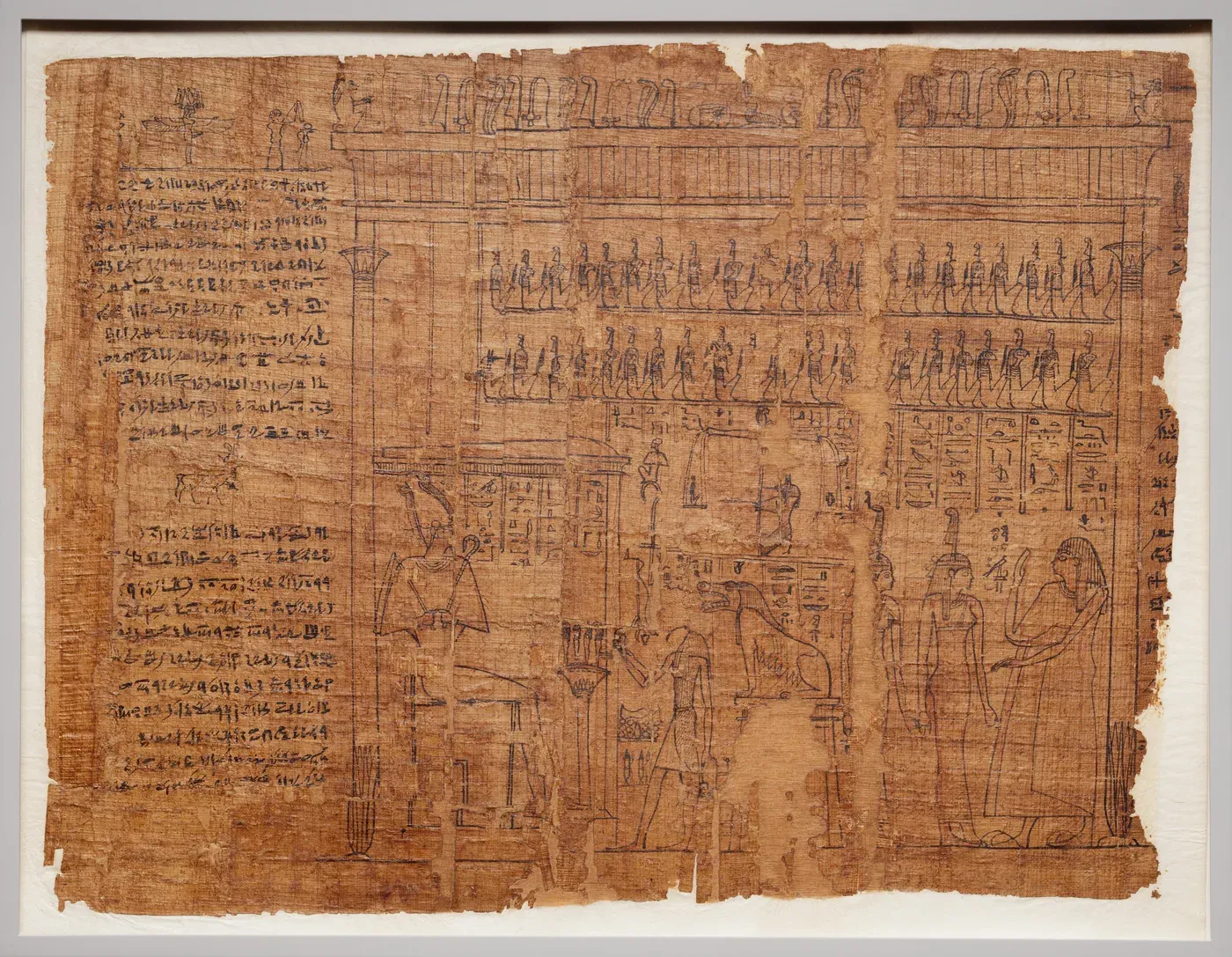
Plate II.5c. Part of a funerary papyrus showing the judgment before Osiris, about 230 to 150 BCE, papyrus and ink. It is a late example: the scene had been drawn for more than a thousand years by then. The record gives no owner’s name and no findspot beyond Egypt. The Met, 66.99.142. Purchase, Fletcher Fund and The Guide Foundation Inc. Gift, 1966. Image: The Metropolitan Museum of Art, public domain. Object record and full image.
The Met’s record identifies the figures. Two figures of Ma’at lead the dead person into the Hall of the Two Truths. Forty-two judges sit in two rows above, each with a feather on his head and a knife in his hand. In the centre Anubis, the jackal-headed god of embalming, weighs the heart against a small squatting figure of Ma’at. Thoth, with his scribe’s equipment, reports the result to Osiris, who sits in a kiosk at the left.15
Stadler sets out how this picture came about. Threats of a judgment before the Great God appear in tombs as early as the fourth dynasty. The scale itself is already present in the Coffin Texts. From the Middle Kingdom the dead were thought to pass a series of trials modelled on the vindication of Osiris, which the third chapter described. But the scene as we see it here, with the declaration of innocence that belongs to it, is not attested before the New Kingdom.14
Why a heart? The Met’s note on another object answers. For the Egyptians the heart was the centre not only of life but of thinking, memory and moral values.16 It was the one witness that had been present for everything.
That was the difficulty. The heart could testify.
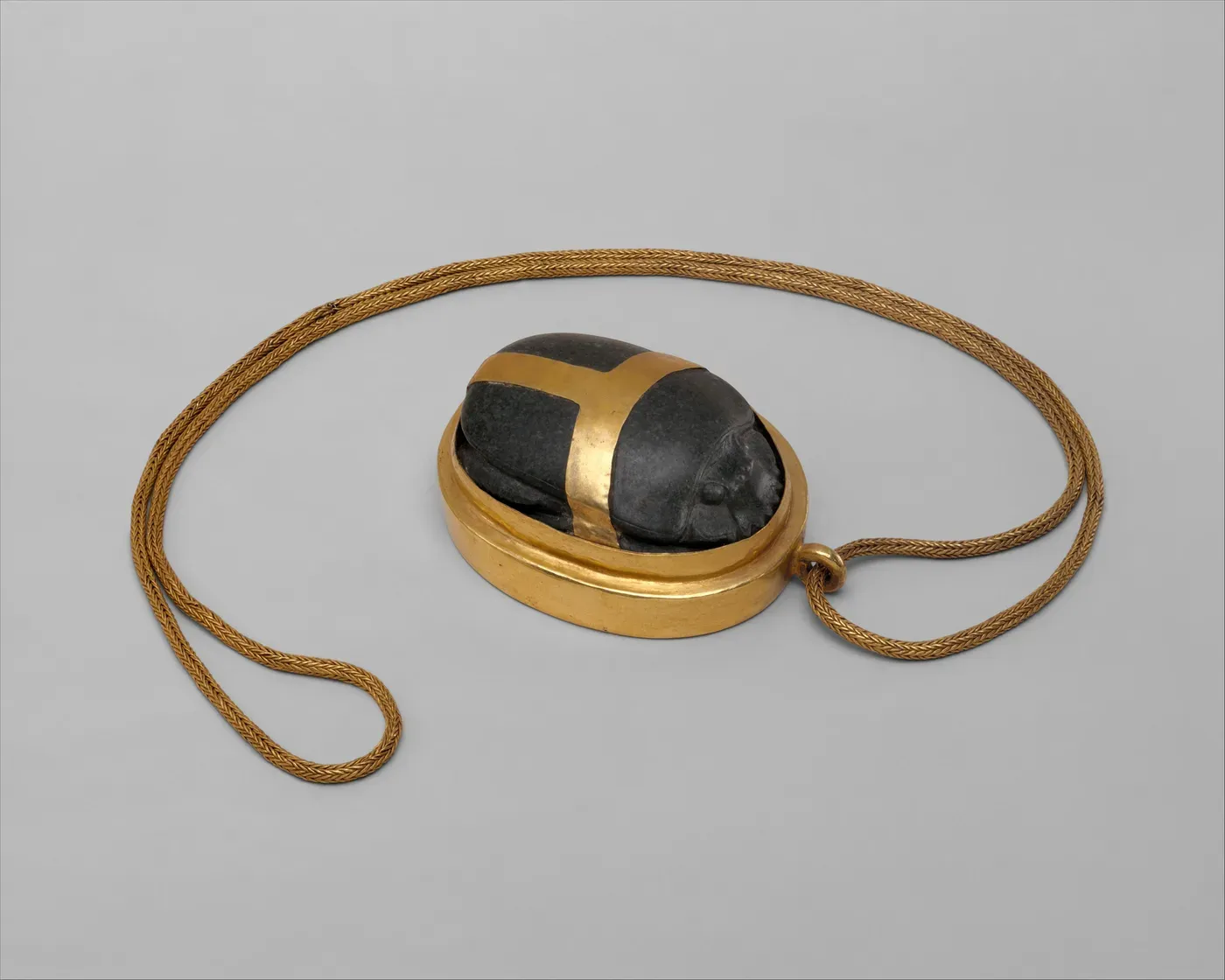
Plate II.5d. Heart scarab of Hatnefer, about 1491 to 1473 BCE, serpentinite and gold, from her tomb at Thebes. The spell is engraved on the flat base, which this view does not show. Her name was cut over an erased one, so the scarab was first made for somebody else. The Met, 36.3.2. Rogers Fund, 1936. Image: The Metropolitan Museum of Art, public domain. Object record and full image.
A heart scarab was placed on the mummy to deal with this. The base of Hatnefer’s is engraved with a version of chapter 30 of the Book of the Dead. In the museum’s translation she addresses her own heart. It is not to rise up against her as a witness, or contend with her in the court, or oppose her before the keeper of the balance. It is not to invent lies about her in the presence of the god.16
The museum states the purpose plainly. The Egyptians feared a bad outcome, and special amulets were used to make sure of a good one.16
So the same burial could contain two things that sit awkwardly together. One is a long list of wrongs the dead person swears not to have done, the list examined in the last chapter. The other is an amulet instructing the only witness not to speak against her. Stadler describes chapter 125 itself as a text intended to ensure that its owner passes, and the judgment as a kind of initiation.14
It would be too simple to say the ethics were insincere, and too simple to say the magic was an afterthought. Both are in the tomb. As in every chapter of this book, the sources keep two answers.
What a good result sounded like is recorded on the papyrus of Nauny, the singer of Amun with whom this book began. Anubis reports that her heart is an accurate witness. Osiris orders that her eyes and her mouth be given back to her.17
What eats the failures
Look again at the centre of the judgment papyrus. Beside the balance, on a stand, a beast is waiting with its jaws open.
The Met calls her Ammut, the Devourer, and describes her in this drawing as a hippopotamus with a crocodile’s head. If the scales do not balance, she eats the heart, and the person dies for ever.15 Lucarelli gives her usual form, the best known of all Egypt’s composite monsters: a crocodile’s head, a lion’s body, and the hindquarters of a hippopotamus. She translates the name as the devourer of the dead.12 Stadler adds what the eating does. It annihilates.14
In this scene, then, the penalty is not a sentence to be served. It is an end. The person who fails stops existing, which is the opposite of everything a burial was meant to secure.
The Amduat has its own version, and it is harsher to look at. The name of the eleventh hour, in Budge’s rendering, is the Mouth of the Circle which judgeth bodies. To one side of the sun’s path are pits of fire. The enemies of Ra are in the first. In the others, separately, are the bodies, the souls, the shadows and the heads of the condemned. Goddesses hack them apart and supply the fire that burns them, and Horus stands by to direct the work.18 In the sixth hour a serpent named Eater of the Spirits has the task of devouring the shadows of the dead.10
Budge thought these pictures might be the distant source of later beliefs in a fiery hell. He also thought the Egyptians had taken the idea from the red clouds of dawn.18 Both suggestions are his own, and are more than a century old. What the text itself says is narrower. Those in the pits are burned until they are consumed. Here too the end is destruction.
Who are the condemned? Budge’s account calls them the enemies of Ra and the damned, and says no more. None of the papyri in this chapter puts its owner among them. Each was made for a named person, and each shows that person passing.
A night of one’s own
So we come back to the question of the first page. Why did a book made for the tombs of kings end up on the bodies of people who were not kings?
Henettawy was not alone. Another woman from the same tomb, Tiye, a singer in the cult of Amun-Re, had an Amduat papyrus with very little writing on it. The museum describes it as a set of abbreviated scenes. Tiye stands before Osiris, worships the sun god in the form of a ram, and presents offerings to the inhabitants of the Duat.19
Nauny had one too. Her Book of the Dead, the roll described at the start of this book, lay inside a hollow figure of Osiris. A second and shorter papyrus had been folded eight times and laid across the knees of her mummy. It is labelled at one edge as the Book of What is in the Duat, though the museum notes that it looks unlike most copies. It shows forty wrapped figures. Some are forms of the sun god. Others are labelled as the Osiris Nauny, true of voice, the phrase for someone who has passed the weighing of the heart.17
Janák supplies the idea that connects these burials to the sun. An ordinary dead person also had a ba, which left the corpse by day and returned to it every night. That bond, he writes, was modelled on the daily course of the sun, and its counterpart in the heavens was the union of the sun god’s ba with his corpse in the underworld.11
Each dead person, in other words, was to do nightly what Ra does in the sixth hour. The Met says as much of Wereshnefer’s sarcophagus. Box and lid together make an image of the journey from death to life that the priest hoped to complete each day in the company of the sun.5
The third chapter said that the dead were given an Osiris of their own. This one adds that they were given a night of their own as well.
Henettawy’s papyrus has one hour on it and an empty space. It is tempting to think the hour was chosen, since it is the one in which those lying in the water are promised that their flesh will not decay. The museum says only that the scribe may have meant to add more.1 We do not know which it was.
Five chapters have not produced a single Egyptian story. They have produced things that had to be done again: a text recited, a beginning repeated, a murder repaired, a right upheld, a night crossed. The Amduat ends with the sun leaving the Duat and turning to bid farewell to its lord. Budge translates the first words: Life to thee, O thou who art over the darkness.4
Footnotes
-
The Metropolitan Museum of Art, “Amduat” Papyrus of Henettawy, daughter of Isetemkheb, 25.3.28. The record gives the length as 139 cm and the findspot as the burial of Henettawy in Tomb MMA 60 at Deir el-Bahri, excavated by the museum in 1923 to 1924. It identifies the tenth hour, summarises the Amduat, glosses the Duat as the netherworld, and suggests that the blank space was meant for further hours. The description of the three bands above is of what the photograph shows. ↩ ↩2 ↩3 ↩4 ↩5 ↩6 ↩7
-
E. A. Wallis Budge, The Egyptian Heaven and Hell, volume III (London, 1905), chapter IV, 80 to 85. For the title of the work, the copies known to him, the tomb of Seti I, the move from walls to sarcophagi to papyrus, the hours usually found on papyrus, his view of the book’s purpose, his objections to the names “Book of Hades” and “Book of Hell”, and his choice of the name Book of Gates. A public-domain work, quoted only in short phrases. Budge writes Tuat, Am-Tuat, Seker and Khepera where this chapter writes Duat, Amduat, Sokar and Khepri. ↩ ↩2 ↩3 ↩4 ↩5 ↩6 ↩7
-
UCL, Gods and goddesses in Ancient Egypt: creation, Digital Egypt for Universities, section “The children of Geb and Nut”, cited in the chapter on Osiris and Set. The other references back, to the papyrus of Nesmin, to chapter 17 of the Book of the Dead and to chapter 125, are documented in the notes to the chapters where they first appear. ↩
-
Budge, The Egyptian Heaven and Hell, volume III, twelfth division, 192 to 195, and the sixth division, 149, for “the dead Sun-god”. ↩ ↩2 ↩3 ↩4
-
The Metropolitan Museum of Art, Sarcophagus of Wereshnefer, 14.7.1a, b. The record gives his priestly offices, the tomb at Saqqara, the length of 292 cm, the arrangement of the hours on the box, the omission of the eighth, and the scenes of the lid, including the goddess Nut bending over a depiction of the world. ↩ ↩2 ↩3
-
Khaled Abdel Ghany, “Investigations of the religious history of the early 18th Dynasty: Documentation and Conservation of the Amduat Specimens from the Tomb of Thutmosis I (KV 38)”, Seminar für Ägyptologie und Koptologie, Georg-August-Universität Göttingen, project description dated January 2024. The dating to Thutmose I is the project’s own conclusion. ↩
-
Budge, The Egyptian Heaven and Hell, volume III, seventh division, 151 to 154. The length of the sandbank is from the shorter version of the text that Budge calls the Summary. He gives the serpent a second name, Neha-hra. The same pages gloss the parallel names Afu-Asar and Afu-Tem as the flesh of Osiris and the flesh of Tem. ↩ ↩2
-
Budge, The Egyptian Heaven and Hell, volume III, fifth division, 134 to 136. ↩
-
Budge, The Egyptian Heaven and Hell, volume III, sixth division, 148 to 151. ↩ ↩2 ↩3
-
Jiří Janák, “Ba”, UCLA Encyclopedia of Egyptology (2016), 4, citing Coffin Text 335 and chapter 17 of the Book of the Dead for the union of Ra and Osiris. Janák notes that “soul” is only an approximate translation of ba. ↩ ↩2
-
Rita Lucarelli, “Demons (benevolent and malevolent)”, UCLA Encyclopedia of Egyptology (2010), 4 to 5. For the guardians of gates and regions, their appearance, chapters 144 to 147 of the Book of the Dead, Ammut, and the place of Apep outside the categories of gods and demons. ↩ ↩2 ↩3
-
Budge, The Egyptian Heaven and Hell, volume III, tenth division, 172 to 175. ↩ ↩2
-
Martin A. Stadler, “Judgment after Death (Negative Confession)”, UCLA Encyclopedia of Egyptology (2008), 1 to 3. For the early roots of the idea, the trials modelled on Osiris, the date of the vignette, the devourer, the purpose of chapter 125, and the Book of Gates in the tomb of Horemheb (KV 57). ↩ ↩2 ↩3 ↩4 ↩5
-
The Metropolitan Museum of Art, Part of a funerary papyrus showing the judgment before Osiris, 66.99.142. ↩ ↩2
-
The Metropolitan Museum of Art, Heart Scarab of Hatnefer, 36.3.2, description and translation by Peter F. Dorman, paraphrased here. The record identifies the text as chapter 30A, the less common of two versions of the heart spell, and notes the erased name. The tomb was found by the museum’s expedition in 1936. ↩ ↩2 ↩3
-
The Metropolitan Museum of Art, Book of the Dead for the Chantress of Amun, Nauny, 30.3.31, and Funerary Papyrus of Nauny, 30.3.32. The second record says the papyrus can be seen as a Litany of Re, in which the sun god appears in different forms, and explains “true of voice”. ↩ ↩2
-
Budge, The Egyptian Heaven and Hell, volume III, eleventh division, 175 to 178. ↩ ↩2
-
The Metropolitan Museum of Art, Amduat Papyrus Inscribed for Tiye, 25.3.33, from the same Tomb MMA 60 at Deir el-Bahri. ↩
Sources
- Examine the papyrus: Amduat Papyrus of Henettawy, 25.3.28, The Metropolitan Museum of Art
- Read an early translation: E. A. Wallis Budge, The Egyptian Heaven and Hell (1905), Internet Sacred Text Archive
- Read the scholarship: Martin A. Stadler, Judgment after Death (Negative Confession), UCLA Encyclopedia of Egyptology
- Read the scholarship: Rita Lucarelli, Demons (benevolent and malevolent), UCLA Encyclopedia of Egyptology
- Examine the amulet: Heart Scarab of Hatnefer, 36.3.2, The Metropolitan Museum of Art