Tabula II
The School of Athens
Raphael, 1509–1511
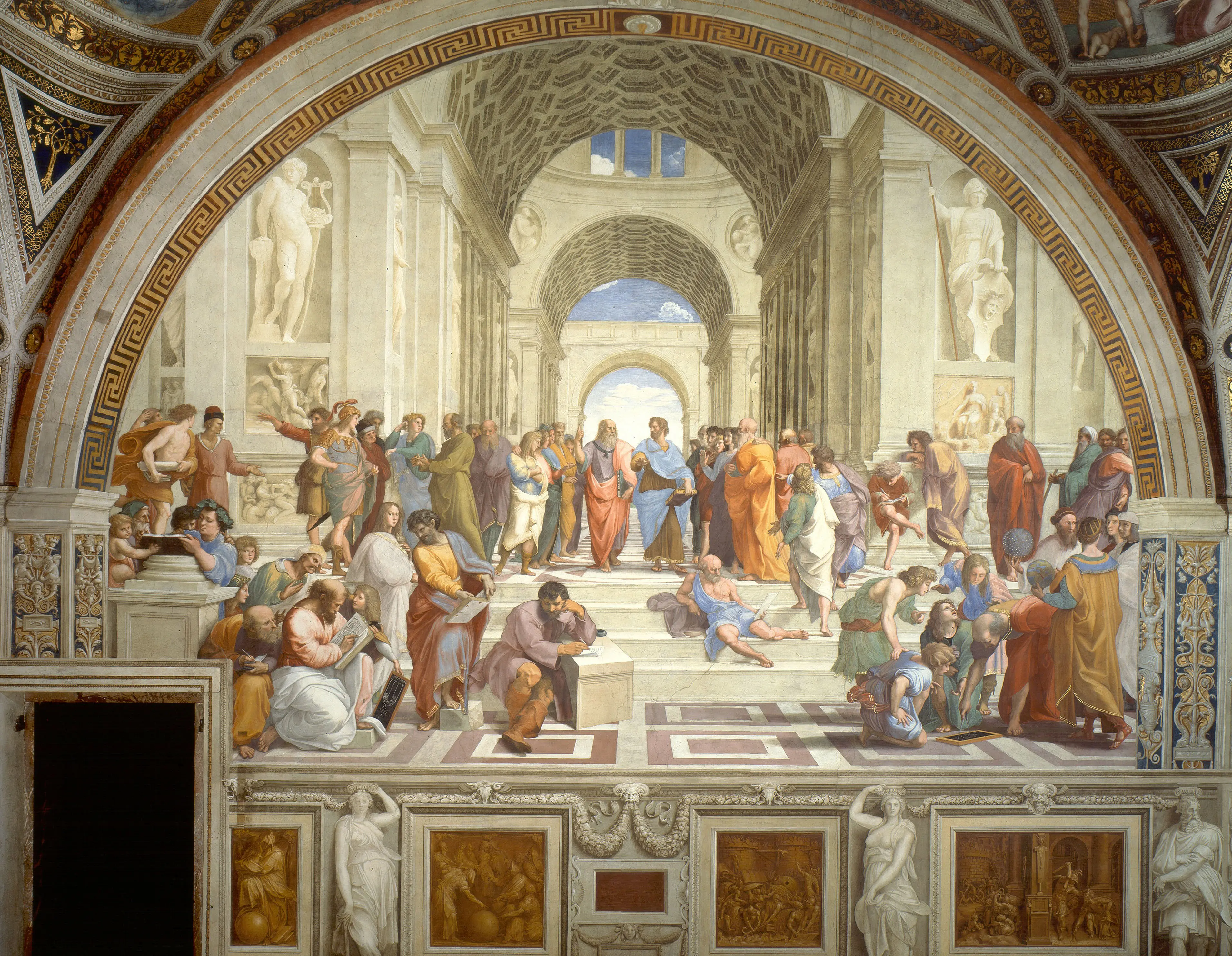

What if an entire history of human thought could be placed inside one room? Raphael’s The School of Athens does exactly that. It is not simply a painting of ancient philosophers. It is a picture of humanity searching for truth, arguing about reality, questioning knowledge, and trying to understand how we should live.
WHAT IS THE SCHOOL OF ATHENS?
The School of Athens is one of the most famous frescoes of the Italian Renaissance. It was painted by Raphael, one of the great masters of the period, between roughly 1509 and 1511.
The fresco is located in the Stanza della Segnatura, one of the rooms of the Apostolic Palace in Vatican City. It was commissioned during the papacy of Pope Julius II, who wanted the rooms to represent important forms of human knowledge.
The painting belongs to the High Renaissance, a period when European artists and thinkers became deeply interested in the intellectual and artistic achievements of ancient Greece and Rome.
But Raphael was doing more than looking backward.
He was using the ancient world to ask a very Renaissance question:
What can human beings achieve through reason, knowledge, art, and intellectual freedom?
WHO WAS RAPHAEL?
Raphael, or Raffaello Sanzio da Urbino, was born in 1483 in Urbino, Italy, and died in 1520 in Rome.
He grew up in an artistic environment.
His father, Giovanni Santi, was a painter and court artist in Urbino. Raphael therefore encountered art early in life.
His father’s death left Raphael without his parent when he was still young, but Raphael continued his artistic education and eventually became one of the leading painters of the Renaissance.
He worked in Florence, where he encountered the achievements of Leonardo da Vinci and Michelangelo.
Later, he moved to Rome.
This was the turning point.
Rome was a center of enormous political, religious, architectural, and artistic power. Pope Julius II wanted to transform Rome into a cultural capital worthy of the ancient city.
Raphael became part of that project.
His work in the Vatican placed him at the center of Renaissance culture.
THE WORLD THAT PRODUCED THE PAINTING
To understand The School of Athens, we need to understand the Renaissance.
Europe in Raphael’s time was experiencing a renewed interest in classical antiquity.
Ancient Greek and Roman texts were being studied, copied, translated, and debated.
Humanist scholars believed that studying the ancient world could improve human beings.
They studied philosophy, literature, history, rhetoric, poetry, languages, and moral thought.
This movement is known as Renaissance humanism.
But the Renaissance was not simply a rejection of Christianity.
That distinction matters.
Raphael painted The School of Athens inside the private rooms of the Pope.
The painting therefore exists within a Christian environment.
The Renaissance project was often an attempt to bring classical philosophy into conversation with Christian thought.
The result was a fascinating intellectual world in which Plato, Aristotle, mathematics, philosophy, theology, art, and science could appear within the same cultural space.
WHY WOULD A POPE COMMISSION A PAINTING OF PAGAN PHILOSOPHERS?
This is one of the most interesting questions about the fresco.
The figures in the painting are largely ancient Greek philosophers and intellectuals.
They lived centuries before Christianity.
Some held beliefs that Christianity would later reject.
Yet they appear in the Pope’s rooms.
Why?
Because Renaissance thinkers often believed that ancient philosophy contained profound truths about reason, morality, nature, and human existence.
The painting can therefore be understood as part of a larger intellectual project.
Christian revelation was not necessarily being placed against human reason.
Instead, Raphael presents a world in which human reason is capable of discovering important truths.
The painting celebrates intellectual inquiry.
THE ARCHITECTURE OF THOUGHT
Before looking at the individual philosophers, look at the architecture.
The scene takes place inside an enormous classical building.
Massive arches rise toward the ceiling.
Columns stretch upward.
The perspective lines converge toward the center.
Everything leads the eye toward two figures.
Plato and Aristotle.
This is not accidental.
Raphael uses architecture to create philosophical meaning.
The building feels rational, balanced, ordered, and almost cosmic.
Human beings are small compared with the architecture.
Yet they fill the space with intellectual activity.
The message is subtle:
Human beings may be physically small, but the world of thought is enormous.
PLATO AND ARISTOTLE
At the center stand the two most important philosophers in the painting.
Plato is on the left.
Aristotle is on the right.
They are walking together while discussing philosophy.
Plato holds his book, Timaeus.
Aristotle holds his Nicomachean Ethics.
Their gestures reveal their philosophical differences.
Plato raises one hand toward the heavens.
Aristotle extends his hand horizontally toward the earth.
This is one of the most famous visual representations of a philosophical disagreement.
PLATO: LOOK ABOVE
Plato’s gesture points upward.
This reflects his emphasis on a reality beyond the changing physical world.
Plato believed that the things we encounter through the senses are not the highest form of reality.
Behind the changing world of particular things lies a more stable intelligible reality, represented by his theory of Forms.
A beautiful object can decay.
A just society can collapse.
A particular circle can be imperfect.
But Plato believed that Beauty, Justice, and mathematical Forms have a more fundamental kind of reality.
His gesture toward the heavens therefore represents a philosophical movement upward.
From changing appearances toward enduring truth.
ARISTOTLE: LOOK AT THE WORLD
Aristotle’s hand points toward the earth.
His philosophy begins from a different emphasis.
He studied nature carefully.
Animals.
Plants.
Politics.
Ethics.
Logic.
Physics.
Human behavior.
He believed knowledge begins with engagement with the world we experience.
Aristotle does not simply reject abstract thought.
He develops sophisticated theories of form, substance, causation, and metaphysics.
But his method is more closely connected to observation and the investigation of particular things.
Raphael therefore turns a philosophical disagreement into a simple visual contrast.
Plato points upward. Aristotle points toward the world.
The painting’s central question becomes:
Is truth found by rising beyond experience, or by understanding the world before us?
That question has remained alive for more than two thousand years.
THE TWO BOOKS
The books held by Plato and Aristotle deepen the symbolism.
Plato carries Timaeus, a dialogue concerned with the structure and origin of the cosmos.
Aristotle carries Nicomachean Ethics, his major work on moral life and human flourishing.
The choice is meaningful.
Plato represents metaphysical speculation about reality.
Aristotle represents ethics grounded in human activity and flourishing.
Together they represent two enormous dimensions of philosophy:
What is reality?
and
How should we live?
THE PHILOSOPHERS AROUND THEM
Raphael does not present the philosophers as isolated statues.
They interact.
They argue.
They teach.
They read.
They write.
They calculate.
They observe.
They move.
The painting therefore looks less like a museum of dead thinkers and more like a living intellectual community.
That is important.
Philosophy is presented as conversation.
Truth is not shown as something possessed by one person.
It is pursued through disagreement.
SOCRATES
On the left side of the composition is Socrates, recognizable by his older appearance and the way he engages those around him.
Socrates is shown talking and questioning.
This is appropriate because his philosophy was largely conducted through dialogue rather than books.
He famously asked questions about justice, virtue, knowledge, and the good life.
His method was simple but disruptive.
Instead of telling people what they should believe, he asked them questions until their assumptions became visible.
For Socrates, philosophy was not merely collecting information.
It was examining one’s life.
Raphael therefore places him among people who are actively engaged in intellectual exchange.
Socrates represents the philosopher as a questioner.
PYTHAGORAS
Near the lower left is Pythagoras, associated with mathematics and numerical harmony.
He is shown writing.
Around him are people interested in mathematical relationships.
Pythagorean thought connected mathematics with the structure and harmony of the cosmos.
This introduces another important dimension of the painting.
Truth is not only philosophical argument.
It can also appear through mathematical order.
The presence of mathematics beside philosophy suggests that the Renaissance imagination saw intellectual knowledge as interconnected.
EUCLID
Near the lower right is a figure commonly identified as Euclid.
He is shown demonstrating geometry to a group of students.
His body bends toward the ground as he uses a geometric instrument.
The scene emphasizes demonstration.
Here, truth is not simply announced.
It is shown through reasoning.
A mathematical proposition can be constructed step by step.
This makes Euclid an important symbol of rational demonstration.
PTOLEMY
Another figure on the right is traditionally identified as Ptolemy.
He holds a globe representing the Earth.
His presence introduces astronomy and cosmology.
But there is an interesting historical irony.
The painting includes intellectual figures from different centuries who never actually lived together.
Pythagoras, Socrates, Plato, Aristotle, Euclid, and Ptolemy belonged to very different historical periods.
Raphael deliberately places them together.
This is not a historical reconstruction.
It is an imagined intellectual community.
DIOGENES
In the foreground lies a figure commonly identified as Diogenes.
Unlike the organized groups around him, he sits or reclines almost independently.
This fits his philosophical reputation.
Diogenes was associated with Cynicism, a philosophy that rejected conventional social values and emphasized living according to nature and simplicity.
He famously challenged social conventions.
His presence adds an important element to the painting.
Not everyone seeking truth must fit comfortably into society.
Sometimes philosophy requires rejecting society’s expectations.
HERACLITUS
The brooding figure in the foreground is traditionally identified as Heraclitus.
He appears more isolated than many of the others.
Heraclitus was famous for his philosophy of change and his claim that reality is characterized by constant transformation.
The figure is also widely understood to have been modeled after Michelangelo.
This creates an interesting bridge between ancient philosophy and Renaissance art.
Raphael was not simply reconstructing ancient Athens.
He was bringing the intellectual world of antiquity into his own time.
THE FIGURE OF APOLLO
On one side of the surrounding room is Apollo.
Apollo represents music, poetry, harmony, and intellectual culture.
His presence matters because the fresco is not only about philosophy in the narrow sense.
It is about the organization of human knowledge.
Reason exists alongside art.
Mathematics exists alongside poetry.
Philosophy exists alongside music.
The Renaissance ideal was broad.
A fully developed human being should not be reduced to one narrow specialization.
ATHENA
Opposite Apollo appears Athena, associated with wisdom and strategic intelligence.
Together, Apollo and Athena frame the intellectual world of the fresco.
The message becomes broader.
Human knowledge involves reason, wisdom, art, mathematics, philosophy, and intellectual discipline.
The painting is therefore not merely a philosophical encyclopedia.
It is a vision of culture.
WHY ARE THE PHILOSOPHERS DOING DIFFERENT THINGS?
One of the painting’s greatest achievements is its movement.
Look carefully.
Nobody seems frozen.
Some people are walking.
Some are speaking.
Some are writing.
Some are listening.
Some are teaching.
Some are calculating.
Some are arguing.
Some appear completely absorbed in their own thoughts.
This movement gives the painting philosophical meaning.
Knowledge is not presented as a finished object.
It is presented as an activity.
Philosophy happens when people think, question, disagree, explain, and revise their ideas.
Raphael has therefore painted not merely philosophers, but the activity of philosophy itself.
THE CENTRAL PHILOSOPHICAL CONFLICT
The greatest intellectual tension in the painting is represented by Plato and Aristotle.
But the disagreement is larger than two individuals.
It represents competing approaches to knowledge.
Plato emphasizes the intelligible.
Aristotle emphasizes the observable world.
Plato asks us to look beyond appearances.
Aristotle asks us to understand the world through careful investigation.
Plato searches for what is eternal.
Aristotle investigates what exists in change and development.
Yet Raphael does something remarkable.
He does not choose one and eliminate the other.
He places them together.
They are walking side by side.
This is perhaps the deepest philosophical message of the painting.
Truth may require disagreement.
THE SCHOOL OF ATHENS AS A MAP OF KNOWLEDGE
The fresco can be understood as a visual map.
At the center are metaphysics and ethics.
Around them are logic, mathematics, natural philosophy, astronomy, politics, and other forms of intellectual inquiry.
The figures represent different approaches.
The architecture represents order.
The groups represent intellectual communities.
The central pair represents philosophical disagreement.
The entire composition therefore becomes a model of knowledge.
But it is not a modern scientific map.
It reflects Renaissance ideas about the unity of knowledge.
The boundaries between philosophy, mathematics, art, science, and theology were not as rigid as they often appear today.
WHY ARE ANCIENT PHILOSOPHERS IN A CHRISTIAN BUILDING?
This question brings us back to the larger purpose of the fresco.
The Vatican was not presenting ancient pagan philosophy as a replacement for Christianity.
Instead, the fresco can be understood within Renaissance attempts to reconcile classical learning with Christian intellectual culture.
The ancient philosophers represent humanity’s capacity to seek truth through reason.
Christian theology represented revealed truth.
The larger cultural project was to ask whether these forms of knowledge could coexist.
The fresco’s placement alongside other major intellectual themes makes this especially clear.
Raphael was constructing a visual philosophy of knowledge.
THE SCHOOL OF ATHENS AND THE RENAISSANCE HUMANIST
The painting expresses a central humanist belief:
Human beings are capable of intellectual development.
They can study the past.
They can question tradition.
They can investigate nature.
They can reason mathematically.
They can debate morality.
They can create beauty.
They can search for truth.
This does not mean Renaissance humanists believed human beings were perfect.
It means they believed human capacities were worth developing.
The human being becomes an active participant in the search for knowledge.
ART AS PHILOSOPHY
Raphael does something philosophers usually do with arguments.
He creates distinctions.
Plato and Aristotle become opposing intellectual directions.
The architecture creates order.
The groups create different forms of inquiry.
The gestures create arguments.
The spatial arrangement creates a hierarchy.
The painting therefore communicates ideas without explaining them in sentences.
This is what makes it philosophically powerful.
You can understand something about Plato and Aristotle before reading either philosopher simply by looking at their bodies.
Plato points upward.
Aristotle points outward.
The painting turns abstract thought into visual language.
THE ARGUMENT OF THE PAINTING
If we treat The School of Athens as an argument rather than simply an image, its structure becomes clearer.
Claim:
Human beings possess the capacity to pursue truth through reason and knowledge.
Evidence:
The painting presents philosophers, mathematicians, astronomers, and teachers actively engaged in intellectual inquiry.
Structure:
Different thinkers disagree about reality, morality, mathematics, nature, and knowledge.
Conclusion:
Intellectual disagreement does not destroy the search for truth.
It can become part of the search itself.
This is why the philosophers are not arranged in separate rooms.
They inhabit the same intellectual world.
THE PAINTING’S GREAT CONTRADICTION
There is a fascinating tension inside The School of Athens.
The painting celebrates rational inquiry.
But it exists inside a religious institution.
It celebrates ancient pagan philosophers.
But it was commissioned by the Pope.
It presents disagreement.
But it appears inside a powerful institution with established religious authority.
It celebrates intellectual freedom.
Yet its meaning is shaped by the political and religious world that commissioned it.
This does not make the painting hypocritical.
It makes it historically interesting.
The Renaissance was not simply a battle between reason and religion.
It was a period of negotiation between them.
RAPHAEL’S OWN PRESENCE
Raphael is also believed to have included himself in the fresco.
He appears near the right side of the composition, traditionally identified as the young man with dark hair looking outward toward the viewer.
If this identification is correct, Raphael has placed himself among the great intellectuals of antiquity.
That is a bold artistic gesture.
He is not saying:
“I am equal to Plato.”
But he is visually placing the Renaissance artist inside the continuing history of intellectual culture.
The past is not dead.
The Renaissance is joining the conversation.
THE SCHOOL OF ATHENS AND THE IDEA OF PROGRESS
The painting also expresses a particular idea of intellectual progress.
Knowledge has a history.
One thinker builds on another.
A mathematical discovery becomes part of later science.
A philosophical question survives across generations.
A disagreement becomes the foundation for a new theory.
This is why Raphael does not depict one philosopher alone.
He depicts a tradition.
The painting says, in effect:
Human thought is a conversation across time.
That idea remains deeply important today.
WHAT THE PAINTING GOT RIGHT
The painting captures something fundamental about intellectual life.
No single thinker possesses all truth.
Plato was brilliant, but Aristotle challenged him.
Socrates questioned assumptions.
Pythagoras emphasized mathematics.
Euclid represented rigorous demonstration.
Ptolemy represented cosmological inquiry.
Diogenes challenged social conventions.
Different intellectual personalities approach reality differently.
The painting therefore resists intellectual uniformity.
It suggests that knowledge becomes richer when different methods confront one another.
That remains true in modern science and philosophy.
A field progresses because people disagree.
WHAT THE PAINTING LEAVES OUT
But the painting also has limitations.
Its world is overwhelmingly male.
Women are almost entirely absent from this imagined intellectual community.
That reflects the intellectual institutions of the Renaissance and ancient world, but it also reveals the exclusions built into those traditions.
The painting also creates an idealized vision of philosophical life.
Real intellectual history was much messier.
Philosophers disagreed violently.
Political power influenced scholarship.
Religious institutions controlled education.
Many people had little access to formal learning.
The fresco transforms this complicated reality into an elegant intellectual harmony.
That beauty is part of its power.
But it can also hide history’s conflicts.
THE SCHOOL OF ATHENS AND MODERN EDUCATION
The painting remains powerful because it resembles an ideal classroom.
A good university is not simply a place where information is transferred.
It is a place where people question one another.
A student asks.
A teacher responds.
Another student disagrees.
Someone provides evidence.
Someone discovers an error.
Another person develops a new argument.
This is the intellectual environment Raphael imagined.
The painting therefore remains a powerful symbol of education.
THE SCHOOL OF ATHENS AND SCIENCE
The presence of mathematics, astronomy, and philosophy is especially important.
Modern science separated itself from philosophy into specialized disciplines.
But historically, these subjects were deeply connected.
Newton could be called a natural philosopher.
Galileo worked within philosophical debates about nature.
Ancient thinkers investigated mathematics, physics, ethics, politics, and metaphysics together.
Raphael’s painting reminds us of a time when knowledge was imagined as one interconnected pursuit.
Modern specialization has enormous advantages.
But it can also create narrow intellectual silos.
The fresco offers a different ideal:
Know your field, but understand that your field is part of a larger human search for understanding.
THE SCHOOL OF ATHENS AND AI
The painting has an unexpected connection to the modern age.
Today, artificial intelligence can generate text, images, mathematical proofs, scientific hypotheses, and arguments.
Machines can participate in activities that once seemed uniquely human.
This makes Raphael’s central question more important.
What is human intellectual activity?
Is intelligence simply the ability to produce correct answers?
Or does intellectual life also involve questioning assumptions, deciding what is worth knowing, choosing between competing values, and understanding why a question matters?
The School of Athens presents knowledge as a community of thinkers engaged in meaningful inquiry.
That is different from simply producing answers.
An AI system may calculate extremely well.
But the human philosophical problem remains:
What questions should we ask?
Which answers should we trust?
What counts as wisdom rather than information?
Raphael’s philosophers still have something to teach us here.
WHY THE SCHOOL OF ATHENS STILL MATTERS
The painting matters because it captures a human ambition that has never disappeared.
We want to understand reality.
We want to know what is true.
We want to understand ourselves.
We want to discover how the universe works.
We want to know how we should live.
We want to distinguish knowledge from illusion.
Plato and Aristotle did not agree.
Socrates questioned everyone.
Diogenes rejected convention.
Pythagoras searched for mathematical order.
Euclid demonstrated geometric truth.
Ptolemy tried to map the heavens.
They represent different answers to the same human desire:
to understand.
And Raphael’s greatest achievement was to show that this search does not belong to one philosopher, one religion, one century, or one civilization.
It belongs to humanity.
THE SCHOOL OF ATHENS IN SIMPLE WORDS
The School of Athens is a painting about the human search for knowledge.
Plato represents the search for higher and eternal truths.
Aristotle represents the study of the world and human life.
Socrates represents questioning.
Pythagoras represents mathematical order.
Euclid represents rational demonstration.
Ptolemy represents astronomy and the attempt to understand the cosmos.
Diogenes represents resistance to social convention.
Together, they represent different paths toward understanding.
The painting does not tell us which philosopher is correct.
Instead, it places them in conversation.
That may be its deepest message.
THE FINAL QUESTION
The School of Athens begins with a simple human desire:
We want to know.
But the painting refuses to give us a single path toward knowledge.
Should we look upward with Plato?
Should we study the world with Aristotle?
Should we question everything like Socrates?
Should we search for mathematical order like Pythagoras?
Should we challenge society like Diogenes?
Or should we do all of these things together?
Raphael’s answer is visual rather than verbal.
The philosophers walk together.
They argue.
They teach.
They listen.
They disagree.
And they continue searching.
That is why The School of Athens is more than a Renaissance fresco.
It is a picture of philosophy itself.
The search for truth does not end when we find one answer. It begins again when someone asks a better question.