Tabula III
The Death of Socrates
Jacques-Louis David, 1787
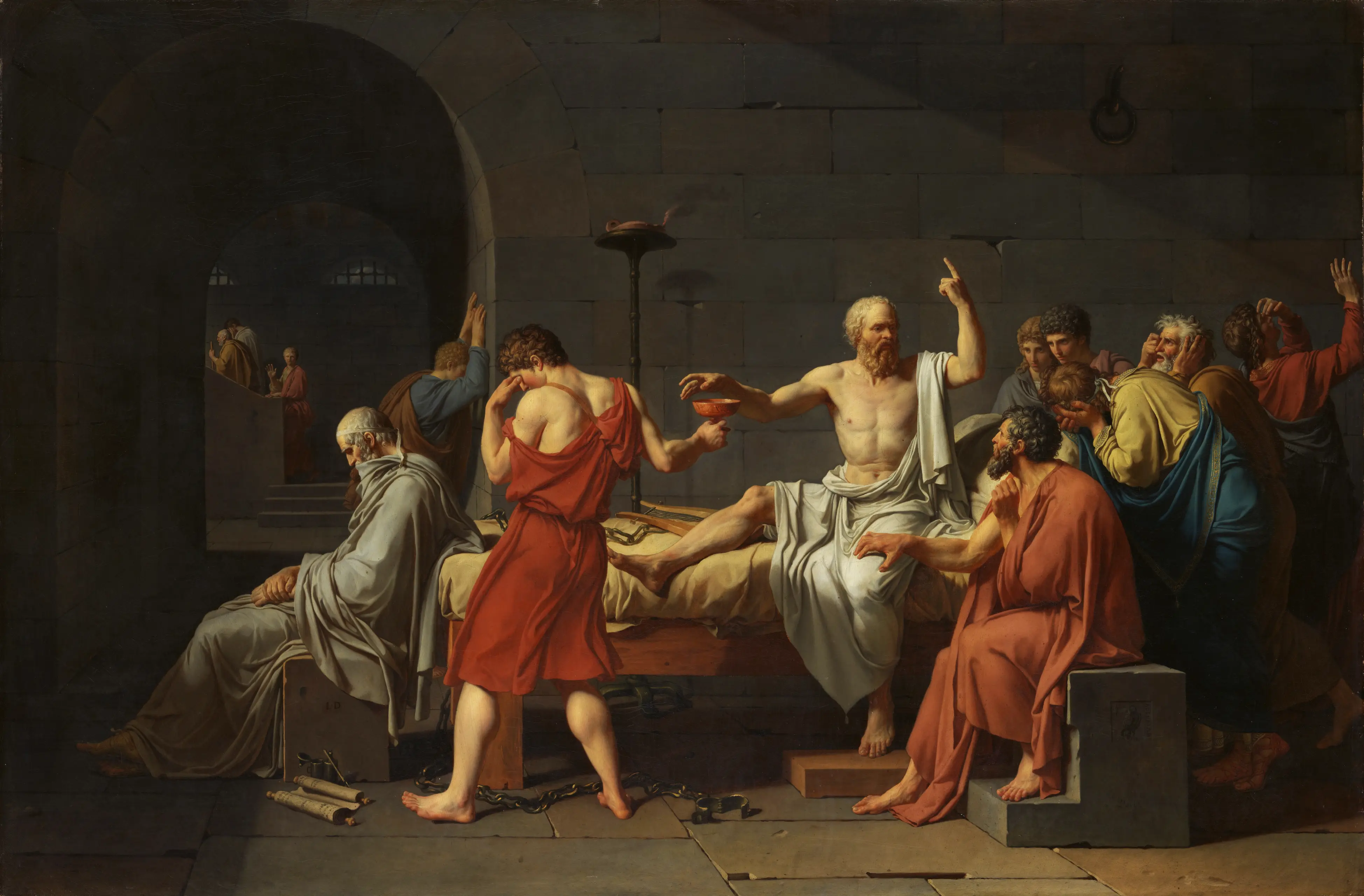

A dying man reaches for the cup of poison while everyone around him grieves. Yet Socrates does not look afraid. He is still teaching. Jacques-Louis David’s The Death of Socrates is not simply a painting of an execution. It is a philosophical argument about truth, duty, law, courage, and the price of refusing to betray what you believe.
WHAT IS THE DEATH OF SOCRATES?
The Death of Socrates is a Neoclassical painting by the French artist Jacques-Louis David, completed in 1787.
It depicts the final moments of the ancient Greek philosopher Socrates, who was sentenced to death by an Athenian court in 399 BCE.
The painting is based primarily on Plato’s account of Socrates’ final hours in the dialogue Phaedo.
Socrates has been condemned to die by drinking hemlock.
His friends are gathered around him.
Some are crying.
Some are reaching toward him.
Some look away.
But Socrates remains calm.
He reaches toward the poison.
His body is still strong.
His finger points upward.
His eyes are directed toward the person bringing the cup.
The scene is filled with movement, but its center is strangely still.
That stillness is the key to the painting.
Socrates is about to die, but he is still behaving according to the philosophy he spent his life defending.
WHO WAS JACQUES-LOUIS DAVID?
Jacques-Louis David was born in Paris in 1748 and died in Brussels in 1825.
He became the leading painter of French Neoclassicism.
David lived during an extraordinary period of political upheaval.
He witnessed the intellectual legacy of the Enlightenment, the French Revolution, the rise and fall of Napoleon, and the restoration of the French monarchy.
His art repeatedly dealt with sacrifice, political loyalty, heroism, death, and civic duty.
This makes The Death of Socrates particularly interesting.
David was not simply fascinated by ancient Greece.
He was interested in the moral power of people who were willing to sacrifice their lives for principles.
Socrates became the perfect subject.
THE WORLD OF THE PAINTING
The painting was created in 1787, only two years before the French Revolution began.
France was experiencing enormous social and political tensions.
The monarchy was under financial pressure.
Social inequality was increasingly criticized.
Enlightenment thinkers were questioning traditional authority.
Ideas about citizenship, liberty, reason, and political legitimacy were spreading.
In this environment, ancient Greece and Rome became powerful sources of political symbolism.
The ancient world was imagined as a place where citizens could demonstrate courage, virtue, sacrifice, and devotion to public principles.
David’s painting belongs to this cultural moment.
It is ancient history painted with contemporary political concerns in the background.
WHY DID DAVID PAINT SOCRATES?
The obvious answer is that Socrates was a famous philosopher.
But that is not enough.
David could have painted Socrates teaching.
He could have painted Socrates debating.
Instead, he chose the moment of death.
Why?
Because death creates a test.
It is easy to claim that you believe something.
It is harder to maintain that belief when it costs you everything.
Socrates had spent his life questioning people about virtue and justice.
Now he must demonstrate whether he actually believes what he taught.
David turns philosophy into action.
THE CENTRAL QUESTION
The painting asks:
What should a person do when their principles conflict with their survival?
Suppose you believe that something is morally right.
Then imagine that obeying your conscience will cost you your freedom.
Then imagine it will cost you your life.
Do you compromise?
Do you escape?
Do you remain faithful?
Socrates chooses fidelity to his principles.
David presents this choice as heroic.
But the painting also leaves us with a difficult question:
Is dying for your principles always morally admirable, or can commitment become stubbornness?
That tension makes the painting more than a simple celebration of courage.
THE STORY BEHIND THE PAINTING
Socrates was tried by an Athenian jury.
He was accused of corrupting the young and failing to respect the city’s gods.
He was found guilty and sentenced to death.
His friends believed he could escape.
According to Plato’s Crito, they encouraged him to leave.
Socrates refused.
He argued that escaping would undermine his relationship with the laws of Athens and contradict the principles he had defended.
Then, according to Plato’s Phaedo, the day of execution arrived.
Socrates spent his final hours discussing philosophy with his friends.
Eventually the poison was brought.
That is the moment David chooses.
THE COMPOSITION
David creates a remarkably controlled composition.
The room is dark.
A bright area surrounds Socrates.
The figures form groups around him.
But the strongest visual lines lead toward Socrates and the cup.
The painting is carefully balanced.
There is grief everywhere.
Yet Socrates dominates the scene.
This is not accidental.
David wants us to see that the true drama is not simply death.
It is the decision to accept death.
SOCRATES AT THE CENTER
Socrates is older, but David gives him an unusually powerful body.
His torso is upright.
His muscles remain strong.
His arm stretches toward the cup.
His other hand points upward.
His body almost resembles a statue.
This is not how we normally imagine a dying man.
A dying person should appear weak.
David makes Socrates physically powerful.
Why?
Because the painting is about moral strength.
Socrates is physically close to death.
But philosophically, he appears stronger than everyone else in the room.
THE CUP OF HEMLOCK
The cup is the most important object in the painting.
It contains the poison that will kill Socrates.
Yet Socrates reaches toward it calmly.
The cup therefore becomes more than a weapon.
It becomes a symbol of choice.
Socrates is not being killed in battle.
He is not struck down by an enemy.
He accepts the poison.
This distinction matters.
The painting presents death as something Socrates willingly confronts rather than something that simply happens to him.
The cup becomes the physical symbol of philosophical conviction.
SOCRATES’ FINGER
One of the most striking details is Socrates’ raised finger.
He points upward while reaching toward the cup.
There are several ways to interpret this gesture.
It can represent his continued philosophical discussion.
It can suggest the soul or the world beyond physical life.
It can also emphasize that Socrates’ attention remains on a higher principle rather than on immediate physical survival.
Most importantly, the gesture tells us that Socrates is still thinking.
Even at the moment of death, philosophy continues.
THE BODY AND THE SOUL
The contrast between Socrates’ body and his philosophical attitude is central.
His body is about to die.
But in Plato’s Phaedo, Socrates discusses the possibility that the soul survives death.
The dialogue explores whether philosophy itself is partly a preparation for dying.
The philosopher learns to separate the pursuit of truth from attachment to bodily pleasures and fears.
David does not illustrate every argument in Phaedo.
Instead, he compresses the entire philosophical problem into one image.
The body is mortal.
The mind continues to reason.
The question becomes:
If death is inevitable, should fear of death control how we live?
PLATO IN THE PAINTING
Near the foot of Socrates’ bed sits a young man writing.
He is commonly identified as Plato.
But this creates an interesting problem.
Historically, Plato was probably not present at Socrates’ death.
Plato’s own Phaedo says he was absent because he was ill.
David therefore deliberately changes history.
Why?
Because Plato is not simply there as a historical witness.
He represents the transmission of Socrates’ philosophy.
Socrates dies.
Plato writes.
The body disappears.
The philosophy survives.
This makes Plato’s presence symbolically essential.
THE STRANGE ROLE OF PLATO
There is an even deeper artistic decision.
Plato appears much older than he would have been at the historical execution.
David essentially turns Plato into an old philosopher contemplating the death of his teacher.
This is historically inaccurate.
But symbolically powerful.
The elderly Plato represents memory.
Socrates is dying in front of him.
Yet Plato’s writings will preserve the conversation.
The painting therefore contains a hidden argument:
Ideas can survive the people who create them.
CRITO
The man holding Socrates’ hand is traditionally identified as Crito.
Crito was a close friend of Socrates.
In Plato’s dialogue Crito, he tries to persuade Socrates to escape.
Socrates refuses.
David therefore places Crito physically close to Socrates.
His posture suggests emotional distress.
He is trying to deal with the human reality of the situation.
Crito represents friendship and attachment.
Socrates represents principle.
The tension between them is crucial.
FRIENDSHIP VERSUS PRINCIPLE
Crito wants Socrates to live.
This is completely understandable.
If you love someone, you do not want them to die because of a political judgment.
But Socrates refuses to escape.
The painting therefore creates a painful conflict.
What do we owe our friends?
What do we owe our principles?
What happens when those obligations conflict?
Socrates chooses principle.
But David does not make Crito look foolish.
He makes him look human.
This prevents the painting from becoming a simple moral poster.
The emotional cost is visible.
THE GRIEVING FIGURES
The people around Socrates react differently.
Some mourn openly.
Some look away.
Some seem emotionally overwhelmed.
These figures are important because they represent the human side of death.
Socrates may be calm.
But death still hurts the people who love him.
This prevents the philosophical ideal from completely erasing emotion.
The painting contains two worlds.
Socrates’ world of principle.
And his friends’ world of grief.
Neither disappears.
SOCRATES’ FAMILY
Women and children appear in the background.
They are often understood as members of Socrates’ family.
Their placement is significant.
They are moving away from the central scene.
Socrates’ death is happening while ordinary life continues.
Children still exist.
Families still exist.
People still have emotions.
History does not stop simply because a philosopher dies.
This contrast makes the scene more human.
THE MAN BRINGING THE POISON
The man carrying the cup is often identified as the executioner or jailer.
His posture is very different from Socrates’.
He appears emotionally affected.
His face and body language suggest discomfort.
He does not look like a triumphant killer.
He looks like someone who does not want to perform the task.
This is an important choice.
The painting does not make the executioner a simple villain.
He is performing an official duty.
That raises another philosophical question:
What happens when a person is ordered to do something they personally believe is terrible?
The executioner obeys.
Socrates refuses to escape.
Both men are constrained by a system larger than themselves.
LAW AND MORALITY
This brings us to the central political problem of the painting.
Socrates has been condemned by law.
But does legal judgment make something morally right?
This question is enormous.
A government can make something legal.
That does not automatically make it just.
A law can be unjust.
A legal system can make mistakes.
A majority can condemn an innocent person.
Socrates’ death therefore forces a distinction between legality and justice.
Yet Socrates’ own response is complicated.
He does not escape.
He appears to accept the authority of the city’s legal process.
This creates a tension that David’s painting does not resolve.
Should we obey unjust laws?
Should we resist?
Should we accept punishment after resisting?
The painting leaves these questions hanging.
SOCRATES AND CIVIL DISOBEDIENCE
Socrates is sometimes treated as an early symbol of civil disobedience.
But the comparison must be handled carefully.
Socrates did not simply break the law and flee.
He criticized society openly.
He refused to abandon his philosophical mission.
But when sentenced, he accepted the legal consequences.
Later thinkers such as Henry David Thoreau, Mahatma Gandhi, and Martin Luther King Jr. developed very different theories of civil resistance.
Their position was often that unjust laws should be resisted.
Socrates’ case is more complicated.
He challenges authority through questioning.
But he does not respond to his sentence through escape.
This tension makes him a fascinating figure in the history of political morality.
THE PHILOSOPHICAL ARGUMENT OF THE PAINTING
David’s painting can be understood as an argument.
Claim:
A person’s principles can be more important than physical survival.
Situation:
Socrates has been condemned to death.
Alternative:
He could escape and preserve his life.
Choice:
He accepts the poison.
Meaning:
His commitment to philosophical and moral principles is stronger than his fear of death.
But there is another possible interpretation.
Counterargument:
A person can become so committed to principle that they stop questioning whether their principle is correct.
This creates a problem.
Socrates teaches us to question everything.
But what if Socrates himself is wrong?
The painting celebrates certainty at precisely the moment when Socrates’ own philosophical method encourages doubt.
That is one of its deepest tensions.
COURAGE
The painting is fundamentally about courage.
But what is courage?
Is courage simply not being afraid?
Socrates appears fearless.
But genuine courage does not necessarily mean the absence of fear.
It can mean acting according to a principle despite fear.
Socrates knows he is going to die.
Yet he acts.
This gives the scene its emotional power.
The painting says:
Courage is not necessarily defeating death. Sometimes it is refusing to let fear decide how you live.
DEATH AS THE FINAL TEST
Socrates spent his life discussing virtue.
Now death tests whether his philosophy is real.
This is important because many philosophical claims remain abstract.
Someone can say:
“I value courage.”
But what happens when courage becomes dangerous?
Someone can say:
“I value truth.”
But what happens when truth destroys your reputation?
Someone can say:
“I value justice.”
But what happens when justice costs you your career?
Socrates’ execution transforms philosophy into an existential test.
His death asks:
Do you actually believe what you say you believe?
THE ROLE OF EMOTION
At first glance, David seems to make Socrates almost emotionless.
But the painting is not anti-emotion.
The grief of the other figures is intense.
The emotional contrast is deliberate.
Socrates controls himself.
His friends cannot.
This creates a philosophical hierarchy.
Reason appears calm.
Emotion appears chaotic.
But should we accept that hierarchy completely?
Modern psychology would make the relationship between reason and emotion much more complicated.
Emotion can distort judgment.
But emotion can also reveal values, relationships, and moral significance.
Crito’s grief is not simply weakness.
It is evidence of love.
This gives the painting another unresolved tension:
Can a good life be governed by reason without losing the human importance of emotion?
DAVID’S OWN POLITICAL WORLD
David painted The Death of Socrates shortly before the French Revolution.
This historical context changes how we see the painting.
The French Enlightenment had encouraged ideas about reason, liberty, citizenship, and criticism of arbitrary authority.
Socrates could therefore appear as an intellectual hero.
He questioned conventional wisdom.
He refused to abandon his principles.
He accepted death rather than surrendering his intellectual integrity.
The painting could speak directly to a society preparing to question its own political order.
But David’s later political career makes the story even more complicated.
He became an active supporter of the French Revolution and later became associated with Napoleon.
He was not simply an artist standing outside politics.
His paintings repeatedly connected art with political ideals.
This makes his portrayal of Socrates particularly interesting.
David was painting an ancient philosopher while living through his own age of political transformation.
NEOCLASSICISM
The style of the painting is Neoclassicism.
Neoclassical artists looked to ancient Greece and Rome for models of order, discipline, virtue, and ideal form.
The figures are clearly defined.
The architecture is controlled.
The composition is balanced.
The bodies are strong and idealized.
Everything feels deliberate.
This style suits the subject.
Socrates himself represents intellectual discipline.
David’s painting style mirrors that discipline.
The form supports the philosophy.
WHY THE PAINTING LOOKS SO ORDERED
Look at the geometry.
The room is built from straight architectural lines.
The figures form carefully organized groups.
Socrates becomes the central horizontal and vertical focus.
The scene contains emotional chaos, but the composition remains controlled.
This creates a powerful contrast.
The characters are emotionally unstable, but the painting itself is rationally ordered.
David makes the viewer feel that philosophical discipline is holding the scene together.
THE LIGHT
Light plays a major role.
Socrates is strongly illuminated.
The background is darker.
The effect is almost theatrical.
Socrates becomes visually separated from the surrounding world.
He is physically inside the room.
But psychologically, he seems to occupy another level.
The light can therefore be read as a symbol of philosophical clarity.
But it also creates a moral judgment.
David is telling us who deserves our attention.
Socrates.
THE HANDS
The hands are among the most important elements of the painting.
Socrates’ hand reaches toward the cup.
His other hand points upward.
Crito reaches toward Socrates.
The executioner extends the poison.
Plato writes.
Different hands perform different actions.
Together, they create a visual narrative.
The cup moves toward Socrates.
Socrates moves toward the cup.
Crito tries to hold onto him.
Plato records.
Everyone is participating in the final moment.
THE PARADOX OF THE CUP
The cup contains death.
Yet Socrates reaches for it.
This reverses the ordinary relationship between human beings and death.
Normally, we run from death.
Here, the dying person moves toward it.
This does not necessarily mean Socrates desires death.
The point is different.
He refuses to allow fear of death to determine his moral decision.
The cup therefore represents not simply death, but the consequence of conviction.
THE PAINTING AS A PHILOSOPHICAL DIALOGUE
The painting itself resembles a Socratic dialogue.
There are competing positions.
Socrates represents principle.
Crito represents friendship.
The executioner represents law and duty.
Plato represents memory and philosophy.
The family represents ordinary human attachment.
Death represents the limit that no human argument can escape.
The painting contains no spoken dialogue.
But every figure is part of an argument.
THE MOST IMPORTANT CONTRADICTION
Here is the deepest contradiction.
Socrates’ entire philosophy is built around questioning.
But at the end, he makes a decision that appears completely certain.
He will not escape.
He will drink the poison.
Why?
Because he believes that some principles are more important than survival.
This creates a question that reaches beyond Socrates:
Can a person remain genuinely philosophical while being committed to a principle strongly enough to die for it?
Perhaps.
But perhaps the willingness to die for an idea can also become dangerous.
History is full of people willing to die for beliefs that were deeply wrong.
So Socrates’ courage cannot by itself prove that his beliefs were correct.
COURAGE DOES NOT EQUAL TRUTH
This is an important distinction.
A person can be brave and wrong.
A person can sacrifice themselves for an unjust cause.
A person can die for an illusion.
Therefore the moral power of Socrates’ death cannot simply establish the truth of everything Socrates believed.
What it demonstrates is something different.
He was willing to live according to his convictions.
That is morally significant.
But it does not make him infallible.
SOCRATES AND ARISTOTLE
Aristotle later challenged some Socratic assumptions about virtue.
Socrates emphasizes knowledge.
Aristotle emphasizes habituation.
For Aristotle, becoming courageous is not simply understanding courage.
You must practice courageous action.
You develop character through repeated choices.
This gives us a different interpretation of David’s painting.
Perhaps Socrates’ final act is not simply knowledge becoming action.
It is the culmination of a lifetime of practice.
He has spent decades developing the character necessary to remain calm under extreme pressure.
This makes the painting compatible with both Socratic and Aristotelian questions.
SOCRATES AND KANT
The painting can also be connected to Kant.
Kant argues that moral action involves acting according to principles rather than simply following desire.
Socrates refuses to escape because doing so would conflict with principles he accepts.
His decision therefore resembles Kant’s emphasis on duty.
But there is an important difference.
Kant develops a systematic theory of universal moral law.
Socrates does not.
Socrates’ morality emerges through questioning and philosophical dialogue.
David’s painting can therefore be read as an image of moral autonomy before modern theories gave that idea a formal structure.
SOCRATES AND THE IDEA OF HUMAN DIGNITY
The painting also raises questions about dignity.
Socrates cannot control the judgment of the court.
He cannot control death.
But he can control how he responds.
This distinction is powerful.
External circumstances can take away freedom in one sense.
But they do not necessarily eliminate the possibility of choosing one’s attitude and principles.
This idea later became important in many theories of human dignity.
A person can be stripped of power.
But the question remains:
Can they still preserve moral agency?
WHAT DAVID GOT RIGHT
David understood that philosophy becomes most powerful when it becomes visible through action.
He also understood that death reveals character.
The painting makes abstract concepts tangible.
Courage becomes a body.
Duty becomes a decision.
Law becomes an executioner.
Friendship becomes Crito’s gesture.
Memory becomes Plato’s writing.
Death becomes the cup.
This is why the painting is so intellectually powerful.
It does not merely tell us that Socrates was courageous.
It makes us watch courage happen.
WHAT DAVID CHANGED
But David also changed the historical story.
His Socrates is more physically heroic than the historical evidence allows us to know.
Plato is placed in the scene even though he was reportedly absent.
The figures are arranged with dramatic precision.
The room is idealized.
The scene is therefore not a documentary record.
It is an interpretation.
David is telling us what Socrates means to him and to his age.
This distinction matters.
Historical painting is never simply history.
It is history filtered through the concerns of the person painting it.
THE POLITICAL MESSAGE
The painting can be read as a warning to political authority.
A government can execute a person.
It cannot necessarily execute an idea.
Socrates dies.
But Plato writes.
Plato’s writings survive.
Socrates becomes one of the most influential figures in Western philosophy.
The Athenian court disappears into history.
Socrates remains.
This creates a powerful reversal.
The state possesses the power to kill the body.
But philosophy can outlive the state.
THE DEATH OF SOCRATES AND MODERN POLITICS
The painting remains relevant whenever individuals confront political authority.
Whistleblowers.
Dissidents.
Journalists.
Activists.
Scientists.
Judges.
Citizens.
Anyone who must decide whether to obey authority or follow conscience faces a version of the Socratic problem.
But the lesson should not be simplified into:
“Always resist authority.”
That would betray Socrates’ own complexity.
The real question is:
When should obedience end and conscience begin?
And perhaps an even harder question:
How can we know that our conscience is right?
Socrates gives us the first question.
His method reminds us to keep asking the second.
THE PAINTING IN SIMPLE WORDS
The Death of Socrates is about much more than death.
Socrates represents moral conviction.
The cup represents the cost of conviction.
Crito represents friendship and emotional attachment.
Plato represents memory and the survival of ideas.
The executioner represents law and institutional duty.
The family represents ordinary human life.
The light emphasizes Socrates as the moral and intellectual center.
The architecture represents order and rational control.
Together, they create a philosophical drama.
A man is about to die.
Everyone around him is reacting emotionally.
But he remains committed to the principles by which he has chosen to live.
WHY THE DEATH OF SOCRATES STILL MATTERS
We live in a world very different from ancient Athens.
Yet the central problem remains.
We constantly face situations where principles compete with convenience.
Truth can cost us.
Integrity can cost us.
Refusing to participate in wrongdoing can cost us.
Speaking against powerful people can cost us.
Admitting that we are wrong can cost us.
The question is not whether most of us will literally face Socrates’ situation.
We will not.
The question is whether we have smaller versions of the same choice every day.
Do we tell the truth when lying would benefit us?
Do we admit ignorance when pretending to know would protect our reputation?
Do we question popular beliefs?
Do we follow our principles only when they are convenient?
Do we value our integrity enough to accept a cost?
These are Socratic questions.
THE FINAL QUESTION
David’s The Death of Socrates begins with death.
But its real subject is life.
What makes a life worth living?
Is survival the highest value?
Should we obey the law even when we believe it is unjust?
When should principle defeat self-interest?
Can courage exist without wisdom?
Can conviction exist without dogmatism?
Can we remain open to questioning while still standing firmly for what we believe?
Socrates gives one answer.
He chooses principle over survival.
David turns that choice into an image of extraordinary power.
But the painting does not give us permission to stop thinking.
Quite the opposite.
It leaves us with the question Socrates himself would probably ask:
If you are willing to die for what you believe, have you first examined whether what you believe is actually true?
That is the deeper lesson of The Death of Socrates.
The highest form of courage is not simply being willing to die for an idea. It is having the courage to examine that idea before you sacrifice your life for it.