Tabula XXIX
The Persistence of Memory
Salvador Dalí, 1931
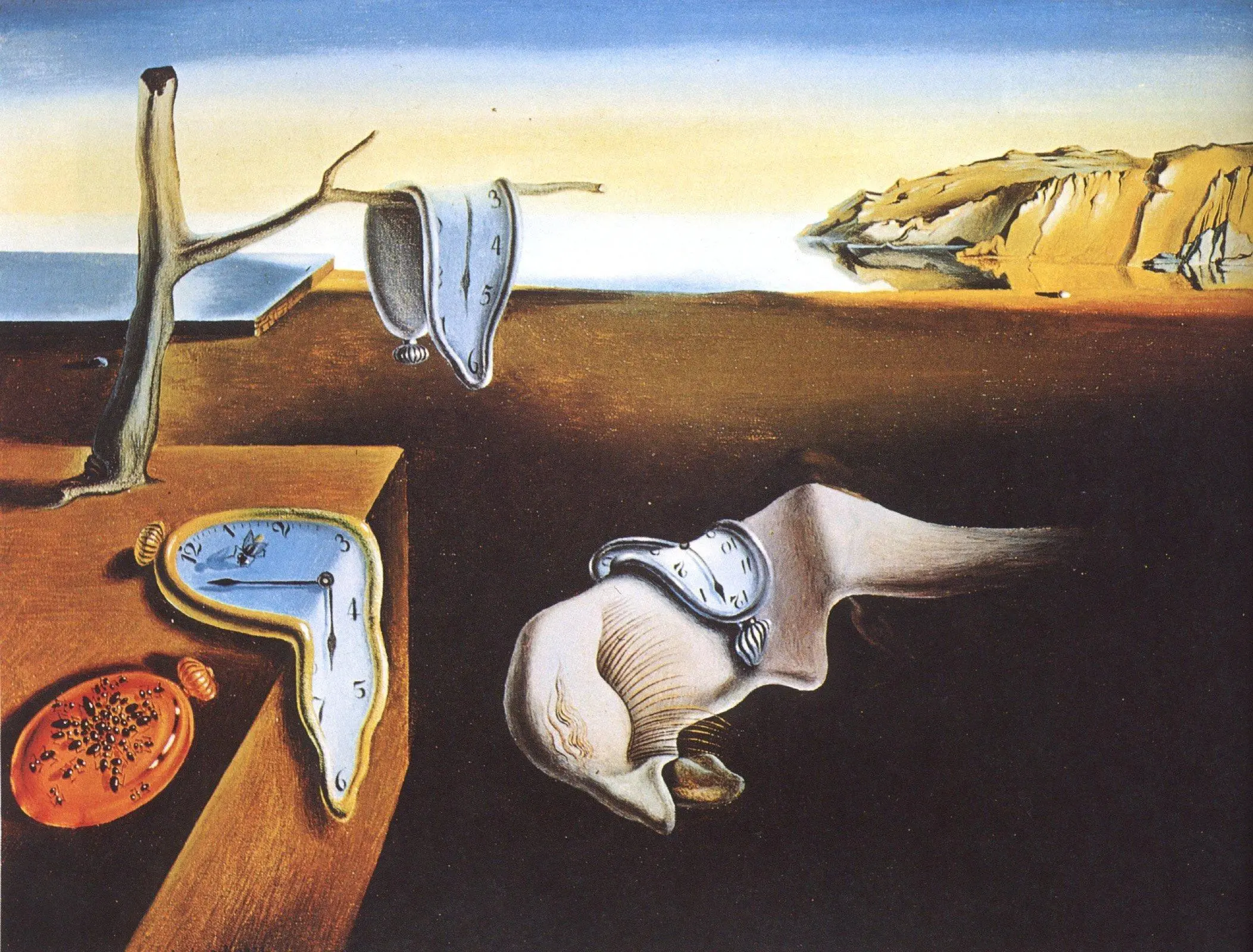
The clocks are melting, the landscape is silent, and yet nothing in the painting feels truly dead. Dalí has created a world where time has lost its certainty, but memory refuses to disappear.
The Artwork at a Glance
The Persistence of Memory is a small oil painting by Salvador Dalí, created in 1931. It measures approximately 24 × 33 cm and is now housed at the Museum of Modern Art (MoMA) in New York.
It is one of the defining images of Surrealism, the twentieth-century artistic movement that explored dreams, unconscious thought, irrationality, desire, and the strange logic of the mind.
At first glance, the painting seems almost absurd.
Clocks melt over a barren landscape.
One hangs over the edge of a rectangular surface.
Another drapes over a strange organic form.
A third lies across the ground.
Ants gather around another clock.
A mysterious soft-bodied shape occupies the center.
In the distance, cliffs and water create an unusually calm landscape.
Everything looks carefully painted.
Nothing makes ordinary sense.
That contradiction is the key.
Dalí does not paint a dream as something blurry and vague.
He paints the impossible with the precision of reality.
The World Behind the Artwork
Dalí created the painting in 1931, during a period of enormous cultural and intellectual change.
The nineteenth-century belief in steady progress had been badly shaken by the First World War.
Europe had experienced mass death on an unprecedented scale.
Traditional political and social structures were unstable.
Modern technology was transforming daily life.
Photography and cinema were changing visual culture.
Psychology was changing ideas about the human mind.
And artists were increasingly interested in what existed beneath conscious thought.
Surrealism emerged from this atmosphere.
The movement developed in the 1920s under the influence of writers and artists such as André Breton, who argued that art should explore dreams, the unconscious, chance, and irrational mental associations.
Surrealists were not simply trying to make strange pictures.
They wanted to challenge the assumption that rational consciousness was the highest or only form of reality.
Dalí took this idea in an intensely visual direction.
The Artist Behind the Work
Salvador Dalí was born in 1904 in Figueres, Spain, and died there in 1989.
He became one of the most recognizable artists of the twentieth century.
His personality was theatrical.
His appearance was theatrical.
His public statements were often provocative.
But beneath the eccentricity was a technically skilled painter.
Dalí had studied traditional European painting closely.
He understood perspective, anatomy, shading, and illusion.
This technical discipline became crucial to his Surrealist method.
He could paint an impossible object so convincingly that the viewer briefly accepts it as real.
That is exactly what happens in The Persistence of Memory.
The clocks are impossible.
But the paint makes them believable.
What We See
The scene is divided into several visual zones.
In the distance is a rocky landscape that resembles the coast around Portlligat, where Dalí later lived and worked.
The landscape is calm.
The sea is quiet.
The cliffs are sharply defined.
In the foreground, however, reality begins to collapse.
Three soft watches appear across the scene.
One hangs over the edge of a rectangular surface.
Another drapes over a pale organic form.
A third lies across the ground.
A fourth watch remains closed and solid, covered with ants.
There is also a strange central form that resembles a sleeping creature or distorted human profile.
The entire landscape feels abandoned.
Yet it is not empty.
Something has happened to time.
The Melting Clocks
The clocks are the painting’s most famous feature.
We normally think of a clock as something rigid.
A clock measures time.
It divides experience into seconds, minutes, and hours.
Its authority comes from precision.
Dalí destroys that authority.
His clocks are soft.
They sag.
They fold.
They hang.
They behave like pieces of cloth.
The object that supposedly measures time becomes physically incapable of maintaining its own structure.
That is the central visual joke.
The clock tells us what time is supposed to be.
The melting clock shows us how unstable our experience of time can feel.
Time as Experience
A clock measures time objectively.
But human beings do not always experience time objectively.
An hour can feel endless when we are suffering.
A whole afternoon can disappear when we are absorbed in something.
A childhood can feel enormous when remembered from adulthood.
A year can feel short when life becomes repetitive.
Time on a clock is uniform.
Time inside consciousness is not.
Dalí’s melting watches can therefore be understood as images of the difference between measured time and lived time.
The painting does not need to say this directly.
It makes the contradiction visible.
The Clock Covered with Ants
The solid watch covered by ants is especially disturbing.
Ants appear repeatedly in Dalí’s work and are often associated with decay, death, anxiety, or decomposition.
But interpretations should remain cautious.
There is no single universal symbolic key that explains every ant in Dalí.
Here, however, the contrast is striking.
The other clocks are soft.
This one remains rigid.
Yet it is being consumed or covered by insects.
The clock may be mechanically intact, but it is not safe from decay.
Time may be measured.
But everything that exists within time eventually changes.
The Central Form
At the center of the painting lies a strange pale form.
It has often been interpreted as a distorted self-portrait or a dream-like representation of Dalí himself.
The shape resembles a face.
A closed eye can be imagined.
A nose-like projection extends outward.
The form appears asleep.
This interpretation is plausible because Dalí repeatedly used distorted forms of his own appearance in his work.
But we should not reduce the object to a simple “portrait of Dalí.”
Its ambiguity is important.
It looks partly human and partly organic.
It seems asleep.
And that makes it fit perfectly into the painting’s world.
The body has become soft.
Time has become soft.
Reality itself has become soft.
Sleep and the Unconscious
The central figure’s apparent sleep connects the painting to one of Surrealism’s major concerns: the unconscious mind.
When we sleep, ordinary logic weakens.
Objects change size.
People become impossible combinations.
Time can disappear.
Places merge.
Events occur without normal causes.
Dreams are convincing while they are happening.
Dalí tries to create a similar experience while keeping the surface of the painting extremely realistic.
This is one of his great achievements.
He makes the irrational look rational.
The Landscape
The landscape is almost the opposite of the melting clocks.
It is hard.
Stable.
Geometric.
Clear.
The cliffs stand firmly.
The sea extends calmly.
The horizon remains straight.
This creates a contrast between external reality and internal experience.
The physical landscape appears stable.
The mind is unstable.
The clocks belong to psychological time.
The landscape belongs to physical space.
The painting places both worlds together without explaining how they can coexist.
That impossibility is precisely what makes the image Surrealist.
How the Artwork Works
Dalí uses an extremely precise painting technique.
Edges are sharp.
Objects are carefully modeled.
Shadows are believable.
Surfaces appear tangible.
The viewer recognizes the visual language of realism.
Then the content breaks reality apart.
This produces a strange psychological effect.
If Dalí had painted the clocks in a loose, abstract style, we could easily dismiss them as fantasy.
Instead, he paints them with convincing physical detail.
The eye says:
This looks real.
The mind says:
This cannot be real.
The conflict between those two responses creates the painting’s tension.
The Power of Shadows
The shadows are important because they help make the impossible objects believable.
A melting clock casts a shadow.
A soft watch has weight.
The objects interact with the ground.
Dalí gives them physical consequences.
This is what makes the fantasy unsettling.
He is not merely drawing strange symbols.
He is constructing an alternate physical world.
A world where watches genuinely behave like soft material.
The Central Idea
At the heart of The Persistence of Memory is a question about time and human consciousness.
What is time when nobody is measuring it?
Does time exist in the same way inside memory?
Can a moment remain alive long after it has disappeared?
Why do some experiences feel permanent even though time continues moving?
The title itself is important.
Dalí does not call the work The Melting Clocks.
He calls it The Persistence of Memory.
The emphasis is therefore not simply on time.
It is on memory resisting time.
Memory and Time
A moment disappears physically.
But memory can preserve it.
A childhood room may no longer exist.
A person may be dead.
A conversation may have happened decades ago.
Yet the mind can bring the moment back.
Memory makes the past strangely present.
The clock says:
That moment is gone.
Memory says:
Not completely.
The painting exists in the tension between those two statements.
The Philosophy of Time
The work naturally raises philosophical questions.
Is time something external to us?
Or is our experience of time created partly by consciousness?
If nobody experienced change, would time have meaning?
Why does the past seem fixed while the future remains open?
Why can memory make something that no longer exists feel present?
Philosophers from Augustine to modern thinkers have struggled with questions like these.
Augustine famously observed the difficulty of explaining what time is, despite our everyday familiarity with it.
Dalí does not provide a philosophical theory of time.
He does something more visual.
He makes the measuring device itself collapse.
Einstein and the Melting Clocks
The painting is sometimes connected to Einstein’s theory of relativity, with claims that Dalí was responding directly to Einstein’s idea that time is relative.
This is often repeated, but the historical connection should be treated carefully.
There is no strong evidence that The Persistence of Memory is a direct visual illustration of relativity.
Dalí’s clocks are much more closely connected to psychological experience, dream imagery, and Surrealist concerns.
Still, the comparison is interesting.
Modern physics had already begun challenging the simple idea of time as one universal, identical flow.
Dalí was exploring another kind of instability.
The instability of time as experienced by the human mind.
Science and art were questioning the old certainty from different directions.
Memory and Mortality
The painting is also deeply connected to death.
The clocks continue to exist.
But they are useless.
They cannot properly measure anything.
The landscape remains.
The human form sleeps.
The ants suggest decay.
Everything is caught between existence and disappearance.
This makes the title even more powerful.
Memory persists because life does not.
We remember precisely because moments vanish.
If everything remained forever, memory would have no purpose.
Memory is born from loss.
The Contradiction of the Title
There is a beautiful tension in the title.
Persistence suggests stability.
Memory suggests something fragile.
Memory can preserve the past.
But memory can also distort it.
We rarely remember events exactly as they happened.
We reshape them.
We forget details.
We exaggerate emotions.
We combine different moments.
We replace reality with interpretation.
So memory persists, but it does not necessarily preserve truth.
Dalí’s unstable clocks fit this perfectly.
The past remains.
But it remains in a softened, altered form.
Reality and Dream
The painting’s deepest contradiction may be between realism and unreality.
Everything looks carefully observed.
Nothing behaves normally.
The landscape looks real.
The clocks behave impossibly.
The shadows are realistic.
The objects are absurd.
The result is neither ordinary reality nor pure fantasy.
It is something between them.
That is the Surrealist world.
Dream logic painted with waking-world precision.
Different Interpretations
One interpretation sees the painting primarily as a meditation on time.
Another emphasizes memory and mortality.
Another focuses on dreams and the unconscious.
Some viewers see the soft clocks as symbols of psychological instability.
Others see them as a playful attack on the authority of clocks and mechanical time.
Some interpretations connect the landscape to Dalí’s Catalan surroundings and personal memories.
None of these explanations needs to cancel the others.
Surrealist art often works through associations rather than fixed meanings.
The mistake would be to assume that every object has one secret code.
Dalí’s paintings are strange precisely because they allow several psychological associations to exist at once.
The Artist’s Intention and the Viewer
Dalí deliberately cultivated mystery.
He developed what he called a “paranoiac-critical” method, using controlled irrationality to generate images and associations.
But his exact intention for every detail is not always recoverable.
This matters.
An artwork can become meaningful beyond the artist’s private explanation.
A modern viewer may see anxiety about digital time.
Another may see aging.
Another may see depression.
Another may see the strange way childhood memories return.
The painting does not have to choose.
Its dream logic allows it to travel between different experiences.
Reception and Historical Importance
The Persistence of Memory quickly became one of Dalí’s most famous paintings and one of the defining images of Surrealism.
Its influence extends far beyond traditional painting.
The melting clock became a cultural symbol of distorted time.
It appears in films, books, advertisements, cartoons, design, and popular discussions of dreams and memory.
Dalí demonstrated that a single visual contradiction could become an entire philosophy of an image.
A clock should be hard.
Make it soft.
That is enough to make the viewer question the entire concept of time.
Why It Still Matters
The painting may be even more relevant in an age of constant clocks.
We have watches on our wrists.
Clocks on our phones.
Calendars.
Notifications.
Deadlines.
Timers.
Work schedules.
Algorithms measuring attention.
Modern life is increasingly organized around precise units of time.
And yet our internal experience remains stubbornly human.
Five minutes of anxiety can feel longer than an hour of happiness.
A childhood summer can seem endless in memory.
A decade can disappear when we look backward.
Technology has made time more measurable.
It has not made time easier to understand.
Dalí’s melting clocks still speak to that contradiction.
A Deeper Reading
Stand back from the painting.
The scene looks almost peaceful.
There is no explosion.
No battle.
No screaming figure.
Nothing dramatic appears to be happening.
And yet something fundamental has gone wrong.
Time has lost its shape.
The clocks cannot perform their one basic function.
The sleeping form suggests consciousness withdrawn from the world.
The ants suggest decay.
The landscape continues silently.
Perhaps this is why the painting is more unsettling than it first appears.
Dalí does not show time as an enemy.
He shows something more frightening.
He shows time as something we may never have understood in the first place.
We imagine time as a straight line because clocks draw circles and numbers around it.
But our lives do not feel like clocks.
We remember the past unevenly.
We experience the present selectively.
We imagine the future before it arrives.
We lose hours.
We replay seconds.
We carry people who are gone.
We return to places that no longer exist.
Memory makes the vanished world present again.
And that may be the real persistence in Dalí’s painting.
Time melts everything eventually, but memory keeps reaching into what has disappeared, asking the past to live for one more moment.