Tabula XXX
David
Michelangelo, c. 1501 – June 8, 1504
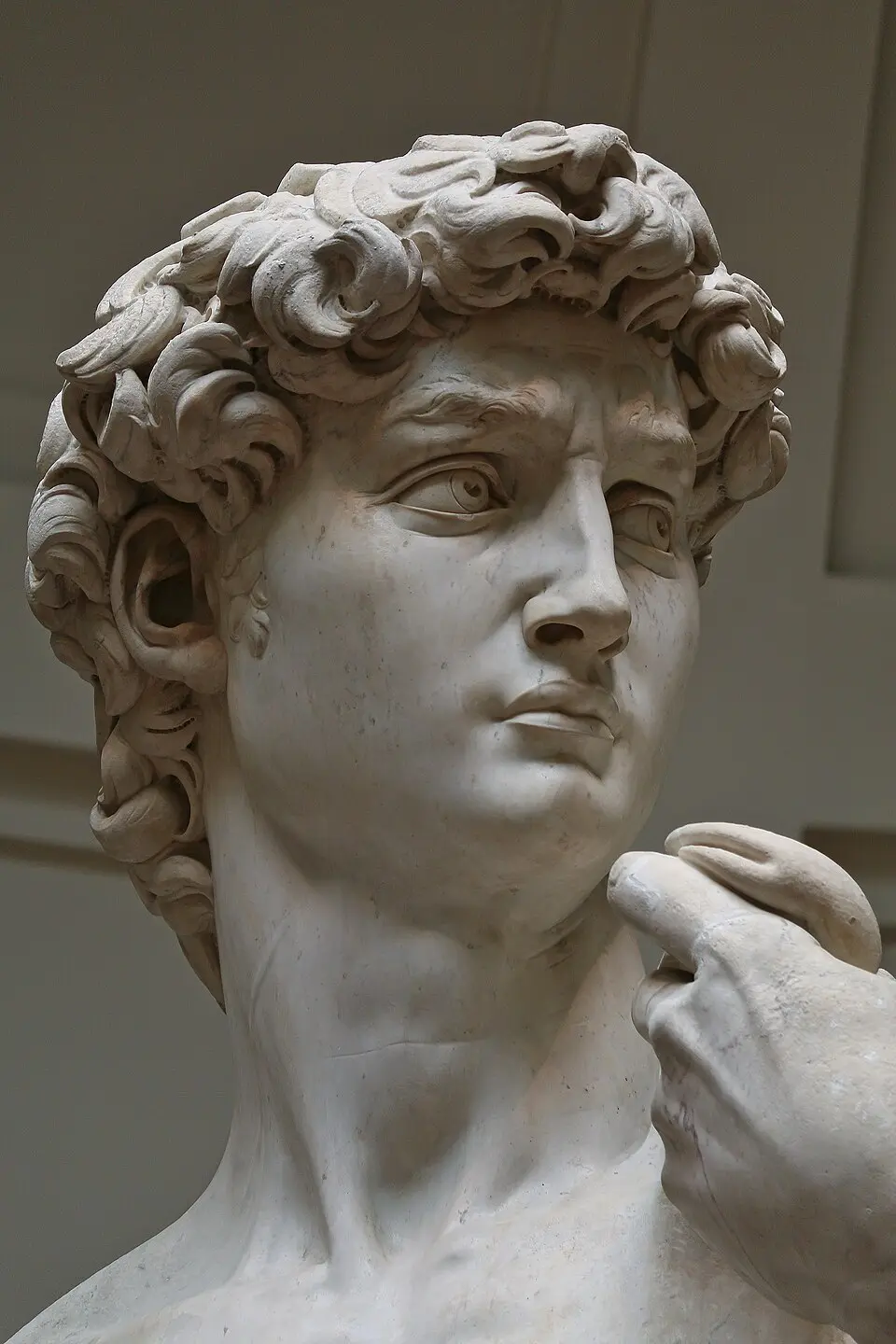
David: The Moment Before the Giant Falls
Michelangelo’s David does not show a hero after victory. It shows something far more powerful: a young man standing alone, knowing that danger is coming, and deciding to face it anyway.
The Artwork at a Glance
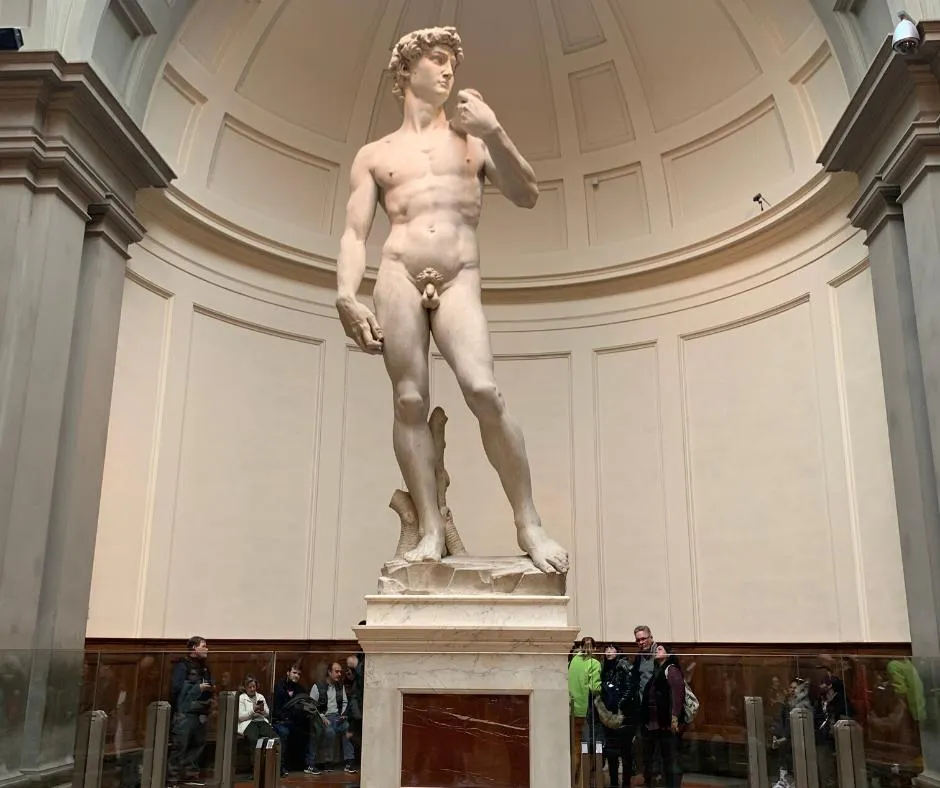
David is a monumental marble sculpture by Michelangelo Buonarroti, created between 1501 and 1504 during the High Renaissance. It stands approximately 5.17 meters (17 feet) tall and is carved from a single block of marble.
The original sculpture is now housed in the Galleria dell’Accademia in Florence, while copies stand elsewhere in the city, including the famous version in Piazza della Signoria.
The subject comes from the biblical story of David and Goliath. David, a young Israelite, defeats the giant warrior Goliath with a sling and a stone.
But Michelangelo makes a striking choice.
He does not show David after the victory.
He does not show Goliath lying dead.
He does not show the stone flying through the air.
He shows David before the battle.
That decision changes everything.
The sculpture becomes less about victory itself and more about the psychological moment before action, when fear, concentration, intelligence, and courage exist together.
The World Behind the Sculpture
Michelangelo created David in Florence during one of the most intellectually and artistically ambitious periods of the Renaissance.
The Renaissance had brought renewed interest in the art and philosophy of ancient Greece and Rome.
Artists studied the human body.
Scholars studied ancient texts.
Architects explored mathematical proportion.
Thinkers reconsidered humanity’s place in the world.
The human being became an important subject of intellectual and artistic attention.
This did not mean Renaissance Italy suddenly became secular.
Christianity remained central to society.
But Renaissance humanism encouraged people to think more deeply about human dignity, intelligence, moral responsibility, and potential.
David stands directly inside that world.
He is a biblical hero.
But he is also an extraordinary image of human capability.
Florence and the Meaning of David
The political setting makes the sculpture even more significant.
Florence was an independent republic whose political identity was deeply connected to the idea of defending itself against more powerful forces.
David was therefore more than a religious character.
He could represent the small and determined defeating the powerful.
The sculpture eventually became closely associated with Florence itself.
David’s struggle against Goliath could be understood as an image of a smaller political community standing against stronger enemies.
We should be careful not to reduce the sculpture to political propaganda.
Michelangelo created a biblical figure within a religious and artistic tradition.
But the sculpture’s public life allowed David to acquire a political meaning.
The young man became an image of strength without domination.
The Artist Behind the Work
Michelangelo was born in 1475 and died in 1564.
He was a sculptor, painter, architect, and poet.
But sculpture remained central to his artistic identity.
He believed marble contained a figure that could be revealed through the sculptor’s work.
His extraordinary understanding of anatomy allowed him to transform stone into bodies that seem capable of thought and movement.
When Michelangelo received the commission for David, the marble block itself had already been worked on by other artists and had acquired a difficult reputation.
Michelangelo nevertheless took on the challenge.
The result became one of the defining achievements of Western sculpture.
What We See
At first, David appears completely still.
He stands upright.
His weight rests primarily on one leg.
His other leg is relaxed.
One arm hangs downward.
The other bends.
His head turns slightly.
His eyes look toward something outside the sculpture.
His body is nude.
His face is serious.
His hands are unusually large.
The entire figure seems caught between stillness and movement.
He is not resting.
He is waiting.
The Face
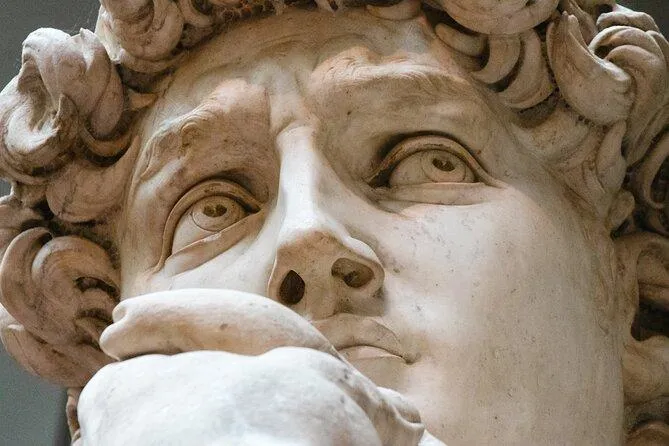
David’s face is perhaps the most psychologically powerful part of the sculpture.
His expression is concentrated.
His eyebrows tighten.
His eyes seem to focus on something beyond us.
There is no triumphant smile.
No expression of victory.
No theatrical display of anger.
Instead, there is thought.
Michelangelo makes courage look like concentration.
David does not appear fearless.
He appears aware.
That distinction matters.
True courage does not necessarily mean the absence of fear.
It can mean acting while fully aware of danger.
The Eyes and the Missing Goliath
David looks toward an opponent who is not physically present.
This creates a fascinating psychological space.
We cannot see what he sees.
But his expression tells us that something is there.
The absent Goliath exists through David’s gaze.
The sculpture therefore contains an invisible character.
The viewer becomes almost part of the scene.
We stand where the threat might be.
David looks past us.
His mind seems to be somewhere beyond the marble.
The Hands
David’s hands are strikingly large.
His right hand hangs beside his thigh.
His fingers are tense.
His left arm bends behind him.
The sling is barely visible.
This is an important detail.
Michelangelo does not make the weapon the center of the composition.
The weapon is almost secondary.
David’s real power seems to be his body and mind.
The hands also communicate tension.
They are not relaxed.
They suggest preparation.
Something is about to happen.
The Contrapposto
One of Michelangelo’s most important technical decisions is the use of contrapposto.
The figure’s weight rests on one leg while the other remains relaxed.
This causes a subtle shift through the hips, shoulders, and spine.
The body does not stand like a rigid column.
It responds naturally to gravity.
The result is both balanced and unstable.
David appears capable of moving at any moment.
This is one of the secrets of the sculpture.
It is made from stone.
But it feels ready to move.
Stillness That Contains Movement
Michelangelo freezes the instant before action.
David has not yet thrown the stone.
But the entire body anticipates the movement.
His muscles are prepared.
His gaze is fixed.
His hands are tense.
His posture is balanced.
The sculpture therefore exists between two moments.
Before action.
And action itself.
We know what will happen next.
That knowledge gives the still figure energy.
The Body
David’s body is idealized rather than anatomically ordinary.
He is muscular.
Young.
Proportional.
Strong.
But Michelangelo does not present strength simply as physical bulk.
David’s body is powerful without being monstrous.
He looks capable but not excessively massive.
This distinguishes him from the giant he is about to confront.
Goliath’s size is not shown.
David’s strength must come from somewhere else.
Humanism and the Ideal Body
The Renaissance admiration for the human body was partly connected to classical antiquity.
Greek and Roman artists had developed sophisticated traditions of representing idealized human forms.
Michelangelo studied these traditions deeply.
But he transformed them.
The classical body becomes Christian.
David is both biblical and ideal.
The sculpture suggests that the human body can express moral and intellectual qualities.
Beauty is not merely decoration.
The body becomes a language of character.
The Unusual Proportions
Some parts of David’s body are deliberately emphasized.
His hands are large.
His head is somewhat oversized.
This may have been partly practical because the sculpture was originally intended to be viewed from below.
The emphasis also strengthens the psychological character of the figure.
The large hands suggest physical capability.
The enlarged head emphasizes thought and awareness.
Michelangelo therefore makes David powerful through both body and mind.
The Marble
The material matters.
David is carved from marble.
Marble is hard.
Cold.
Heavy.
Permanent.
Yet Michelangelo gives it skin.
Muscle.
Veins.
Hair.
Bone.
Expression.
The miracle of the sculpture is not simply that it looks like a human being.
It is that we know it is stone and still feel the presence of a person.
The tension between material and illusion is fundamental to sculpture.
We are looking at matter pretending to be life.
How Michelangelo Uses Light
Unlike a painting, the sculpture does not have a fixed lighting system.
Natural or gallery light moves across the surface.
Different lighting conditions emphasize different muscles and contours.
The body therefore changes as the viewer moves.
This creates another important difference from painting.
There is no single correct viewpoint.
The viewer must walk.
The sculpture reveals itself gradually.
Its meaning develops through physical encounter.
The Scale of the Sculpture
David is far larger than an ordinary person.
That scale changes our psychological relationship with him.
If he were life-sized, he might seem like a beautiful young man.
At more than five meters tall, he becomes monumental.
We look upward.
He occupies our space.
He appears capable of standing before something enormous.
The scale transforms an individual into a symbol.
David becomes more than one person.
He becomes an idea of human courage.
The Central Idea
At its deepest level, David is about human courage in the face of overwhelming danger.
But it is not simply about physical strength.
David’s strength comes from concentration.
He does not carry a sword.
He does not wear armor.
He is almost completely exposed.
His enemy is larger.
His resources are limited.
Yet he stands.
The sculpture therefore asks a timeless question:
What allows a vulnerable person to confront something more powerful?
Power Without Armor
One of the most striking things about David is his vulnerability.
He is naked.
He has no armor.
He has no shield.
He has no large weapon.
He has almost no visible protection.
Yet he does not look helpless.
This creates a powerful contradiction.
Vulnerability and strength exist in the same body.
Michelangelo seems to suggest that being vulnerable does not necessarily mean being weak.
Sometimes courage becomes visible precisely because protection is absent.
The Philosophy of Courage
The sculpture can be read philosophically as a study of courage.
Courage is often misunderstood as fearlessness.
But David’s expression suggests something more complicated.
He knows the danger.
He does not look unaware.
His body is tense because he is preparing himself.
His courage therefore appears closer to deliberate action under threat.
This makes the sculpture psychologically modern.
The hero is not a machine.
He is a person making a decision.
Intelligence Against Force
David defeats Goliath not through greater physical strength but through strategy.
He uses a sling.
The story therefore contains an important idea.
Power does not always belong to the strongest body.
Intelligence can defeat brute force.
Skill can defeat size.
Strategy can defeat domination.
This is reflected in Michelangelo’s David.
His body is strong.
But his greatest weapon appears to be his mind.
Beauty and Violence
There is another contradiction at the center of the sculpture.
David is extraordinarily beautiful.
But he is preparing for violence.
The calm human body contains the possibility of killing.
This creates an unsettling tension.
The Renaissance ideal of beauty does not exist outside the reality of violence.
The hero must use his strength.
The sculpture therefore asks whether beauty and violence can coexist within the same human being.
They can.
Human beings are capable of creating beauty and destruction with the same hands.
David Before the Victory
This is perhaps the most important artistic decision.
Earlier artists often represented David after defeating Goliath.
Michelangelo chooses the moment before.
Why?
Because the moment before action contains uncertainty.
After victory, the outcome is known.
Before victory, anything is possible.
The sculpture therefore creates suspense.
We know the biblical story.
David will win.
But for the figure himself, the future remains unknown.
Michelangelo turns a familiar story into a psychological experience.
Different Interpretations
Some viewers see David primarily as a religious sculpture.
Others emphasize Renaissance humanism and the celebration of human potential.
Others see the sculpture as an expression of Florentine republican identity.
Some focus on its idealized beauty and classical influences.
Others read David’s tense expression as a study of anxiety and psychological concentration.
These interpretations are not necessarily contradictory.
The sculpture was capable of carrying religious, political, artistic, and human meanings simultaneously.
The Artist’s Intention and the Viewer
Michelangelo was working within a Christian biblical tradition.
That context should never be forgotten.
But the sculpture has grown beyond its original circumstances.
A modern viewer may not think about the biblical story at all.
They may see a young person facing impossible odds.
A political leader confronting a powerful opponent.
A student facing a difficult challenge.
A person standing before uncertainty.
The sculpture continues to work because its central situation is universal.
Someone is afraid.
Someone is vulnerable.
Someone must act anyway.
Reception and Historical Importance
When David was completed, it was immediately recognized as an extraordinary achievement.
Originally intended for the exterior of Florence Cathedral, the sculpture’s enormous scale and beauty led Florentine authorities to reconsider its placement.
It was eventually installed in Piazza della Signoria, beside the Palazzo Vecchio, the political heart of Florence.
That location strengthened its civic meaning.
David stood not inside a private religious space but in the center of public political life.
The sculpture became associated with Florence’s identity.
Later, in the nineteenth century, the original was moved to the Accademia Gallery for protection.
A copy remains in its former public location.
Influence on Western Art
Michelangelo’s David became one of the defining achievements of Renaissance sculpture.
Later artists studied its anatomy, posture, proportions, and psychological intensity.
It helped establish a model of the heroic male nude that influenced European art for centuries.
But its influence is larger than anatomy.
It demonstrated that sculpture could contain a moment of thought.
A body could communicate fear.
A pose could communicate intelligence.
Stillness could communicate action.
Stone could communicate a decision.
Why It Still Matters
The story of David and Goliath remains familiar because human beings repeatedly find themselves in unequal situations.
A small person confronting a large institution.
A weak nation confronting a powerful one.
An individual challenging an established system.
A person facing an illness, loss, failure, or uncertain future.
The modern world has changed dramatically since Michelangelo’s time.
But the emotional structure remains.
We often stand before things larger than ourselves.
We cannot guarantee victory.
We can only decide how we will stand.
That is what Michelangelo captures.
A Deeper Reading
Look carefully at David’s face.
He does not look victorious.
He does not look peaceful.
He looks ready.
That difference is everything.
Michelangelo has taken a biblical story about defeating a giant and moved the emotional center away from the victory.
He gives us the moment when victory does not yet exist.
The moment when the future is still open.
The moment when courage is still a choice.
David’s greatest power is therefore not his muscles.
It is the fact that he stands there despite knowing what is coming.
He is exposed.
He is alone.
He is uncertain.
And still he looks forward.
Perhaps this is why David remains more than a masterpiece of anatomy or Renaissance technique.
It speaks to a condition that every human being understands.
There are moments when we stand before something larger than ourselves and cannot know what will happen next.
We may not have enough strength.
We may not have enough protection.
We may not even feel ready.
But there comes a moment when preparation ends and action begins.
Michelangelo captures that moment in marble.
David does not show us what courage looks like after fear has disappeared. He shows us what courage looks like when fear is still there, and we choose to stand anyway.