Tabula IV
The Greek philosopher Plato
Unknown, Plato (born 428/427 bce, Athens, Greece—died 348/347, Athens)
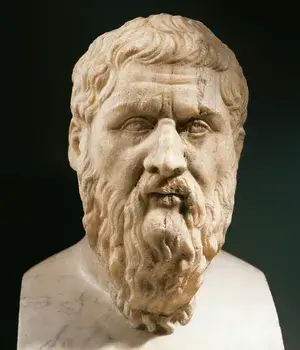
Plato: The Philosopher Who Asked Whether the World We See Is the Real World
Plato wanted to understand reality, justice, knowledge, and the good life. But behind all of these questions was a deeper problem: if our senses can deceive us, our opinions can be wrong, and our society can be unjust, how can human beings discover what is genuinely true?
WHO WAS PLATO?
Plato was born around 427 BCE in Athens or nearby and died around 347 BCE.
He was born into an aristocratic Athenian family. His family had political connections, and Plato grew up during a period when Athens was experiencing war, political instability, and dramatic changes in its democratic system.
His original name may have been Aristocles. “Plato” was probably a nickname, although the exact reason for it is uncertain.
He was young when he encountered Socrates.
That meeting changed the history of philosophy.
Socrates did not leave books behind. Plato did.
After Socrates was executed in 399 BCE, Plato became one of the most important people responsible for preserving and developing his teacher’s philosophical legacy.
But Plato did more than record Socrates.
He transformed Socratic questioning into a vast philosophical system covering:
reality, knowledge, ethics, politics, education, mathematics, psychology, art, love, justice, the soul, and the nature of the good.
He founded the Academy, one of the most influential philosophical schools of the ancient world.
Aristotle would later study there.
So Plato stands at one of the great turning points in intellectual history:
Socrates questioned the world. Plato tried to explain it.
THE HISTORICAL WORLD OF PLATO
Plato lived during the Classical Greek period, when Athens was one of the major centers of Mediterranean culture.
But this was not a peaceful golden age.
Athens had fought Sparta in the Peloponnesian War.
Athens lost.
Its political system was damaged.
The Thirty Tyrants briefly ruled the city.
Democracy was restored.
Then Socrates was executed.
For Plato, this was not merely a personal tragedy.
It was a political and philosophical crisis.
A democratic city had killed a man Plato believed was one of the most morally serious people he had ever known.
This forced Plato to ask:
How can a society claim to be just when it can condemn a genuinely good person?
That question eventually became central to The Republic.
Plato’s philosophy cannot be separated from this experience.
His political philosophy was partly born from disappointment with the political world he saw around him.
THE INTELLECTUAL WORLD BEFORE PLATO
Plato inherited several philosophical traditions.
The first was the tradition of the early Greek philosophers who asked about the structure of reality.
Heraclitus argued that everything is constantly changing.
Parmenides argued that genuine reality must be stable and unchanging.
This created a serious philosophical problem.
If everything changes, how can we have stable knowledge?
For example, we can recognize many beautiful things.
But beautiful things change.
People become old.
Flowers die.
Buildings collapse.
Beautiful paintings can be destroyed.
Yet we seem to have some idea of beauty itself.
Where does that idea come from?
Plato’s philosophy develops partly as an answer to this problem.
He also inherited the influence of Pythagorean mathematics, which encouraged the idea that reality has a deeper rational and mathematical structure.
And above all, he inherited Socrates.
Socrates had asked:
What is justice?
What is courage?
What is virtue?
What is knowledge?
Plato takes these questions and pushes them much further.
THE CENTRAL QUESTION
Plato’s philosophy revolves around a group of connected questions:
What is truly real?
What can we genuinely know?
What makes a human being good?
What is justice?
What kind of society should we build?
What is the highest good?
These questions are connected.
If we do not know what is real, how can we know what is true?
If we do not know what is good, how can we know how to live?
If individuals do not know what justice is, how can they create a just society?
Plato therefore does not treat philosophy as separate subjects.
For him, metaphysics, epistemology, ethics, psychology, education, and politics are deeply connected.
PLATO’S BASIC WORLDVIEW
Before looking at individual arguments, it helps to see Plato’s philosophy as a map.
Plato believes that there is a difference between:
appearance and reality
opinion and knowledge
body and soul
desire and reason
ordinary objects and their perfect Forms
the visible world and the intelligible world
the good life and the merely pleasurable life
This does not mean the physical world is completely unreal.
It means that what we experience through our senses is not the deepest level of reality.
The world we see is changing.
Genuine knowledge, Plato argues, requires understanding what does not change.
This leads to one of his most famous ideas.
THE THEORY OF FORMS
The Theory of Forms is probably Plato’s most famous philosophical doctrine.
Imagine a beautiful flower.
It is beautiful.
But it will eventually die.
Imagine a beautiful building.
It can decay.
Imagine a beautiful person.
Their appearance changes with age.
Yet we can recognize all of them as beautiful.
Plato asks:
What is beauty itself?
The individual beautiful things are temporary.
But our concept of beauty seems more stable.
Plato’s answer is that there is a Form of Beauty.
The Form is not simply another physical object.
It is the stable reality that individual beautiful things imperfectly reflect.
The same reasoning applies to other concepts.
There is the Form of Justice.
The Form of Equality.
The Form of Goodness.
The Form of Beauty.
And many others.
Physical things come and go.
The Forms are stable.
PROBLEM → EARLIER VIEW → PLATO’S ANSWER
Problem:
The world we experience is constantly changing.
Earlier philosophical problem:
If everything changes, how can stable knowledge be possible?
Plato’s answer:
True knowledge concerns stable realities, the Forms, rather than merely changing appearances.
Example:
Many things can be beautiful, but they are not Beauty itself.
Consequence:
Philosophy becomes a search for what lies beneath appearances.
This is one of Plato’s greatest moves.
He turns philosophy from the question:
“What things do we see?”
toward:
“What makes those things what they are?”
THE CAVE
Plato’s most famous philosophical image is the Allegory of the Cave, found in The Republic.
Imagine prisoners chained inside a cave.
They cannot turn around.
Behind them is a fire.
People carry objects in front of the fire.
The prisoners see only shadows projected onto the wall.
They have lived there their entire lives.
So they believe the shadows are reality.
Then one prisoner is freed.
At first, the light hurts his eyes.
He struggles.
He gradually realizes that the shadows were not the real objects.
Then he leaves the cave.
Outside, he sees the world.
Eventually, he looks toward the sun.
Now he understands where the light came from.
Plato uses this story to describe education.
WHAT THE CAVE MEANS
The cave represents ordinary human existence when people mistake appearances for reality.
The shadows represent appearances and opinions.
The objects outside represent deeper knowledge.
The sun represents the Form of the Good.
The prisoner represents the philosopher.
The journey out of the cave represents education.
But education, for Plato, is not simply putting information into someone’s head.
The mind must be turned around.
A person must learn to see differently.
This is a radical idea.
Education is not filling an empty container. It is changing the direction of the mind.
WHY EDUCATION CAN BE PAINFUL
The cave also explains why learning can be uncomfortable.
Imagine discovering that something you believed for twenty years was false.
Your first reaction may not be happiness.
You may feel embarrassed.
You may become defensive.
You may even become angry at the person who challenged you.
Plato understands this.
The prisoner does not immediately enjoy the sunlight.
It hurts.
This is why genuine education can feel like a crisis.
Learning is sometimes painful because it forces us to abandon a world we thought we understood.
THE FORM OF THE GOOD
At the top of Plato’s philosophical hierarchy is the Form of the Good.
The Good is difficult to explain because Plato does not treat it simply as one good thing among others.
It is closer to the ultimate source of intelligibility and value.
In the Republic, Plato compares the Good to the sun.
The sun allows us to see physical things.
The Good allows the mind to understand truth and value.
Without understanding the Good, knowledge remains incomplete.
A person can be intelligent and still use intelligence badly.
A brilliant scientist can develop destructive weapons.
A clever politician can manipulate people.
A talented businessperson can exploit workers.
Intelligence alone does not tell us what intelligence should serve.
Plato’s deeper question is therefore:
What should knowledge ultimately be used for?
His answer points toward the Good.
KNOWLEDGE AND OPINION
Plato makes a strong distinction between knowledge and opinion.
Opinion concerns things that can change.
Knowledge concerns what is stable and intelligible.
Imagine someone says:
“This food tastes good.”
That is an opinion.
Another person may disagree.
But mathematical truth does not depend on personal preference in the same way.
Plato therefore gives mathematics an important role in philosophical education.
Mathematical reasoning trains the mind to move beyond immediate sensory experience.
It teaches us to think about relationships that are abstract and stable.
THE DIVIDED LINE
In The Republic, Plato develops another image called the Divided Line.
He divides cognition into different levels.
At the lowest level are images and appearances.
Above them are physical objects.
Then come mathematical objects and reasoning.
At the highest level comes philosophical understanding of the Forms and ultimately the Good.
The basic movement is:
appearance → belief → reasoning → understanding
The higher the mind rises, the less dependent it becomes on mere sensory appearance.
This is Plato’s model of intellectual development.
THE SOUL
Plato does not think human beings are simply bodies.
The soul is central to his philosophy.
In The Republic, he divides the soul into three parts:
Reason
Spirit
Appetite
Reason seeks truth.
Spirit is connected with courage, honor, pride, and anger.
Appetite seeks physical pleasures, possessions, food, sex, and material satisfaction.
A healthy person is one in whom reason properly governs the other parts.
This becomes the psychological foundation of Plato’s ethics.
THE CHARIOT
In Phaedrus, Plato gives us another famous image.
The soul is compared to a charioteer controlling two horses.
The charioteer represents reason.
One horse represents noble impulses.
The other represents unruly desire.
The charioteer must guide both.
The image captures something important.
Human beings are not simply rational.
We have desires.
We have emotions.
We have ambitions.
Sometimes these forces pull us in different directions.
Plato’s ideal is not to destroy desire.
It is to bring the different parts of the soul into proper order.
PLATO’S ETHICS
Plato’s ethics begins with a simple but difficult question:
What makes a human life good?
His answer is not wealth.
Not pleasure.
Not popularity.
Not political power.
The good life is a life in which the soul is properly ordered and guided toward truth and the Good.
This is why justice matters.
Justice is not simply following laws.
It is harmony.
A just person has the different parts of the soul functioning properly.
Reason governs.
Spirit supports reason.
Appetite remains under control.
The unjust person is internally divided.
Their desires control them.
They may appear powerful from the outside.
But internally, they are disordered.
JUSTICE
Plato’s most famous discussion of justice appears in The Republic.
He asks:
What is justice?
At first, the dialogue considers several ordinary answers.
Justice might mean telling the truth.
Or giving people what they deserve.
Or helping friends and harming enemies.
Or simply whatever benefits the powerful.
Plato rejects these easy answers.
He wants a deeper definition.
Eventually, he argues that justice involves proper order.
This applies both to individuals and societies.
JUSTICE IN THE INDIVIDUAL
Imagine a person whose appetite controls everything.
They eat whenever they want.
Spend whenever they want.
Pursue pleasure whenever they want.
They may think they are free.
Plato would disagree.
They are controlled by desire.
Now imagine someone whose reason guides their desires.
They still enjoy food.
They still experience pleasure.
But they can say no when necessary.
Plato would call this person more genuinely free.
This produces a surprising idea:
Freedom is not simply doing whatever you want.
Freedom can mean having enough self-control that your desires do not rule you.
JUSTICE IN SOCIETY
Plato applies the same structure to society.
He divides the ideal city into three main groups:
Rulers
Guardians
Producers
The rulers govern.
The guardians defend the city.
The producers include farmers, craftsmen, merchants, and others who provide material goods.
A just city is one in which each part performs its proper role and the city is governed according to wisdom.
This produces Plato’s controversial political philosophy.
THE PHILOSOPHER-KING
Plato’s most famous political claim is:
Philosophers should rule.
The famous idea is often summarized as the philosopher-king.
But why?
Plato does not mean philosophers should rule because they are intellectually superior in some abstract sense.
His argument is that rulers need to understand the Good.
Political power without knowledge is dangerous.
Imagine giving a ship to someone who knows nothing about navigation simply because the passengers voted for them.
Plato asks why governing a city should be treated differently.
A ruler needs knowledge of justice, human nature, and the Good.
Therefore, the best ruler should be someone trained to understand these things.
THE PROBLEM WITH THE PHILOSOPHER-KING
This argument is powerful.
But it creates a serious problem.
Who decides who is truly wise?
A person might claim to understand the Good.
But what if they are mistaken?
What if the philosopher becomes authoritarian?
What if political knowledge cannot be separated from ordinary citizens’ experiences?
What if wisdom does not give someone the right to control everyone else?
Modern democracy rejects Plato’s solution for good reasons.
But his question remains valuable:
Should political power belong to whoever is popular, or should political leaders possess genuine knowledge and competence?
Modern politics still struggles with this problem.
PLATO’S CRITICISM OF DEMOCRACY
Plato was deeply skeptical of democracy.
His criticism was shaped by experience.
Athens had democratically condemned Socrates.
Plato therefore saw a danger in political systems where public opinion could determine important decisions.
He compares democracy to a ship where passengers choose the captain without understanding navigation.
But his criticism has weaknesses.
Democracy does not claim that every citizen is an expert.
It claims that citizens should have political equality.
Modern democratic systems also use institutions, experts, courts, constitutions, and professional administration.
Plato’s critique therefore identifies a genuine problem:
How should political equality coexist with expertise?
But his solution risks creating another problem:
How do we prevent the wise ruler from becoming an unaccountable ruler?
THE ALLEGORY OF THE SHIP
Plato gives another powerful image.
Imagine a ship.
The owner is physically strong but does not understand navigation.
The sailors fight over who should control the ship.
One sailor uses persuasion to convince the owner that he should become captain.
He does not actually know navigation.
He simply knows how to manipulate people.
Plato compares this to politics.
A politician may know how to win elections without knowing how to govern well.
This distinction between political persuasion and political competence remains one of Plato’s most important insights.
PLATO AND RHETORIC
Plato was suspicious of rhetoric when it became disconnected from truth.
A speaker can persuade people without being correct.
This was especially important in democratic Athens, where public speech had enormous political power.
Plato therefore asks:
Should political speech aim to make people believe something, or should it aim to help them understand what is true?
Modern politics has not solved this problem.
Advertising, propaganda, political campaigns, social media, and public relations all show how easily persuasion can operate independently of truth.
Plato’s concern remains remarkably modern.
PLATO AND LOVE
Plato also wrote deeply about love.
His dialogue Symposium explores eros, or desire.
Love begins with attraction to a particular beautiful person.
But Plato suggests that love can develop.
We can move from loving one beautiful body toward appreciating beauty in many bodies.
Then toward beautiful minds.
Then toward beautiful practices and institutions.
Eventually, the lover may seek Beauty itself.
This movement is sometimes called the Ladder of Love.
The deeper point is that desire can educate us.
We begin by wanting one beautiful thing.
Eventually we may ask:
What is beauty itself?
PLATO AND ART
Plato’s relationship with art is complicated.
He understood the power of poetry and drama.
But he was also suspicious of them.
Why?
Because art can imitate appearances without necessarily teaching truth.
A painting of a bed is not a real bed.
The physical bed itself is also not the ultimate reality.
So the artistic image may be several steps removed from the Form.
Plato also worried about emotional influence.
A powerful poem can make people admire behavior that philosophy might reject.
Art can shape character.
Therefore, Plato treats art as morally serious.
PLATO’S ATTACK ON POETRY
In The Republic, Plato famously proposes restrictions on certain kinds of poetry in the ideal city.
This has made him a controversial figure among later defenders of artistic freedom.
The problem is obvious.
If the state controls art because art can influence people, what prevents political authorities from censoring anything they dislike?
Plato’s argument begins with a real insight:
Art shapes how people think and feel.
But the political conclusion is dangerous.
A government that claims to protect citizens from harmful ideas can easily become a government that controls ideas.
PLATO AND THE BODY
Plato often presents the body as a source of distraction.
The body experiences hunger, pleasure, pain, sexual desire, and illness.
The soul seeks truth.
This creates a tension between physical existence and philosophical contemplation.
But Plato should not be reduced to someone who simply “hates the body.”
His philosophy is more complicated.
The body is part of human life.
The problem is allowing bodily desires to dominate reason.
The ideal is not necessarily destroying desire.
It is ordering desire.
PLATO AND DEATH
Plato’s understanding of death is deeply connected to Socrates.
Socrates’ execution becomes one of the foundations of Plato’s philosophical project.
In Phaedo, philosophy is presented partly as preparation for death.
Why?
Because philosophers learn not to make bodily pleasure the highest good.
They learn to seek truth.
Death therefore becomes a test of what we value.
Socrates’ calmness before death becomes a model of philosophical courage.
THE IMMORTALITY OF THE SOUL
Plato offers several arguments for the immortality of the soul.
One argument involves opposites.
Life comes from death and death from life, forming a cycle.
Another argument appeals to the soul’s relationship with eternal realities.
Another suggests that what is simple and non-composite may not be destroyed in the same way physical objects are.
These arguments are controversial.
They do not establish immortality by modern scientific standards.
But they reveal Plato’s larger concern.
If the soul is capable of understanding eternal truths, perhaps the soul itself has a deeper nature than the physical body.
PLATO’S THEORY OF KNOWLEDGE
Plato is deeply concerned with how genuine knowledge differs from belief.
One important dialogue is Meno.
There Plato explores the paradox of inquiry.
If you do not know what you are looking for, how will you recognize it when you find it?
If you already know it, why search for it?
Plato’s famous response involves recollection.
The soul, he suggests, has some prior relationship with truth and can recover knowledge through questioning.
This doctrine is metaphysical and controversial.
But philosophically, the important point is that learning is not merely receiving information.
It involves awakening understanding.
PLATO’S VIEW OF MATHEMATICS
Mathematics was extremely important in Plato’s philosophical education.
Why?
Because mathematical objects are not directly dependent on sensory experience.
You can draw a triangle.
But the physical triangle will never be perfectly geometrical.
The mathematical concept is more exact.
This makes mathematics a bridge between the physical world and abstract reasoning.
For Plato, mathematics trains the mind to move away from immediate appearances and toward stable structures.
PLATO’S ARGUMENT ABOUT REALITY
Plato’s argument can be simplified like this:
Premise 1: Physical objects constantly change.
Premise 2: Knowledge requires something stable enough to be understood.
Premise 3: Therefore, genuine knowledge cannot depend entirely on changing physical objects.
Conclusion: There must be stable intelligible realities that the mind can understand.
These are the Forms.
This argument is not universally accepted.
But it is one of the most important attempts in philosophy to explain how stable knowledge is possible in a changing world.
PLATO’S CONTRADICTIONS
Plato’s philosophy contains serious tensions.
He values philosophical questioning.
Yet his ideal political system gives enormous power to philosopher-rulers.
He wants truth.
Yet his metaphysical system makes claims about invisible Forms that cannot easily be demonstrated.
He values reason.
Yet his own dialogues rely heavily on powerful myths and stories.
He criticizes imitation in art.
Yet he uses some of the most memorable literary images in philosophical history.
He distrusts democracy.
Yet the philosophical dialogue itself depends on open questioning.
These contradictions do not make Plato worthless.
They make him more interesting.
They show that his philosophy is wrestling with problems that cannot be solved easily.
ARISTOTLE’S CHALLENGE TO PLATO
Plato’s greatest philosophical student eventually became one of his greatest critics.
Aristotle rejected important parts of the Theory of Forms.
Aristotle asks:
Why place Forms in a separate realm?
If we want to understand a horse, why do we need a separate Form of Horse?
Why not study actual horses and examine what they have in common?
Aristotle therefore moves philosophy closer to the investigation of the natural world.
Plato looks upward toward eternal Forms.
Aristotle looks more closely at things themselves.
This disagreement becomes one of the great divisions in Western philosophy.
PLATO:
Reality has a deeper intelligible structure beyond changing appearances.
ARISTOTLE:
The forms of things are not separate objects existing somewhere beyond the things themselves.
The argument between them would influence philosophy for centuries.
PLATO AND SOCRATES
Plato’s relationship with Socrates is both intellectual and emotional.
Socrates taught Plato to question definitions.
Plato inherited his teacher’s concern with virtue.
But Plato went beyond Socrates.
Socrates asked:
“What is justice?”
Plato asks:
“What is justice, what is its relationship to the soul, what kind of city expresses it, and what kind of education produces it?”
Socrates questioned.
Plato systematized.
This is why Plato becomes the bridge between the conversational philosophy of Socrates and the systematic philosophy that follows.
PLATO’S HUMAN SIDE
Plato is often presented as an abstract thinker.
But his philosophy is deeply shaped by personal experience.
He witnessed political failure.
He saw his teacher executed.
He lived through war and instability.
He became concerned with education because he believed society produces the kind of citizens and rulers it has.
He became concerned with justice because he had seen political power produce injustice.
He became concerned with knowledge because people confidently defended beliefs they could not justify.
His philosophy therefore begins not in a vacuum but in a crisis.
How should human beings organize their lives when their societies, institutions, and beliefs can all be wrong?
PLATO’S ACADEMY
Plato founded the Academy around 387 BCE.
It became one of the most important intellectual institutions of the ancient world.
Students studied philosophy, mathematics, astronomy, and other subjects.
The Academy was not simply a modern university.
But it created a sustained community devoted to intellectual inquiry.
Aristotle studied there for roughly twenty years.
The influence of the Academy would continue long after Plato’s death.
The very word “academy” ultimately carries this legacy.
PLATO’S INFLUENCE
Plato’s influence is enormous.
Aristotle responded to him.
Plotinus developed a later Platonist tradition.
Christian thinkers such as Augustine drew heavily on Platonic ideas.
Medieval Islamic philosophers engaged deeply with Platonic and Aristotelian thought.
Renaissance thinkers revived Plato.
Modern philosophers continued debating his theory of knowledge, political philosophy, metaphysics, and ethics.
His influence also extends beyond philosophy.
Political theory.
Education.
Mathematics.
Psychology.
Theology.
Literature.
Art.
The idea that philosophy should seek a reality deeper than appearances became one of the most enduring themes in intellectual history.
WHAT PLATO GOT RIGHT
Plato identified several problems that remain deeply relevant.
Appearances can deceive us.
What looks true is not necessarily true.
Opinion is not knowledge.
Being confident does not make a belief justified.
Education changes how people see the world.
Learning is not simply memorizing facts.
Power requires knowledge and moral responsibility.
Intelligence without ethics can become dangerous.
Human beings are divided internally.
We often want things that conflict with what we know is good for us.
Society shapes individuals.
Bad institutions can produce bad behavior.
Art has moral and psychological power.
Stories influence what people admire and desire.
These insights remain powerful.
WHAT PLATO GOT WRONG OR LEFT UNRESOLVED
Plato’s theory of Forms raises difficult questions.
Where exactly do Forms exist?
How do physical objects participate in them?
Why do we need Forms to explain concepts?
Aristotle’s criticism remains powerful.
His political philosophy is even more controversial.
The philosopher-king risks becoming authoritarian.
The division of society into fixed classes can undermine individual freedom.
His distrust of democracy can become elitist.
His restrictions on art threaten freedom of expression.
And his view of the body and desire can sometimes become too suspicious of ordinary human life.
Plato gives us powerful questions.
But some of his answers create new problems.
PLATO AND THE MODERN WORLD
Plato remains surprisingly relevant.
We live in a world dominated by images.
Social media.
Advertising.
Virtual reality.
Deepfakes.
Artificial intelligence.
Algorithms.
Plato’s cave suddenly feels familiar.
We constantly encounter representations of reality.
But how do we know what is real?
A photograph can be manipulated.
A video can be generated.
An AI system can produce convincing text that is false.
A social media algorithm can show us a carefully selected version of the world.
Plato’s question becomes:
Are we seeing reality, or are we seeing shadows produced by systems we do not understand?
This does not mean modern technology proves Plato’s Theory of Forms.
It does not.
But the cave remains a powerful metaphor for the difference between appearance and understanding.
PLATO AND ARTIFICIAL INTELLIGENCE
AI creates another interesting Platonic problem.
Suppose an AI produces an image of a beautiful landscape.
The image represents something.
But is the image itself beautiful?
Suppose an AI generates an essay about justice.
Does producing the right words mean the system understands justice?
Plato would force us to distinguish:
representation from reality
information from knowledge
persuasion from truth
appearance of understanding from understanding itself
These distinctions are becoming increasingly important.
PLATO’S PHILOSOPHY IN SIMPLE WORDS
Plato’s philosophy can be remembered through a few ideas.
The world of appearances is not the whole of reality.
What we see is not necessarily what is ultimately true.
Knowledge is different from opinion.
Confidence does not equal truth.
The mind must be educated.
Education should transform how we understand reality.
The Good is higher than mere pleasure or power.
A successful life is not automatically a good life.
Justice is harmony.
A good person and a good society require proper order.
Reason should guide desire.
Freedom requires self-mastery.
Political power should be connected to wisdom.
A ruler who understands power but not the Good can become dangerous.
Philosophy is a journey.
Like the prisoner leaving the cave, the philosopher moves from appearance toward understanding.
THE GREAT IDEA BEHIND PLATO
Perhaps Plato’s deepest contribution is the idea that we should not accept the world exactly as it appears to us.
The ordinary person sees the world and asks:
“What can I get from it?”
Plato asks:
“What is it?”
The ordinary person asks:
“Who has power?”
Plato asks:
“What makes power legitimate?”
The ordinary person asks:
“What do people believe?”
Plato asks:
“Is what people believe actually true?”
The ordinary person asks:
“What makes me happy?”
Plato asks:
“Is what makes me feel good actually good for me?”
That shift is the beginning of philosophy.
THE FINAL QUESTION
Plato begins with a world that does not make sense.
People disagree about justice.
Politicians claim to know how to govern.
Citizens mistake persuasion for truth.
Human beings pursue pleasure while damaging themselves.
A society can execute a good person.
The senses show us a changing world, yet the mind searches for something permanent.
Plato’s answer is to look deeper.
Beyond appearances, search for what is stable.
Beyond opinion, seek knowledge.
Beyond pleasure, seek the Good.
Beyond political power, seek wisdom.
Beyond the visible world, ask whether there is a deeper reality that makes the visible world intelligible.
But Plato’s philosophy leaves us with a problem he never completely resolves:
How can we be certain that the reality we discover beyond appearances is actually reality, rather than another construction of the human mind?
Perhaps that is why Plato remains so important.
He does not simply tell us that there is a world beyond the cave.
He forces us to ask whether we are still inside one.
Plato’s greatest challenge is therefore not “Believe in the Forms.” It is much more unsettling:
Before you decide that you understand reality, ask whether you have ever turned around to see what is casting the shadows.