Tabula V
Aristotle
Lysippos cast the primary bronze likeness of Aristotle around 330 BC, born in 384 BC in Stagira, Greece, and died in 322 BC at the age of 62 in Chalcis, Greece
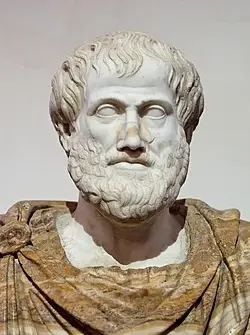
Aristotle: The Philosopher Who Asked What It Means to Live Well
Plato looked beyond the changing world in search of eternal reality. Aristotle looked back at the world itself and asked a different question: if human beings want to live well, should we escape ordinary life in search of perfection, or learn to understand the world we actually inhabit?
WHO WAS ARISTOTLE?
Aristotle was born in 384 BCE in Stagira, a Greek city in northern Greece, and died in 322 BCE in Chalcis.
His father, Nicomachus, was a physician connected to the Macedonian royal court. This probably influenced Aristotle’s lifelong interest in biology, medicine, observation, and the natural world.
At around seventeen, Aristotle went to Athens and joined Plato’s Academy.
He remained there for roughly twenty years.
This was one of the most important intellectual relationships in history.
Aristotle became one of Plato’s greatest students.
But he did not become a simple follower.
He admired Plato while challenging some of Plato’s deepest ideas.
After Plato’s death, Aristotle eventually left Athens.
He spent time in places including Assos and Lesbos, where he studied living organisms and natural phenomena.
Later, he became tutor to the young Alexander of Macedon, who would become known as Alexander the Great.
Eventually Aristotle returned to Athens and founded his own school, the Lyceum.
His life therefore connected three worlds:
Plato’s philosophy, empirical investigation, and the expanding Macedonian world of Alexander.
THE WORLD ARISTOTLE INHERITED
Aristotle lived during a major transformation in Greek history.
The old independent Greek city-states were losing their political dominance.
Macedon was becoming increasingly powerful.
Philip II of Macedon united and expanded Macedonian power.
His son Alexander would conquer a huge territory stretching from Greece toward Egypt, Persia, and parts of Central Asia.
Aristotle lived at the boundary between two political worlds.
The classical Greek polis was changing.
At the same time, intellectual life was becoming increasingly sophisticated.
Philosophers were asking questions about:
nature,
politics,
ethics,
logic,
mathematics,
language,
knowledge,
and the structure of reality.
Aristotle attempted something extraordinary.
He did not limit philosophy to one subject.
He tried to understand almost everything.
THE PHILOSOPHICAL WORLD BEFORE ARISTOTLE
Aristotle inherited two major philosophical problems.
The first came from the early Greek philosophers.
Heraclitus emphasized change.
Everything appears to flow.
Parmenides emphasized permanence.
True reality, he argued, cannot simply be a world of constant change.
This created a problem:
How can something change and still remain the same thing?
A tree grows.
It becomes larger.
Its leaves fall.
Its branches change.
Eventually it dies.
But we still call it the same tree throughout its life.
How?
Aristotle develops his theories of form, matter, change, potentiality, and actuality partly to answer this problem.
The second major influence was Plato.
Plato argued that the changing physical world points toward a deeper reality of Forms.
Aristotle admired this search for stable knowledge.
But he disagreed with placing Forms in a separate realm.
He wanted to understand reality by examining the things themselves.
THE CENTRAL QUESTION
Aristotle’s philosophy revolves around a remarkably practical question:
What does it mean for something to fulfill its nature well?
For human beings, this becomes:
What is the best way to live?
This question leads into everything else.
What is happiness?
What is virtue?
What is human nature?
What is knowledge?
What is reality?
What is justice?
What makes a political community good?
What makes an action right?
What makes a life flourish?
Unlike philosophers who treat ethics as a separate subject, Aristotle connects ethics to a broader understanding of human nature.
To know how humans should live, we first need to understand what humans are.
ARISTOTLE’S BASIC WORLDVIEW
Aristotle sees the world as intelligible.
Things have structures.
Things have purposes.
Things develop from potential into actuality.
Human beings have distinctive capacities.
Good living means developing those capacities properly.
This produces a broad philosophical picture:
Reality → nature → human capacities → virtue → flourishing
Aristotle therefore moves constantly between the abstract and the practical.
He asks not only:
“What is a human being?”
but also:
“What should a human being become?”
ARISTOTLE AND PLATO
Aristotle’s relationship with Plato is one of the most important intellectual relationships in history.
Plato asks us to look beyond appearances toward eternal Forms.
Aristotle asks whether we really need a separate world of Forms to explain things.
Imagine a horse.
Plato might say that individual horses participate in the Form of Horse.
Aristotle asks:
Why not study actual horses?
What do they have in common?
What makes them horses?
How do they develop?
How do their parts function?
Aristotle does not abandon form.
Instead, he brings form into the world of individual things.
This is one of his biggest philosophical departures from Plato.
MATTER AND FORM
Aristotle argues that ordinary physical things can be understood through matter and form.
A bronze statue has:
matter: bronze
form: the particular shape of the statue.
But form is not simply appearance.
It is what makes a thing the kind of thing it is.
A living organism also has matter and form.
Its body is not just a pile of material.
It has an organized structure that allows it to function as a living being.
This theory is called hylomorphism, from Greek words associated with matter and form.
WHY FORM MATTERS
Imagine a human body.
You can list its physical materials:
bones,
muscles,
blood,
organs,
cells.
But simply listing the materials does not explain what makes the organism alive.
A corpse contains many of the same materials.
Yet a living person is different.
Something about the organization and activity of the body matters.
Aristotle uses form to explain this organization.
Form is connected with what a thing is and how it functions.
This becomes particularly important in his biology.
POTENTIALITY AND ACTUALITY
One of Aristotle’s most powerful ideas is the distinction between potentiality and actuality.
A child can become an adult.
A piece of wood can become a table.
An untrained musician can become skilled.
The potential is not the same as the finished reality.
Aristotle calls the developed state actuality.
This gives him a way to explain change.
Change is not simply something appearing from nothing.
It is often the realization of a potential already present in a thing.
PROBLEM → ARISTOTLE’S ANSWER
Problem:
How can something change without becoming something completely unrelated?
Answer:
A thing can move from potentiality toward actuality.
Example:
An acorn has the potential to become an oak.
Consequence:
Change becomes intelligible rather than mysterious.
This idea becomes central to Aristotle’s metaphysics.
THE FOUR CAUSES
Aristotle argues that understanding something requires asking several different kinds of questions.
He calls them the four causes.
Suppose we have a bronze statue.
Material cause: What is it made of?
Bronze.
Formal cause: What form or structure does it have?
The shape of the statue.
Efficient cause: What brought it into existence?
The sculptor.
Final cause: What is it for?
Perhaps it was created as a monument or artwork.
Modern science often emphasizes efficient and material causes.
Aristotle thinks explanation can require more.
To understand something fully, we may need to know:
what it is made of, what it is, what produced it, and what it is for.
TELOS AND PURPOSE
The Greek word telos means an end, goal, or purpose.
Aristotle believes nature is not simply a random collection of objects.
Living things develop toward characteristic forms of fulfillment.
An acorn develops toward becoming an oak.
A human being develops capacities that are distinctively human.
This leads Aristotle to his ethical theory.
If we want to know what a good human life is, we should ask:
What is the characteristic fulfillment of human nature?
HAPPINESS
Aristotle’s answer is eudaimonia.
This word is often translated as “happiness.”
But “happiness” can be misleading.
Aristotle does not mean simply feeling cheerful.
Eudaimonia is closer to:
flourishing
living well
fulfilling one’s human capacities
A person can feel happy while living badly.
A corrupt person can enjoy luxury.
A selfish person can experience pleasure.
But that does not mean their life is flourishing.
For Aristotle, a good life is a life lived well over time.
THE FUNCTION ARGUMENT
Aristotle asks:
If a thing has a characteristic function, what is the human function?
A knife cuts.
A musician performs music.
A good eye sees well.
What is distinctive about human beings?
Not merely eating.
Animals eat.
Not merely growing.
Plants grow.
Not merely sensing.
Animals sense.
Aristotle argues that human beings have the distinctive capacity for reason.
Therefore:
A good human life involves excellent activity of the rational part of the soul.
This is the foundation of his ethics.
VIRTUE
Virtue, for Aristotle, is not simply knowing what is right.
It is developing a stable character that enables you to act well.
This is where Aristotle strongly differs from Socrates.
Socrates emphasizes knowledge.
Aristotle says knowledge is not enough.
You need habit.
Imagine someone knows that exercise is healthy.
That knowledge does not make them physically fit.
They must repeatedly exercise.
Similarly, knowing that honesty is good does not automatically make someone honest.
They must practice honesty.
Over time, actions shape character.
VIRTUE AS HABIT
Aristotle famously argues that we become just by doing just actions.
We become courageous by practicing courageous behavior.
We become generous by practicing generosity.
Virtue therefore develops through repeated action.
This gives Aristotle an important psychological insight:
Who you are is partly shaped by what you repeatedly do.
Your habits gradually become your character.
This means moral development is not simply about making one perfect decision.
It is about becoming the kind of person who tends to make good decisions.
THE GOLDEN MEAN
Aristotle’s most famous ethical idea is the Golden Mean.
Virtue often lies between two extremes.
For example:
Too little courage can become cowardice.
Too much can become recklessness.
The virtue lies somewhere between them.
Similarly:
Too little concern for money can become wastefulness.
Too much concern can become greed.
The virtuous response is generosity.
But the “mean” does not mean an exact mathematical middle.
It is not:
50% cowardice + 50% recklessness.
The appropriate action depends on the situation.
The mean is relative to the person and circumstances.
THE MEAN IS NOT MEDIOCRITY
This is important.
Aristotle does not say:
“Always choose the middle.”
Sometimes the correct action is extreme.
If someone is being tortured, for example, it would not make sense to say the appropriate response is halfway between resistance and surrender.
The mean is the appropriate response given the circumstances.
Virtue requires judgment.
This is why Aristotle places enormous importance on practical wisdom.
PRACTICAL WISDOM
The Greek term is phronesis.
Practical wisdom is the ability to understand what should be done in particular circumstances.
Imagine two people both know that honesty matters.
One person tells a painful truth at exactly the wrong moment and causes unnecessary harm.
Another knows how to communicate the truth with care.
The second person may possess greater practical wisdom.
Moral life cannot be reduced to memorizing rules.
You need judgment.
You need experience.
You need sensitivity to circumstances.
This makes Aristotle’s ethics more flexible than systems based entirely on fixed rules.
COURAGE
Aristotle’s idea of courage is a perfect example.
Courage does not mean feeling no fear.
A person who feels no fear because they do not understand danger may be foolish.
Courage means responding properly to fear.
The coward runs away when they should stand firm.
The reckless person rushes into danger without proper judgment.
The courageous person understands the danger and acts appropriately.
This is one reason Aristotle’s ethics feels psychologically realistic.
Virtue is not about eliminating emotions.
It is about educating them.
ANGER
Aristotle does not believe we should simply eliminate anger.
Sometimes anger is appropriate.
If someone commits a serious injustice, complete indifference may itself be a moral failure.
But uncontrolled anger can become destructive.
The virtuous person learns:
when to be angry,
why to be angry,
how much anger is appropriate,
and how to express it.
Again, virtue is about proportion and judgment.
FRIENDSHIP
Aristotle’s discussion of friendship is one of the most beautiful parts of his philosophy.
He argues that friendship is essential to a flourishing life.
He identifies three broad kinds.
Friendship of utility
We value someone because they provide a benefit.
Friendship of pleasure
We value someone because we enjoy their company.
Friendship of virtue
We value someone because we appreciate who they are and want what is genuinely good for them.
The third is the highest form.
It is based on mutual recognition of character.
WHY FRIENDSHIP MATTERS
A person cannot flourish completely alone.
We need others for:
support,
conversation,
cooperation,
moral development,
shared experiences,
and affection.
This is another major difference from an overly individualistic picture of human life.
Aristotle believes human flourishing is fundamentally social.
A good person needs a good community.
POLITICS
This leads directly to Aristotle’s political philosophy.
His famous statement is:
“Man is by nature a political animal.”
This does not mean human beings simply enjoy politics.
It means human beings naturally live in communities.
We possess language.
Language allows us to discuss:
what is just,
what is unjust,
what is good,
what is harmful.
Therefore political life is connected to our rational and moral nature.
The city is not merely a place where people happen to live.
It is a community in which human beings can pursue a flourishing life.
THE STATE AND THE GOOD LIFE
Aristotle does not see government merely as a mechanism for preventing violence.
A political community should help create conditions in which citizens can flourish.
This raises an important question:
Should government merely protect individual freedom, or should it also cultivate the conditions for a good society?
Modern political philosophy often debates this exact issue.
Aristotle belongs firmly on the side that says political institutions inevitably shape character.
ARISTOTLE’S TYPES OF GOVERNMENT
Aristotle analyzes different forms of government.
He distinguishes between governments that serve the common good and governments that serve the rulers’ private interests.
His categories include:
monarchy
aristocracy
polity
and their corrupted forms:
tyranny
oligarchy
democracy, in his ancient classification.
His use of “democracy” does not correspond exactly to modern democratic theory.
For Aristotle, the important distinction is whether rulers govern for the common good or for their own interests.
THE RULE OF LAW
Aristotle is deeply concerned with law.
A ruler who governs according to personal desire can become a tyrant.
Law can provide stability because it represents established principles rather than the changing passions of individuals.
But Aristotle also recognizes that laws cannot anticipate every situation.
This creates another role for practical judgment.
Good government therefore requires:
law + institutions + judgment + concern for the common good.
ARISTOTLE AND DEMOCRACY
Aristotle is more nuanced about democracy than Plato.
He does not simply dismiss political participation.
He studies different forms of government and examines their strengths and weaknesses.
He recognizes that collective judgment can sometimes be valuable.
But he also worries about rule driven by class conflict and immediate popular interest.
His political analysis is therefore empirical.
He examines actual constitutions rather than constructing only one ideal city.
This is another important difference from Plato.
Plato asks what the perfect city would look like.
Aristotle asks how different political systems actually work.
ARISTOTLE AND SCIENCE
Aristotle’s contribution is not limited to ethics and politics.
He studied:
biology,
physics,
astronomy,
logic,
psychology,
animals,
plants,
rhetoric,
poetry,
and many other subjects.
He observed the natural world systematically.
He collected information about animals.
He studied their structures.
He classified organisms.
He investigated causes.
His approach helped establish a tradition of systematic natural inquiry.
Some of his scientific conclusions were wrong.
But his commitment to studying nature was historically transformative.
ARISTOTLE’S BIOLOGY
Aristotle was fascinated by living organisms.
He examined animals and tried to understand how their parts function.
He asked questions such as:
Why does an animal have this organ?
What does it do?
How does its structure relate to its way of life?
This functional approach was enormously influential.
Aristotle wanted to understand organisms as organized wholes rather than merely collections of parts.
ARISTOTLE’S LOGIC
Aristotle also developed one of the first systematic theories of formal logic.
His theory of the syllogism became foundational.
Consider:
All humans are mortal.
Socrates is human.
Therefore:
Socrates is mortal.
The structure of the argument matters.
If the premises are true and the reasoning is valid, the conclusion follows.
Aristotle’s work on logic influenced philosophical and scientific reasoning for centuries.
DEDUCTIVE REASONING
Aristotle distinguishes different forms of reasoning.
Deduction begins with general principles and derives a specific conclusion.
For example:
All mammals breathe air.
Whales are mammals.
Therefore whales breathe air.
The structure is more important than the specific example.
Aristotle’s formalization of such reasoning helped establish logic as a major philosophical discipline.
INDUCTION
But Aristotle also recognizes the importance of moving from observations toward general understanding.
We observe individual cases.
We identify patterns.
We develop general principles.
This becomes especially important for natural science.
Aristotle therefore stands between abstract reasoning and empirical observation.
He does not simply choose one.
He uses both.
ARISTOTLE’S METAPHYSICS
Aristotle’s Metaphysics asks some of the deepest questions in philosophy.
What does it mean for something to exist?
What is substance?
What causes things?
What is form?
What is matter?
What explains change?
What is the ultimate cause of reality?
These questions eventually lead him to the idea of the Unmoved Mover.
THE UNMOVED MOVER
Aristotle reasons that things in the world undergo change.
Something changes because something else causes or explains that change.
But if every cause required another cause indefinitely, Aristotle asks whether explanation would ever be complete.
He therefore proposes an ultimate principle that causes motion without itself being moved in the same way.
This is the Unmoved Mover.
Aristotle describes it as pure actuality.
It does not need to change from potentiality to actuality because it is already fully actual.
This idea would later have enormous influence on Christian, Jewish, and Islamic philosophy.
ARISTOTLE’S GOD
Aristotle’s Unmoved Mover is not simply the personal God of later Abrahamic theology.
It is a metaphysical principle.
Aristotle describes it as pure actuality and as the ultimate object of desire and thought.
The Unmoved Mover does not necessarily create the universe in the later theological sense.
This distinction matters.
Later thinkers would reinterpret Aristotle through their own religious frameworks.
ARISTOTLE AND HAPPINESS
We can now see how Aristotle’s philosophy connects.
The universe has structures.
Living things have characteristic capacities.
Human beings have rational capacities.
Virtue develops those capacities.
Virtue allows us to act well.
Acting well over a complete life produces eudaimonia.
Therefore:
To flourish as a human being is to live actively and rationally in accordance with virtue.
This is the heart of Aristotle’s ethical philosophy.
PLEASURE
Aristotle does not reject pleasure.
He simply refuses to make pleasure the definition of happiness.
A good activity can naturally produce pleasure.
The pleasure of friendship.
The pleasure of understanding.
The pleasure of achievement.
The pleasure of excellent action.
The problem is not pleasure itself.
The problem is making pleasure the highest standard.
For Aristotle, pleasure should accompany good activity rather than replace it.
WEALTH
Aristotle also does not treat wealth as inherently evil.
Money is useful.
Resources are necessary.
A person cannot easily live a flourishing life without certain basic material conditions.
But wealth is a means.
It is not the final purpose of human life.
This distinction remains important.
Money can help us live.
But if money becomes the entire purpose of life, we have confused the means with the end.
HONOR AND FAME
Aristotle also distinguishes honor from genuine flourishing.
Being respected by others can be valuable.
But reputation depends partly on other people’s opinions.
A person can be famous and morally terrible.
Therefore honor cannot be the foundation of happiness.
The good life must depend more deeply on character and activity.
ARISTOTLE AND SELF-CONTROL
Aristotle recognizes a phenomenon that Socrates struggled to explain.
People sometimes know what they should do and still fail to do it.
He calls this akrasia, often translated as weakness of will.
You know you should stop scrolling.
You continue.
You know you should study.
You watch another video.
You know anger will make the situation worse.
You still react.
Aristotle takes this seriously.
Moral life therefore requires more than intellectual understanding.
It requires training desire.
ARISTOTLE’S PRACTICAL WISDOM
This is why practical wisdom is so important.
A morally mature person does not simply memorize rules.
They learn to recognize what a situation requires.
A good doctor knows medicine.
But they also know how to treat a particular patient.
A good leader knows principles.
But they also understand people.
A good friend knows when to speak.
But also when to remain silent.
Moral intelligence is therefore partly situational.
THE HUMAN BEING AS A POLITICAL ANIMAL
Aristotle’s political philosophy and ethics eventually converge.
Humans need communities.
Communities shape character.
Character affects political life.
Political institutions influence whether people can flourish.
Therefore ethics cannot be separated completely from politics.
A society that rewards greed may produce greedy citizens.
A society that rewards courage may produce courageous citizens.
Institutions educate us even when they are not called schools.
THE HUMAN SIDE OF ARISTOTLE
Aristotle is sometimes portrayed as an emotionless cataloguer of facts.
That is misleading.
His philosophy is deeply concerned with human life.
He writes about:
friendship,
love,
anger,
pleasure,
ambition,
wealth,
justice,
politics,
education,
death,
and happiness.
His great question is not:
“How can I know everything?”
It is:
“What kind of life is worth living?”
His philosophy becomes powerful because he refuses to separate abstract thought from ordinary human experience.
THE CONTRADICTIONS IN ARISTOTLE
Aristotle’s philosophy contains serious tensions.
He argues that human flourishing requires political participation, yet his political world excluded women, slaves, and many others from full citizenship.
He gives powerful arguments for reason and human dignity in some areas, yet accepts forms of social hierarchy that modern ethics rejects.
He emphasizes empirical investigation, yet some of his scientific claims were incorrect.
He values practical judgment, yet some parts of his philosophical system can appear highly hierarchical and teleological.
These contradictions matter.
We should neither erase them nor allow them to erase everything valuable in his philosophy.
ARISTOTLE’S VIEW OF WOMEN AND SLAVERY
This is one of the clearest areas where Aristotle is deeply limited by his historical context.
He defended forms of hierarchy that included claims about women and slavery that are incompatible with modern ideas of equality and human rights.
His concept of the “natural slave” is particularly troubling.
The argument is that some people are naturally suited to be ruled by others.
This argument has been strongly rejected by later moral and political thought.
It also conflicts with broader questions Aristotle himself raises about justice and human flourishing.
This is a crucial lesson.
A philosopher can produce profound insights while still accepting assumptions inherited from their society.
Greatness does not mean intellectual perfection.
ARISTOTLE’S CRITICS
Aristotle has been criticized from many directions.
Plato would reject his move away from separate Forms.
Epicureans would challenge his account of the good life.
Stoics would develop a different account of virtue and external goods.
Christian philosophers would reinterpret his metaphysics and ethics through theology.
Modern scientists would reject many of his physical and biological conclusions.
Modern political philosophers would challenge his acceptance of hierarchy and exclusion.
Yet Aristotle survives these criticisms because his questions remain powerful even when some answers do not.
WHAT ARISTOTLE GOT RIGHT
Aristotle understood several things with extraordinary clarity.
Character matters.
Who you become is shaped by repeated actions.
Habits matter.
Small repeated behaviors can create a life.
Human beings are social.
We cannot flourish entirely alone.
Emotion matters.
A good life does not require destroying emotions.
Practical judgment matters.
Rules cannot anticipate every situation.
Friendship matters.
A life without meaningful relationships is incomplete.
External goods matter, but they are not enough.
Money, health, and security contribute to flourishing but do not define it.
Knowledge must connect to action.
Knowing what is good is not the same as becoming good.
These ideas continue to influence contemporary virtue ethics, psychology, education, leadership, and political philosophy.
WHAT ARISTOTLE GOT WRONG
His natural science contained many errors.
Some of his biological classifications were inaccurate.
His physics was eventually overturned by modern science.
His cosmology was wrong.
His political hierarchy cannot be defended today.
His theory of natural slavery is deeply flawed.
His teleological view of nature can be difficult to reconcile with modern evolutionary biology if interpreted too literally.
But rejecting these errors does not require rejecting Aristotle entirely.
A philosopher can be scientifically wrong while philosophically valuable.
ARISTOTLE’S LEGACY
Few thinkers have influenced as many areas of knowledge.
Aristotle shaped:
logic
biology
ethics
political philosophy
metaphysics
rhetoric
poetics
psychology
natural philosophy
theology
His works became central to medieval Islamic philosophy.
Thinkers such as Avicenna and Averroes engaged deeply with Aristotle.
Christian thinkers such as Thomas Aquinas incorporated Aristotelian concepts into Christian theology.
Jewish philosophers also engaged deeply with him.
Later European science eventually rejected important parts of Aristotelian physics, but even this rejection happened partly through engagement with his framework.
Aristotle was not simply one philosopher among many.
For centuries, he was one of the central intellectual reference points of the known world.
ARISTOTLE AND MODERN LIFE
Aristotle’s philosophy may be especially relevant today because modern life often asks:
How can I become successful?
Aristotle asks a different question:
What does success mean?
You can have money and be miserable.
You can have fame and be empty.
You can have power and be corrupt.
You can have pleasure and still lack purpose.
So Aristotle forces us to distinguish:
success from flourishing
pleasure from happiness
knowledge from wisdom
freedom from uncontrolled desire
wealth from the good life
ARISTOTLE AND HABITS
Modern discussions of habits often sound surprisingly Aristotelian.
You become what you repeatedly practice.
If you repeatedly lie, lying becomes easier.
If you repeatedly exercise, discipline becomes easier.
If you repeatedly act generously, generosity becomes more natural.
If you repeatedly avoid difficult tasks, avoidance becomes a habit.
Aristotle’s insight is therefore simple but profound:
Character is not something we merely possess. We build it through action.
ARISTOTLE AND MODERN TECHNOLOGY
Technology creates an interesting Aristotelian question.
A tool can make us more capable.
But does it make us better?
AI can help us write.
Social media can help us communicate.
Automation can make work easier.
Algorithms can help us make decisions.
But Aristotle would ask:
What kind of human being are these tools helping us become?
A technology can increase efficiency while weakening judgment.
It can save time while destroying attention.
It can increase connection while reducing friendship.
It can provide information while weakening wisdom.
The important question is therefore not simply:
“What can technology do?”
It is:
“What kind of life does technology help create?”
That is a profoundly Aristotelian question.
ARISTOTLE’S PHILOSOPHY IN SIMPLE WORDS
Aristotle’s philosophy can be remembered through a few principles.
Understand the world as it actually is.
Do not abandon observation for speculation.
Everything has capacities and ways of developing.
Understand what something can become.
Human beings are rational and social creatures.
We need both thought and community.
Happiness is flourishing, not merely pleasure.
A good feeling is not enough for a good life.
Virtue is developed through practice.
You become good by repeatedly doing good actions.
Virtue often lies between extremes.
Courage avoids both cowardice and recklessness.
Practical wisdom matters.
Good judgment requires understanding circumstances.
Friendship is essential.
A flourishing life is shared with others.
Politics matters because society shapes human life.
Institutions influence character.
The good life is an activity.
You do not simply possess happiness.
You live it.
THE DIFFERENCE BETWEEN SOCRATES, PLATO, AND ARISTOTLE
The development becomes clearer when we put the three together.
Socrates asks:
“How should we live?”
He responds through questioning, self-examination, and the pursuit of virtue.
Plato asks:
“What is reality, and what kind of knowledge allows us to live justly?”
He looks beyond appearances toward the Forms and the Good.
Aristotle asks:
“Given what human beings actually are, how can we develop our capacities and flourish?”
He turns toward nature, character, practice, friendship, politics, and practical judgment.
The movement is remarkable.
Socrates → question
Plato → deeper reality
Aristotle → flourishing in the world
Together they create one of the most important philosophical conversations in history.
THE FINAL QUESTION
Aristotle begins with a problem that still follows us:
Human beings want happiness, but we often misunderstand what happiness is.
We chase money.
Status.
Pleasure.
Recognition.
Power.
Comfort.
But none of these automatically makes a life good.
Aristotle’s answer is demanding.
A good life is not something that happens to us.
It is something we practice.
We develop virtues.
We train our desires.
We cultivate friendships.
We participate in our communities.
We use reason.
We develop practical wisdom.
We repeatedly choose actions that shape the kind of person we become.
But Aristotle leaves us with an important difficulty.
Who decides what human flourishing really requires?
Human beings differ.
Cultures differ.
Circumstances differ.
And what counts as a flourishing life may not be completely universal.
Perhaps Aristotle’s greatest contribution is not that he gave us a perfect definition of happiness.
It is that he changed the question.
Instead of asking only:
“What will make me feel good today?”
he asks:
“What kind of person am I becoming, and is the life I am building actually worth living?”
That question reaches beyond ancient Greece.
It reaches into our work, relationships, ambitions, politics, education, technology, and everyday habits.
For Aristotle, the good life is not a feeling you find. It is a character you build, a community you share, and a life you practice well.