Tabulae · Tabula XXVI
Tabula XXVI
The Great Wave off Kanagawa
When Nature Reminds Humanity How Small It Is
Katsushika Hokusai, 1831
A wave rises like a mountain, boats disappear beneath it, and suddenly the entire human world seems to hang by a thread.
The Artwork at a Glance
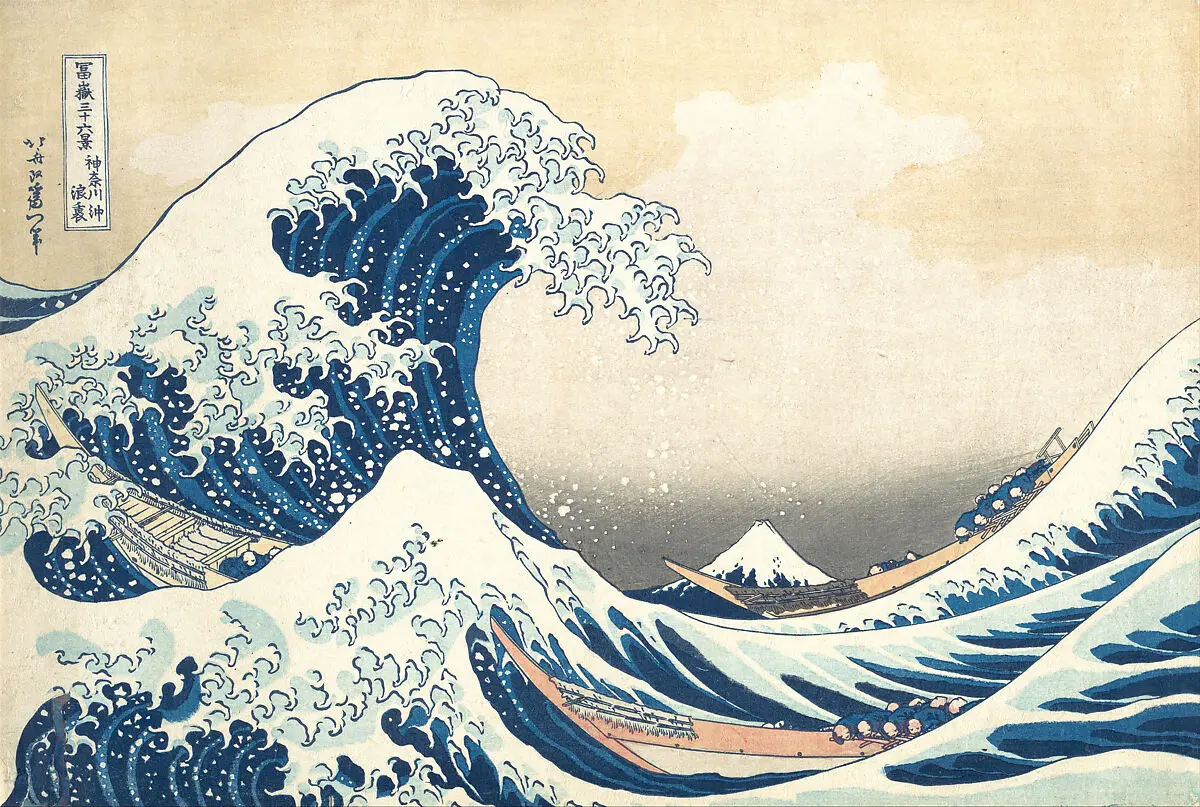
The Great Wave off Kanagawa is a woodblock print by Katsushika Hokusai, created around 1830 to 1832 as part of his famous series Thirty-Six Views of Mount Fuji. It is a ukiyo-e print, made in Japan during the late Edo period. The image is relatively small, but its visual force is enormous. The composition shows a gigantic wave curling over three narrow boats. At the center in the distance stands Mount Fuji, appearing remarkably small beneath the towering water. The contrast is immediate. The wave is enormous. The mountain is distant. The people are tiny. And yet the humans are not passive. They row desperately through the storm.
This makes the print more than an image of a natural disaster. It is a meditation on nature, human vulnerability, courage, beauty, movement, and impermanence.
The World Behind the Artwork
Hokusai created the print during the Edo period, when Japan was relatively politically stable under the Tokugawa shogunate. This was a period of strong social structure, urban growth, commercial development, and expanding popular culture. Cities such as Edo, now Tokyo, became major cultural centers. A growing urban population supported theater, literature, entertainment, illustrated books, and woodblock prints. Ukiyo-e developed within this world. The word ukiyo can be translated roughly as “floating world,” referring to the changing pleasures and experiences of urban life.
Artists depicted actors, beautiful women, landscapes, travelers, famous places, and scenes of everyday life. Hokusai transformed the landscape print. Instead of treating landscape merely as background, he made nature itself the dramatic subject. In The Great Wave, the landscape is no longer something humans simply look at. It becomes an overwhelming force.
The Artist Behind the Work
Hokusai was born in 1760 and died in 1849. His life was unusually long, and his artistic career was constantly changing. He used many names throughout his life and repeatedly reinvented his artistic identity. He worked in painting, drawing, book illustration, and printmaking. He was intensely curious. He studied traditional Japanese art but also absorbed ideas from Chinese painting and, to some extent, European visual traditions that entered Japan through limited foreign trade. Hokusai became particularly fascinated with landscapes. He was also fascinated by Mount Fuji. For him, Fuji was not simply a mountain. It was a powerful cultural and visual symbol.
By placing Fuji beneath the enormous wave, Hokusai creates a complicated relationship between nature, permanence, and human existence.
What We See
The composition is built around three major elements:
- The wave.
- The boats and their occupants.
- Mount Fuji.
The wave occupies most of the image. Its curved crest forms a huge claw-like shape. White foam extends from the wave like fingers. Below it, long narrow boats cut through the water. The rowers lean forward. Their bodies form repeated lines. They are trying to move through the waves. Far behind them, Mount Fuji rises beneath the horizon. Its triangular shape almost echoes the shape of the great wave. This visual relationship is one of the painting’s most brilliant features. The mountain and wave resemble each other. One is solid. One is fluid. One appears permanent. The other exists for only a moment.
The Great Wave
The wave is the unquestionable protagonist. It is not simply large. It feels alive. Its curved body creates the impression of movement. The crest bends downward toward the boats. The white foam resembles claws. The wave appears almost like a giant creature reaching toward the humans below.
But we should be careful about turning this into a literal symbol. Hokusai was deeply interested in the visual structure of water and movement. The wave’s almost animal-like appearance comes partly from the way he stylizes natural forms. Yet the emotional effect is unmistakable. The ocean feels powerful enough to swallow everything.
The Boats
The boats are long, narrow vessels used for transporting fish and other goods. They move in the opposite direction from what our eye initially expects. Their long bodies create horizontal lines beneath the curved wave. Inside them, the rowers work together. They are not portrayed as individual heroes. Their bodies form a rhythm. One bends.
Another bends. Another bends. They become a collective human effort. This is important. Hokusai does not place one heroic person at the center. Human beings survive through coordinated action. The individuals are tiny. The group is stronger.
Human Vulnerability
The people are almost invisible compared with the wave. This creates one of the most powerful ideas in the image. Human civilization has boats. People have tools. They have knowledge. They work together. Yet none of this makes them equal to the ocean. Nature does not need to hate them. It does not need to attack them intentionally. It simply moves. That indifference makes nature even more powerful. The wave is not evil. It is simply a force. Humans must adapt to it.
Mount Fuji
In the distance stands Mount Fuji. It is surprisingly small. This is one of the great visual reversals of the print. Fuji is usually associated with grandeur. Here, the wave is visually larger. But Fuji appears calm. Stable. Unmoving. The wave is temporary. The mountain seems permanent. This creates a contrast between movement and stillness. The wave will collapse. The boats will pass. The storm will end. Fuji will remain. The image therefore contains two different kinds of time. The instant. And the enduring.
The Wave and Fuji
The shapes of the wave and Mount Fuji mirror each other. The wave forms a great triangular mass. Fuji forms a smaller triangle in the distance. This creates visual unity. It also creates a philosophical tension. The wave seems to threaten the mountain. But of course it cannot destroy it. The enormous wave is temporary. The mountain endures. The small Fuji therefore possesses a strange power. Size does not equal permanence. The largest thing in the picture may be the least lasting. The smallest may be the most enduring.
How the Artwork Works
The print’s composition is extraordinarily controlled. Hokusai uses strong curves. The wave’s crest pulls the viewer’s eye downward. The boats create horizontal movement. The mountain provides a distant point of stability. The viewer’s eye moves through the composition almost like a wave itself. We begin with the enormous curved form.
Then descend toward the boats. Then move toward Fuji. The image therefore creates a visual journey from chaos toward stillness.
Color
The famous blue is one of the most recognizable features of the print. Hokusai used Prussian blue, a pigment that had become increasingly available in Japan through international trade. Its deep blue allowed him to create a strong contrast with the lighter areas of foam and sky. The color also gives the ocean a remarkable intensity.
But the blue is not simply decorative. It helps separate different levels of space. Dark water comes forward. Lighter areas recede. Fuji becomes distant. The color therefore contributes to both emotion and perspective.
Woodblock Printing
The medium is essential to the work’s appearance. Woodblock printing allows an image to be reproduced multiple times. Each color could be printed from a separate carved block. This means Hokusai had to think in terms of shapes and layers. Fine modeling through painterly brushwork was not the goal.
Instead, he created powerful contours and areas of color. This helped produce the graphic clarity that makes the print so recognizable. The limitations of the medium became part of its strength. The image is simplified. But that simplification makes it more powerful.
The Relationship Between Control and Chaos
The subject appears chaotic. A huge wave. Dangerous water. People struggling. Yet the composition itself is extremely controlled. Nothing is random. Every curve has a role. Every boat is positioned carefully. Fuji is placed precisely. This creates a fascinating contradiction.
Chaos is represented through order.
Hokusai controls the image so carefully that he can make nature appear uncontrollable. That is one of the great achievements of the print.
The Central Idea
At its heart, The Great Wave is about the relationship between human beings and forces larger than themselves. We like to believe that we control our environment. We build houses. We create ships. We construct cities. We invent technology. But the ocean reminds us that control is limited. The people in the boats are not conquering the wave. They are negotiating with it. They survive by responding. This makes the image less about heroic victory and more about adaptation.
The Philosophy of Impermanence
The print can also be connected to a broader Japanese awareness of impermanence. The Buddhist idea that all conditioned things change has had a deep influence on Japanese culture. The ocean is constantly moving. The wave exists for a brief moment. Its beautiful form is inseparable from its disappearance. This is one reason the image can feel strangely beautiful despite depicting danger. The wave is terrifying.
But it is also temporary. Its beauty comes partly from the fact that it cannot last. We should not claim that Hokusai painted the work as a direct philosophical illustration of Buddhist impermanence. Its meaning is broader than that. But the idea of impermanence provides a useful way to understand why the image can hold beauty and fear at the same time.
Beauty and Danger
The wave threatens the people. Yet we are attracted to it. We admire its shape. We admire its rhythm. We admire the foam. We admire its color. This creates a powerful contradiction. The same thing that terrifies us can also be beautiful. This is closely related to the idea of the sublime, in which something overwhelming produces both fear and fascination. Hokusai makes the viewer experience the ocean from a safe distance. We are spectators. The rowers are not. That difference matters.
We experience the beauty of danger without having to experience the danger itself.
The Human Condition
The rowers are not famous heroes. They are ordinary workers. They have jobs. They have responsibilities. They are simply trying to reach their destination. That makes the scene more human. Their struggle can stand for something larger. Life often places people inside forces they did not choose. Storms come. Illness comes. Economic hardship comes. Political change comes. Aging comes. Death comes. We cannot control everything.
But we can still row. That may be one of the quietest messages in the image. The people do not defeat the ocean. They continue moving through it.
The Question of Courage
What does courage mean when victory is uncertain? The rowers do not appear heroic in the traditional sense. They are not posing. They are not celebrating. They are working. Their courage is practical. Keep rowing. Stay together. Move forward. Do what can be done. This is a different kind of heroism from the heroic tradition of Western painting. It is not about defeating nature. It is about surviving within nature.
Different Interpretations
Some viewers interpret the wave as a symbol of the overwhelming power of nature. Others see it as a meditation on human vulnerability. Some emphasize Mount Fuji as a symbol of permanence, spiritual significance, or Japanese identity. Others focus on the technical achievement of combining Western-style perspective with Japanese woodblock design. There are also historical interpretations connected to the dangers faced by Japanese fishermen and the changing society of the Edo period.
But the image does not need a single secret meaning. Its strength comes from the way several ideas coexist. Nature is beautiful. Nature is dangerous. Human beings are fragile. Human beings are resilient. The moment is temporary. Something more permanent exists beyond it.
Japan and the Outside World
The print also belongs to a fascinating period in Japanese history. Japan’s interaction with foreign countries was tightly controlled under the Tokugawa shogunate, but it was not completely isolated. Foreign goods and ideas entered through limited channels. Prussian blue was one example. Its availability helped artists create new visual effects. The image therefore carries a subtle historical irony. A distinctly Japanese cultural icon was partly shaped by a pigment connected to international trade. The artwork is deeply Japanese.
But it also reveals that cultures are rarely completely sealed from one another.
The Artist’s Intention and the Viewer
Hokusai created the print as part of a series devoted to views of Mount Fuji. His intention was not necessarily to create a universal philosophical statement about human existence. He was also working within a commercial print culture. People bought these images. They were reproduced. They circulated. They were meant to be seen.
Yet the work eventually acquired meanings far beyond its original commercial setting. Modern viewers see climate, disaster, technology, mortality, anxiety, and human vulnerability in it. Those interpretations belong partly to us. The artwork gives us the structure. History gives us new questions to place inside it.
Reception and Historical Importance
The Great Wave became one of the most influential Japanese prints in global art history. Its influence spread beyond Japan, particularly during the nineteenth century when Japanese art became increasingly known in Europe. European artists associated with Impressionism and Post-Impressionism admired Japanese prints. Artists such as Claude Monet, Edgar Degas, Vincent van Gogh, and others encountered Japanese visual ideas that influenced European art. The strong outlines, unusual cropping, flat areas of color, asymmetrical compositions, and unexpected viewpoints offered an alternative to traditional European academic painting.
Hokusai therefore helped change how Western artists thought about composition. The wave itself became an international visual symbol.
Why It Still Matters
The image feels especially powerful in an age when humanity possesses extraordinary technological power. We can launch spacecraft. Map the ocean floor. Predict storms. Build enormous structures. Use artificial intelligence. Manipulate genes. And yet a storm can still destroy a city. A virus can still disrupt societies. A wildfire can cross borders. An earthquake can transform a landscape in seconds. The lesson is not that human technology is useless. The rowers themselves have technology. The lesson is that power does not eliminate vulnerability.
Human beings are capable of extraordinary things while remaining fundamentally exposed to forces beyond their control.
A Deeper Reading
Look again at the composition. The wave is enormous. But it will collapse. The people are tiny. But they keep moving. Fuji is small. But it remains. The image therefore reverses our usual assumptions. The largest thing is temporary. The smallest human figures possess agency. The distant mountain possesses stillness. Everything exists within a larger rhythm. Perhaps that is why the print feels less like a simple disaster scene and more like a meditation on existence.
We are all, in some sense, inside those boats. We do not control the ocean. We do not know what the next wave will bring. Yet we have hands. We have companions. We have knowledge. We have the ability to keep moving. And perhaps that is the quiet wisdom hidden beneath the enormous wave.
We do not become strong because the sea becomes smaller. We become human because, knowing how small we are, we keep rowing.