Tabulae · Tabula XXVII
Tabula XXVII
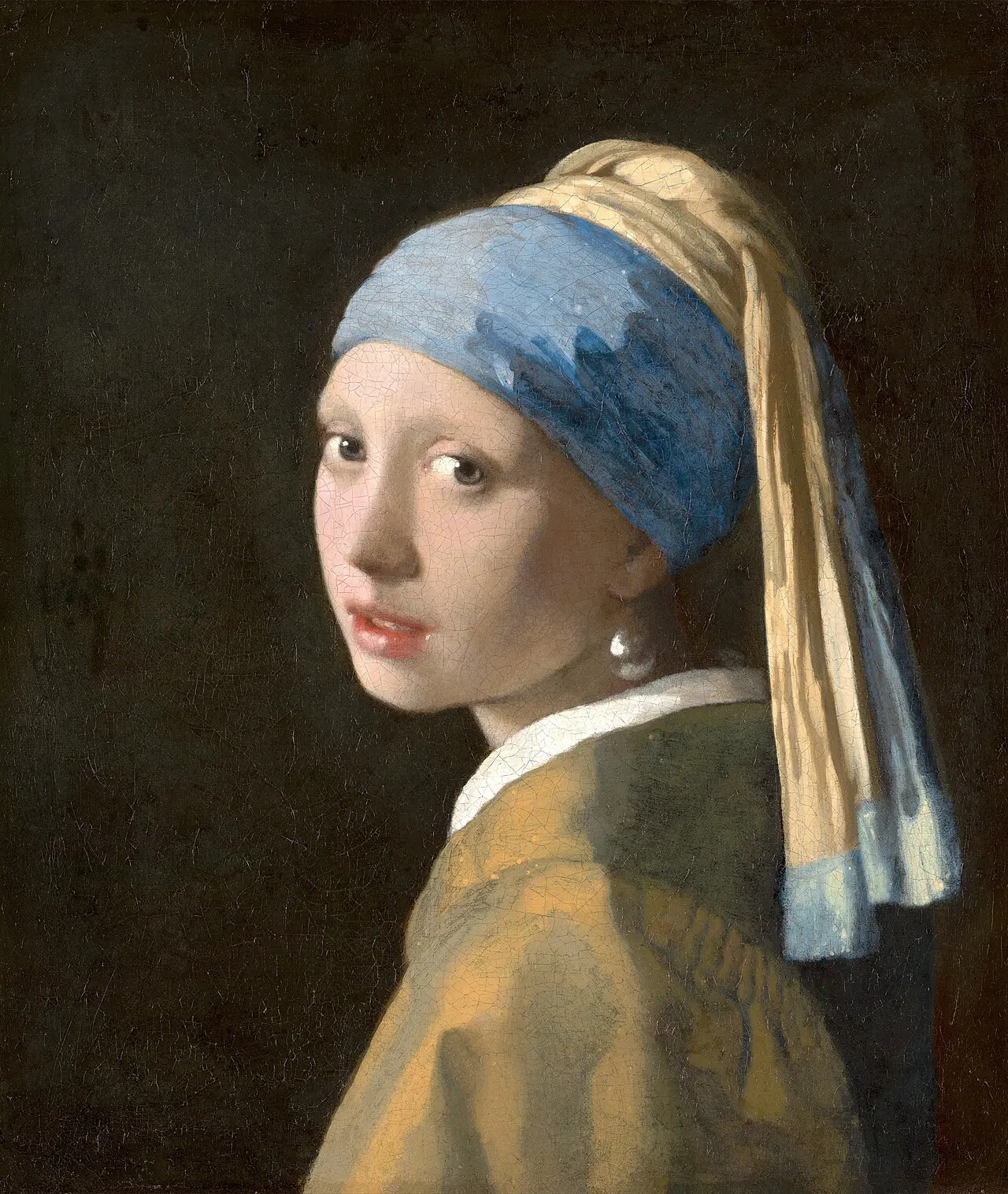
Girl with a Pearl Earring
The Face That Refuses to Give Away Its Secret
Johannes Vermeer, c. 1665
She turns toward us as if we have just called her name, and in that single instant Vermeer makes a stranger feel strangely familiar.
The Artwork at a Glance
Girl with a Pearl Earring is a painting by Johannes Vermeer, created around 1665, during the Dutch Golden Age. It is an oil painting on canvas, measuring approximately 44.5 × 39 cm, and is held by the Mauritshuis in The Hague, Netherlands. It is often called the “Mona Lisa of the North,” but the comparison can be misleading. Leonardo’s Mona Lisa is deeply concerned with identity, psychological ambiguity, and the passage of time. Vermeer’s girl is different. We do not know who she is. She has no identifiable setting. She carries no obvious story.
She is not presented as a historical figure, saint, aristocrat, or famous person. She simply turns toward us. And somehow, that is enough. The painting’s mystery begins with the fact that it may not be a portrait in the conventional sense. It is generally understood as a tronie, a Dutch term for a study of a face or character type rather than a commissioned portrait of a specific individual. That distinction changes how we look at her.
We are not necessarily being asked to identify her. We are being asked to encounter her.
The World Behind the Artwork
Vermeer painted during the seventeenth-century Dutch Golden Age, when the Netherlands had become a major center of trade, commerce, science, navigation, and culture. Dutch society was changing rapidly. Merchants were becoming wealthy. Cities were expanding. Private homes became important spaces for art. Unlike the enormous religious and political paintings produced for churches and royal courts elsewhere in Europe, much Dutch art was made for private viewers. Paintings could show domestic rooms, landscapes, still lifes, merchants, servants, musicians, and ordinary moments.
Vermeer became one of the great painters of this intimate world. But his paintings rarely feel like simple records of everyday life. He transformed ordinary interiors into spaces of extraordinary concentration. Light becomes important. Silence becomes important. A woman reading a letter becomes important. A glass of wine becomes important. A face turning toward the viewer becomes important. He found something profound in the seemingly insignificant.
The Artist Behind the Work
Johannes Vermeer was born in Delft around 1632 and died there in 1675. Compared with Rembrandt, he produced relatively few surviving paintings. He did not become a famous international celebrity during his lifetime. He appears to have lived largely within Delft and worked on a small scale. His financial situation was difficult toward the end of his life, and after his death his reputation faded for a long period. Only centuries later did Vermeer become one of the most celebrated painters in Western art. This delayed fame is revealing. Vermeer was not an artist of spectacle. His paintings are quiet. Their power develops slowly.
They ask the viewer to look rather than react. Girl with a Pearl Earring is perhaps the purest example.
What We See
The composition is remarkably simple. A young girl turns her head toward us. Her body faces partly away. Her head turns back. She wears a large blue and yellow head covering. Her clothing is dark. Her lips are slightly parted. A small amount of light touches her face. And beneath her ear hangs the famous pearl. There is almost nothing else. The background is dark and empty. No room. No furniture. No window. No landscape. No narrative explanation.
The girl appears against darkness as if she has emerged from another world. This is one reason the painting feels so immediate. There is nothing competing with the face.
The Turn of the Head
Her pose is crucial. She is not facing us directly. She is turning. That creates movement inside an otherwise still image. We imagine that something has just happened. Perhaps she has heard someone. Perhaps she has been interrupted. Perhaps she is about to speak. The painting captures a fraction of a second. That makes the viewer feel strangely present. We are not looking at someone posing for a long portrait session. We feel as though we have caught her in the middle of an action.
The Eyes
Her eyes are directed toward us. They are soft but alert. There is no obvious smile. There is no obvious sadness. There is no clear emotional label. This ambiguity is central to the painting. We instinctively search the face for information. We want to know what she feels.
But Vermeer gives us very little. The result is an unusual psychological experience. The girl appears open enough to invite us closer. But closed enough to remain unknowable.
The Slightly Open Lips
Her lips are parted. This tiny detail contributes enormously to the sense of immediacy. It makes the girl appear as though she might speak. A completely closed mouth would make the image feel more formal. The parted lips create a moment of uncertainty. Is she surprised? Is she about to answer? Is she breathing? Is she simply looking? We cannot know. The painting does not resolve the question. It suspends it.
The Pearl
The pearl is the most famous object in the painting. But its meaning is more complicated than it first appears. It is large. Almost unnaturally large. It catches the light. Its lower edge is sharply visible against the darkness. Yet Vermeer does not describe it through a large number of detailed marks. The impression of the pearl comes largely through light. This is typical of Vermeer’s approach. He does not always paint objects by describing every physical detail.
He paints the way light makes us perceive them. The pearl is therefore almost less an object than an event of light.
The Mystery of the Pearl
There has been much discussion about whether the object is actually a pearl or perhaps an imitation pearl. The exact material is impossible to establish from the painting alone. Its size and appearance have encouraged debate. But perhaps the more interesting point is why Vermeer made it so visually powerful. The pearl catches the eye because it is almost the only bright object against the dark background. It becomes a point of light. Our attention moves from the eyes to the lips and then toward the pearl. The painting therefore creates a visual triangle.
- Eyes.
- Mouth.
- Pearl.
Human expression and reflected light become connected.
Light as the Real Subject
Vermeer is often called a painter of light. That description is deserved, but it can sound too simple. He does not merely illuminate objects. He shows how light changes our experience of them. The girl’s face is built through subtle transitions. The forehead. The cheek. The nose. The lips. The neck. Nothing is aggressively outlined. Forms emerge gradually. This gives the face softness. The viewer does not feel that the face has been constructed from lines. It seems to exist through light itself.
Color
The blue and yellow head covering is one of the most striking elements of the painting. The deep blue creates a strong visual anchor. The warm yellow or ochre balances it. Against the dark background, the colors become intense without needing to be bright. Vermeer was particularly interested in the relationship between cool and warm tones. The blue makes the yellow appear warmer. The dark background makes the skin appear luminous. The pearl becomes brighter because almost everything around it is darker. Color is therefore relational. Nothing has its full visual meaning in isolation.
How Vermeer Creates Realism
Vermeer’s realism is unusual. He does not give us every detail. In fact, many parts of the painting are surprisingly simplified. The background is almost completely empty. The clothing is not described with elaborate texture. The pearl itself is suggested rather than minutely rendered. Yet the image feels extremely real. Why? Because Vermeer understands what the eye actually needs. A few precise transitions of light can create the impression of a nose. A small highlight can make an eye feel wet. A soft edge can make skin appear three-dimensional. A dark background can make a face emerge. Vermeer does not imitate everything. He selects.
The Camera Obscura Question
Vermeer’s paintings have often been discussed in relation to the camera obscura, an optical device that projects an image through a small opening. Some scholars believe that optical devices may have influenced his way of seeing. Others caution against turning this possibility into a simple explanation of his art. There is no need to claim that Vermeer mechanically copied an optical projection. The important point is that his paintings show an extraordinary sensitivity to optical phenomena. Highlights. Blurred edges. Unexpected brightness. Changes in focus.
These effects contribute to the sense that we are looking at the world through an eye rather than reading a carefully outlined drawing.
The Central Idea
At its deepest level, Girl with a Pearl Earring is about presence. Not biography. Not history. Not narrative. Presence. The girl exists in front of us for a moment. She looks. We look. That is almost the entire event. And yet the experience is powerful because human beings naturally want to know the person behind a face. The painting gives us just enough information to awaken that desire.
Then it refuses to satisfy it.
Identity and Anonymity
This may be the painting’s greatest philosophical mystery. We see a human face. But we do not know the person. There is no name. No biography. No documented story. No clear social identity. The girl becomes strangely universal. If Vermeer had given her a name and detailed biography, the painting might become more specific. Because she remains anonymous, viewers can imagine possibilities. She becomes less a historical individual and more an encounter with human presence itself.
The Philosophy of Looking
The painting also raises a question about how we perceive other people. We often believe that seeing someone’s face means knowing something about them. But does it? We can look into someone’s eyes without knowing their thoughts. We can recognize an expression without understanding its cause. We can find someone beautiful without knowing anything about their character. Vermeer turns this everyday problem into art. The girl looks available to our understanding.
But she remains beyond it. The more carefully we look, the more aware we become of what we cannot know.
Beauty and Vulnerability
The girl is beautiful. But her beauty does not feel triumphant. She is not dressed like a queen. She does not possess wealth or power. Her beauty is temporary and fragile. The soft light on her face seems to exist for only an instant. This creates a quiet awareness of time. The image preserves a moment that, in reality, lasted perhaps only seconds. Painting becomes a form of resistance against disappearance.
But it can never completely defeat time. The real girl, whoever she was, continued to age. The painted girl does not.
The Contradiction of Stillness and Movement
The entire painting is still. Yet everything important is based on movement. The head has just turned. The lips may be about to move. The eyes meet ours. The pearl swings slightly beneath the ear. We experience an instant suspended between past and future. This is one reason the painting feels alive. Vermeer has not painted a static person. He has painted a moment of transition.
The Artist’s Intention and the Viewer
We do not know exactly what Vermeer intended the girl to represent. Because the work is probably a tronie, it may not have been intended to document a specific person at all. That makes modern attempts to identify her uncertain. The famous novel and later film adaptation based on the painting have given her a fictional identity, but that story belongs to modern imagination, not established history. This distinction matters. The mystery is powerful precisely because Vermeer did not explain her. We should allow the painting to remain mysterious.
Different Interpretations
Some viewers see the work as an idealized portrait of youthful beauty. Others emphasize the sensual relationship between the girl’s face, lips, skin, and pearl. Some see the image as an exploration of light and optical perception. Others focus on the psychological encounter between viewer and subject. Some interpret the pearl as a symbol of purity, wealth, femininity, or transience.
But these symbolic readings should be treated carefully. There is no secure evidence that Vermeer intended one fixed symbolic message. The pearl may simply be part of the visual structure that makes the girl’s face luminous. Sometimes an object does not need a secret meaning. Sometimes its greatest purpose is to make us look.
The Girl and the Viewer
The painting creates an unusual relationship. The girl is looking at us. But she does not know who we are. We are separated by centuries. She could not have imagined us. Yet the image makes the encounter feel immediate. This is one of art’s strangest powers. A person can die. A civilization can disappear. Languages can change. Cities can transform.
But an image can preserve a relationship between two acts of looking. The girl’s eyes meet ours. The centuries between us seem to disappear.
Reception and Historical Importance
Vermeer was not always recognized as one of the greatest painters in European history. After his death, his reputation declined considerably. It was not until the nineteenth century, particularly through the work of art critic Théophile Thoré-Bürger, that Vermeer was rediscovered and his importance reassessed.
Today he is regarded as one of the supreme masters of light, color, quiet domestic space, and visual perception. Girl with a Pearl Earring became especially famous in the modern era. Its reproduction has spread throughout global popular culture. It appears in books, posters, exhibitions, educational materials, advertisements, and adaptations.
But its fame creates an interesting paradox. The more famous the painting becomes, the less mysterious it seems. Yet the girl herself remains unknown.
Why It Still Matters
We live in an age obsessed with images of faces. We photograph ourselves. We create profile pictures. We use filters. We construct online identities. We constantly decide how we want to be seen. Vermeer’s painting comes from a completely different world, but it asks a surprisingly modern question:
What happens when a face becomes an image?
The girl has no social media profile. No biography attached to the painting. No explanation of her thoughts. She exists almost entirely as an appearance. And yet we desperately want to know her. That desire says something about us. Human beings cannot easily encounter a face without imagining a person behind it.
A Deeper Reading
Look again at her face. There is no dramatic story. No death. No war. No religious miracle. No historical event. Nothing appears to be happening. And yet something has happened. She has looked at us. That is enough. Vermeer takes one of the smallest events imaginable, a person turning her head and meeting another person’s gaze, and gives it permanence. The darkness behind her removes the world. The blue and yellow cloth removes ordinary time. The pearl catches a brief flash of light. Her lips remain slightly open. Her eyes remain fixed on ours. Everything is suspended.
Perhaps the painting’s deepest mystery is not who the girl was. Perhaps it is why we care so much about knowing. We look at an anonymous face painted more than three centuries ago, and our first instinct is to invent a story. We want a name. A family. A life. A personality.
But Vermeer gives us none of these. He gives us something more fragile and more universal. A moment in which one human being looks at another. And perhaps that is why she continues to fascinate us.
She does not tell us who she is. She simply looks back, and in that silence we are forced to confront our own need to turn a face into a story.