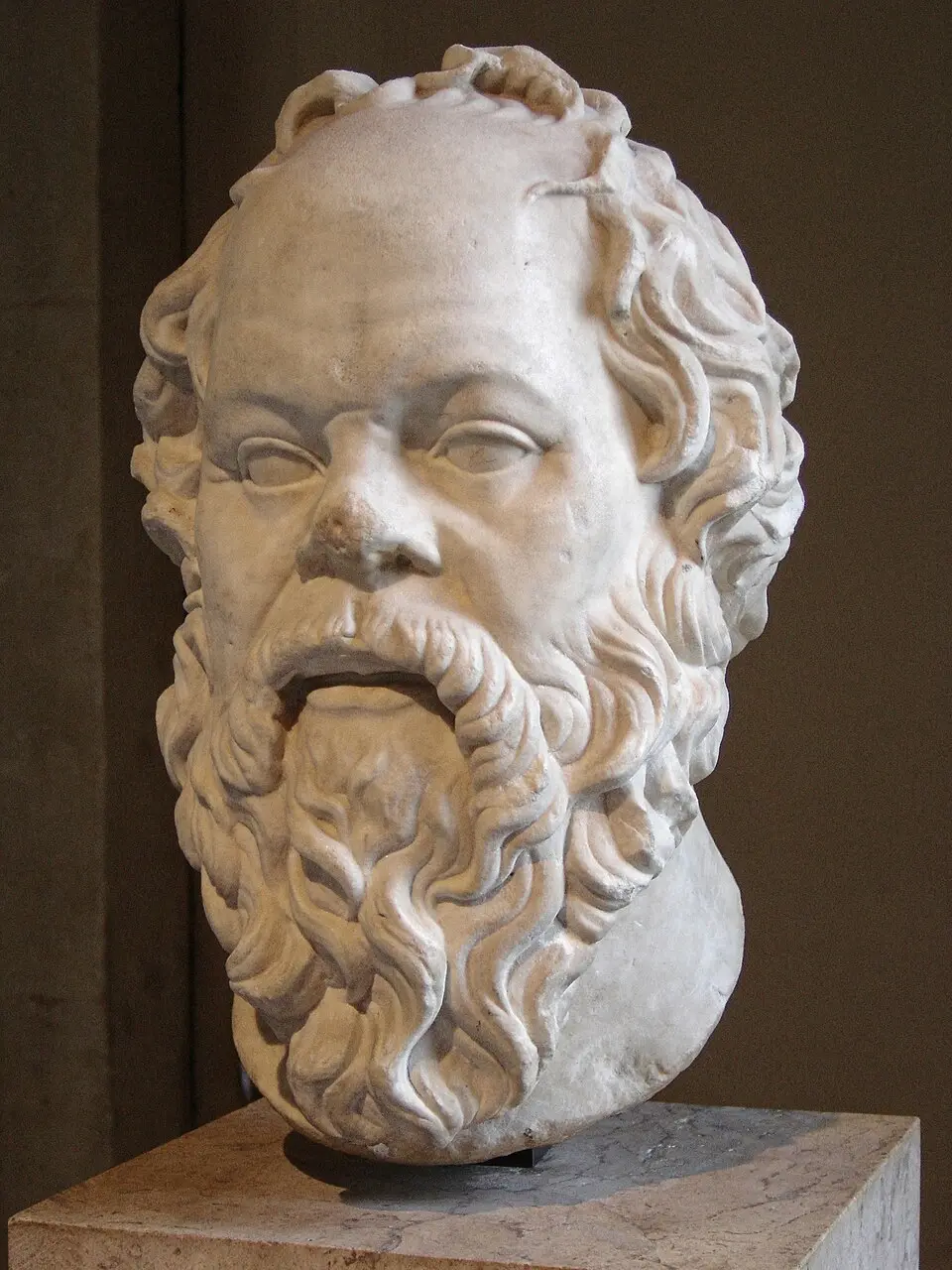
Tabulae · Tabula XXII
Tabula XXII
Socrates
Lysippos, The ancient Greek philosopher Socrates was born around 470/469 BC and died in 399 BC at about 71 years old in Athens, Greece.
Who Was Socrates?
Socrates was born around 470 BCE in Athens and died in 399 BCE. Unlike Plato and Aristotle, Socrates left no writings of his own. Almost everything we know about him comes from other people, especially Plato, Xenophon, Aristophanes, and later writers. That creates an immediate problem. Who was the historical Socrates? The Socrates we know may partly be a philosophical character created by Plato. Plato presents Socrates as the central figure in many dialogues. Xenophon presents a somewhat different Socrates. Aristophanes portrays him as a strange intellectual who teaches clever arguments. So before understanding Socrates, we need to recognize something unusual:
We are trying to understand a philosopher who never wrote his philosophy down himself.
This uncertainty is part of the Socratic story.
The Person Behind the Philosopher
Socrates was not born into Athens’ wealthiest class. His father, according to ancient sources, was a stonemason or sculptor, while his mother was traditionally described as a midwife. Socrates himself served as a soldier and fought in several military campaigns. This matters because the popular image of Socrates as an old man wandering around asking abstract questions can make him seem disconnected from ordinary life. He was not. He was an Athenian citizen who participated in military life, public life, family life, and political life. He married Xanthippe and had children.
He lived simply and became famous for his unusual appearance, lack of concern for wealth, and willingness to endure physical discomfort. But his most unusual feature was intellectual. Socrates believed that human beings should examine the beliefs by which they live.
The Athens of Socrates
Socrates lived during one of the most fascinating and turbulent periods of ancient Greece. Athens was a major political, cultural, military, and intellectual center. It had developed a form of democracy in which male citizens could participate directly in political decision-making. Athens also produced extraordinary achievements in drama, architecture, history, philosophy, and art.
But the city was deeply unstable. Athens fought the Persian Wars. Later it entered a long and destructive conflict with Sparta in the Peloponnesian War. The war ended with Athens defeated. Political instability followed. A brutal oligarchic government known as the Thirty Tyrants briefly seized power. Democracy was later restored. Socrates lived through this political turbulence. This background matters because many of his philosophical questions concerned the relationship between knowledge, virtue, leadership, and political power.
Athens was a city that allowed citizens to speak. Socrates wanted to know:
Did speaking well mean that someone actually knew what they were talking about?
The Intellectual World Before Socrates
Before Socrates, Greek philosophy had often focused heavily on nature. The early philosophers asked: What is the universe made of? What is reality? What is change? What is the basic substance of everything? Thales proposed water. Anaximenes proposed air. Heraclitus emphasized change. Parmenides argued that genuine reality cannot be understood through ordinary appearances of change. Pythagoreans emphasized mathematical order. These thinkers were trying to understand the structure of reality.
Then another group became increasingly important:
the Sophists.
Sophists were teachers who trained people in rhetoric, argument, politics, and public speaking. In democratic Athens, this was valuable. If political success depended partly on persuasion, the ability to speak convincingly could provide enormous power. Socrates saw a danger. Someone could become extremely persuasive without being genuinely wise. A person could win an argument without discovering the truth. That distinction became central to Socrates.
The Central Question
Socrates’ philosophy can be organized around one fundamental question:
How should a human being live?
But this question immediately produces others. What is virtue? What is justice? What is courage? What is wisdom? What is goodness? Can virtue be taught? What is knowledge? Why do people do wrong? Can a person know what is good and still deliberately choose evil? Socrates did not answer these questions with a complete philosophical system.
Instead, he investigated them through conversation. His philosophy was not primarily a collection of doctrines. It was a method of inquiry.
Socrates and the Delphic Oracle
One of the most famous stories about Socrates concerns the Oracle of Apollo at Delphi. According to Plato’s Apology, Socrates’ friend Chaerephon asked the oracle whether anyone was wiser than Socrates. The oracle supposedly answered no. Socrates was confused. He did not believe himself to be wise. So he began investigating. He went to people who were considered wise. Politicians. Poets. Craftsmen. He questioned them. And he discovered something. Many people who believed they possessed wisdom could not explain the foundations of their own beliefs. They knew something in one area.
But they assumed this meant they understood much more than they actually did. Socrates concluded that whatever advantage he had was connected to recognizing his own ignorance. This produced the famous Socratic idea:
Wisdom begins with recognizing that you do not know.
This is not the claim that Socrates knew absolutely nothing. It is a deeper claim.
The person who knows that they may be wrong is intellectually better positioned than the person who is confidently wrong.
Socratic Ignorance
Socratic ignorance is one of the most misunderstood ideas in philosophy. Socrates does not simply say: “I know nothing.” His point is that he does not possess the kind of wisdom people often claim to possess. He knows that his understanding is limited. This creates intellectual humility. Imagine two people discussing justice. The first says: “I already know exactly what justice is.” The second says: “I think I understand it, but I may be mistaken. Let’s investigate.” Socrates prefers the second attitude. For him, intellectual confidence without examination is dangerous.
The Socratic Method
Socrates became famous for a particular style of questioning. Today we call it the Socratic method. He would begin with a question. “What is courage?” Someone would offer a definition. Socrates would ask another question. The person would modify the definition. Socrates would find another problem. Eventually the conversation could reach a point where the original definition collapsed. This process is sometimes called elenchus, or Socratic refutation. Its purpose is not simply to embarrass people. At its best, it exposes contradictions.
Consider a simple example. Someone says: “Courage means never being afraid.” Socrates might ask: “Can a person be courageous while feeling fear?” If the answer is yes, then fearlessness cannot be the complete definition. The person may then say: “Courage means doing what is right despite fear.” Socrates can ask: “Then does a person need to know what is right before they can be courageous?” The discussion continues. The goal is to move from an easy definition toward deeper understanding.
Problem → Answer → Contradiction → Revision
This is the basic rhythm of Socratic inquiry. It is why Socrates often appears not to teach anything. He is teaching people how to discover the weaknesses in their own thinking.
Why Socrates Asked So Many Questions
Socrates believed that people often live according to ideas they have never examined. Someone says: “Money makes a good life.” Socrates asks: “What is money for?” “To provide security.” “What if wealth makes you dishonest?” “Then wealth is not enough.” “What makes a life good?” The question moves deeper. Socrates’ method therefore attacks assumptions. He wants people to stop living automatically. His philosophy begins when ordinary confidence becomes uncertainty.
Virtue
One of Socrates’ central concerns was virtue, or aretē. But virtue did not simply mean being morally nice. It referred to excellence. The question was What makes a human being excellent? What kind of person should we become? Socrates repeatedly examined virtues such as justice, courage, moderation, and wisdom.
But he did not simply list them. He wanted to understand what they really were. If someone claims to be courageous, what exactly makes their action courageous? If someone claims to be just, what makes justice different from power?
If someone claims to be wise, what does wisdom actually involve? The deeper question is always:
Can we live well without understanding what “living well” means?
Socrates and Knowledge
One of the most controversial ideas associated with Socrates is the connection between knowledge and virtue. Some Socratic dialogues suggest that nobody knowingly does wrong. If a person truly understood what was good, Socrates suggests, they would choose it. Why would someone knowingly choose something harmful? Because they misunderstand what is truly good. Imagine someone chooses immediate pleasure over long-term health. Socrates might argue that the person does not fully understand the value of the future consequences. They know one thing intellectually.
But they do not possess the deeper knowledge necessary to guide their life correctly. This idea is sometimes called Socratic intellectualism. It creates a difficult problem. What about people who know something is wrong but do it anyway? We all seem to experience this. We know we should not lie. We lie. We know we should study. We procrastinate. We know anger will make things worse. We still lose our temper. This suggests that knowledge may not be enough.
Later philosophers, especially Aristotle, would challenge Socrates on precisely this point.
Socrates and the Soul
For Socrates, the most important part of a human being was not wealth, appearance, status, or physical pleasure. It was the soul, understood as the moral and rational center of the person. This is why Socrates constantly tells people to care for their souls. A person can become rich while becoming morally worse. They can become powerful while becoming unjust. They can become famous while becoming foolish. External success does not guarantee inner excellence. Socrates therefore reverses ordinary priorities. Athenians might ask: “How can I become wealthy?” Socrates asks: “How can I become good?” That change is enormous.
The Good Life
Socrates did not believe that the good life was simply a pleasurable life. A person who spends their entire life pursuing pleasure may still become selfish, ignorant, or unjust. The good life requires examination. This is why one of the most famous Socratic statements appears in Plato’s Apology:
“The unexamined life is not worth living.”
The sentence is often misunderstood. Socrates does not mean that every person must spend every day studying philosophy. He means that a life should not simply be lived according to habit, desire, social pressure, or convention. We should ask: Why do I believe this? Why do I want this? What makes this action right? What kind of person am I becoming? Without these questions, we may achieve everything society tells us to desire while failing to understand whether those things are actually worth wanting.
Socrates and Death
Socrates’ philosophy becomes most powerful when his own life is threatened. In 399 BCE, Socrates was put on trial in Athens. He was accused of corrupting the young and not properly recognizing the city’s gods. The historical details are complicated. The accusations were connected to religious concerns, but political tensions also surrounded Socrates. Some Athenians associated him with controversial figures. His association with people such as Alcibiades and Critias made him politically suspicious in the eyes of some citizens.
The city had recently experienced war, oligarchy, and political violence. Socrates’ habit of questioning authority could also be deeply irritating. He was not simply an innocent teacher living outside politics. His philosophy had political consequences.
The Trial of Socrates
Plato’s Apology presents Socrates defending himself. The word “apology” here does not mean saying sorry. It means a defense. Socrates does not beg the jury for mercy. He does not abandon his philosophical method. Instead, he argues that his mission is to examine himself and others. He compares himself to a gadfly. A gadfly annoys a large horse and keeps it awake. Athens, Socrates suggests, is like a large horse. He is the annoying insect.
His purpose is to keep the city intellectually awake. This is an extraordinary idea. The philosopher’s role is not necessarily to make society comfortable. It may be to prevent society from becoming intellectually lazy.
The Sentence
Socrates was found guilty and sentenced to death. His friends offered him opportunities to escape. But according to Plato’s account, Socrates refused. Why? Because he believed that obeying the law mattered, and because escaping would contradict principles he had defended throughout his life. This produces one of the great philosophical questions:
Should a person obey an unjust law?
Socrates’ answer is not simple. He does not claim that every law is morally good. But he believes that his relationship with the city and its laws cannot simply be abandoned when the outcome becomes personally inconvenient. His position is developed most clearly in Plato’s Crito.
Socrates and the Problem of Civil Disobedience
This creates an important tension. Socrates spent his life questioning society. Yet when society sentenced him to death, he refused to escape. Was he contradicting himself? One interpretation says no. Socrates distinguished between criticizing a political order and abandoning one’s obligations to it. Another interpretation is more critical. Perhaps Socrates placed too much faith in the legal order. Perhaps a truly unjust law should be resisted. This question later became central to political thinkers. Should we obey law because it is law? Or should justice come before legality? Socrates’ death does not settle the question. It makes the question unavoidable.
The Last Day
Plato’s Phaedo describes Socrates’ final hours. His friends are gathered around him. He discusses the soul and death. Then he drinks hemlock. The scene is one of the most famous deaths in philosophical history. What makes it powerful is not simply that Socrates dies. It is that his death becomes the final test of his philosophy. He spent his life saying that fear of death should not control our judgment.
Now he faces death. And he continues discussing philosophy. Whether every detail of Plato’s account is historically accurate is impossible to know. But philosophically, the scene expresses something profound.
Socrates did not merely teach philosophy. He tried to live according to it.
The Philosopher as a Way of Life
This may be Socrates’ greatest contribution. Philosophy was not an academic subject for him. It was a way of living. He did not write a textbook called Introduction to Ethics. He questioned people in the streets. He challenged politicians. He questioned poets. He challenged craftsmen. He examined himself. His philosophy existed through practice.
This is why Socrates remains so different from many later philosophers. His greatest philosophical work was his life.
Socrates and the Sophists
Socrates is often presented as the opposite of the Sophists. The distinction is important but should not be exaggerated. Sophists were not simply dishonest people. Many were highly educated teachers who provided valuable training in rhetoric and argument. The problem, from Socrates’ perspective, was the possibility that rhetoric could become detached from truth. A skilled speaker can persuade people whether or not the argument is true. Socrates therefore asks:
Is the goal of speech to win, or to discover what is true?
This problem remains relevant. A politician can give a persuasive speech without having a good policy. A social media post can go viral without being true. An advertisement can be convincing without being honest. A person can win an argument without understanding the subject. Socrates teaches us to separate persuasion from truth.
Socrates and Politics
Socrates had a complicated relationship with democracy. He did not simply praise Athenian democracy. He questioned whether political leadership should be treated as a skill that anyone could perform without knowledge. Imagine choosing a ship’s captain by asking every passenger to vote, regardless of whether they understand navigation. Socrates might ask: Why should governing a city be different? If governing requires knowledge, perhaps political decisions should involve expertise and wisdom.
But this argument creates another problem. Who decides who is wise? And who watches the experts? This is one reason Socratic political thought remains complicated. His criticism of democracy can sound elitist. Yet his deeper concern was not simply that ordinary people should not rule. It was that power without knowledge is dangerous. Modern democracy faces the same problem. How do we combine political equality with competence?
Socrates and Education
Socrates’ educational philosophy is radically different from memorization. He does not simply pour knowledge into students. He makes students think. This is why Socratic education begins with questions. Instead of asking students to memorize: “What is justice?” A Socratic teacher asks: “What makes an action just?” Then: “Can a law be unjust?” Then: “If an unjust law is legal, is it still wrong?” The student is forced to think through the problem. The goal is not simply to produce an answer.
It is to develop the ability to examine answers.
The Socratic Method in Real Life
Imagine someone says: “Money is the most important thing in life.” A Socratic response is not: “You’re wrong.” It is “Why?” They might answer: “Because money gives freedom.” Then ask: “Does having more money always make someone more free?” “No.” “Then what kind of freedom matters?” The conversation moves from money toward freedom.
Then perhaps from freedom toward happiness. Then from happiness toward the meaning of a good life. This is how Socratic questioning works. It begins with an ordinary belief and keeps asking questions until the deeper assumptions become visible.
Socrates and Modern Life
Modern society gives us enormous amounts of information. But Socrates would probably ask whether information has made us wiser. We can instantly search for facts. But do we know which questions matter? We can find thousands of opinions. But can we distinguish evidence from persuasion? We can follow political commentators, influencers, academics, celebrities, and online communities.
But do we examine the beliefs we inherit from them? Socrates would likely be deeply uncomfortable with a culture in which people repeat claims without examining them. His message would be simple:
Do not confuse having an opinion with understanding something.
Socrates and Social Media
Social media creates a world where confidence is often rewarded more than intellectual humility. People speak quickly. They react immediately. They defend identities. They attack opponents. They rarely pause to ask: “What evidence would change my mind?” Socrates would probably begin there. What do you mean? How do you know? What is your evidence? Does your argument contradict something else you believe? What would prove you wrong? These questions are uncomfortable. That is precisely why they are useful.
The Great Socratic Paradox
Socrates is famous for exposing ignorance. But there is an irony. The more he questioned people, the less certain he sometimes appeared. This suggests an important philosophical paradox:
The search for knowledge can increase awareness of ignorance.
A beginner may believe everything is simple. An expert may discover how complicated everything is. Socrates therefore represents a kind of intellectual maturity. Wisdom is not necessarily having more answers. Sometimes it is knowing which questions you cannot yet answer.
The Contradictions in Socrates
Socrates was not free from contradictions. He attacked the Sophists, yet he was also a highly skilled speaker. He criticized conventional political assumptions, yet he accepted the authority of the city when sentenced. He claimed ignorance, yet he believed strongly in certain moral principles. He questioned definitions of virtue, yet he seemed convinced that virtue was essential to human life. He challenged society, yet he did not simply reject society. These tensions should not be hidden.
They are part of what makes Socrates philosophically interesting. He did not create a perfectly consistent philosophical system. He created a practice of examination.
Criticism of Socrates
One criticism is that Socrates often destroys definitions without replacing them. A person says what courage is. Socrates shows the definition fails. But what exactly is courage? The dialogue ends without a final answer. This is called aporia, a state of puzzlement or intellectual impasse. Some people see this as a weakness.
If philosophy only produces uncertainty, how does it help? But another interpretation is more sympathetic. Perhaps Socrates believes that recognizing a false answer is genuine progress. It is better to know that your definition fails than to build your life upon it.
Aristotle’s Criticism
Aristotle later disagreed with important parts of Socrates’ ethical thought. Most importantly, Aristotle rejected the idea that knowledge alone is sufficient for virtue. A person may know what is right and still fail to do it because of desire, weakness, or bad habits. Aristotle’s solution was to emphasize character. We become good partly by repeatedly doing good actions until good behavior becomes a stable disposition. This creates an important contrast. Socrates emphasizes examination and knowledge. Aristotle emphasizes habit and character. The disagreement remains relevant. Can knowing what is right make us good? Or do we need discipline and practice to become good?
Probably the truth is more complicated than either extreme.
Socrates and Plato
Plato became Socrates’ greatest philosophical heir. But we must be careful. Because Socrates wrote nothing, much of what people call “Socratic philosophy” comes from Plato. Early Platonic dialogues may preserve something close to the historical Socrates. Later dialogues develop Plato’s own philosophical ideas. This creates the famous Socratic problem: How much of Plato’s Socrates is historical? How much is Plato? There is no completely certain answer.
But there is something fitting about this uncertainty. The philosopher who taught people to question everything has himself become an object of endless questioning.
Socrates’ Influence
Socrates influenced Western philosophy more deeply than most philosophers who came after him. Plato built an enormous philosophical system around his legacy. Aristotle developed a different philosophical framework partly in response to Plato and the Socratic tradition. The Stoics adopted and transformed Socratic ideas about virtue and self-control.
Later moral philosophers returned to the Socratic idea that philosophy should shape how we live. Modern educational theory has adopted the Socratic method. Legal education uses Socratic questioning. Philosophical counseling uses dialogue. Scientific thinking shares an important Socratic habit:
question assumptions.
His influence is therefore much larger than the surviving evidence about his own doctrines might suggest.
What Socrates Got Right
Socrates understood something fundamental about human beings. We are very good at believing things without examining them. We inherit ideas from parents. We absorb assumptions from society. We accept claims from authority. We confuse confidence with knowledge. We defend beliefs because they are ours. Socrates attacks this psychological tendency. He teaches intellectual humility. He teaches that disagreement can be useful. He teaches that asking “why?” is not a sign of ignorance. Sometimes it is the beginning of wisdom.
What Socrates Got Wrong or Left Unresolved
Socrates’ intellectualism is difficult to defend in its strongest form. People can know what is right and still fail to do it. Human behavior is influenced by emotion, habit, desire, social pressure, fear, and unconscious processes. Socrates may underestimate these forces. His criticism of democracy is also problematic. Political equality cannot simply be replaced by rule according to whoever claims to possess knowledge. Experts can be wrong. Experts can be corrupt. Experts can disagree. His method can also become destructive if questioning never reaches constructive conclusions. A person cannot live forever in doubt. Eventually, we must act.
The Human Side of Socrates
Perhaps the most fascinating thing about Socrates is that he did not behave like the image of a conventional intellectual. He was physically unusual. He did not seem concerned with wealth. He could endure hardship. He fought as a soldier. He spent his time talking with ordinary people and powerful citizens alike. He did not establish a private philosophical empire. He became famous by asking questions. His life suggests that philosophy does not require a library, laboratory, or university. It can begin with a conversation. It can begin with a single question:
“How do you know?”
The Philosophy of Socrates in Simple Words
Socrates’ philosophy can be reduced to a few ideas.
Examine your life.
Do not live entirely according to habit or social expectation.
Know the limits of your knowledge.
Recognize how much you do not understand.
Question assumptions.
An idea is not true simply because everyone believes it.
Seek definitions.
Before arguing about justice, courage, or freedom, ask what those words actually mean.
Care for your character.
External success is less important than becoming a good person.
Prefer truth to victory.
Winning an argument does not mean discovering what is true.
Use dialogue.
Understanding often develops through questioning and disagreement.
Do not fear intellectual uncertainty.
Discovering that you were wrong can be progress.
The unexamined life is dangerous.
A person can be successful while never asking whether their life is worth living in the way they live it.
Why Socrates Still Matters
Socrates matters because modern life has not solved the problem he identified. We have more information than the ancient Athenians could imagine. But information does not automatically produce wisdom. We have sophisticated political systems. But political disagreement still confuses persuasion with truth. We have universities.
But credentials do not guarantee wisdom. We have science. But scientific knowledge does not tell us automatically what is morally worth pursuing. We have artificial intelligence. But machines can produce answers without deciding which questions are worth asking. The Socratic challenge therefore remains:
- What do you really know?
- Why do you believe what you believe?
- What would change your mind?
- What kind of person are you becoming?
- Are you living according to values you have examined, or simply following the world around you?
These questions can be uncomfortable. But Socrates would say that discomfort is often the beginning of intellectual growth.
The Final Question
Socrates began with a simple problem. Human beings think they know. But much of what they think they know rests on assumptions they have never examined. His response was not to create a final system of truth. It was to question. Question the politician. Question the poet. Question the craftsman. Question the teacher. Question society. And eventually:
Question yourself.
Socrates’ answer was that wisdom begins with intellectual humility and that a good life requires continual self-examination. But his philosophy leaves us with a problem. If questioning everything is necessary, when do we finally stop questioning and act?
How much certainty do we need before we make a moral decision? Can a life of examination become another form of paralysis? And can knowledge really make us virtuous, or do we need something more than knowledge to become good? Socrates never gives us a final answer. Perhaps that is the point. He leaves philosophy unfinished because he wants us to continue it.
His greatest lesson is not that Socrates knew the truth. It is that he understood the danger of believing we already do.
And that is why, more than two thousand years after his death, the philosopher who wrote nothing still has something to say to anyone willing to ask one uncomfortable question:
“How do you know?”