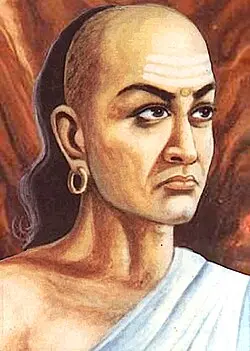
Tabulae · Tabula XXIII
Tabula XXIII
Chanakya
Unknown, Chanakya (also known as Kautilya or Vishnugupta) was born around 350 BCE and died around 275 BCE or 283 BCE in ancient India.
Chanakya looked at politics without the comforting illusion that rulers are always wise, enemies are always honest, or morality alone can protect a kingdom. His central question was harder: how can a state survive, prosper, and remain orderly in a world where power is constantly contested?
Who Was Chanakya?
Chanakya, also known as Kautilya and Vishnugupta, is traditionally associated with the Mauryan Empire and is usually placed around the 4th century BCE. The historical details of his life are uncertain. Ancient Indian traditions portray him as a scholar, political strategist, teacher, and adviser who played a crucial role in helping Chandragupta Maurya establish the Mauryan Empire. He is most famously associated with the Arthashastra, one of the most important works of ancient Indian political thought. The text discusses: government, economics, law, war, diplomacy, taxation, espionage, administration, agriculture, trade, and state security.
Chanakya therefore cannot be understood simply as an ancient Indian version of a philosopher who asks, “What is the morally perfect state?” His approach is much more practical. He asks:
What makes a state powerful enough to survive? And then: How should that power be organized so that the state remains prosperous, secure, and politically stable?
The Historical World of Chanakya
Chanakya is traditionally placed in the period when northern India contained numerous kingdoms, republic-like polities, and competing regional powers. The Nanda dynasty controlled the powerful kingdom of Magadha. Greek and Macedonian campaigns had also transformed the political landscape of northwestern South Asia. The invasion of Alexander the Great reached the northwestern regions of the Indian subcontinent in the late 4th century BCE.
After Alexander’s death in 323 BCE, his empire fragmented. This created another period of political uncertainty. In this environment, the emergence of the Mauryan Empire under Chandragupta was a major transformation. The traditional story presents Chanakya as one of the intellectual forces behind this transformation. Whether every detail of that story is historically accurate is difficult to establish.
But the political world described by the Arthashastra clearly belongs to a world in which:
states compete, rulers seek expansion, wealth supports military power, and political survival requires intelligence and strategy.
The Philosophical World Before Chanakya
Indian political thought did not begin with Chanakya. He inherited ideas from older traditions concerning:
- dharma
- kingship
- social order
- law
- economics
and statecraft. The Indian tradition often connected political authority with dharma, the moral and social order that sustains society. But Chanakya’s approach is distinctive. He gives extraordinary attention to the practical mechanisms of power. He asks not only:
“What should a king ideally be?” but also: “What should a king do when another king is preparing an attack?”
That difference is crucial.
The Central Question
Chanakya’s political philosophy can be organized around a fundamental problem:
How can a ruler protect the state while increasing its wealth, stability, and power?
From this follow several questions:
- What makes a state strong?
- How should a ruler deal with enemies?
- When should a king negotiate?
- When should he fight?
- How can intelligence networks protect the state?
- How should taxes be collected?
- What causes economic prosperity?
- How should corruption be controlled?
- When can deception be justified?
- What happens when moral ideals conflict with political survival?
These questions make Chanakya one of the great thinkers of political realism.
Chanakya’s Worldview
Chanakya’s philosophy is not based on one abstract principle. It is a system of interconnected ideas. For him:
- political power requires wealth.
- wealth requires productive economic activity.
- economic activity requires social order.
- social order requires effective administration.
- administration requires a capable ruler.
- security requires military strength and intelligence.
And all of these support one another. This creates a political cycle:
Prosperity → State capacity → Security → Stability → Further prosperity
A weak economy produces a weak state. A weak state becomes vulnerable. A vulnerable state loses wealth. The cycle then moves downward.
The Seven Elements of the State
One of Chanakya’s most important political ideas is the theory of the seven elements of the state, often called the saptanga theory. A state consists of:
- the ruler
- ministers
- territory and population
- fortified centers
- treasury
- army
- allies
The state is therefore more than a king. This is extremely important. A ruler cannot create power alone. A kingdom needs: competent administration, productive territory, financial resources, defensive infrastructure, military capacity, and diplomatic relationships. Political power is institutional.
The King
Chanakya places enormous responsibility on the ruler. A king must be: disciplined, educated, vigilant, hardworking, strategic, and attentive to administration. The ruler cannot simply enjoy luxury. He must constantly monitor the state. This creates a demanding image of kingship. The king’s personal life becomes subordinate to political responsibility.
Self-control of the Ruler
Chanakya is deeply suspicious of rulers controlled by personal desires. A king who is addicted to pleasure, anger, greed, vanity, or excessive luxury can destroy the state. This produces an interesting connection with classical philosophy.
Power requires self-control.
A ruler who cannot govern himself cannot reliably govern others. Chanakya therefore treats personal discipline as a political necessity.
The Welfare of the People
Chanakya is often portrayed only as a ruthless strategist. That is incomplete. The Arthashastra gives significant attention to public welfare and economic prosperity. A famous principle associated with the text is:
“In the happiness of his subjects lies the king’s happiness.”
The basic idea is clear. A ruler cannot treat the population merely as a source of taxes. The prosperity of the population strengthens the state itself. This creates a practical connection between:
public welfare and state power.
Why Economics Matters
For Chanakya, political power depends heavily on economics. A kingdom needs revenue. Revenue supports: the army, administration, infrastructure, diplomacy, and public works. Therefore agriculture, trade, mining, forests, taxation, and commerce are not secondary matters. They are foundations of political power. This is one reason the Arthashastra is far more than a military manual. It is also a work of:
political economy.
Artha
The word artha has a broad meaning involving: material well-being, wealth, economic prosperity, and practical interests. In classical Indian thought, artha is one of the important aims of human life. Chanakya gives it extraordinary political importance. A state without resources cannot reliably defend itself. Therefore economic strength is not merely about personal wealth. It is a matter of national survival.
Taxation
Chanakya treats taxation as necessary. But taxation must be designed carefully. If the ruler takes too much from the population, production declines and resentment grows. If the ruler takes too little, the state becomes financially weak. The problem is therefore:
How can the state collect enough revenue without destroying the economic base that produces that revenue?
This is an extraordinarily modern problem. Governments still struggle with it.
The State as an Economic Organizer
The Arthashastra describes extensive state involvement in economic activity. The state can regulate: markets, trade, mining, forests, agriculture, weights and measures, and various productive activities. This does not fit neatly into modern categories such as “capitalist” or “socialist.” Chanakya’s concern is practical. The question is:
What economic arrangements make the kingdom productive, stable, and secure?
Corruption
Chanakya has a remarkably realistic view of corruption. Officials control resources. Whenever people control resources, some will attempt to misuse them. The problem is that corruption can be difficult to detect. Chanakya therefore recommends: supervision, auditing, inspection, intelligence gathering, and punishment. The important insight is:
Do not build a political system on the assumption that everyone will behave honestly.
Build institutions that remain functional even when people are tempted by personal gain.
The Problem of Human Nature
Chanakya’s political realism begins partly with a skeptical view of human behavior. People can be motivated by wealth, power, fear, desire, ambition, loyalty, honor, and self-interest. Therefore a ruler must understand incentives. You cannot govern effectively by assuming everyone shares your moral goals. Politics requires knowledge of what people actually do. This is where Chanakya resembles Machiavelli.
Chanakya and Machiavelli
The comparison is obvious but important. Both thinkers reject naive political idealism. Machiavelli asks: How does political power actually work? Chanakya asks: How can a ruler actually preserve and expand state power? Both discuss: deception, intelligence, war, alliances, political calculation, and the gap between morality and necessity.
But there is an important difference. Machiavelli is often focused on the survival of the ruler and the political state. Chanakya places much greater emphasis on economic administration, public welfare, bureaucracy, taxation, and the broader machinery of government. Chanakya’s political theory is therefore not simply a manual for personal power. It is a theory of statecraft.
Dharma and Realpolitik
One of Chanakya’s deepest tensions is between:
dharma
and artha. Dharma represents moral and social order. Artha represents material and political interests. What happens when the two conflict? Suppose a ruler can save thousands of lives only by deceiving an enemy. Is deception wrong? Or is protecting the population the higher duty? Chanakya’s political realism tends to prioritize the survival and security of the state when circumstances demand difficult choices. This creates a morally uncomfortable but politically realistic philosophy.
The Four Methods of Statecraft
Chanakya discusses several major methods for dealing with political opponents. They are traditionally summarized as:
- sama
- dana
- bheda
- danda
These can be understood roughly as:
- conciliation
- gifts or inducements
- division or creating dissension
- force or punishment
The order itself is revealing. Military force is not always the first option. A clever ruler should use the least costly method that achieves the political objective.
Conciliation
The first strategy is persuasion. If an enemy can be brought into cooperation through negotiation, there may be no reason to fight. War is expensive. Peace can be more useful. This demonstrates that Chanakya is not simply obsessed with military power. He is obsessed with effective outcomes.
Gifts and Incentives
The ruler can also use economic or political incentives. People may cooperate because cooperation benefits them. This reflects Chanakya’s understanding of human motivation. Politics is partly the management of incentives.
Division
A ruler can exploit divisions among opponents. If an enemy alliance is unstable, the ruler may weaken it by encouraging disagreement. This is strategically effective. But it creates a serious ethical question:
Can political success justify deliberately manipulating other people’s relationships?
Chanakya’s realism often answers from the perspective of state necessity. Modern moral philosophy may be less comfortable with that answer.
Force
Finally comes force. Military power remains essential. A state that cannot defend itself is vulnerable to stronger states. But Chanakya does not treat force as sufficient. A military without: money, intelligence, logistics, administration, and strategy cannot sustain power.
The Mandala Theory
One of Chanakya’s most famous ideas is the mandala theory of interstate relations. The basic insight is that neighboring states often have conflicting interests. A nearby kingdom may be a natural rival. The rival’s rival may become a potential ally. The ruler should therefore analyze the surrounding political environment as a system. This is strategic thinking. Do not ask:
“Who is my friend?” Ask: “What interests does each state have, and how are those interests likely to change?”
The Enemy’s Enemy
The famous principle that:
“the enemy of my enemy is my friend”
captures part of the logic of mandala theory. But Chanakya’s approach is more sophisticated than the slogan. Alliances are conditional. A state may cooperate today and compete tomorrow. Therefore diplomacy must be based on interests, relative power, geography, timing, and strategic calculation.
The Six Measures of Foreign Policy
Chanakya also discusses different approaches toward other states, including:
- peace
- war
- remaining neutral
- marching or preparing for action
- seeking protection
and dual policy or balancing between peace and conflict. The important principle is flexibility. Foreign policy should not follow one permanent rule. It should respond to circumstances.
Intelligence and Spies
The Arthashastra places enormous importance on intelligence. Chanakya recommends networks of informants and spies. Why? Because rulers cannot make good decisions if they do not know what is happening. Information can reveal: conspiracies, corruption, enemy plans, public dissatisfaction, and political weaknesses. This produces a central principle:
Power depends on information.
Information as Political Power
A ruler who knows what others are planning has an advantage. A ruler who knows nothing may be defeated before realizing a threat exists. This is why Chanakya’s political theory includes something that feels surprisingly modern:
information systems are part of state power.
Today the equivalent might include intelligence agencies, economic data, cybersecurity, surveillance, diplomatic analysis, and strategic forecasting. The technology changes. The political problem remains.
War
Chanakya does not romanticize war. War consumes: money, soldiers, resources, and time. Therefore military action should serve strategic objectives. A wise ruler calculates: strength, terrain, timing, logistics, morale, alliances, and economic costs. Victory is not simply defeating an army. Victory means achieving the political objective.
The Importance of Timing
Chanakya repeatedly emphasizes timing. A ruler should not fight simply because war is possible. A weaker state may wait. A stronger state may exploit the moment. An alliance may be useful temporarily. A treaty may create time to prepare. This is political pragmatism.
The right action depends partly on when it is taken.
Fortifications
Chanakya also recognizes the importance of defensive infrastructure. A kingdom needs secure centers from which it can: store resources, protect populations, organize armies, and resist attacks. This demonstrates again that state power is not simply personal. It is institutional.
Law and Punishment
Chanakya gives significant attention to law and punishment. The ruler must maintain order. Crime cannot simply be ignored. But punishment must also be administered systematically. The purpose is not personal revenge. It is political order. This creates another important distinction:
punishment as arbitrary cruelty versus punishment as institutional enforcement.
Danda
The concept of danda, often associated with punishment or coercive authority, is central to political order. Without some capacity to enforce law, society can become unstable. Chanakya therefore rejects the idea that moral persuasion alone is sufficient. People may act selfishly. Some will commit crimes. Some will rebel. The state needs coercive capacity. This is a hard truth of political realism.
The Problem of Power
Chanakya’s philosophy begins from an uncomfortable assumption:
power cannot be wished away.
If a state refuses to think about power while others do, it may become vulnerable. If a ruler ignores military threats because war is morally unpleasant, an enemy may exploit that weakness. Therefore moral seriousness requires strategic competence. This is one of Chanakya’s deepest contributions.
Chanakya’s View of the Ideal Ruler
The ideal ruler is not simply: strong, rich, or feared. He should be: educated, disciplined, strategic, economically competent, attentive, and concerned with the welfare of the population. This creates a paradox. Chanakya gives rulers extraordinary power. But he also gives them extraordinary responsibilities. Power is justified partly by what it accomplishes for the state and its people.
The King’s Happiness
Chanakya’s conception of kingship can be summarized through the famous principle:
The ruler’s welfare is tied to the welfare of the subjects.
A king cannot remain secure while the population is starving. He cannot maintain a strong army without economic resources. He cannot collect taxes forever from an impoverished population. Therefore:
public prosperity becomes state power.
This is practical rather than purely sentimental.
Chanakya and Human Nature
Chanakya is less interested than Confucius in transforming people through moral education. He asks instead:
Given that people have desires and weaknesses, how should institutions be designed?
This is a major difference. Confucius says:
Cultivate virtue. Chanakya says: Understand incentives, monitor behavior, and design institutions accordingly.
Both recognize human weakness. They simply respond differently.
Chanakya and Confucius
This comparison is especially revealing. Confucius believes social order depends heavily on virtue, ritual, education, family, and moral example. Chanakya emphasizes: administration, law, economic power, intelligence, military strength, and strategic calculation. Confucius asks:
How should people become good? Chanakya asks: How should a state remain secure and effective even in a world where people are not always good?
The two philosophies therefore represent two complementary dimensions of political life.
Chanakya and Aristotle
Aristotle asks:
What political arrangement allows human beings to flourish? Chanakya asks: What political arrangements allow the state to survive, prosper, and expand?
Aristotle places greater emphasis on virtue, citizenship, the good life, and constitutional forms. Chanakya places greater emphasis on administration, security, economics, diplomacy, and strategic power. Both believe politics cannot be separated from human behavior. But their priorities differ.
Chanakya and Machiavelli
This is perhaps the closest comparison. Both reject naive moralism. Both recognize: fear, ambition, deception, competition, and strategic calculation. Both believe rulers must sometimes do things that ordinary morality would condemn. But Chanakya’s political system is broader. He discusses: agriculture, taxation, trade, mining, forests, infrastructure, bureaucracy, law, spies, diplomacy, and war. Machiavelli concentrates more narrowly on political power and leadership. Chanakya gives us a much more comprehensive theory of state administration.
Chanakya and Sun Tzu
There is also an interesting comparison with Sun Tzu. Sun Tzu emphasizes: strategy, information, deception, timing, and winning without unnecessary fighting. Chanakya similarly emphasizes: intelligence, strategy, alliances, deception, and careful calculation. But Sun Tzu is primarily a strategist of warfare. Chanakya is a strategist of the entire state. His concern extends from the battlefield to the treasury, the marketplace, the court, the bureaucracy, and the village.
Chanakya and Morality
The most uncomfortable part of Chanakya’s philosophy is his willingness to discuss deception and manipulation. Can a ruler: spy on citizens? deceive enemies? create divisions? use covert operations? punish severely? In the Arthashastra, political necessity can sometimes justify actions that would be morally questionable in ordinary personal life. This creates a fundamental distinction:
personal morality versus reason of state.
The Moral Problem of Realism
Suppose a ruler can prevent a war by secretly deceiving an enemy. Is the deception wrong? Suppose eliminating one dangerous conspirator prevents thousands of deaths. Is political violence justified? Suppose surveillance prevents rebellion but destroys privacy. Where is the limit? Chanakya’s realism provides tools for answering:
“What works?”
But it gives us a harder problem:
“What should never be done, even if it works?”
This is where moral philosophy must challenge political realism.
The Danger of Chanakyan Politics
If we take Chanakya’s realism too far, almost anything can become justified in the name of national security. A ruler could say: “Deception is necessary.” “Surveillance is necessary.” “Repression is necessary.” “Violence is necessary.” “Propaganda is necessary.” The language of necessity can become a weapon. This is one of the biggest weaknesses of pure political realism. It needs ethical limits.
What Chanakya Got Right
Chanakya understood several realities of politics with remarkable clarity.
- Power matters.
- States need resources.
- Economic strength supports political strength.
- Information is a form of power.
- Institutions matter more than personal intentions alone.
- Leaders need self-control.
- Corruption must be anticipated.
- Foreign policy should respond to interests and circumstances.
- Military power without economic capacity is unsustainable.
- Public welfare contributes to political stability.
- Diplomacy can sometimes achieve what war cannot.
- A ruler must understand human incentives rather than assuming universal virtue.
These ideas remain relevant to modern governance.
What Chanakya Got Wrong or Left Open
Chanakya’s political realism can become too comfortable with manipulation. He does not give modern readers a sufficiently developed theory of individual rights, political equality, democratic accountability, freedom of expression, or constitutional limits on state power. His model assumes a strong centralized ruler. That can create enormous risks. What happens if the ruler is incompetent? What happens if the ruler becomes corrupt?
What happens if the intelligence system itself becomes abusive? What happens when the state’s definition of security conflicts with individual freedom? Chanakya provides powerful tools for building state capacity. He provides fewer protections against the abuse of that capacity.
Chanakya and Democracy
Chanakya lived in a political world very different from modern constitutional democracy. We should therefore avoid simply asking: “Was Chanakya democratic?” That question imposes a modern framework on an ancient thinker. A better question is:
What can his theory teach us about modern democratic states?
The answer includes strong institutions, competent administration, economic stability, anti-corruption systems, intelligence, strategic diplomacy, and accountable leadership. But modern democracy adds something Chanakya’s framework does not fully provide:
institutional limits on political power.
Chanakya and Modern Government
A modern government still faces many problems that Chanakya identified: How should taxes be designed? How should corruption be controlled? How should national security be protected? How should economic resources be managed? How should governments respond to hostile states? How should intelligence agencies operate?
How should leaders balance national interest and ethical constraints? How should public welfare be connected to political legitimacy? The vocabulary has changed. The problems have not disappeared.
Chanakya and Business
Chanakya’s thinking can also be applied to organizations. A company needs: leadership, employees, capital, infrastructure, information, strategy, and external partnerships. A leader who ignores competitors can lose the market. A company that ignores corruption can collapse. A business that mistreats workers may create instability. A firm that has no financial reserves becomes vulnerable. Again, Chanakya’s principle is:
power requires systems.
Chanakya and Ai
Chanakya becomes surprisingly relevant to artificial intelligence. Modern states increasingly depend on data, cybersecurity, AI systems, surveillance, intelligence analysis, and automated decision-making. Chanakya would immediately recognize information as a strategic resource. But his philosophy also raises a dangerous question:
Who controls the intelligence system?
If AI gives governments unprecedented surveillance capabilities, what prevents those capabilities from being abused? If one state develops more powerful AI than another, how does that change the balance of power? If autonomous systems become strategically important, how should states respond? Chanakya would probably begin with:
- Understand the capabilities.
- Understand the incentives.
- Understand the adversary.
- Do not assume the world will remain peaceful simply because you wish it to.
But modern constitutional ethics must add:
Power must also be constrained.
The Human Side of Chanakya
The historical Chanakya is difficult to separate from later legend. Stories portray him as brilliant, severe, strategic, determined, and deeply committed to political transformation. The famous stories about his conflict with the Nanda rulers and his role in establishing Chandragupta’s empire have become part of South Asian cultural memory.
But historians must distinguish:
historical evidence from later literary tradition.
The Chanakya we know is therefore partly historical figure and partly political archetype. He represents the image of the intellectual strategist who understands that power requires more than ideals. It requires: planning, discipline, information, patience, and action.
The Great Contradiction
Chanakya wants a strong state. But strong states can become dangerous. He wants intelligent rulers. But intelligent rulers can manipulate populations more effectively. He wants surveillance to prevent corruption. But surveillance can itself become oppressive. He wants political stability. But excessive stability can suppress legitimate dissent. He wants public welfare.
But the ruler remains the central political authority. This produces a question that Chanakya does not completely resolve:
How do we create a state powerful enough to protect society but constrained enough not to dominate it?
That remains one of the central problems of political philosophy.
The Deepest Lesson of Chanakya
Chanakya teaches us not to confuse:
good intentions with good governance.
A ruler may sincerely want to help people. But if the state has: no revenue, no competent officials, no intelligence, no military capacity, and no institutional discipline, good intentions may accomplish very little. Political morality therefore needs political competence. This is perhaps Chanakya’s greatest lesson.
Chanakya’s Philosophy in Simple Words
- A state must be strong enough to protect itself.
- Political power depends on economic power.
- A ruler must first govern himself.
- Public welfare and state strength are connected.
- Good institutions matter more than good intentions alone.
- Corruption should be anticipated, not merely condemned.
- Information is essential to political power.
- Diplomacy can be more useful than war.
- War should serve strategic objectives, not personal pride.
- Alliances depend on interests and circumstances.
- A ruler must understand human incentives.
- Political realism requires facing the world as it is, not merely as we wish it to be.
- But political effectiveness without moral limits can become oppression.
The Final Question
Confucius asked:
How can human beings become good enough to create a harmonious society? Plato asked: Who should rule?
Aristotle asked:
What kind of political community allows human beings to flourish? Machiavelli asked: How does political power actually survive?
Chanakya asked a related but distinctly Indian question:
How can a state remain secure, prosperous, and powerful in a world governed by competing interests, ambition, uncertainty, and conflict?
His answer was uncompromising. Build institutions. Build wealth. Build intelligence. Build military strength. Understand human behavior. Choose strategy according to circumstances. And never confuse moral aspiration with political capability. Yet Chanakya leaves us with a problem larger than statecraft.
If power is necessary to protect society, who protects society from the people who hold that power?
That is where Chanakya’s realism reaches its limit. He teaches us how to make power effective. Modern political philosophy must add another question:
How do we make power accountable?
Perhaps the deepest lesson of Chanakya is therefore not that politics is ruthless. It is that politics is a realm where ideals without power can fail, but power without limits can become the very danger it was created to prevent.