Tabula IX
The Sleep of Reason Produces Monsters, plate 43 from Los Caprichos
Francisco José de Goya y Lucientes, 1797/99
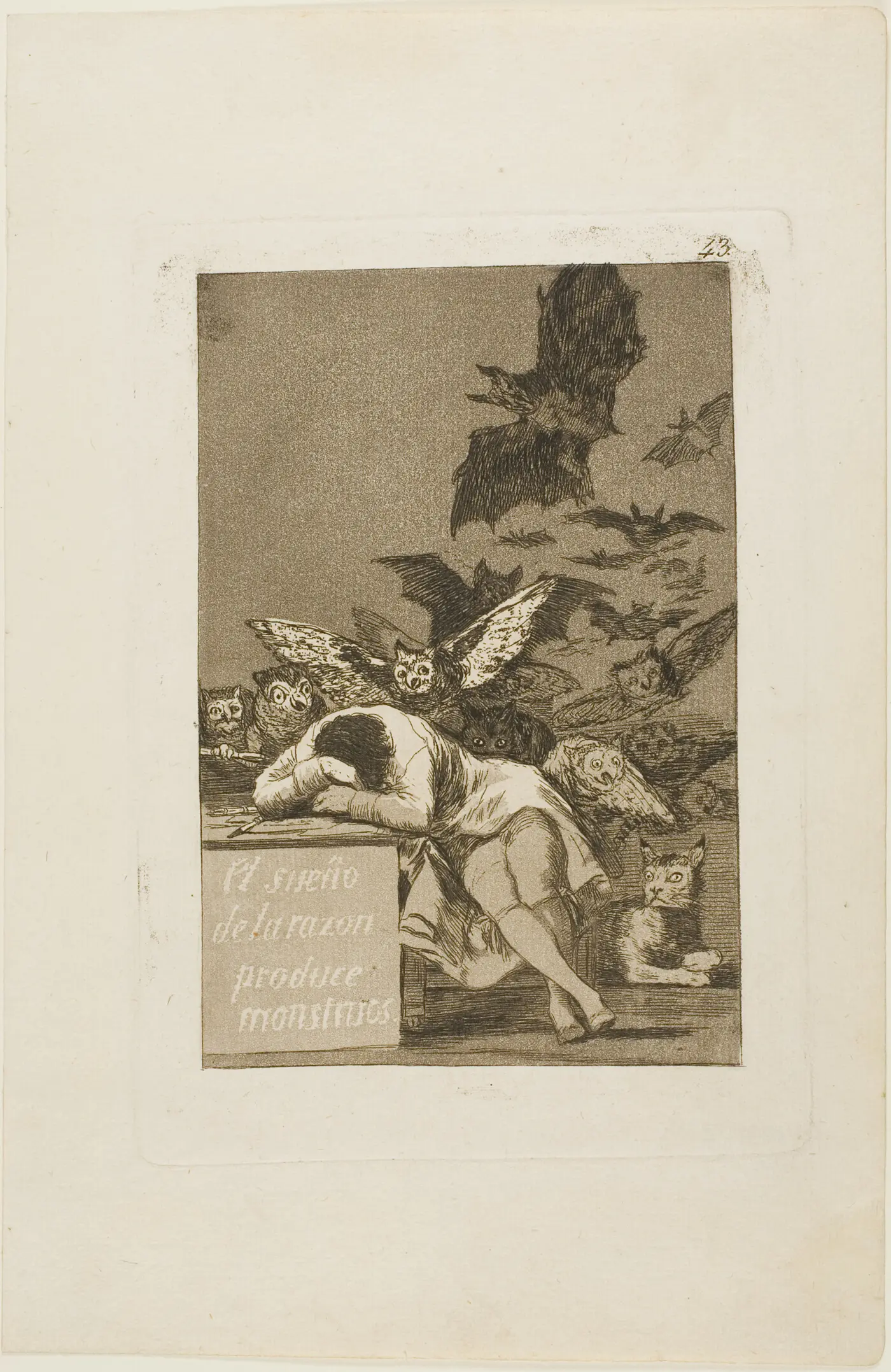
The Sleep of Reason Produces Monsters: When the Mind Closes Its Eyes
What if the monsters that frighten us are not born in the darkness outside, but in the darkness we create when we stop thinking?
The Artwork at a Glance
The Sleep of Reason Produces Monsters is Plate 43 of Francisco de Goya’s Los Caprichos, a series of 80 etchings first published in 1799. Goya created the series in Spain during the late eighteenth century, at a moment when Enlightenment ideas about reason, education, superstition, and social reform were colliding with deeply rooted traditions and fears.
The work is an etching and aquatint, with drypoint and burnishing also used to shape the image. It is small, but its psychological power is enormous.
The central figure is a sleeping man, slumped over a desk with his head resting on his arms. Behind him, a dark swarm of creatures emerges from the darkness: owls, bats, and other nocturnal animals.
The title is written directly beneath the image:
“The sleep of reason produces monsters.”
The sleeping man is generally understood as Goya himself, or at least as a representation of the artist or intellectual. Yet the image is deliberately open enough to become something larger than a self-portrait.
It is a picture about reason and imagination, enlightenment and superstition, consciousness and unconscious fear.
And it asks one of the most unsettling questions in modern art:
What happens when reason stops watching?
The World Behind the Artwork
Goya created Los Caprichos at the end of the eighteenth century, when Europe was undergoing enormous intellectual and political change.
The Enlightenment had placed enormous faith in reason. Thinkers argued that human beings could improve society through education, critical thought, science, observation, and the rejection of superstition.
But eighteenth-century Spain remained deeply shaped by religious tradition, social hierarchy, superstition, and institutional power.
Goya lived inside this contradiction.
He was a court painter who worked for the Spanish monarchy. At the same time, he observed the absurdity, cruelty, hypocrisy, ignorance, and irrationality around him.
Los Caprichos became his great satirical response.
The prints attack foolishness in many forms: superstition, sexual exploitation, corruption, vanity, ignorance, abuse of power, and social hypocrisy.
But Goya does something more complicated than simply saying that reason is good and superstition is bad.
He knows that reason itself has limits.
That is what makes Plate 43 so powerful.
The Artist Behind the Work
Francisco de Goya was born in 1746 and died in 1828. He lived through a period of extraordinary upheaval, including the rise of Enlightenment thought, the French Revolution, the Napoleonic invasion of Spain, war, political repression, and changing ideas about authority.
His career moved through several worlds.
He painted royal portraits.
He produced elegant works for aristocratic patrons.
He created religious paintings.
He made popular scenes of Spanish life.
But alongside this public career was another Goya, a darker observer who increasingly explored violence, irrationality, fear, madness, and human cruelty.
Los Caprichos belongs to this second world.
Goya was not simply an outsider attacking society from a safe distance. He was part of the society he criticized.
That makes the series more uncomfortable.
He was looking at human beings and asking what was wrong with them, while knowing that he was one of them.
What We See
The composition is remarkably simple.
A man sits at a table.
His body has collapsed forward.
His head rests heavily on his arms.
His eyes are closed.
Behind him, darkness begins to move.
Owls spread their wings.
Bats fly through the air.
Creatures crowd together.
Their bodies overlap.
Their wings create a chaotic pattern.
The man appears small and vulnerable compared with the creatures rising behind him.
The table itself becomes a boundary between two worlds.
On one side is the sleeping human being.
On the other is the world of nightmares.
The image therefore has a very clear visual structure.
Stillness in front. Chaos behind.
The man’s body is heavy and horizontal.
The animals are restless and airborne.
He sleeps.
They move.
The contrast gives the image its psychological tension.
How the Artwork Works
Goya’s technique is essential to the meaning.
He uses aquatint to create large areas of deep darkness. Instead of describing every object with precise outlines, he allows darkness itself to become an active visual force.
The background is not simply empty space.
It is almost alive.
The animals seem to emerge from it.
This makes the viewer unsure where the darkness ends and the creatures begin.
The technique creates something close to a nightmare.
The image does not feel like an ordinary room containing some animals.
It feels like the room has opened into another psychological dimension.
Goya’s use of contrast is especially important.
The sleeping figure is relatively light.
Behind him is darkness.
The viewer’s eye therefore moves immediately toward the human figure and then outward into the threatening swarm.
The darkness seems to grow behind the man’s unconscious mind.
The Meaning of the Title
The title is the key to the entire work.
But it is also ambiguous.
“The sleep of reason produces monsters” can mean that when reason becomes inactive, superstition and irrationality take control.
That interpretation fits the Enlightenment context extremely well.
If people stop questioning what they believe, false ideas can become powerful.
Fear can become superstition.
Ignorance can become cruelty.
Authority can become abuse.
But there is another possibility.
The work may suggest that reason itself cannot completely control the human imagination.
When consciousness sleeps, dreams appear.
Fear appears.
Fantasy appears.
Desire appears.
The unconscious mind produces images that reason cannot fully regulate.
In that reading, the monsters are not simply external enemies.
They are part of us.
Reason and Imagination
This is where the work becomes more complicated than a simple Enlightenment warning.
If Goya wanted to say only that reason is good and irrationality is bad, why would he create such a visually imaginative image?
The monsters themselves are products of imagination.
Goya needs imagination to reveal the dangers of losing reason.
This creates a paradox:
The artist uses the irrational imagination to warn us about irrationality.
The work therefore does not demand that imagination disappear.
Instead, it suggests that imagination needs awareness.
Reason and imagination may need one another.
Reason without imagination can become cold and rigid.
Imagination without reason can become terrifying.
Goya places both possibilities inside the same image.
The Monsters
The animals are not merely decorative.
They are the visual embodiment of things that become possible when consciousness is absent.
The bats have long associations with darkness, night, fear, and the unknown.
The owls are more complicated.
The owl can symbolize wisdom, but here the creatures are part of a frightening swarm.
That ambiguity matters.
The creature traditionally associated with wisdom appears inside a scene about the failure of reason.
Goya may therefore be playing with the instability of symbols themselves.
Even knowledge can become frightening when it is not understood.
Even wisdom can exist alongside darkness.
It is important, however, not to claim that every animal has one fixed symbolic meaning. Goya’s imagery often deliberately resists such neat decoding.
The creatures work first as a collective force.
They are overwhelming.
They are difficult to control.
They are the visual language of mental disorder and fear.
The Sleeping Man
The central figure is perhaps the most important element.
He does not fight the monsters.
He does not even see them.
He sleeps.
This makes him vulnerable.
But it also makes him responsible.
The danger is not simply that monsters exist.
The danger is that he is not awake to them.
This distinction is crucial.
Goya’s monsters become powerful because consciousness is absent.
The work therefore becomes a warning about passivity.
A person does not have to actively create evil to allow it to grow.
Sometimes simply failing to question, observe, or resist is enough.
The Central Idea
At its deepest level, the work is about the consequences of unexamined life.
Human beings create beliefs.
Then beliefs can control human beings.
People become afraid of things they do not understand.
They repeat ideas because everyone else repeats them.
They accept authority because questioning it feels dangerous.
They mistake tradition for truth.
They allow prejudice to become normal.
Goya’s monsters can therefore be understood as the consequences of a mind that stops examining itself and the world.
The work does not say that human beings are naturally monsters.
It suggests something more frightening:
monsters can be produced.
They can emerge from ignorance, fear, superstition, social pressure, and intellectual laziness.
Philosophy of the Artwork
The work has a strong connection to Enlightenment thought, but its deeper philosophical question is much broader.
What does it mean to think?
Thinking is not simply possessing intelligence.
It requires attention.
It requires doubt.
It requires the willingness to question what appears obvious.
It requires the courage to discover that we may be wrong.
In this sense, the sleeping figure represents more than physical sleep.
He represents the condition in which human beings stop examining their assumptions.
The image therefore touches a philosophical problem that remains important across centuries:
Can we trust ourselves when we are not aware of the forces shaping our thoughts?
Goya’s answer seems deeply skeptical.
Our minds contain fears and desires that we may not fully understand.
Society contains beliefs that may not survive examination.
Power can take advantage of ignorance.
And reason itself can become weak when we stop practicing it.
The Human Condition
The image is not frightening simply because there are monsters.
It is frightening because the monsters appear behind a human being.
They seem connected to him.
That makes the image psychologically modern.
The real terror is not an external demon.
It is the possibility that the darkness belongs partly to us.
This idea would become extremely important in later art and literature.
Romantic artists would explore dreams, nightmares, madness, and the irrational imagination. Later psychologists would explore unconscious thought and hidden desires. Modern artists would repeatedly return to the idea that the human mind contains worlds that conscious reason cannot completely control.
Goya arrives early at this territory.
Contradictions and Tensions
The work contains several powerful contradictions.
Sleep and awareness.
The man is unconscious while the viewer is completely awake.
Reason and imagination.
The title praises reason while the image depends upon imagination.
Knowledge and ignorance.
The owl can suggest wisdom, yet it appears among terrifying creatures.
Order and chaos.
The sleeping man’s body is still and organized, while the background explodes into movement.
Human control and vulnerability.
The man sits at his own desk, apparently in control of his environment, yet his unconsciousness leaves him powerless.
Reality and fantasy.
We know that these creatures may be dream images, but Goya makes them visually convincing.
These tensions prevent the image from becoming a simple moral lesson.
Different Interpretations
One interpretation sees the sleeping figure as the artist himself.
From this perspective, Goya may be reflecting on his own creative process. When reason sleeps, imagination awakens, producing strange and powerful images.
Another interpretation treats the work as a broader social criticism.
The sleeping man becomes society itself.
While citizens remain intellectually passive, superstition and irrationality grow around them.
A third interpretation sees the image psychologically.
The monsters represent the hidden contents of the mind that appear when conscious control weakens.
These interpretations can coexist.
Goya’s genius lies partly in his ability to make a political, intellectual, and psychological image at the same time.
The Artist’s Intention and the Viewer
Goya originally presented Los Caprichos as a critique of human foolishness and social abuses. The series was closely connected to the intellectual climate of the Enlightenment.
Yet modern viewers often experience Plate 43 in a broader way.
For one person, the monsters may represent superstition.
For another, misinformation.
For another, anxiety.
For another, political fanaticism.
For another, the frightening world of dreams.
The image can absorb these interpretations because its basic structure is universal.
A human being closes his eyes.
Something dark begins to emerge.
Reception and Historical Importance
Los Caprichos appeared in 1799, but Goya withdrew the edition from sale after only a short period, reportedly because of concerns surrounding the Spanish Inquisition and the potential consequences of the series.
Over time, however, the prints became increasingly recognized as major achievements of European graphic art.
Their importance grew beyond their original Spanish context.
Goya’s combination of satire, darkness, psychological intensity, and social criticism influenced later generations of artists.
His work became an important precursor to Romanticism, Symbolism, Surrealism, and later forms of psychological and political art.
The monsters of Goya did not disappear.
They changed shape.
Why It Still Matters
The phrase “the sleep of reason” feels almost painfully relevant today.
We live in a world where information is everywhere, but information does not automatically produce knowledge.
People can believe false things while having access to enormous amounts of evidence.
Fear can spread faster than careful thought.
Rumors can become reality in people’s minds.
Groups can become convinced that their enemies are less than human.
Technology can amplify both knowledge and irrationality.
Goya could not have predicted the internet.
But he understood something deeper about human beings.
Having the ability to think does not mean that we will think.
Reason has to be practiced.
Attention has to be maintained.
Doubt has to be tolerated.
Otherwise, the monsters return.
A Deeper Reading
Look once more at the sleeping man.
He is not evil.
He is simply asleep.
That is what makes the image so disturbing.
Goya does not show a villain creating monsters.
He shows an ordinary human being who has stopped watching.
Behind him, the darkness gathers.
The animals multiply.
The world becomes irrational.
And the man does not know.
Perhaps the greatest warning in the image is therefore not “beware of monsters.”
It is:
Stay awake.
Stay awake to your own assumptions.
Stay awake to fear.
Stay awake to power.
Stay awake to ignorance.
Stay awake to the stories you tell yourself about other people.
And perhaps most importantly, stay awake to the darkness inside your own mind.
Goya’s genius is that he never gives us the comfort of believing that the monsters belong only to other people. They appear behind a human being, perhaps even behind the artist himself. The boundary between reason and irrationality is therefore fragile.
We are capable of creating extraordinary things with our minds.
We are also capable of creating extraordinary horrors.
The difference may begin with something as simple, and as difficult, as keeping our eyes open.