Tabula X
Buddha Shakyamuni Seated in Meditation (Dhyanamudra)
Unknown, Chola period, about 12th century
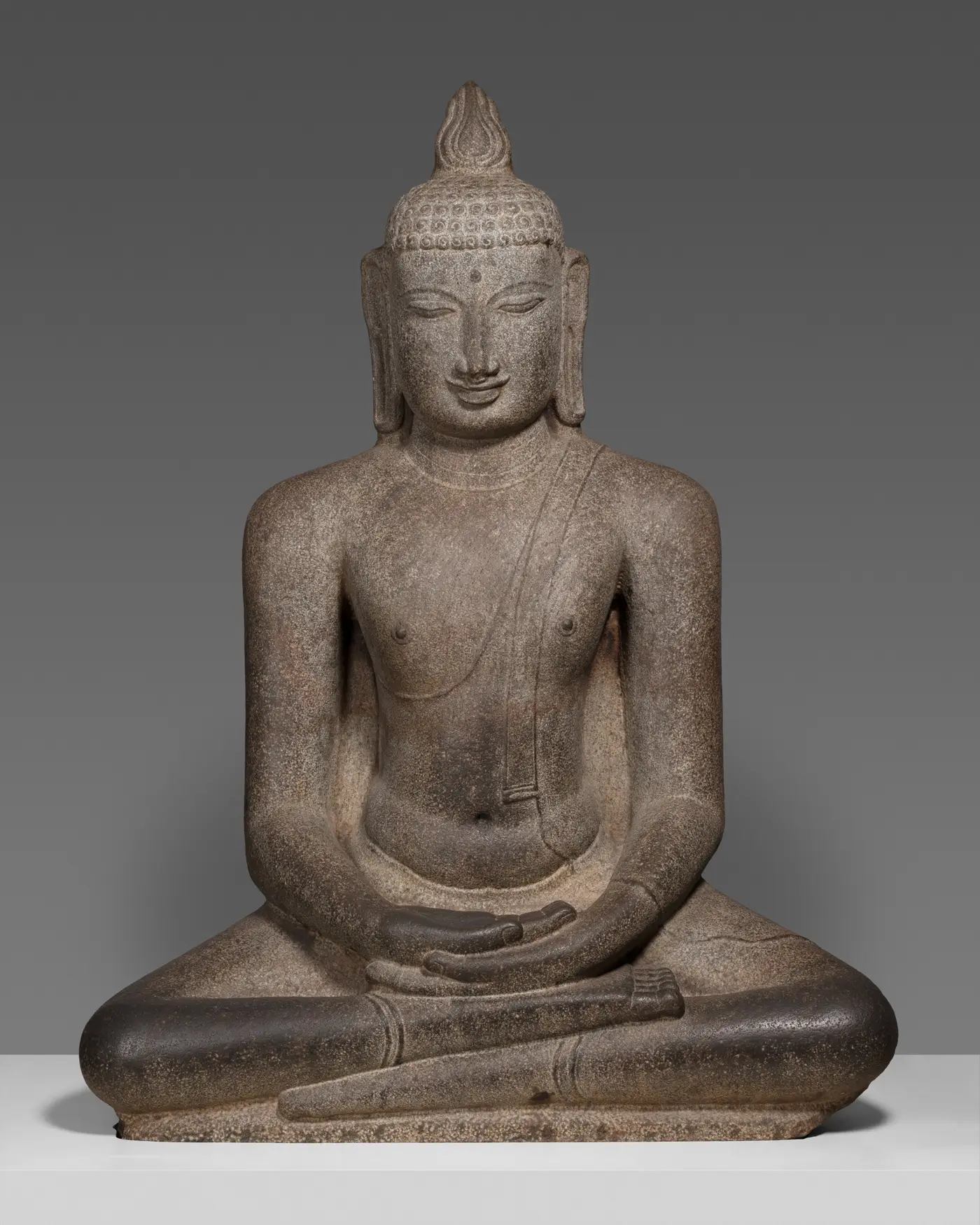
Buddha Shakyamuni Seated in Meditation: The Stillness That Confronts the Restless Mind
The Buddha does not conquer the world in this sculpture. He conquers something much harder: the restless mind within himself.
The Artwork at a Glance
Buddha Shakyamuni Seated in Meditation (Dhyanamudra) represents Shakyamuni Buddha, the historical Buddha who lived in ancient India, traditionally dated to around the 5th century BCE, although the exact dates of his life remain debated.
The sculpture belongs to the long Buddhist artistic tradition of representing the Buddha in meditation. The title refers to Dhyana Mudra, the meditation gesture in which the hands rest together in the lap, palms facing upward, with the thumbs often touching.
The precise date, material, dimensions, and present collection depend on the particular museum version identified by this title, because the image type exists in several periods and regions of Buddhist art. What remains constant is the central visual idea: the Buddha seated in profound meditation.
This is important because Buddhist art is not primarily concerned with showing the Buddha as an ordinary human portrait.
It is concerned with showing a state of being.
The seated body becomes a visual expression of concentration, awakening, balance, detachment, and inner freedom.
The sculpture therefore asks us to look at stillness not as inactivity, but as a form of power.
The World Behind the Artwork
To understand this image, we have to enter the religious and intellectual world of ancient India.
Long before the Buddha, Indian religious traditions had already developed sophisticated ideas about meditation, rebirth, karma, sacrifice, discipline, and liberation.
The Buddha emerged within this environment but challenged important assumptions of his time.
According to Buddhist tradition, Siddhartha Gautama was born into a privileged family and later encountered the realities of old age, sickness, death, and religious seeking. These experiences led him to question the nature of human existence.
Why do people suffer?
Why do we become attached to things that inevitably change?
Why do desire and fear keep returning?
Can a human being become free from this cycle?
These questions eventually became central to Buddhist thought.
The Buddha’s awakening was not presented simply as the discovery of a new god.
It was the discovery of a way of understanding existence.
The seated Buddha therefore represents more than a religious founder.
He represents a human being who has awakened to the nature of reality.
The Buddha Behind the Image
The historical Buddha is traditionally known as Siddhartha Gautama, and after his awakening he became known as the Buddha, meaning “the awakened one.”
His teachings developed around ideas such as the Four Noble Truths, the Noble Eightfold Path, impermanence, non-self, karma, compassion, and liberation from suffering.
But Buddhist traditions differ in how they understand and represent him.
The historical person became, over centuries, a religious and philosophical figure whose image could communicate ideals that went far beyond ordinary portraiture.
This is why the sculpture should not be approached as if an ancient artist were simply trying to record what Gautama looked like.
The artist was presenting an ideal of awakened existence.
The body becomes a vessel for a philosophy.
What We See
The Buddha sits cross-legged in a stable meditation posture.
His body is upright.
His shoulders are relaxed.
His head is centered.
His hands rest in the lap in Dhyana Mudra.
The face is calm.
The eyes are lowered or gently closed.
The expression is neither joyful nor sorrowful.
It is quiet.
The figure does not appear to be looking at the viewer.
This is important.
Many religious images demand attention through dramatic gestures, movement, or expressions of power.
The Buddha does almost the opposite.
He withdraws from spectacle.
His power comes from stillness.
The body forms a stable geometric structure.
The crossed legs create a broad base.
The torso rises vertically.
The head completes the upward movement.
The composition therefore suggests stability from bottom to top.
The sculpture feels rooted.
Nothing appears to be pulling the Buddha away from his center.
The Meditation Gesture
The Dhyana Mudra is one of the most important elements of the image.
The hands are placed together in the lap, creating a closed and balanced form.
The gesture expresses meditation and concentration.
But its meaning becomes deeper when we consider the entire body.
The hands are still.
The face is still.
The shoulders are still.
The spine is upright.
The whole figure participates in the same state.
The mudra is therefore not an isolated symbol.
It completes the sculpture’s larger visual language.
Everything points toward inward attention.
How the Artwork Works
The most striking feature of the sculpture is its symmetry and balance.
The Buddha sits almost exactly at the center.
The vertical axis of the body creates order.
The crossed legs create a stable foundation.
The hands create another centered form.
The face provides the highest point of concentration.
This symmetry is not merely decorative.
It creates a physical experience of calm.
When we look at the sculpture, our eyes are given few reasons to move rapidly.
There is no violent diagonal.
No dramatic gesture.
No struggle.
The composition slows us down.
In that sense, the artwork does not simply represent meditation.
It encourages something like meditation in the viewer.
The visual form changes our behavior.
We begin to look more slowly.
Stillness as Power
In many traditions, power is shown through movement.
Kings stand over subjects.
Warriors raise weapons.
Heroes defeat enemies.
Gods perform miracles.
The Buddha’s image proposes another definition of power.
Power can mean not being controlled by every impulse that arises within you.
The Buddha does not need to dominate the world around him.
He sits.
He observes.
He remains centered.
This is an important philosophical reversal.
The strongest person is not necessarily the person who controls others.
Perhaps strength is the ability to understand oneself deeply enough that anger, fear, greed, and desire no longer control one’s actions.
The sculpture makes that abstract idea visible.
The Face
The Buddha’s face is one of the most important parts of the sculpture.
There is usually a deliberate absence of strong emotion.
He is not smiling broadly.
He is not crying.
He is not angry.
He is not staring intensely at the viewer.
This does not mean emotional emptiness.
It suggests freedom from emotional disturbance.
The expression is sometimes described as serene.
But serenity here should not be confused with simple happiness.
Happiness depends on circumstances.
Serenity suggests a deeper stability.
The Buddha has not escaped the world because the world is pleasant.
He has learned to see the world without being completely controlled by its changing conditions.
The Eyes
The lowered eyes are especially meaningful.
They avoid the theatrical direct gaze common in many portraits.
The Buddha does not demand that we look at him.
His gaze turns inward.
This creates a subtle relationship between the sculpture and the viewer.
We look at him.
He appears to be looking beyond the immediate world.
The viewer therefore becomes aware of the difference between looking outward and observing inward.
This is exactly the movement meditation encourages.
The Body and the Mind
One of the most interesting things about Buddhist sculpture is that an invisible mental state is communicated through a physical body.
We cannot see meditation itself.
We cannot see enlightenment.
We cannot directly see detachment or awakening.
Yet the artist gives these ideas a body.
The upright spine suggests alertness.
The relaxed shoulders suggest release.
The symmetrical posture suggests balance.
The calm face suggests inner stability.
The hands suggest concentration.
The sculpture therefore becomes a visual translation of Buddhist philosophy.
An idea becomes a body.
Symbolism and Meaning
Depending on the specific sculpture, several traditional Buddhist features may appear.
The ushnisha, the raised protuberance on the top of the head, is traditionally associated with the Buddha’s extraordinary wisdom or spiritual attainment.
The urna, often represented as a small mark between the eyebrows, is another traditional sign of the Buddha.
The elongated earlobes recall the Buddha’s former princely life, when he wore heavy ornaments. Their presence suggests that although he abandoned worldly luxury, traces of that earlier life remain in his transformed body.
The robe represents monastic discipline.
The lotus, when included, connects the Buddha with one of Buddhism’s most powerful images.
The lotus grows from muddy water yet rises clean above it.
It therefore became an image of spiritual awakening emerging from the conditions of ordinary suffering.
These symbols should not be treated as decoration.
They allow the viewer to recognize the figure and understand the qualities the image is meant to embody.
The Lotus and Human Existence
The lotus offers a useful way to understand the entire sculpture.
The Buddhist path does not begin in a perfect world.
It begins in suffering.
Human beings experience desire, loss, illness, aging, fear, attachment, and death.
The Buddhist response is not necessarily to deny these things.
It is to understand them.
This is why the Buddha’s calmness should not be mistaken for escape.
His serenity is meaningful precisely because it exists in a world where suffering exists.
The lotus is beautiful because it grows from mud.
The awakened person is meaningful because awakening occurs within human existence.
The Central Idea
The sculpture is fundamentally about awakening through disciplined awareness.
It does not show the moment of enlightenment as a dramatic explosion of light.
Instead, it shows what awakening looks like after the struggle has been transformed into understanding.
The Buddha sits.
His mind is not represented through frantic movement.
His body has become stable.
The image therefore gives us an alternative idea of human achievement.
We often measure achievement by what people build, acquire, control, or accomplish.
Buddhist thought asks a different question:
What kind of person have you become?
The sculpture answers visually.
Become centered.
Become attentive.
Become less controlled by craving and fear.
Understand impermanence.
Cultivate compassion.
Wake up.
Philosophy of the Artwork
The Buddha’s meditation posture connects directly to some of Buddhism’s deepest philosophical ideas.
One is impermanence.
Everything conditioned changes.
Bodies change.
Relationships change.
Possessions disappear.
Emotions rise and fall.
Even life itself ends.
Human suffering often emerges when we demand permanence from things that cannot provide it.
Another idea is non-self, the Buddhist challenge to the assumption that there is a permanent, independent self behind experience.
The meditating Buddha does not appear as a personality demanding recognition.
His identity has become secondary to awareness.
A third idea is the relationship between desire and suffering.
Buddhism does not teach that every form of desire is equally evil. Rather, attachment and craving can bind people to cycles of suffering.
The meditating figure represents a mind learning not to cling.
That is why his hands are open and resting.
There is no grasping.
Stillness and Time
The Buddha sits outside the usual drama of time.
He is not moving toward something.
He is not running away from something.
The posture creates a sense of suspended time.
This does not mean that Buddhism denies change.
Quite the opposite.
Because everything changes, the mind must learn how to remain aware while change happens.
The Buddha’s stillness therefore exists inside impermanence.
The body will eventually age.
The sculpture itself will eventually deteriorate.
The viewer will eventually leave.
Yet for a moment, everything is gathered into stillness.
That paradox gives the image much of its philosophical force.
The Human Condition
The Buddha is often represented as extraordinarily calm.
But the reason this image continues to matter is that the viewer is usually not calm.
We arrive carrying thoughts.
Plans.
Fear.
Regret.
Desire.
Questions.
The Buddha sits there without responding to any of them.
This creates a strange encounter.
The sculpture does not tell us what to buy.
It does not tell us what political position to take.
It does not praise achievement.
It does not ask for our admiration.
It simply presents another possibility for being human.
A person can sit still.
A person can observe thought without immediately obeying it.
A person can recognize suffering without being completely consumed by it.
That possibility is radical.
Contradictions and Tensions
The sculpture contains a powerful contradiction between stillness and transformation.
Nothing appears to happen.
Yet the entire Buddhist tradition is about one of the greatest transformations imaginable: awakening.
There is also a tension between detachment and compassion.
Detachment can sound cold if we misunderstand it.
But Buddhist detachment is not supposed to mean indifference to suffering.
It means loosening the selfish attachment that prevents clear understanding and compassionate action.
There is another tension between human and transcendent.
The Buddha has a human body.
He sits like a human being.
Yet the image presents him as someone who has reached a state beyond ordinary human confusion.
The sculpture therefore keeps one foot in ordinary physical existence and another in spiritual possibility.
Different Interpretations
A Buddhist viewer may approach the sculpture as a sacred image that supports devotion and meditation.
An art historian may focus on its formal qualities, iconography, historical period, and regional style.
A philosopher may see a visual expression of questions about selfhood, suffering, desire, and consciousness.
A secular viewer may see something even more universal: an image of disciplined attention.
None of these interpretations has to cancel the others.
The artwork can function simultaneously as a religious object, a work of sculpture, a philosophical statement, and an invitation to introspection.
That is one reason Buddhist art has traveled so successfully across cultures.
Its symbols are specific.
Its questions are universal.
The Artist’s Intention and the Viewer
The original makers of such an image worked within a Buddhist religious tradition. The sculpture was not created simply to be admired as decoration.
It served a purpose.
The image helped make the Buddha present to communities of believers.
It could support meditation, devotion, teaching, ritual, and contemplation.
But modern viewers can encounter it differently.
Someone unfamiliar with Buddhist philosophy may still immediately recognize the emotional quality of the figure.
Why?
Because the posture communicates something before we understand its religious symbolism.
It communicates calm.
The viewer does not need to know every Buddhist doctrine to feel that the figure is deeply centered.
This is where artistic form becomes powerful.
Meaning begins before explanation.
Why It Still Matters
Modern life rewards movement.
Work faster.
Respond faster.
Consume more.
Learn more.
Communicate constantly.
Remain available.
The Buddha sits in the opposite direction.
He offers no urgency.
That can feel almost revolutionary.
In a world where attention is constantly being pulled outward, meditation turns attention inward.
The sculpture therefore becomes surprisingly contemporary.
It asks whether a human being can remain present without constantly reaching for the next thing.
It asks whether silence can be valuable.
It asks whether freedom might involve wanting less rather than possessing more.
And it asks whether we can observe our own minds instead of becoming prisoners of every thought that passes through them.
A Deeper Reading
Look at the Buddha again.
The body is grounded.
The hands are open.
The shoulders are relaxed.
The face is quiet.
The eyes turn inward.
There is no weapon.
No throne of worldly power.
No crowd.
No dramatic miracle.
The entire sculpture depends on one extraordinary idea:
nothing needs to happen for this moment to matter.
The Buddha’s achievement is not represented as conquest over other people.
It is represented as mastery of attention.
He has not become powerful because he controls the world.
He has become free because the world no longer controls his mind in the same way.
That is why the image can remain powerful even for someone who does not share its religious beliefs.
It confronts a question that belongs to every human life:
Can we learn to sit with reality as it is, without endlessly demanding that it become something else?
The Buddha does not answer with words.
He answers with stillness.
And perhaps the longer we look at him, the more we begin to understand that stillness is not the absence of life.
It may be one of the deepest forms of awareness.