Tabula VI
St. Jerome in His Study
Albrecht Dürer, 1514
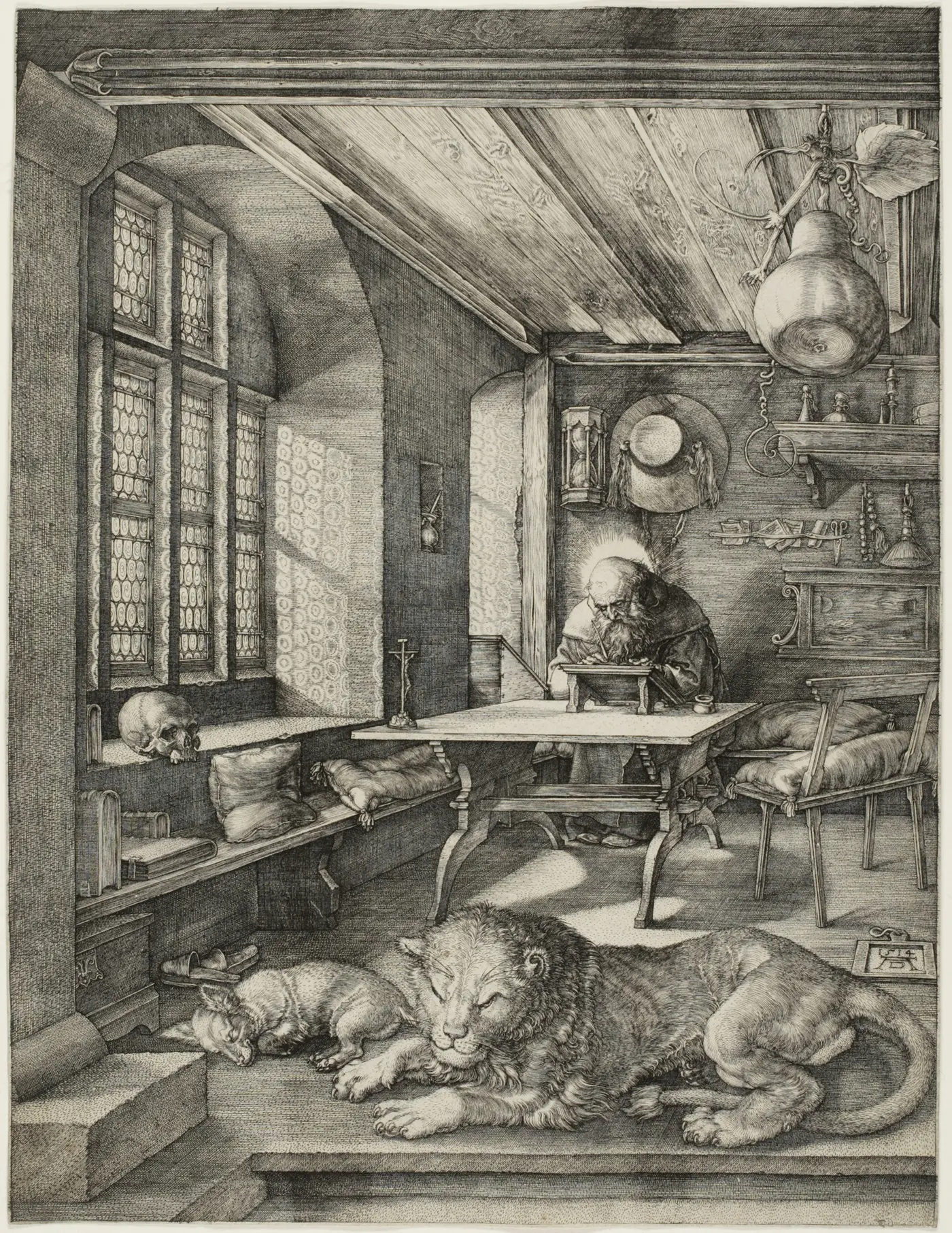
Saint Jerome in His Study: The Quiet Room Where Knowledge Becomes a Spiritual Life
A room can be small, quiet, and almost completely still, yet contain an entire philosophy of human existence.
The Artwork at a Glance
Albrecht Dürer’s Saint Jerome in His Study, created in 1514, is one of the most intimate and celebrated engravings of the Northern Renaissance. It is a small work, roughly 24.7 × 18.7 cm, yet Dürer fills its limited space with extraordinary detail. The work is an engraving on laid paper, and impressions of it are held in major collections including the National Gallery of Art in Washington, the Metropolitan Museum of Art, the National Gallery of Scotland, and the National Gallery of Victoria.
The subject is Saint Jerome, the fourth-century Christian scholar and translator who produced the Latin translation of the Bible known as the Vulgate. But Dürer does not show Jerome as a heroic preacher, a suffering hermit, or a dramatic saint. He shows him simply sitting at his desk, absorbed in study.
That choice is the heart of the work.
Nothing dramatic is happening. There is no battle, miracle, crowd, or grand architectural setting. There is only a scholar, a room, sunlight, books, animals, and the quiet discipline of thought.
Yet Dürer makes this ordinary moment feel almost sacred.
The World Behind the Artwork
Dürer created the engraving in 1514, during the Northern Renaissance, a period when European culture was being transformed by new interest in learning, observation, printing, classical knowledge, and religious scholarship.
The Renaissance was not simply a return to ancient Greece and Rome. It was also a period in which people were increasingly interested in the human capacity to read, study, observe, measure, translate, and understand the world.
This was especially important in the religious culture of the time.
The Bible was not only a sacred text. It was also a text that scholars studied through languages, manuscripts, translation, commentary, and interpretation. Jerome represented an ideal combination of faith and intellectual labor.
Dürer’s own world was also shaped by the rapidly expanding culture of print. Unlike a unique painting that could remain in one church or palace, an engraving could be reproduced and circulated. Dürer became one of the great masters of this medium, turning printmaking into an art form capable of extraordinary detail and intellectual complexity.
The small copper plate therefore carries something larger than an image of a saint. It represents a culture increasingly fascinated by the power of knowledge and the disciplined human mind.
The Artist Behind the Work
Dürer was born in Nuremberg in 1471 and died there in 1528. He became one of the most important artists of the Northern Renaissance, known not only for painting but also for engraving, woodcut, drawing, and theoretical writing.
His art combined the intense observational tradition of Northern Europe with ideas he encountered during his travels, especially in Italy.
He was fascinated by proportion, geometry, perspective, nature, human anatomy, and the possibilities of artistic technique. But his intellectual curiosity did not separate him from the religious world around him.
That combination is essential to understanding Saint Jerome in His Study.
Dürer does not present knowledge and faith as enemies. Instead, he places them in the same room.
Jerome studies because his intellectual work is itself a form of devotion.
What We See
At first glance, the composition appears simple.
Saint Jerome sits in the far corner of a wooden study. His body bends naturally over his writing desk. His hands are close together as he writes. His head is surrounded by a delicate halo.
To the left, sunlight enters through windows filled with small pieces of bottle glass. The light falls across the room and creates soft patterns on the surfaces.
In the foreground, a lion and a dog sleep peacefully.
A bench runs along the wall. Books rest on it. A pair of slippers sits underneath. A skull lies near the window. An hourglass hangs on the wall. A crucifix sits on the writing table. A rosary, hat, broom, papers, scissors, containers, and other everyday objects fill the room.
The room is therefore neither empty nor overloaded.
It feels lived in.
That is one of Dürer’s greatest achievements. He makes a saint’s study feel like an actual human room.
There is warmth in it.
There is also silence.
How the Artwork Works
Dürer’s technical achievement becomes clearer the longer one looks.
The engraving is constructed from countless lines. Fine parallel lines, cross-hatching, short marks, and tiny changes in density create the illusion of wood, glass, fabric, skin, fur, metal, shadow, and light.
This is remarkable because Dürer has no color to depend on.
Everything must be created through the relationship between black ink and untouched paper.
The untouched paper becomes particularly important around Jerome’s halo. The surrounding room is described through dense lines, while the area around the saint’s head remains unusually light. The light therefore seems almost to emerge from the paper itself. The National Gallery of Victoria notes that Dürer defines almost every surface through lines, hatching, and flecks, while leaving the halo area largely untouched.
This produces an extraordinary effect.
The light is both physical and spiritual.
Sunlight enters through the windows, but Jerome’s halo suggests another kind of illumination.
The two forms of light quietly meet.
The Room as a Philosophy
Perhaps the most powerful thing about the work is that Dürer does not separate the sacred from the ordinary.
The study contains slippers.
A broom.
Books.
A sleeping dog.
A sleeping lion.
An hourglass.
A skull.
A writing desk.
These are not objects from some distant supernatural world. They belong to everyday life.
And yet this everyday room becomes a place of contemplation.
This suggests something important about Dürer’s vision of spirituality.
The sacred does not necessarily require escape from ordinary life.
It can emerge from concentration within it.
Jerome does not need a cathedral around him to become a spiritual figure. His desk is enough. His work is enough. His attention is enough.
The artwork therefore gives intellectual labor a dignity usually associated with prayer.
Symbolism and Hidden Meaning
Many objects in the room have recognizable religious or symbolic associations.
The lion is connected to the traditional story of Saint Jerome. According to legend, Jerome encountered a wounded lion and removed a thorn from its paw. The animal subsequently became his companion. The lion therefore allows viewers to identify Jerome immediately.
The cardinal’s hat hanging on the wall also identifies Jerome through his traditional iconography.
But the lion does something more than identify the saint.
It transforms the potentially dangerous into the peaceful.
A wild animal rests quietly beside a dog.
The world outside the room contains violence and danger, yet inside this space everything appears temporarily reconciled.
The hourglass and skull introduce another idea: time and death.
The room is comfortable, peaceful, and full of intellectual activity. Yet death is quietly present.
The National Gallery of Art’s educational material identifies the skull and hourglass as traditional symbols of the transience of life.
This is important because Dürer does not make death terrifying.
He simply places it there.
The scholar works while time passes.
The skull waits.
The hourglass continues measuring.
The Central Idea
At its deepest level, Saint Jerome in His Study is about the disciplined life of the mind.
But it is also about something larger.
It asks what human beings can do with the limited time they have.
Jerome is surrounded by reminders that life is temporary. Yet he continues to read and write.
That creates a quiet relationship between knowledge and mortality.
We do not have unlimited time.
Therefore, what we choose to give our attention to becomes deeply meaningful.
Jerome gives his attention to understanding and transmitting knowledge.
His work becomes a response to mortality.
The message is not that knowledge defeats death.
It does not.
The skull makes that impossible to believe.
Instead, knowledge becomes one way of giving meaning to the time before death arrives.
Philosophy of the Artwork
The engraving raises a question that reaches far beyond Christianity:
What makes a life meaningful?
Dürer’s answer seems to be connected to attention.
Jerome is not chasing pleasure. He is not seeking fame. He is not demonstrating physical power.
He is working.
Quietly.
Patiently.
His world is reduced to the things necessary for his task.
This makes the work surprisingly close to a broader philosophical idea: that a meaningful life may depend not on possessing more, but on learning how to direct one’s attention.
The room also suggests a second idea.
Knowledge is not presented as cold or purely intellectual.
Jerome’s study is filled with warmth, light, animals, objects, and domestic comfort. The mind does not exist separately from the body or the physical world.
The scholar thinks inside a real room, surrounded by real things.
Dürer therefore gives us an image of intellectual life that is deeply human.
Beauty and Death
One of the work’s greatest tensions is between comfort and mortality.
The room is beautiful.
Sunlight enters gently.
The dog sleeps.
The lion sleeps.
The wooden surfaces feel warm.
Books rest quietly on the bench.
Everything seems peaceful.
Then we notice the skull.
And the hourglass.
Suddenly the peacefulness becomes more profound.
The room is not peaceful because death does not exist.
It is peaceful because death is already part of the world.
This is a distinctly Renaissance way of thinking about human existence. Beauty and mortality are not opposites that must be separated. They exist together.
The beautiful room matters precisely because it is temporary.
The Lion and the Dog
The sleeping animals deserve special attention.
The lion belongs naturally to the story of Jerome, but the dog is less obvious.
The Metropolitan Museum describes the entire composition as one of unusual repose and harmony, with both animals sleeping peacefully in the foreground.
The contrast is striking.
A lion is powerful.
A dog is vulnerable.
Yet both sleep.
The difference in power temporarily disappears.
The animals suggest a world in which conflict has stopped.
Some interpretations connect the dog with loyalty, but we should be careful not to turn every object into a fixed code. Dürer’s art often rewards interpretation, but not every detail has a single secret meaning.
What matters visually is certain: the animals help establish the extraordinary calm of the room.
The lion that could represent danger has become harmless.
Reality and Idealization
There is another tension here.
Jerome is a saint, but the room feels remarkably ordinary.
The National Gallery of Victoria notes that the study resembles a domestic interior and emphasizes Dürer’s careful treatment of perspective.
This makes the scene feel believable.
Dürer takes a legendary religious figure and places him inside a world that viewers can recognize.
The supernatural is not removed.
It is brought into ordinary life.
Jerome’s halo remains.
But so do his slippers.
That combination is one reason the image feels so human.
Different Interpretations
The Metropolitan Museum considers the interpretation relatively straightforward: Jerome appears as the Christian scholar, peacefully working in a typical study, surrounded by a harmonious arrangement of horizontal forms and gentle light.
Other readings can go further.
The work can be understood as an image of Christian scholarship, but also as an image of the Renaissance intellectual.
It can be seen as a celebration of solitude.
It can be read as a meditation on mortality.
It can also be understood as a reflection on the relationship between intellectual work and spiritual life.
These interpretations do not necessarily contradict one another.
That is the strength of the engraving.
The work does not need to choose between them.
The Artist’s Intention and the Viewer
Dürer clearly wanted us to recognize Jerome and his scholarly identity. The lion, cardinal’s hat, religious objects, and writing activity make that clear.
But the experience of the artwork can exceed its original religious purpose.
A modern viewer does not have to be Christian to understand the solitude of the scholar.
Someone studying late at night may recognize the room immediately.
Someone working quietly on a difficult problem may recognize Jerome’s concentration.
Someone thinking about mortality may notice the skull before anything else.
The artwork therefore survives because its central experience is human.
It is about what it feels like to concentrate, to work, to live quietly, and to know that time is passing.
Reception and Historical Importance
Dürer’s engravings of the early 1510s established him as one of Europe’s great printmakers. Saint Jerome in His Study belongs with his celebrated group of technically brilliant master engravings created around 1513 and 1514. The Metropolitan Museum identifies it as one of the three major engravings of this period.
Its importance comes partly from technical mastery.
Dürer demonstrated that an engraving could achieve the visual richness and intellectual seriousness associated with painting.
But technique alone does not explain its lasting reputation.
The work also captures something fundamental about Renaissance culture: the idea that the disciplined human mind could become a worthy subject of art.
The saint is not performing a miracle.
He is thinking.
Why It Still Matters
Modern life is filled with noise.
Notifications.
Messages.
Videos.
News.
Endless information.
Attention has become one of the most valuable and difficult things to control.
That is why Dürer’s quiet room feels strangely contemporary.
Jerome is surrounded by information too. His books represent a world of accumulated knowledge. Yet he is not distracted by it.
He is reading.
Writing.
Thinking.
His entire body seems organized around a single task.
The image therefore asks a question that modern people may find uncomfortable:
What happens when we give our attention completely to something that matters?
The engraving does not answer with a theory.
It answers with an image.
A Deeper Reading
Look at the room again.
The light comes through the windows.
Jerome bends over his work.
His halo creates another circle of light.
The lion sleeps.
The dog sleeps.
The books wait.
The skull remains on the ledge.
The hourglass continues measuring time.
Nothing dramatic happens.
And that is precisely the point.
Dürer has created a picture in which time, knowledge, faith, mortality, and ordinary life occupy the same small room.
Jerome cannot escape death.
He cannot stop time.
He cannot know everything.
But he can choose what to do with the moment given to him.
He can read.
He can write.
He can think.
Perhaps this is why the engraving feels so peaceful without becoming sentimental. Dürer does not promise that human life will last. Instead, he shows us how a finite life can still contain depth.
The skull does not destroy the beauty of the room.
It gives that beauty its seriousness.
The sunlight matters because it will fade.
The scholar’s work matters because his life will end.
The quietness matters because time is passing inside it.
And perhaps that is the deepest lesson of Saint Jerome in His Study: we cannot make time stay, but we can decide what deserves our attention while it is here.