Tabula VII
Friedrich Nietzsche
Unknown, born on October 15, 1844, in Röcken, Prussia, and died on August 25, 1900, in Weimar, Germany.
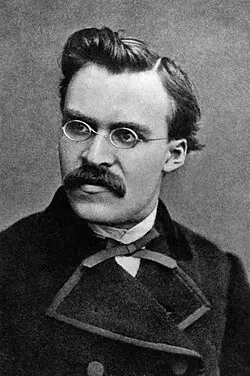
Friedrich Nietzsche: The Philosopher Who Asked What Happens When We No Longer Believe in the Values That Govern Us
Nietzsche did not simply ask whether God exists. He asked something more frightening: if the old foundations of morality, religion, and meaning collapse, what will human beings live for afterward?
WHO WAS FRIEDRICH NIETZSCHE?
Friedrich Wilhelm Nietzsche was born on October 15, 1844, in Röcken, a small village in the Kingdom of Prussia, and died on August 25, 1900, in Weimar, Germany.
He was born into a religious Protestant family. His father, Carl Ludwig Nietzsche, was a Lutheran pastor who died when Nietzsche was only five years old.
His younger brother died soon afterward.
Nietzsche therefore grew up surrounded by religion, but also by early experiences of death and loss.
His mother, Franziska, later raised him with his sister Elisabeth.
Nietzsche was exceptionally gifted.
He studied classical philology, the study of ancient Greek and Roman languages and literature, and became a professor at the University of Basel at only twenty-four years old.
That was an extraordinary achievement.
But Nietzsche would eventually become deeply dissatisfied with academic life.
His health was fragile for much of his adult life. He suffered from severe headaches, vision problems, and other recurring illnesses.
He never married.
He spent much of his later life moving between small European towns, living quietly, writing intensely, and thinking about questions that he believed Western civilization had not yet faced honestly.
His major works include:
The Birth of Tragedy
Human, All Too Human
The Gay Science
Thus Spoke Zarathustra
Beyond Good and Evil
On the Genealogy of Morality
Twilight of the Idols
Nietzsche’s writing is unusual.
He did not usually construct philosophy like a mathematical proof.
He used:
aphorisms,
stories,
provocations,
poetry,
myths,
psychological observations,
genealogies,
and attacks on familiar assumptions.
He wanted philosophy not merely to explain the world, but to transform the person who reads it.
THE HISTORICAL WORLD OF NIETZSCHE
Nietzsche lived during the nineteenth century, a period of enormous transformation.
Europe was being reshaped by:
industrialization
modern science
secularization
nationalism
capitalism
urbanization
political revolution
and the decline of traditional religious authority.
The scientific revolution had already challenged traditional explanations of nature.
Darwin’s theory of evolution was transforming ideas about life and human origins.
Modern historical scholarship was questioning traditional religious accounts of history.
Industrial society was changing how people worked and lived.
The authority of Christianity was weakening among many educated Europeans.
Nietzsche saw something approaching.
If Christianity had traditionally provided Western civilization with answers to questions such as:
Why are we here?
What is good?
What is evil?
What gives life meaning?
What happens after death?
then what happens when people stop believing those answers?
Nietzsche believed Europe had not fully understood the consequences.
THE PHILOSOPHICAL WORLD BEFORE NIETZSCHE
Nietzsche inherited a philosophical tradition stretching from the Greeks through Christianity and modern philosophy.
He admired some ancient Greek thinkers, especially the tragic worldview of Heraclitus and the pre-Socratic tradition.
He was deeply influenced by Schopenhauer, especially Schopenhauer’s idea that beneath conscious reasoning lies a deeper force of striving and desire.
But Nietzsche eventually rejected Schopenhauer’s pessimism.
He also reacted strongly against Christian morality.
And he challenged the confidence of modern rationalism.
Thinkers such as Descartes had emphasized reason and certainty.
The Enlightenment had emphasized rational inquiry.
Kant had explored the limits and powers of human reason.
Nietzsche pushes the question further:
What if reason itself is partly shaped by instincts, desires, culture, history, and the need to survive?
That question becomes central to his philosophy.
THE CENTRAL QUESTION
Nietzsche’s philosophy can be organized around one enormous question:
What happens when the traditional foundations of value collapse?
From this come several related questions:
What does it mean to live well?
Where do our moral values come from?
Why do we call some things good and others evil?
Are our moral beliefs really objective, or did they develop historically?
What happens when belief in God declines?
Can human beings create meaning without relying on traditional religion?
How can we overcome ourselves rather than simply obey inherited values?
Nietzsche does not want us to accept inherited values merely because our society calls them “good.”
He wants us to investigate where those values came from.
NIETZSCHE’S BASIC WORLDVIEW
Nietzsche’s philosophy can be mapped around several ideas:
perspectivism
will to power
nihilism
the death of God
master and slave morality
genealogy
self-overcoming
the Übermensch
eternal recurrence
affirmation of life
These ideas are deeply connected.
Nietzsche believes that human beings are not neutral observers of reality.
We interpret.
We desire.
We struggle.
We create values.
We inherit values from earlier generations.
And sometimes those inherited values may be hostile to life itself.
THE DEATH OF GOD
Nietzsche’s most famous phrase is:
“God is dead.”
This is often misunderstood.
Nietzsche was not simply claiming that a supernatural being physically died.
He was describing a cultural transformation.
Christian belief had provided Europe with a framework for morality and meaning.
But modern science, historical criticism, secularization, and changing intellectual culture were weakening that framework.
The problem was not simply that people stopped attending church.
The deeper problem was:
What happens to the values built on that religious foundation?
Nietzsche believed many Europeans would continue living by Christian moral assumptions even after losing faith in Christianity itself.
That creates a contradiction.
People may reject God while continuing to rely on a moral system whose authority traditionally came from God.
Nietzsche wanted to expose this tension.
THE MADMAN
In The Gay Science, Nietzsche tells a famous story.
A madman enters a marketplace carrying a lantern and announces that God is dead.
The people around him laugh.
They do not take him seriously.
Then the madman asks what humanity has done.
If God is gone, what happens to the moral and metaphysical structure that depended on God?
The people cannot understand the seriousness of the announcement.
Nietzsche’s point is not simply that atheism has arrived.
It is that human beings may not yet understand what their loss of traditional belief means.
The “madman” is ahead of his culture.
The crisis has arrived, but society is not psychologically prepared for it.
NIHILISM
This leads to nihilism.
Nihilism is the condition in which traditional values lose their authority and life appears to lack objective meaning or purpose.
Imagine someone believes:
“Life has meaning because God created us for a purpose.”
Then they stop believing in God.
The question becomes:
Why should life have meaning at all?
Or:
“Good and evil are objectively established by divine law.”
What happens when that foundation disappears?
Nietzsche thinks modern Europe is moving toward this crisis.
But Nietzsche does not simply want to defeat nihilism.
He wants to pass through it.
That is one of the most important parts of his philosophy.
NIETZSCHE DOES NOT SIMPLY SAY “NOTHING MATTERS”
This distinction is crucial.
A simplistic reading says:
Nietzsche = nihilism = nothing matters.
That is wrong.
Nietzsche sees nihilism as a problem to overcome, not the final answer.
If inherited values collapse, we face two possibilities.
We can conclude:
“Nothing has meaning.”
Or we can ask:
“Can human beings create and affirm new values?”
Nietzsche chooses the second path.
THE PROBLEM OF VALUES
Nietzsche asks us to stop treating morality as something obvious.
Suppose we say:
“Self-sacrifice is good.”
Nietzsche asks:
Why?
Who decided?
When did this value emerge?
What kind of person benefits from it?
What psychological needs does it satisfy?
What kind of society does it produce?
This is the beginning of his genealogical method.
Instead of asking only whether a moral rule is true, Nietzsche asks:
Where did this moral rule come from?
GENEALOGY OF MORALITY
In On the Genealogy of Morality, Nietzsche investigates the historical development of moral concepts.
He challenges the idea that morality simply descended from heaven as a finished system.
Values have histories.
Words change meanings.
Moral systems emerge from social conflict.
Psychological needs influence what people call good and evil.
Power relations shape values.
This does not automatically prove that morality is false.
But it changes how we investigate morality.
Instead of assuming:
“Good is good because it is good.”
Nietzsche asks:
“Why did human beings come to call this good?”
MASTER MORALITY AND SLAVE MORALITY
Nietzsche famously distinguishes between two broad forms of moral valuation.
Master morality
and
slave morality.
Master morality begins from strength.
The noble person sees themselves as good.
Strength, courage, pride, excellence, confidence, and achievement are valued.
“Good” originally means something like noble or excellent.
“Bad” means ordinary or low.
Slave morality emerges differently.
Nietzsche associates it with people who lack direct power and therefore reinterpret the qualities of the powerful.
Strength becomes evil.
Humility becomes good.
Obedience becomes good.
Weakness becomes morally valuable.
The oppressed person gains psychological power by condemning the powerful.
RESSENTIMENT
This leads to one of Nietzsche’s most important psychological concepts:
ressentiment.
Ressentiment is not simply ordinary resentment.
It is a deep, accumulated hostility produced when a person feels unable to act directly against what frustrates them.
Instead of changing the world, they reinterpret it morally.
Imagine someone who cannot compete with a powerful person.
Instead of saying:
“I wish I were stronger.”
they may say:
“Strength itself is evil.”
Nietzsche thinks something like this happened historically in certain moral traditions.
The weak could not defeat the powerful physically.
So they created a moral framework in which the powerful became morally condemned.
NIETZSCHE AND CHRISTIANITY
Nietzsche’s criticism of Christianity is one of the most controversial aspects of his philosophy.
He argues that Christian morality places great value on:
humility,
obedience,
self-denial,
suffering,
forgiveness,
meekness,
and compassion.
Nietzsche does not simply ask whether these values are socially useful.
He asks:
What kind of human being does this morality produce?
His concern is that excessive emphasis on self-denial may turn against life.
Instead of developing strength, creativity, ambition, and excellence, people may learn to feel guilty about their desires.
This is Nietzsche’s accusation of life-denial.
BUT NIETZSCHE IS NOT SIMPLY AGAINST KINDNESS
This is another common misunderstanding.
Nietzsche does not say:
“Always be cruel.”
His criticism is more subtle.
He asks whether compassion always helps.
Sometimes helping someone strengthens them.
Sometimes it makes them dependent.
Sometimes compassion reduces suffering.
Sometimes it merely prolongs weakness.
The question becomes:
Does this value increase human flourishing, strength, creativity, and life, or does it produce dependence and self-denial?
Nietzsche wants us to examine consequences rather than automatically worship moral labels.
WILL TO POWER
One of Nietzsche’s most famous concepts is the will to power.
It is often misunderstood as simply wanting political power.
That is too narrow.
The will to power refers more broadly to the drive to expand, express, overcome resistance, develop capacities, shape oneself, and exert one’s form upon the world.
An artist creates.
A scientist seeks understanding.
An athlete pushes beyond previous limits.
A thinker challenges inherited ideas.
A person transforms themselves.
These can all express something like will to power.
It is therefore connected to growth and self-overcoming, not merely domination.
PROBLEM → PLATO/CHRISTIANITY → NIETZSCHE
Problem:
Human beings naturally experience desire, ambition, conflict, and striving.
Traditional response:
Control or suppress these impulses in the name of higher moral or spiritual values.
Nietzsche’s challenge:
What if some of these drives are not defects but sources of creativity?
His question:
Can we transform our drives rather than simply repress them?
This becomes central to Nietzsche’s idea of self-overcoming.
SELF-OVERCOMING
Nietzsche does not want human beings simply to accept themselves.
He wants them to overcome themselves.
The person you are today does not have to remain the person you become tomorrow.
You can challenge:
your habits,
your fears,
your inherited beliefs,
your weaknesses,
your need for approval,
your intellectual limitations.
This is why Nietzsche’s philosophy is often less about discovering a fixed identity and more about creating oneself.
THE ÜBERMENSCH
Nietzsche’s Übermensch, often translated as “Overman” or “Superman,” is one of his most misunderstood concepts.
It does not mean a biologically superior human race.
It is not a racial theory.
It is not simply a physically powerful person.
The Übermensch represents a human being who can move beyond inherited value systems and participate in the creation of new values.
The Übermensch does not merely ask:
“What does society expect from me?”
They ask:
“What values can I affirm and live by?”
The concept is primarily about self-transformation and value creation.
THUS SPOKE ZARATHUSTRA
Nietzsche develops the Übermensch most famously in Thus Spoke Zarathustra.
Zarathustra is a fictional prophetic figure.
Nietzsche uses him to dramatize the transformation of human beings.
One of the central images is the movement from:
camel → lion → child
The camel carries inherited burdens.
The lion says no to inherited authority.
The child represents the ability to create and affirm anew.
This is an important pattern in Nietzsche.
First:
Carry the values you inherited.
Then:
Challenge them.
Finally:
Create and affirm your own values.
THE CHILD
The child is especially important.
A child can represent:
creation,
play,
innocence,
renewal,
experimentation,
and affirmation.
The child does not merely destroy old values.
It creates something new.
This is why Nietzsche’s philosophy cannot stop at criticism.
Destroying old beliefs is not enough.
After criticism comes creation.
ETERNAL RECURRENCE
Nietzsche’s eternal recurrence is one of his most powerful thought experiments.
Imagine someone tells you:
You will have to live this exact life again and again.
Every joy.
Every mistake.
Every humiliation.
Every success.
Every boring afternoon.
Every relationship.
Every painful moment.
Everything will repeat infinitely.
How would you react?
Would you curse the universe?
Or would you say:
Yes.
Nietzsche uses this idea as a test of life affirmation.
WHAT ETERNAL RECURRENCE ASKS
The question is not necessarily:
“Does the universe literally repeat itself?”
The deeper philosophical question is:
Can you affirm your life so completely that you would accept living it again?
This transforms how we think about regret.
Instead of asking:
“How can I escape my life?”
Nietzsche asks:
“Can I live in a way that makes me willing to affirm my existence?”
This is one of his most demanding ideas.
AMOR FATI
Nietzsche’s phrase amor fati means love of fate.
It is stronger than merely accepting what happens.
Acceptance says:
“I cannot change this, so I will tolerate it.”
Amor fati says:
“I affirm my life, including what I did not choose.”
This does not mean pretending suffering is pleasant.
It means refusing to build your identity around resentment toward reality.
You cannot rewrite the past.
But you can change your relationship with it.
NIETZSCHE AND SUFFERING
Nietzsche does not believe suffering automatically makes people better.
That would be too simple.
But he argues that suffering can become part of growth.
A difficult experience can force someone to become stronger, more creative, or more self-aware.
The important question is not:
“How can I avoid every form of suffering?”
It is:
“What can I become through what I experience?”
This is why Nietzsche writes about turning suffering into strength.
“WHAT DOES NOT KILL ME…”
Nietzsche famously writes that what does not kill him makes him stronger.
The phrase is often used as a motivational slogan.
But Nietzsche’s idea is more complicated.
Suffering does not automatically strengthen someone.
It can also destroy them.
The deeper point is that human beings can sometimes transform hardship into strength.
The crucial concept is transformation.
Pain becomes meaningful when it becomes part of growth.
PERSPECTIVISM
Nietzsche challenges the idea that human beings simply observe reality from a completely neutral viewpoint.
We interpret the world from perspectives.
Our:
culture,
language,
history,
needs,
values,
and psychological structures
influence what we notice and how we interpret it.
This is often called perspectivism.
But perspectivism does not necessarily mean:
“Every opinion is equally true.”
Nietzsche is not simply saying truth does not exist.
He is questioning whether human beings can completely escape perspective.
The important question becomes:
Which perspectives are stronger, richer, more explanatory, and more capable of revealing reality?
NIETZSCHE AND TRUTH
Nietzsche is suspicious of the simple idea that truth is always valuable merely because it is truth.
He asks:
Why do human beings want truth?
Could truth sometimes destroy comforting beliefs?
Could illusions sometimes help life?
Could a belief be false but psychologically useful?
These are unsettling questions.
Nietzsche therefore investigates not only whether beliefs are true but also:
What does this belief do to life?
THE CRITIQUE OF REASON
Nietzsche challenges the idea that human beings are primarily rational creatures.
He thinks conscious reasoning often comes after deeper impulses.
We may believe we chose something for one reason while unconscious motives influenced us.
We may create philosophical systems that secretly justify our psychological needs.
This is why Nietzsche becomes an important precursor to later psychological thinkers.
He treats philosophy partly as a form of psychological investigation.
He asks:
What desire is hiding behind this argument?
PHILOSOPHERS AS HUMAN BEINGS
Nietzsche believes philosophers often pretend to discover objective truth while actually expressing their personalities and values.
A philosopher who praises self-denial may have a personality inclined toward self-denial.
A philosopher who praises rational order may have a psychological need for order.
A philosopher who praises equality may be reacting against experiences of hierarchy.
Nietzsche does not think this automatically proves their philosophy false.
But it means we should investigate the philosopher as well as the philosophy.
This is a radical shift.
Do not ask only, “Is this argument true?”
Also ask:
“What kind of person needs this argument to be true?”
NIETZSCHE AND THE BODY
Nietzsche strongly resists the tradition of treating the body as inferior to the mind.
He sees human beings as embodied creatures.
Our:
hormones,
instincts,
drives,
physical condition,
and unconscious tendencies
influence our thinking.
Reason does not float above the body.
It emerges from a living organism.
This is one reason Nietzsche’s philosophy feels surprisingly modern.
NIETZSCHE AND ART
Art is extremely important to Nietzsche.
His first major book, The Birth of Tragedy, explores ancient Greek tragedy.
Nietzsche believes the Greeks were not simply cheerful lovers of beauty.
They understood suffering.
They knew that existence could be terrifying, chaotic, and painful.
Yet they created art anyway.
For Nietzsche, this is extraordinary.
Art does not need to deny suffering.
It can transform suffering into something meaningful.
APOLLONIAN AND DIONYSIAN
Nietzsche introduces two powerful concepts.
The Apollonian
represents order, clarity, structure, beauty, restraint, and form.
The Dionysian
represents instinct, ecstasy, chaos, intoxication, unity, and the dissolution of boundaries.
Nietzsche believes Greek tragedy combined both.
Life contains both order and chaos.
A philosophy that accepts only one side becomes incomplete.
We need form.
But we also need vitality.
NIETZSCHE AND MODERNITY
Nietzsche was deeply suspicious of modern civilization.
He worried that modern people might become comfortable, passive, and intellectually conformist.
He imagined a future where people no longer believe traditional values but also lack the courage to create new ones.
This produces the figure of the last man.
The last man does not seek greatness.
He seeks comfort.
He avoids risk.
He wants security.
He says:
“We have invented happiness.”
Nietzsche fears that humanity might choose comfortable mediocrity over difficult greatness.
THE LAST MAN
The last man is almost the opposite of the Übermensch.
The Übermensch creates.
The last man consumes.
The Übermensch risks.
The last man seeks safety.
The Übermensch overcomes.
The last man wants approval.
The Übermensch creates values.
Nietzsche’s concern here is not that everyone must become extraordinary.
It is that a civilization can become so obsessed with comfort that it loses the capacity for ambition, creativity, courage, and transformation.
NIETZSCHE AND POLITICS
Nietzsche does not fit comfortably into modern political categories.
He criticized:
nationalism,
mass politics,
antisemitism,
German nationalism,
and political movements that demanded conformity.
His sister Elisabeth Förster-Nietzsche later helped promote interpretations of his work that connected him with nationalist and antisemitic ideas.
Those interpretations significantly distorted his philosophy.
Nietzsche himself made strongly critical statements about antisemitism and German nationalism.
His philosophy is much more concerned with individual transformation, culture, values, and human excellence than with constructing a conventional political ideology.
NIETZSCHE AND WOMEN
Nietzsche’s writings contain statements about women that are deeply problematic and sometimes openly sexist.
Some remarks are deliberately provocative.
Others reflect nineteenth-century assumptions.
His personal attitudes and relationships are also difficult to separate completely from the provocative style of his writing.
We should neither ignore these passages nor pretend they define his entire philosophy.
They are part of the historical thinker we must evaluate.
A philosophy of overcoming inherited values does not automatically mean the philosopher himself successfully overcame every inherited prejudice.
That is an important contradiction.
THE HUMAN SIDE OF NIETZSCHE
Nietzsche lived much of his adult life in physical discomfort.
He was intellectually isolated.
His relationship with his family was complicated.
He had intense friendships and painful intellectual breaks, especially with Richard Wagner.
Nietzsche initially admired Wagner deeply.
But he eventually rejected him.
The break was philosophical as much as personal.
Nietzsche came to see Wagner’s art and cultural politics as symptoms of values he increasingly opposed.
This illustrates something central about Nietzsche himself.
He was willing to turn his philosophical criticism against things he once loved.
NIETZSCHE AND WAGNER
Wagner represented, for Nietzsche, a major early source of inspiration.
But Nietzsche eventually believed Wagner’s art appealed too heavily to decadence, nationalism, Christianity, and mass emotion.
The relationship ended bitterly.
Nietzsche’s intellectual development can therefore be seen partly as a process of repeatedly overcoming his own earlier commitments.
This is exactly what his philosophy demands.
Do not remain loyal to your former self simply because it was once yours.
NIETZSCHE’S BREAKDOWN
In 1889, Nietzsche suffered a severe mental collapse in Turin.
He never recovered enough to return to independent intellectual life.
His mother and later his sister cared for him.
He died in 1900.
The exact medical nature of his final illness remains debated.
His final years were therefore very different from the intellectual force of his earlier writing.
But his philosophical legacy continued growing after his death.
NIETZSCHE’S CONTRADICTIONS
Nietzsche is full of tensions.
He attacks dogmatism while sometimes making extremely sweeping claims.
He criticizes herd thinking while sometimes sounding elitist.
He rejects traditional morality but offers strong evaluations of his own.
He criticizes Christianity for suppressing life while sometimes underestimating the value of compassion.
He praises self-overcoming but his writings can be interpreted as celebrating domination.
He attacks inherited values but does not give a simple replacement moral system.
He wants us to question every value.
But then we must ask:
On what basis does Nietzsche himself judge values as higher or lower?
This is one of the deepest problems in his philosophy.
THE CRITICISM OF NIETZSCHE
One major criticism is that Nietzsche’s rejection of objective morality risks collapsing into relativism.
If values are created, why should one person’s values be better than another’s?
Nietzsche might respond that not all values are equally life-enhancing.
Some values produce strength, creativity, courage, and flourishing.
Others produce resentment, weakness, guilt, and self-denial.
But this response creates another problem:
What exactly counts as “life-enhancing”?
Nietzsche never gives us a completely neutral measuring instrument.
Another criticism is political.
If society abandons common moral standards, powerful individuals might use Nietzsche to justify domination.
Nietzsche would likely reject crude domination as a misunderstanding of strength.
But the ambiguity remains.
His language is powerful enough to be misused.
WHAT NIETZSCHE GOT RIGHT
Nietzsche saw several problems before many later thinkers fully recognized them.
People often rationalize desires after the fact.
We may not be as rational as we think.
Values have histories.
Moral concepts did not simply appear from nowhere.
People can use morality psychologically.
Moral language can hide resentment, fear, or desire for control.
The decline of religion creates a crisis of meaning.
Removing traditional beliefs does not automatically create new values.
Comfort can become a form of stagnation.
A society can become so comfortable that it stops striving.
Human beings need self-transformation.
We are not finished products.
Art can transform suffering.
Life does not need to be painless to be meaningful.
These insights helped prepare the ground for modern psychology, existentialism, cultural criticism, and philosophy.
WHAT NIETZSCHE GOT WRONG OR LEFT DANGEROUSLY OPEN
Nietzsche’s psychology can sometimes become speculative.
His attacks on morality can go too far.
His praise of strength can be misunderstood.
His elitism can create serious ethical problems.
His comments about women are difficult to defend.
His alternative values remain incomplete.
Most importantly, Nietzsche tells us to overcome inherited morality, but he does not give us a universally accepted method for deciding which new values deserve to replace it.
That problem remains unresolved.
NIETZSCHE’S INFLUENCE
Nietzsche’s influence exploded in the twentieth century.
He influenced:
Sigmund Freud
Carl Jung
Martin Heidegger
Jean-Paul Sartre
Albert Camus
Michel Foucault
Gilles Deleuze
existentialism
psychoanalysis
literary criticism
modern cultural theory
post-structuralism
His influence is especially strong wherever thinkers investigate:
power,
identity,
morality,
meaning,
language,
psychology,
and the construction of values.
NIETZSCHE AND EXISTENTIALISM
Nietzsche is often treated as a major precursor to existentialism.
Existentialist thinkers later asked:
If there is no predetermined meaning to human existence, what should we do?
Nietzsche’s answer is not:
“Give up.”
It is:
Create.
Create values.
Create yourself.
Affirm existence.
Take responsibility for the life you construct.
This becomes one of the central currents of modern existential thought.
NIETZSCHE AND CAMUS
Albert Camus would later explore the problem of the absurd.
Camus and Nietzsche differ significantly.
But both confront a world in which traditional guarantees of meaning have become uncertain.
The question becomes:
Can we live without absolute certainty?
Nietzsche says:
Create and affirm.
Camus emphasizes revolt and lucid acceptance.
Both refuse the easy answer of simply returning to comforting illusions.
NIETZSCHE AND MODERN LIFE
Nietzsche is especially relevant to a world obsessed with:
followers,
likes,
status,
career success,
personal branding,
productivity,
consumerism,
and constant comparison.
He would ask:
Are you actually choosing your values, or have you inherited them from the crowd?
You want a prestigious job.
Why?
You want more followers.
Why?
You want luxury.
Why?
You want to be admired.
Why?
Nietzsche’s philosophy forces us to keep asking:
Whose desire is this?
That may be one of his most useful questions today.
NIETZSCHE AND SOCIAL MEDIA
Social media creates a strange version of the herd.
People constantly observe what others value.
What is fashionable?
What is successful?
What should I believe?
What should I be angry about?
What should I desire?
Algorithms amplify popular reactions.
Nietzsche’s critique of conformity becomes relevant here.
But there is an important warning.
Rejecting the crowd does not automatically make you independent.
You can become dependent on being different.
If you define yourself entirely against society, society still controls you.
True independence requires something deeper:
the ability to create your own standards rather than simply reversing the crowd’s standards.
NIETZSCHE’S PHILOSOPHY IN SIMPLE WORDS
Remember Nietzsche through these ideas:
Do not accept values simply because society inherited them.
Ask where they came from.
The death of God creates a crisis of meaning.
Old foundations can collapse.
Nihilism is a problem to overcome, not a final answer.
“Nothing matters” is not Nietzsche’s destination.
Question your motives.
Your reasons may hide deeper desires.
Become who you can become.
Do not remain trapped inside your inherited identity.
Practice self-overcoming.
Turn weakness into development.
Create values.
Do not merely destroy old ones.
Affirm life.
Do not build your philosophy around resentment toward existence.
Love your fate.
Learn to affirm even the parts of life you did not choose.
Ask whether you could say yes to your life again.
That is the challenge of eternal recurrence.
THE DIFFERENCE BETWEEN SOCRATES, PLATO, ARISTOTLE, AND NIETZSCHE
The philosophical journey becomes especially interesting when we place them together.
Socrates:
How should I live?
Examine yourself.
Question your beliefs.
Seek virtue.
Plato:
What is truly real and truly good?
Move beyond appearances.
Seek knowledge of the Forms and the Good.
Aristotle:
How can a human being flourish?
Develop virtue.
Build good habits.
Cultivate friendship.
Participate in a community.
Nietzsche:
What happens when the values we inherited lose their authority?
Question their origins.
Overcome nihilism.
Create values.
Become capable of affirming life.
The movement is extraordinary.
Socrates questions the self.
Plato searches beyond appearances.
Aristotle studies human flourishing within the world.
Nietzsche questions the foundations of the values by which we judge that world.
THE FINAL QUESTION
Nietzsche begins with a terrifying possibility.
Perhaps the values that have guided Western civilization are losing their foundation.
Perhaps we have inherited moral rules without understanding why we believe them.
Perhaps God is no longer convincing to modern humanity.
Perhaps the old meaning is disappearing.
And perhaps the greatest danger is not that people become atheists.
It is that they become nihilists.
Nietzsche’s answer is not to restore the past.
He asks us to become strong enough to face the collapse.
To question.
To examine our motives.
To overcome ourselves.
To create.
To affirm.
To love life without requiring life to guarantee that everything will be fair.
But this creates Nietzsche’s deepest unresolved problem:
If we destroy inherited values, by what authority do we create new ones?
Nietzsche gives us no easy answer.
And perhaps that is exactly why he remains so disturbing.
Socrates tells us to question our beliefs.
Plato tells us to search for the Good.
Aristotle tells us to build a life of virtue.
Nietzsche asks something more dangerous:
What if the very idea of “good” that we inherited needs to be questioned?
His philosophy leaves us standing after the collapse of the old answers.
There is no guaranteed meaning waiting for us.
No universal instruction manual.
No inherited value that we can accept without examination.
There is only the difficult task of deciding what kind of human being we will become.
Nietzsche’s greatest challenge is therefore not “God is dead.” It is what comes next: when the old values disappear, will we collapse into nihilism, or will we become capable of creating values worthy of life?