Tabula XI
Knight, Death, and the Devil
Albrecht Dürer, 1513
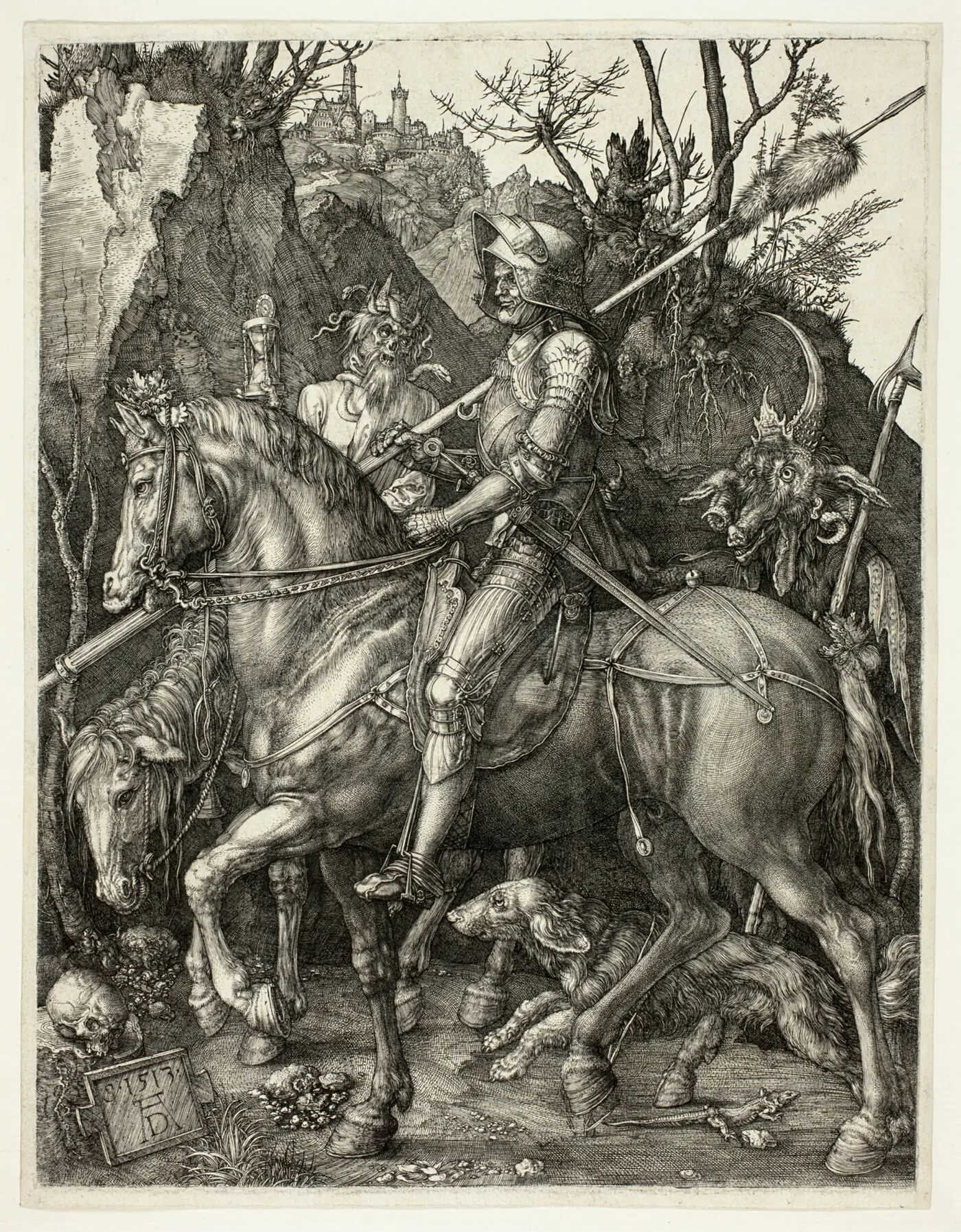
Knight, Death, and the Devil: The Road Through Fear
A man rides toward death, with the devil beside him, and yet he does not turn back.
The Artwork at a Glance
Albrecht Dürer’s Knight, Death, and the Devil was created in 1513 and is one of the three great master engravings that established Dürer’s reputation as one of the greatest printmakers of the Northern Renaissance. The other two are Melencolia I and Saint Jerome in His Study, both made in 1514.
The work is an engraving on copper, approximately 24.5 × 18.8 cm. It depicts an armored knight riding through a dark, rocky landscape. Beside him appears Death, riding a pale horse, while the monstrous Devil follows behind.
The knight does not look at either creature.
He continues forward.
This simple act is the heart of the image.
The work is often interpreted as an allegory of the Christian knight, whose faith and moral discipline allow him to continue along the difficult path of life despite the constant presence of death, temptation, and fear.
But Dürer’s engraving is richer than a simple religious lesson.
It is also a meditation on mortality, courage, discipline, temptation, uncertainty, and the human decision to keep moving when the road ahead is frightening.
The World Behind the Artwork
Dürer created the engraving in the early sixteenth century, during the Northern Renaissance, a period when Europe was experiencing major changes in religion, philosophy, science, politics, and culture.
Christianity shaped almost every part of European life.
Death was not an abstract idea.
People lived with high mortality, disease, war, religious anxiety, and uncertain medical knowledge. The possibility of sudden death was much closer to everyday experience than it is for many people today.
At the same time, Renaissance humanism was encouraging greater interest in education, classical philosophy, individual ability, observation, and the dignity of human reason.
Dürer lived at the meeting point of these worlds.
His art combines medieval religious ideas with Renaissance interest in the human figure, natural observation, geometry, and intellectual complexity.
Knight, Death, and the Devil carries both traditions.
The subject is deeply Christian.
But the knight himself is presented with extraordinary physical and psychological presence.
He is not simply a symbol.
He feels like a person.
The Artist Behind the Work
Albrecht Dürer was born in Nuremberg in 1471 and died there in 1528.
He was a painter, draftsman, printmaker, and writer whose influence reached across Europe.
Dürer traveled to Italy and encountered Renaissance ideas about proportion, perspective, anatomy, and classical art. At the same time, he remained deeply connected to the visual traditions of Northern Europe, especially its extraordinary attention to texture and detail.
His engravings demonstrate this combination.
He could make a small piece of copper carry an astonishing amount of information.
Armor looks like metal.
Hair looks like hair.
Animal fur becomes visible.
Wood, stone, leaves, and skin are differentiated through thousands of carefully controlled lines.
But Dürer’s technical brilliance is not an end in itself.
In Knight, Death, and the Devil, detail becomes psychological.
The more carefully we look, the more threatening the road becomes.
What We See
The composition is dominated by a mounted knight moving through a narrow landscape.
He wears full armor.
His helmet covers much of his face.
He carries a large lance.
A sword hangs at his side.
His horse moves steadily forward.
Behind him rides Death.
The figure of Death is skeletal and horrifying. He holds an hourglass, reminding the knight that time is running out.
Beside them is the Devil, a grotesque creature whose appearance combines several animal-like features.
A large dog runs near the horse.
The landscape is rocky and enclosed.
Trees surround the road.
A distant castle appears in the background.
The overall effect is strangely claustrophobic.
The knight is moving forward, but the road does not feel open.
It feels like a passage through danger.
The Knight
The knight is the emotional center of the work.
His armor makes him appear almost invulnerable.
But he is not invulnerable.
The creatures around him make that clear.
Death is right beside him.
The Devil follows him.
The landscape is dangerous.
Yet the knight does not show panic.
His posture remains upright.
His horse continues forward.
His head faces the road.
This composure is essential.
The knight’s courage does not come from the absence of fear.
It comes from refusing to allow fear to determine his direction.
That distinction makes the image psychologically powerful.
Death
Death is perhaps the most disturbing figure.
His flesh has decayed.
His face is skeletal.
A snake emerges around his head.
His horse is emaciated.
Yet the most important object he carries is the hourglass.
Death does not need to attack the knight.
Time itself is enough.
The hourglass says something brutally simple:
Your time is passing.
The knight cannot defeat that.
His armor cannot stop it.
His horse cannot outrun it.
His sword cannot kill it.
This makes Death more powerful than any physical enemy.
Death does not threaten the knight with a future possibility.
Death is already riding beside him.
The Devil
The Devil is different from Death.
Death represents an unavoidable fact.
The Devil represents temptation, corruption, fear, and moral danger.
He follows behind the knight rather than riding directly beside him.
This placement matters.
The knight is caught between two kinds of threat.
One is inevitable.
The other is something he must resist.
Death cannot be defeated.
Temptation can be resisted.
The distinction gives the image a moral structure.
Human beings cannot control everything that happens to them.
But they can still make choices about how they respond.
The Horse
The horse moves steadily through the scene.
It is not beautiful in the idealized sense of a heroic war horse.
It feels heavy and powerful.
Its body forms a strong diagonal through the composition.
The knight and horse become almost one unit.
The rider controls the direction.
The horse provides the physical strength to continue.
There is therefore a relationship between human will and animal force.
The knight’s determination becomes visible through the horse’s movement.
The horse does not look toward Death.
It keeps going.
The Dog
The small dog running beside the horse is easy to overlook.
But it adds another layer to the scene.
The dog is associated with loyalty and companionship in many artistic traditions.
Here it moves along the same road as the knight.
It also contributes to the sense of movement.
The dog is alive.
Death is skeletal.
The Devil is monstrous.
The knight remains human.
The image therefore contains several different states of existence in one narrow passage.
Life.
Death.
Temptation.
Companionship.
Movement.
How the Artwork Works
Dürer’s engraving technique gives the scene extraordinary physical clarity.
He uses dense networks of lines to describe the armor, horse, trees, rocks, and figures.
The armor is especially important.
Its surfaces are constructed through carefully controlled lines that make the metal appear solid and reflective.
This creates a visual paradox.
The knight looks physically protected.
But his spiritual situation is completely exposed.
His armor may defend his body.
It cannot defend him from time.
It cannot prevent moral failure.
It cannot make him immortal.
The more impressive the armor becomes, the more obvious its limitations appear.
The Composition
The knight occupies the center of the image and moves diagonally through the landscape.
Death and the Devil follow along the same path.
This creates a visual procession.
The viewer’s eye follows the knight forward.
But Death remains close behind.
The distant castle offers a destination.
This is important because the knight is not wandering randomly.
He appears to be traveling toward somewhere.
The road therefore becomes a metaphor for life.
We move forward toward an uncertain destination while death follows us.
We cannot turn around and eliminate it.
We can only decide how we travel.
The Castle
In the distance, a fortified castle rises above the landscape.
Its interpretation is debated.
It can be read as a symbol of a goal, a destination, or a heavenly realm.
Some interpretations connect it with the idea of the Christian’s ultimate destination.
But the image does not explicitly tell us that this is heaven.
It is safer to say that the castle provides direction.
Without it, the knight would simply be wandering through darkness.
With it, the road has a purpose.
This strengthens the contrast between the knight and his companions.
Death asks him to stop.
The Devil tries to pull him away.
The castle gives him somewhere to go.
The Central Idea
The engraving is fundamentally about how to live in the presence of death.
The knight does not defeat Death.
He does not destroy the Devil.
He does not escape the dangerous landscape.
He continues anyway.
This is a profound idea.
Human courage is not the elimination of mortality.
It is the ability to act meaningfully while knowing that mortality exists.
The knight knows, or at least symbolizes someone who knows, that the road ends.
Yet he rides.
That is what makes the image heroic.
Not victory over death.
Persistence in spite of death.
Philosophy of the Artwork
The work raises an ancient philosophical question:
How should a human being live knowing that death is unavoidable?
Different traditions have answered this differently.
Stoic philosophy emphasizes accepting what cannot be controlled and directing attention toward one’s own choices.
Christian thought emphasizes faith, moral discipline, and salvation.
Existential philosophy, centuries later, would examine the problem of living meaningfully in the face of mortality.
Dürer’s knight can be placed into conversation with all of these ideas, although we should not force later philosophies onto a sixteenth-century artwork.
His original world was fundamentally Christian.
Yet the human problem he represents is much older and broader.
Death follows everyone.
The question is what we do before it catches us.
Faith and Fear
The knight’s calmness is sometimes interpreted as evidence of faith.
He does not look at Death.
He does not look at the Devil.
He looks forward.
This can be understood as moral focus.
But there is another possibility.
Perhaps he is not fearless.
Perhaps he simply knows that looking at fear will not change the road.
This makes the image psychologically richer.
Courage does not require certainty.
It requires action despite uncertainty.
The knight has no guarantee that the road will be safe.
He rides anyway.
The Contradiction of the Armor
The armor creates one of the artwork’s strongest contradictions.
It suggests protection.
But the hourglass reminds us that no protection is complete.
The knight can defend himself from another human warrior.
He cannot defend himself from time.
This is almost cruelly ironic.
Human beings build walls.
Weapons.
Medicine.
Institutions.
Technology.
We protect ourselves in countless ways.
But none of these things changes the basic condition of mortality.
Dürer’s knight therefore becomes a symbol of human civilization itself.
We build armor around ourselves.
But underneath it, we remain vulnerable.
The Devil and Human Choice
Death is unavoidable.
The Devil is different.
This distinction makes the Devil an important part of the composition.
The Devil can represent the forces that tempt people away from their chosen path.
Greed.
Fear.
Cowardice.
Desire.
Dishonesty.
Distraction.
The precise meaning is not fixed, but the general structure is clear.
The knight’s journey is not only about reaching a destination.
It is about remaining faithful to the direction he has chosen.
The Devil represents everything that can make that difficult.
A World Full of Danger
The landscape is not peaceful.
The trees twist upward.
The rocks are rough.
The path is narrow.
The animals are unsettling.
Even the vegetation feels slightly hostile.
Nature does not provide the knight with comfort.
This is important because many Renaissance landscapes idealize nature.
Dürer instead gives us a world filled with obstacles.
The road is difficult because life is difficult.
The knight’s dignity comes from continuing through the landscape rather than expecting the landscape to become easier.
Different Interpretations
The traditional interpretation sees the knight as a Christian warrior traveling confidently through the dangers of earthly life.
The work has also been associated with Erasmian humanism, Christian morality, and the idea of steadfastness in the face of temptation.
Another interpretation sees the knight as a broader symbol of disciplined human character.
He may represent anyone who continues toward a chosen goal despite fear, mortality, and distraction.
There are also readings that emphasize the darker side of the image.
Perhaps the knight’s confidence is not pure courage.
Perhaps it is stubbornness.
Perhaps he is trapped in his own certainty.
The engraving does not give us enough information to settle every question.
That ambiguity is part of its strength.
The Artist’s Intention and the Viewer
Dürer almost certainly expected his audience to recognize the Christian symbolism.
His original viewers would have understood Death, the Devil, the knight, the hourglass, and the journey through the landscape within a religious framework.
But the image has outgrown that historical context.
A modern viewer may not see a Christian knight at all.
They may see a person moving through grief.
Someone facing illness.
Someone pursuing a difficult ambition.
Someone continuing after failure.
Someone who knows that life is temporary but refuses to stop living.
The symbols change.
The human experience remains.
Reception and Historical Importance
Knight, Death, and the Devil quickly became one of Dürer’s most admired engravings.
Its fame was strengthened by the extraordinary technical precision of the image and by its intellectual density.
Dürer demonstrated that printmaking could carry the same seriousness as painting.
The engraving also became an important example of Northern Renaissance art’s ability to combine microscopic observation with large philosophical questions.
A tiny copper plate could contain an entire moral universe.
Later generations continued to study the image because it offered something more than technical brilliance.
It gave visual form to an experience that every human being eventually confronts.
Why It Still Matters
The knight’s road looks strangely familiar.
We all move forward without knowing exactly what waits ahead.
We carry responsibilities.
We encounter fear.
We lose people.
We experience failure.
We become aware of our own mortality.
And yet daily life requires us to continue.
That is why the image still feels powerful.
Death does not wait at the end of the road.
It travels with us.
The hourglass is always present.
The question is therefore not how to escape death.
The question is how to live while knowing that it is there.
This makes Dürer’s engraving surprisingly modern.
It speaks to anyone who has ever had to continue walking through a difficult period without knowing how the story will end.
A Deeper Reading
Look at the knight one final time.
Death is beside him.
The Devil is behind him.
The landscape is dark.
The road is narrow.
Yet the knight keeps moving.
He does not look back.
He does not pretend that Death is not there.
He simply refuses to let Death determine his direction.
That may be the deepest idea in Dürer’s engraving.
Human beings cannot choose whether they will die.
They cannot control every danger.
They cannot eliminate uncertainty.
But they can choose the manner in which they travel through the world.
The armor protects the body, but the real strength of the knight is not the metal around him.
It is his direction.
He knows the road is dangerous.
He knows the hourglass is running.
He knows the monsters are close.
And still he rides.
Perhaps courage has always been less about defeating fear than about refusing to let fear decide where we go.