Tabula XX
Karl Marx
Photograph by John Jabez Edwin Mayall, born on May 5, 1818, in Trier, Prussia (now Germany) and died on March 14, 1883, in London, England at the age of 64.
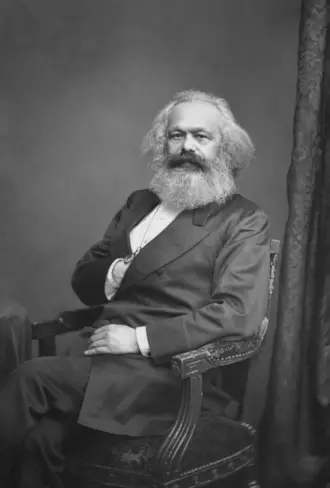

Karl Marx: The Philosopher Who Asked Why Human Beings Create a World That Can Dominate Them
Marx looked at a society producing enormous wealth and asked a disturbing question: if human beings create the economy, why do the economy and the institutions built around it so often seem to control human beings instead?
WHO WAS KARL MARX?
Karl Marx was born on May 5, 1818, in Trier, in the Kingdom of Prussia, and died on March 14, 1883, in London.
He was born into a middle-class family.
His father, Heinrich Marx, was a lawyer who converted from Judaism to Christianity in the context of the political and legal restrictions facing Jews in Prussia.
Marx studied law at the universities of Bonn and Berlin, but philosophy soon became more important to him than law.
At the University of Berlin, he became deeply interested in G. W. F. Hegel, whose philosophy dominated much of German intellectual life.
Marx eventually completed his doctorate, but an academic career became difficult because of his radical political and philosophical views.
He therefore turned toward journalism.
That decision changed his life.
As a journalist, Marx encountered political conflicts not as abstract philosophical problems but as concrete struggles over:
poverty,
property,
law,
labor,
political power,
and economic inequality.
He began asking a question that would dominate his entire intellectual life:
What lies beneath the political and moral ideas of a society?
His answer increasingly became:
Look at how people produce and distribute the material necessities of life.
THE WORLD MARX INHERITED
Marx lived during the transformation from traditional European society toward modern industrial capitalism.
Factories were expanding.
Cities were growing rapidly.
Machines were transforming production.
Railways connected markets.
International trade expanded.
A new industrial working class was emerging.
But industrialization also produced terrible working conditions.
Workers could face:
long working hours,
low wages,
dangerous factories,
child labor,
crowded housing,
and little political power.
At the same time, industrial capitalism created enormous new wealth.
This contradiction fascinated Marx.
How could a system that dramatically increases productive power also produce enormous poverty and insecurity?
This became one of the central problems of Marx’s philosophy.
THE PHILOSOPHICAL WORLD BEFORE MARX
Marx inherited several major intellectual traditions.
The most important were:
Hegelian philosophy
French revolutionary thought
British political economy
and socialist criticism of capitalism.
Each contributed something different.
HEGEL AND THE DIALECTIC
Marx was deeply influenced by Georg Wilhelm Friedrich Hegel.
Hegel believed history was not a random sequence of events.
Human societies develop through contradictions.
Ideas clash.
Institutions contain internal tensions.
Those tensions produce transformation.
Marx accepted the importance of contradiction and historical development.
But he rejected Hegel’s tendency to make ideas and consciousness the deepest foundation of history.
Marx famously turned Hegel “right side up.”
The basic shift was:
Hegel: ideas and consciousness are central to historical development.
Marx: material social relations and human productive activity are fundamental.
This became historical materialism.
FEUERBACH AND MATERIALISM
Marx was also influenced by Ludwig Feuerbach, who criticized abstract religious philosophy.
Feuerbach argued that human beings create religious ideas by projecting human qualities onto God.
Marx accepted part of this critique.
But he thought Feuerbach stopped too early.
It was not enough to explain religion as an idea.
Marx wanted to ask:
Why do human beings produce these forms of consciousness in the first place?
What social conditions produce alienation?
What economic conditions produce religious consolation?
What political conditions make people experience themselves as powerless?
Marx therefore moved from:
criticism of ideas
toward
criticism of the social conditions producing those ideas.
BRITISH POLITICAL ECONOMY
Marx studied thinkers such as:
Adam Smith
and
David Ricardo.
They analyzed:
labor,
wages,
profit,
production,
markets,
and economic value.
Marx admired their seriousness but believed classical political economy did not go far enough.
It described the mechanisms of capitalism.
Marx wanted to uncover its underlying social relationships.
He wanted to know:
Who owns the means of production?
Who must work for someone else?
Who receives the profits?
Why does labor become a commodity?
Why does capital continuously seek expansion?
THE SOCIALISTS BEFORE MARX
Marx also encountered early socialist thinkers such as:
Henri de Saint-Simon
Charles Fourier
and Robert Owen.
They criticized the inequalities of industrial society and imagined more cooperative forms of social organization.
Marx agreed with their criticism of capitalism.
But he thought many early socialists relied too much on ideal communities.
He wanted a theory based on the actual structure and contradictions of capitalist society.
This is why Marx later distinguished his approach from what he called “utopian socialism.”
MARX’S CENTRAL QUESTION
Marx’s philosophy revolves around one enormous question:
Why is society divided into classes, and how does economic organization shape human life?
From this follow several others:
Who owns productive resources?
Who controls labor?
Why do workers become dependent on wages?
How does capitalism produce profit?
Why do economic crises occur?
Why do social classes conflict?
How does economic power become political power?
Can capitalism overcome its own contradictions?
What would a society beyond class domination look like?
Marx did not see these as separate problems.
They were connected.
HISTORICAL MATERIALISM
One of Marx’s most important ideas is that we should understand history through the material organization of society.
Human beings must first:
eat,
drink,
find shelter,
produce tools,
raise children,
and organize work.
Before people can spend their lives doing philosophy, politics, art, or religion, they must somehow reproduce their material existence.
Therefore Marx asks:
How do people produce the things they need to survive?
And:
Who controls that production?
This is the foundation of historical materialism.
THE MEANS OF PRODUCTION
To understand Marx, we need one key concept:
means of production.
These are the resources and instruments used to produce goods.
They include things such as:
land,
factories,
machines,
tools,
raw materials,
and productive infrastructure.
In capitalism, these means are primarily privately owned.
This creates a fundamental social division.
One group owns productive property.
Another group largely owns its ability to work.
That difference produces class relations.
THE BOURGEOISIE AND THE PROLETARIAT
Marx identifies two central classes within capitalism.
The bourgeoisie are the capitalist class.
They own and control productive property.
The proletariat are the working class.
They generally do not own the means of production and therefore must sell their labor power to survive.
This creates an unequal relationship.
The worker needs employment.
The capitalist needs labor.
But they do not have equal economic power.
The capitalist owns the productive resources.
The worker owns mainly their capacity to work.
CLASS STRUGGLE
Marx’s famous claim is:
The history of class societies is fundamentally shaped by class struggle.
Ancient societies had conflicts between:
masters and slaves.
Feudal societies had conflicts involving:
lords and serfs.
Capitalism produces conflict between:
capitalists and workers.
The forms change.
The underlying problem remains:
Who controls the means of production, and who must work under that control?
WHY CLASS MATTERS
Class for Marx is not simply about income.
Two people can earn similar incomes but occupy different positions within the production process.
The deeper question is:
What is your relationship to the means of production?
Do you own a factory?
Do you own land?
Do you employ workers?
Do you have to sell your labor to someone who owns productive property?
Class is therefore a structural relationship.
LABOR POWER
Marx makes an important distinction.
Workers do not literally sell “labor.”
They sell their labor power, their capacity to work for a certain period.
The capitalist purchases that capacity.
The worker receives wages.
The worker then produces goods or services.
But the value created during the working day can exceed the value represented by the worker’s wage.
This difference becomes central to Marx’s theory of surplus value.
SURPLUS VALUE
Imagine a worker is paid enough to cover the value of what they need to reproduce their labor power.
But during the working day, the worker produces more value than the value represented by their wage.
Where does the additional value go?
Marx calls it surplus value.
It becomes the source of profit and other forms of income accruing to capital.
This is one of the central mechanisms Marx sees within capitalist production.
A SIMPLE EXAMPLE
Imagine a worker produces goods worth $200 in a day.
The worker’s wage for that day is $80.
The difference is not automatically pure profit because the capitalist must also cover:
materials,
machines,
energy,
rent,
transport,
and other costs.
But Marx’s key question remains:
Why can the owner claim the surplus generated through the labor process?
His answer lies in ownership of the means of production.
The worker must sell labor power.
The capitalist owns the productive system.
This creates a structural relationship of exploitation.
EXPLOITATION
When Marx calls capitalism exploitative, he is not simply saying:
“Capitalists are personally evil.”
This distinction is crucial.
A capitalist may be kind.
A worker may be treated respectfully.
Yet the structure can still produce exploitation.
Why?
Because the worker must sell labor power to obtain a livelihood, while the owner purchases labor power and appropriates the surplus generated through production.
Exploitation is therefore structural, not merely a matter of personal cruelty.
ALIENATION
One of Marx’s most human ideas is alienation.
He develops this especially in his early writings.
Alienation means that workers can become separated from important aspects of their own human activity.
Under certain forms of wage labor, workers may become alienated from:
the products they create
the process of work
their own human potential
and other people.
ALIENATION FROM THE PRODUCT
Imagine spending your entire day manufacturing something.
You create it.
You improve it.
You invest your energy in it.
But once it is finished, you do not own it.
Someone else does.
The product becomes an object belonging to another person.
The worker’s own activity produces something that stands outside them.
The more the worker produces, the more wealth can accumulate outside their control.
This is alienation from the product.
ALIENATION FROM WORK
Work should ideally be a way for human beings to express:
creativity,
intelligence,
skill,
cooperation,
and purpose.
But if work becomes repetitive and controlled entirely by someone else, the worker may experience it as something external.
You do not work because the activity itself fulfills you.
You work because you need wages.
Work becomes something you endure rather than something through which you develop yourself.
ALIENATION FROM HUMAN POTENTIAL
Marx believes human beings are creative and productive by nature.
We do not simply consume.
We create.
We plan.
We cooperate.
We transform the world.
But alienated labor can reduce this creative capacity to a means of survival.
A person becomes:
“I work so that I can live.”
Rather than:
“My productive activity is part of the life I freely express.”
That distinction is central to Marx’s humanism.
ALIENATION FROM OTHER PEOPLE
Economic competition can also affect relationships.
Instead of seeing another worker as a partner, people may see them as:
a competitor for a job,
a threat to wages,
or a rival for promotion.
The capitalist may see workers primarily as costs.
Workers may see owners primarily as sources of exploitation.
Economic structures can therefore shape social relationships.
COMMODITY
Marx begins Capital with something surprisingly ordinary:
the commodity.
A commodity is something produced for exchange.
A shirt.
A phone.
A chair.
A machine.
A kilogram of coffee.
In capitalism, an enormous portion of human life becomes organized around commodities.
Marx wants to know:
Why do social relationships between people appear as relationships between things?
This leads to one of his most difficult concepts.
COMMODITY FETISHISM
Marx argues that commodities can conceal the social relationships involved in their production.
Imagine buying a cheap shirt.
You see:
fabric,
design,
brand,
price.
But you may not see:
the workers who produced it,
their wages,
working conditions,
the factory,
the supply chain,
the ownership structure,
or the global economic relationships involved.
The social labor behind the object disappears.
The commodity seems to exist independently.
Marx calls this commodity fetishism.
The object appears natural.
The social relationship disappears.
THE PROBLEM OF CAPITAL
Capital is not simply money.
A person can have money without being a capitalist in Marx’s technical sense.
Capital is money and resources organized for the purpose of generating more value.
The basic movement is:
Money → Production → More Money
Capital therefore seeks expansion.
A capitalist who simply keeps money in a drawer is not functioning as capital in this sense.
Capital must move.
It must be invested.
It must generate returns.
Then those returns are reinvested.
The process becomes continuous.
CAPITAL ACCUMULATION
Capital tends toward accumulation.
If one capitalist reinvests profits into:
more machines,
larger factories,
new technologies,
cheaper production,
or wider markets,
then competitors must respond.
Competition creates pressure to accumulate.
A capitalist cannot simply say:
“I have enough.”
If competitors become more efficient, refusing to invest may mean losing the market.
Thus Marx sees an important point:
Capitalism is not driven only by individual greed. It contains structural pressures that encourage continuous accumulation.
COMPETITION AND THE SYSTEM
A capitalist may personally dislike exploitation.
But if another company cuts wages and lowers prices, the first company may be pressured to do the same.
If one company automates production, competitors may need to automate too.
Individual choices therefore operate inside systemic pressures.
This is a major feature of Marx’s method.
Do not ask only:
“Why did this individual behave badly?”
Ask:
“What incentives does the system create?”
CAPITALISM AND TECHNOLOGY
Marx had a complicated relationship with technology.
He recognized that capitalism revolutionizes production.
Machines can dramatically increase productivity.
Scientific knowledge becomes economically useful.
Old industries disappear.
New industries emerge.
Global markets expand.
This is historically transformative.
Marx therefore does not simply condemn capitalism as technologically backward.
He sees capitalism as extraordinarily powerful.
It transforms the productive capacities of humanity.
But this creates another contradiction.
The same system that develops enormous productive power can leave many people economically insecure.
THE CONTRADICTION OF CAPITALISM
Marx sees capitalism as containing internal contradictions.
One is:
social production vs. private ownership.
Thousands or millions of people may collectively produce a product.
But the means of production and the resulting profits may be privately controlled.
Another is:
productive capacity vs. poverty.
Society can produce enormous quantities of goods while people still lack secure access to them.
Another is:
competition vs. concentration.
Competition can push firms to become larger and more powerful.
Successful capital accumulates more capital.
This can lead toward greater concentration of economic power.
ECONOMIC CRISES
Marx also tries to explain why capitalism experiences recurring crises.
Capitalist production is not organized primarily around human need.
It is organized around profitable production and exchange.
Companies produce commodities expecting to sell them.
But what if markets cannot absorb everything produced profitably?
Factories reduce production.
Workers lose jobs.
Demand falls.
More businesses suffer.
A downturn can reinforce itself.
This creates a paradox:
People may need goods while businesses cannot profitably sell them.
Production and human need are not automatically aligned.
THE RESERVE ARMY OF LABOR
Marx argues that capitalism tends to produce a pool of unemployed or underemployed workers.
He calls this the reserve army of labor.
Why does this matter?
If workers know that many others are waiting for their jobs, their bargaining power can weaken.
Employers may find it easier to discipline workers.
Unemployment therefore has a structural role within capitalist labor markets.
Marx’s argument is not that every capitalist consciously creates unemployment for this reason.
Again, the point is systemic.
BASE AND SUPERSTRUCTURE
Marx is often associated with the idea of:
base
and
superstructure.
The economic structure of society forms a fundamental layer involving:
production,
property,
labor,
and class relations.
Political institutions, legal systems, and cultural forms develop in relation to this material structure.
But the relationship is more complicated than:
“Economics causes everything.”
Marx himself recognizes reciprocal relationships.
Politics can shape economic life.
Ideas can influence history.
Social movements can transform institutions.
The important insight is:
Ideas do not float above material life.
They exist within social structures.
IDEOLOGY
Marx’s concept of ideology is often misunderstood.
Ideology is not simply “a false opinion.”
It refers to systems of ideas that can make existing social arrangements appear:
natural,
inevitable,
fair,
or permanent.
For example, if a society treats extreme economic inequality as the natural result of individual talent alone, Marx would ask:
What social structures made that inequality possible?
Ideology can therefore hide historical relationships behind apparently natural facts.
THE RULING IDEAS
Marx writes that the ideas of the ruling class tend to become the ruling ideas of an age.
The point is structural.
People with enormous economic resources often have greater ability to influence:
education,
media,
politics,
publishing,
law,
and culture.
This does not mean every idea in society is secretly controlled by capitalists.
It means economic power can shape the production and circulation of ideas.
RELIGION
Marx’s famous description of religion as the “opium of the people” is often reduced to:
“Marx hated religion.”
That is too simple.
Marx saw religion as expressing real human suffering.
People living under oppressive conditions may seek consolation in religion.
Religion can provide:
meaning,
community,
hope,
and emotional relief.
But Marx worries that consolation can also reduce the pressure to transform the social conditions producing suffering.
His deeper question is therefore:
Why do people need consolation in the first place?
If suffering is socially produced, perhaps changing society is more important than merely comforting people within it.
MARX’S REVOLUTIONARY CLAIM
Marx believed capitalism was not the final stage of human history.
Like earlier social systems, it had emerged historically.
Therefore it could also change.
Capitalism had already transformed feudal society.
Marx believed capitalism would create a working class increasingly capable of collective political action.
Workers share common conditions.
They work in large organizations.
They experience similar forms of dependence.
They can therefore develop class consciousness.
CLASS IN ITSELF AND CLASS FOR ITSELF
A group can objectively share the same economic position without consciously acting together.
Workers may all be exploited but still compete against one another.
They form a class in itself.
But if they recognize their shared position and organize collectively, they become a class for itself.
This distinction is crucial.
A class does not become politically powerful simply because it exists.
It needs consciousness and organization.
THE COMMUNIST MANIFESTO
In 1848, Marx and Friedrich Engels published The Communist Manifesto.
Its language is powerful because it presents history as a struggle between classes.
The famous opening declaration says:
“The history of all hitherto existing society is the history of class struggles.”
The manifesto argues that capitalism has transformed the world more rapidly than earlier social systems.
It has:
expanded global trade,
destroyed old social structures,
created industrial production,
and brought distant societies into a single economic system.
Marx therefore saw capitalism as both destructive and revolutionary.
MARX AND ENGELS
Marx’s intellectual life cannot be understood without Friedrich Engels.
Engels was not simply a friend.
He was a collaborator, intellectual partner, and important financial supporter.
Engels came from a wealthy industrial family.
Yet he became a critic of capitalism.
His experience in industrial Manchester helped him observe working-class conditions directly.
The relationship between Marx and Engels was unusual.
Marx developed much of the theoretical system.
Engels helped support, explain, edit, and promote it.
Together they became one of the most influential intellectual partnerships in modern history.
MARX’S PERSONAL LIFE
Marx married Jenny von Westphalen, whom he had known since youth.
Their relationship lasted through political exile, financial hardship, illness, and personal tragedy.
The family lived for years under severe financial pressure.
Marx spent much of his later intellectual life in London, often working in the British Museum.
He studied enormous amounts of economic and historical material.
His work was physically demanding.
He suffered from chronic health problems and financial insecurity.
The contrast is striking.
Marx became one of history’s greatest critics of capitalism while living a life marked by economic instability.
This does not prove his theory.
But it helps us understand the intensity with which he studied poverty, labor, and economic dependence.
THE HUMAN SIDE OF MARX
Marx was intellectually intense.
He could be fiercely argumentative.
He developed strong friendships but also experienced serious personal and political conflicts.
He was deeply committed to his family but often absorbed in intellectual work.
His letters reveal humor, affection, anger, frustration, and ambition.
He was not simply the emotionless theorist sometimes presented in textbooks.
He was a person who believed that philosophy should confront the conditions under which people actually live.
MARX’S FAMOUS THESIS ON PHILOSOPHY
Marx famously writes in his Theses on Feuerbach:
“The philosophers have only interpreted the world, in various ways; the point, however, is to change it.”
This sentence captures an important transformation.
Traditional philosophy often asks:
What is reality?
What is truth?
What is justice?
Marx asks another question:
What social conditions make these questions possible, and what should we do about them?
For Marx, philosophy should not remain only interpretation.
It should become praxis.
Theory and action must connect.
MARX AND PRACTICAL LIFE
Imagine a society where a worker is constantly told:
“You are poor because you did not work hard enough.”
Marx asks:
What if the worker’s poverty is partly produced by:
wage structures,
property ownership,
education inequality,
labor markets,
and economic institutions?
The question changes.
Instead of asking only:
“How can this individual become successful?”
we also ask:
“What kind of system produces this pattern repeatedly?”
This is Marx’s characteristic move.
MARX AND MODERN WORK
Marx’s theory remains relevant to questions about:
gig work,
platform labor,
automation,
warehouse work,
AI,
outsourcing,
temporary contracts,
and algorithmic management.
Consider a delivery worker managed by an app.
The worker may technically be independent.
But the platform can determine:
prices,
routes,
ratings,
work allocation,
and incentives.
Marx would ask:
Who controls the means through which the work is organized?
The technology changes.
The question of control remains.
MARX AND AI
AI creates a new version of an old Marxian problem.
Suppose an AI system dramatically increases productivity.
Who owns the system?
Who benefits from the increased productivity?
Does automation reduce working hours for everyone?
Or does it increase profits while making some workers redundant?
Who owns the data?
Who owns the models?
Who controls the computing infrastructure?
Marx would not simply ask:
“Is AI intelligent?”
He would ask:
“Who owns the productive power created by AI, and how does that ownership reshape class relations?”
That is a genuinely Marxian question.
MARX AND AUTOMATION
Automation creates a fascinating contradiction.
Technology can reduce the amount of human labor needed to produce goods.
That should theoretically create the possibility of:
more leisure,
less exhausting work,
and greater human freedom.
But under capitalism, increased productivity can instead produce:
job insecurity,
unemployment,
wage pressure,
and greater profits for owners.
Marx’s question becomes:
Why does technological progress not automatically produce human liberation?
MARX AND INEQUALITY
Modern inequality also raises Marxian questions.
A society may become enormously productive while wealth becomes highly concentrated.
Marx would ask:
Is inequality simply the result of individual differences?
Or is it partly produced by:
ownership,
inheritance,
capital accumulation,
labor bargaining power,
and institutional structures?
This does not mean Marx automatically explains all modern inequality.
But he gives us a powerful structural lens.
MARX AND FRIENDSHIP
Marx’s philosophy even changes how we can think about personal relationships.
If economic pressure dominates every aspect of life, relationships can become transactional.
We may evaluate people through:
status,
income,
professional success,
networking value,
or social usefulness.
Marx would ask:
What happens to human relationships when economic exchange becomes the dominant model for social life?
This connects directly to alienation.
MARX AND MONEY
Money can be extraordinarily useful.
It allows exchange.
It allows specialization.
It can increase freedom.
But Marx worries about a deeper transformation.
When everything becomes measurable through price, qualities that are not easily priced may become undervalued.
Friendship.
Care.
Beauty.
Community.
Human dignity.
The question becomes:
What happens when exchange value begins to dominate every sphere of life?
MARX’S CONTRADICTIONS
Marx’s philosophy contains major tensions.
He emphasizes historical forces but also calls for revolutionary human action.
If history is structurally determined, how can revolutionary freedom emerge?
He criticizes capitalism for exploiting workers but recognizes capitalism’s extraordinary ability to develop productive forces.
He wants to overcome alienation but gives relatively little detail about the everyday institutional structure of the society that should replace capitalism.
He emphasizes class but sometimes underestimates other sources of identity and conflict:
nationalism,
religion,
race,
gender,
culture,
and ethnicity.
He sees historical development in powerful structural terms, but real societies often change in ways that do not fit a single class-centered model.
These criticisms matter.
CRITICISM: IS EVERYTHING ABOUT CLASS?
One major criticism of Marx is economic reductionism.
If all social life is explained through class and production, what happens to:
religion?
culture?
gender?
national identity?
psychology?
individual personality?
Marx does not literally say these things are irrelevant.
But some Marxist interpretations have treated economic structure as too dominant.
Later thinkers therefore expanded Marx’s framework.
MARX AND WEBER
Max Weber accepted that economic power matters.
But he argued that social life cannot be explained by class alone.
Weber also emphasized:
status
religion
bureaucracy
and legitimate authority.
This creates a useful contrast.
Marx asks:
Who owns?
Weber also asks:
Who has status?
Who has legitimate authority?
What ideas motivate people?
Together, they give us a richer understanding of modern society.
MARX AND NIETZSCHE
Marx and Nietzsche both criticize aspects of modern society, but from very different directions.
Marx focuses on:
class,
labor,
capital,
economic power,
and material conditions.
Nietzsche focuses on:
values,
morality,
power,
psychology,
and the creation of meaning.
Marx asks:
Who controls production?
Nietzsche asks:
Who controls values?
Marx sees emancipation through transforming social relations.
Nietzsche fears that mass movements may create new forms of conformity.
Their disagreement is enormous.
Yet both reject the idea that society’s dominant values should simply be accepted at face value.
MARX AND KANT
Kant begins with the autonomous individual.
Marx asks whether that individual can actually exercise meaningful autonomy under unequal material conditions.
Kant says:
Treat every person as an end.
Marx asks:
What social system repeatedly forces people to become means for the economic goals of others?
Kant gives us a moral principle.
Marx gives us a structural critique.
The two can therefore be read together.
Kant asks what respect for persons requires.
Marx asks what institutions prevent that respect from becoming real.
THE BIGGEST PROBLEM FOR MARX
Perhaps the most difficult problem is this:
What comes after capitalism?
Marx believed capitalism’s contradictions would eventually create conditions for a new social order.
But he did not provide a fully detailed blueprint.
He described the direction more clearly than the final architecture.
This created a huge historical problem.
Later movements claimed to act in Marx’s name.
Some produced:
centralized states,
political repression,
economic planning,
and one-party systems.
The historical results were often very different from Marx’s vision of human emancipation.
MARXISM AND MARX ARE NOT THE SAME THING
This distinction is essential.
Marx’s writings are not identical to everything later governments called Marxism.
Marx did not write the political constitution of the Soviet Union.
He did not design twentieth-century communist states.
Later thinkers interpreted, modified, and sometimes radically transformed his ideas.
Those historical regimes must therefore be studied in their own context.
At the same time, Marx’s ideas undeniably influenced revolutionary movements that eventually produced those systems.
Both facts matter.
THE PROBLEM OF REVOLUTION
Marx believed class conflict could become revolutionary.
But revolutions create another problem:
Who controls power after the revolution?
If a revolutionary organization becomes centralized, how can it avoid becoming a new ruling class?
If the state becomes extremely powerful, what prevents political domination?
Marx’s critique of capitalism does not automatically solve the problem of political power.
This is one of the major weaknesses later political philosophers identified.
WHAT MARX GOT RIGHT
Marx’s most enduring insights include:
Economic structures shape social life.
Ownership matters.
Power is often structural rather than personal.
Work affects human identity.
Economic inequality can reproduce itself through institutions.
Technology changes social relationships, not merely productivity.
Markets do not exist outside politics and society.
Capital tends toward accumulation and expansion.
Economic crises can emerge from structural contradictions.
People can become alienated from their own work.
Ideas can reflect and reinforce social power.
Human beings should not be reduced to economic instruments.
These insights remain powerful even among people who reject Marx’s revolutionary conclusions.
WHAT MARX GOT WRONG OR LEFT OPEN
Marx underestimated the ability of capitalism to reform itself.
Capitalist societies developed:
labor unions,
social insurance,
minimum wages,
public education,
progressive taxation,
welfare states,
and democratic institutions.
Capitalism did not simply collapse according to the revolutionary sequence Marx expected.
His theory also underestimated:
the resilience of capitalism,
the importance of middle classes,
the role of consumer culture,
national identity,
religion,
and the capacity of capitalist systems to absorb criticism.
And the historical attempts to build post-capitalist societies often produced political problems Marx did not adequately solve.
MARX’S GREAT ACHIEVEMENT
Marx’s greatest contribution may be a way of seeing.
When we look at a society, he asks us not to stop at appearances.
If we see poverty, ask:
What institutions reproduce it?
If we see wealth, ask:
How is it produced?
If we see a job, ask:
Who controls the workplace?
If we see a commodity, ask:
Who produced it?
If we see a political law, ask:
Whose interests does it protect?
If we see an idea, ask:
What social conditions made that idea powerful?
This does not mean Marx is always right.
It means he teaches us to look behind the surface.
MARX’S PHILOSOPHY IN SIMPLE WORDS
People must produce the things they need to live.
The way production is organized shapes society.
Those who control productive resources gain economic power.
Economic power can become political and cultural power.
Capitalism divides society into classes with conflicting interests.
Workers sell their labor power because they generally lack control over productive property.
The difference between what labor produces and what workers receive is central to capitalist profit.
Work can become alienating when people lose control over what and how they produce.
Capitalism constantly transforms technology and production, but this does not automatically mean greater human freedom.
Social systems are historical, not eternal.
If human beings created a system, human beings can potentially change it.
THE FINAL QUESTION
Marx began with a question about poverty and inequality.
But his philosophy became much larger.
He wanted to know:
Why do human beings create social structures that later appear to control them?
His answer was that our material organization of life shapes:
class,
politics,
culture,
ideas,
work,
and human relationships.
Capitalism unleashes extraordinary productive power.
It connects the world.
It transforms technology.
It creates enormous wealth.
But Marx argues that this achievement comes with a contradiction.
Human beings collectively produce more and more, while control over that productive power remains concentrated.
The worker produces.
The machine amplifies.
The market distributes.
Capital accumulates.
But the human being can become alienated from the very world they have created.
That is Marx’s deepest philosophical problem.
Not simply:
“Are capitalists greedy?”
Not simply:
“Is capitalism good or bad?”
But something more difficult:
If human beings possess the productive power to transform the world, why should the economic systems they create remain forces that dominate their lives?
And this leaves Marx’s most enduring challenge:
Can we build a society in which economic production serves human freedom rather than human beings becoming instruments of production?
Marx never provided a completely convincing answer to what such a society would look like.
But he forced philosophy to confront a question it could no longer comfortably ignore:
It is not enough to ask what a just world should look like. We must also ask what material and economic structures would make that justice possible.