Tabula XXI
Confucius
Wu Daozi, Confucius was born on September 28, 551 BCE and died in 479 BCE (traditionally given as April 11, 479 BCE) at the age of 72 or 73 in Qufu, state of Lu, China.
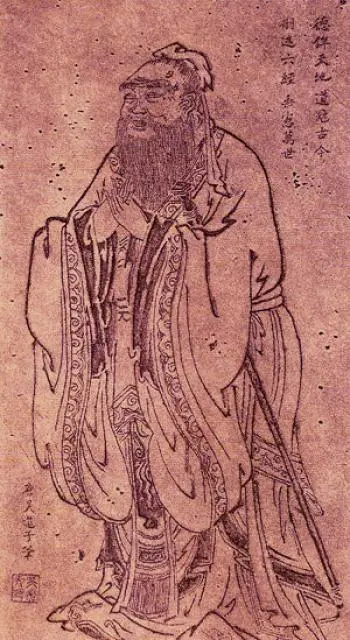
Confucius: The Philosopher Who Asked How Human Beings Can Build a Good Life by Becoming Good People
Confucius lived in an age of political disorder and asked a deceptively simple question: if families, governments, and societies are made of human relationships, can a broken society be repaired by teaching people how to become better human beings?
WHO WAS CONFUCIUS?
Confucius, known in Chinese as Kongzi or Kong Fuzi, was born around 551 BCE in the state of Lu, in ancient China, and died around 479 BCE.
His personal name was Kong Qiu.
He was born during the Spring and Autumn period, a time when the political order associated with the Zhou dynasty was weakening.
Confucius did not come from the highest level of aristocratic society.
His family had some connection to the old ruling class, but by his lifetime the family had lost much of its earlier status.
This mattered.
Confucius lived in a world where inherited social roles were becoming unstable.
He became a teacher, scholar, political adviser, and philosopher.
He is traditionally said to have held several government positions in Lu, although the historical details of his career are uncertain.
Later tradition portrays him as a teacher who attracted many students and eventually became one of the most influential thinkers in Chinese history.
But Confucius did not think of himself as creating an entirely new philosophy.
He saw himself as recovering and transmitting the wisdom of an older civilization.
His concern was not:
“How can I invent a new world?”
It was:
“How can human beings recover the moral qualities that make a good society possible?”
THE WORLD CONFUCIUS INHERITED
Confucius lived during a period of political fragmentation.
The old Zhou political order was weakening.
Powerful states competed with one another.
Rulers fought wars.
Aristocratic families struggled for influence.
Traditional political and social relationships were becoming unstable.
The old rituals and customs still existed, but their authority was weakening.
This produced a fundamental problem.
If political institutions are collapsing, what holds society together?
Is it military force?
Fear?
Punishment?
Economic power?
Or something deeper?
Confucius increasingly answered:
moral character.
THE PROBLEM OF SOCIAL DISORDER
Confucius saw political disorder as more than a political problem.
A government can write laws.
A ruler can create punishments.
An army can enforce obedience.
But none of these automatically make people morally good.
A society may be orderly because people are afraid.
Confucius wanted something better.
He wanted people to behave well because they understood:
duty,
respect,
responsibility,
self-discipline,
and the proper way to treat others.
This leads to one of his central ideas:
A good society begins with good human relationships.
THE PHILOSOPHICAL WORLD BEFORE CONFUCIUS
Confucius inherited an ancient Chinese cultural tradition centered on:
ritual,
ancestral practices,
social roles,
political hierarchy,
and the moral authority of the Zhou tradition.
He lived before many later Chinese philosophical schools had fully developed.
The famous intellectual competition among:
Confucians,
Daoists,
Mohists,
Legalists,
and others
would become especially prominent after his lifetime.
Confucius therefore stands near the beginning of what later became known as the Hundred Schools of Thought.
His philosophy developed around a fundamental tension:
How can traditional social order survive while still producing genuinely moral human beings?
CONFUCIUS’S CENTRAL QUESTION
Confucius’s philosophy can be organized around one question:
How should human beings live together?
But this immediately becomes several questions:
What makes someone a good person?
How should parents and children treat each other?
What makes a ruler legitimate?
Can government create morality through punishment?
What is the role of education?
Why do rituals matter?
How should we behave toward people who depend upon us?
Can society become harmonious without forcing everyone to become identical?
For Confucius, ethics begins in relationships.
THE HUMAN BEING AS A RELATIONAL BEING
One of Confucius’s most important assumptions is that human beings do not exist as isolated individuals.
We are:
children,
parents,
siblings,
friends,
students,
teachers,
citizens,
leaders,
neighbors.
Our character develops through these relationships.
This means that becoming a good person is not simply a private psychological project.
You become a better person through learning how to behave toward others.
Confucius therefore places relationships at the center of ethics.
REN: HUMANENESS
The central virtue in Confucian philosophy is often translated as:
ren
It can mean:
humaneness,
benevolence,
compassion,
human-heartedness,
or simply becoming fully human.
But ren is difficult to translate into one English word.
It is not merely:
“Be nice.”
It is a deeper quality of character.
A person with ren genuinely recognizes the humanity of others.
They do not treat relationships merely as opportunities for personal advantage.
They develop a moral sensitivity to how their actions affect others.
WHAT DOES REN LOOK LIKE?
Imagine someone has power over you.
They could humiliate you.
They could exploit you.
They could ignore you.
But instead they consider your dignity and circumstances.
That is closer to ren.
Ren is not weakness.
A good ruler may need to make difficult decisions.
A good parent may need to discipline a child.
A good teacher may need to correct a student.
The question is:
Are these actions guided by genuine concern for human flourishing?
THE GOLDEN RULE
Confucius is associated with a powerful principle:
“Do not impose on others what you yourself do not desire.”
This resembles what is sometimes called the Golden Rule.
The basic idea is:
Before acting toward another person, imagine yourself in their position.
Would you want to be treated this way?
This is not a complete moral theory by itself.
But it captures something central to Confucian ethics:
Moral understanding requires learning to see beyond your own immediate perspective.
LI: RITUAL AND PROPER CONDUCT
Another central Confucian concept is li.
Li is often translated as:
ritual,
ritual propriety,
custom,
ceremony,
or proper conduct.
But li is much broader than religious ritual.
It includes the patterns of behavior that make social life orderly and meaningful.
How do you greet someone?
How do you speak to your parents?
How do you behave during a ceremony?
How should a ruler address subjects?
How should a teacher behave toward students?
How should people mourn the dead?
These actions may appear small.
Confucius thinks they matter enormously.
WHY DO RITUALS MATTER?
Imagine a society where everyone says:
“I know morality in my heart, so I do not need manners.”
Confucius would disagree.
Good intentions are unstable.
People become angry.
They become selfish.
They misunderstand one another.
Ritual gives moral character a form.
It teaches people how to express:
respect,
restraint,
gratitude,
and responsibility.
Ritual is therefore not merely external decoration.
It is a form of moral education.
THE BODY TRAINS THE MIND
Confucius recognizes something psychologically important.
We often become a certain kind of person by repeatedly acting in certain ways.
If you practice patience, patience becomes easier.
If you practice respect, respect becomes habitual.
If you practice selfishness, selfishness becomes easier too.
Ritual therefore trains character.
This makes Confucianism strongly connected to the idea of moral habit.
You do not become virtuous by understanding virtue once.
You become virtuous through practice.
THE JUNZI: THE EXEMPLARY PERSON
Confucius’s ideal human being is often called the junzi.
The term originally referred to someone of noble birth.
Confucius transformed its moral meaning.
The truly noble person is not simply someone born into a powerful family.
The noble person is someone who has developed:
character,
self-discipline,
wisdom,
responsibility,
and moral seriousness.
This is a major shift.
Moral nobility can be cultivated.
Birth does not guarantee virtue.
THE JUNZI VS. THE SMALL PERSON
Confucian texts contrast the junzi with the xiaoren, often translated as the “small person.”
The small person is guided mainly by:
personal advantage,
immediate desire,
status,
and short-term gain.
The junzi asks:
What is right?
The small person asks:
What benefits me?
This distinction is not about social class alone.
A poor person can be a junzi.
A king can be a small person.
Moral worth depends on character.
SELF-CULTIVATION
Confucius does not think virtue appears automatically.
Human beings must cultivate themselves.
This requires:
study,
reflection,
practice,
discipline,
observation,
and correction.
Education is therefore not simply about passing exams.
It is about becoming a certain kind of person.
A truly educated person should become:
more thoughtful,
more responsible,
more humane,
and more capable of governing themselves.
CONFUCIUS AND EDUCATION
Confucius is famous for treating education as something that should be widely available.
Tradition portrays him as teaching students from different social backgrounds.
This challenged the assumption that moral and intellectual development belonged only to hereditary elites.
Confucius believed that people could improve through education.
But education for him was not merely accumulation of information.
Knowledge without moral transformation is incomplete.
LEARNING AND REFLECTION
Confucius famously emphasizes the relationship between learning and thinking.
If you only learn without reflecting, your knowledge remains shallow.
If you only think without learning, your thinking can become unreliable.
This is an important intellectual principle.
Education requires both:
receiving knowledge
and
actively thinking about it.
This remains relevant to modern education.
Memorization alone does not produce wisdom.
But independent thinking without knowledge can also become empty speculation.
XIAO: FILIAL PIETY
One of the most famous Confucian concepts is xiao, usually translated as filial piety.
It means respecting and caring for one’s parents and elders.
But it is not simply:
“Obey your parents.”
The deeper idea is that family relationships create moral responsibilities.
Parents raise children.
Children therefore have obligations toward parents.
Families become the first school of morality.
A child learns:
gratitude,
respect,
responsibility,
patience,
and care
through family life.
WHY FAMILY MATTERS SO MUCH
Confucius sees society as extending outward from relationships.
A person learns to care for family.
That care expands into relationships with others.
The family therefore becomes a training ground for moral life.
This leads to an important Confucian idea:
If people cannot behave responsibly toward those closest to them, why should we expect them to behave responsibly toward strangers?
THE DANGER OF FILIAL OBEDIENCE
But this creates a serious problem.
What if parents are wrong?
What if a ruler is unjust?
What if tradition itself is harmful?
Confucianism does not simply say:
“Obey authority no matter what.”
The tradition contains ideas about correcting one’s parents respectfully and advising rulers.
The ideal relationship is therefore not blind obedience.
It is:
loyalty combined with moral responsibility.
This distinction becomes crucial.
ZHENGMING: RECTIFICATION OF NAMES
One of Confucius’s most politically important ideas is often translated as:
the rectification of names.
The basic idea is:
Words and social roles should correspond to reality.
If someone is called a ruler, they should behave like a ruler.
If someone is called a parent, they should behave like a parent.
If someone is called a teacher, they should behave like a teacher.
Titles alone do not create virtue.
WHY NAMES MATTER
Imagine a government calling itself:
“the people’s government.”
But it systematically ignores its people.
The name says one thing.
The reality says another.
Confucius would see a serious disorder here.
Language matters because social roles carry expectations.
A ruler who does not act like a ruler undermines the meaning of rulership itself.
Thus political reform begins partly with restoring the connection between:
words
and
conduct.
THE IDEAL RULER
Confucius did not believe the best ruler is simply the most powerful ruler.
The ideal ruler governs through virtue.
Why?
Because people imitate those above them.
If rulers are:
greedy,
violent,
corrupt,
and obsessed with personal gain,
those values spread downward.
If rulers demonstrate:
justice,
self-control,
responsibility,
and humanity,
they create a moral example.
Government therefore has an educational function.
VIRTUE VS. PUNISHMENT
Confucius contrasts governing through moral example with governing primarily through punishment.
A society based mainly on punishment can make people afraid of being caught.
But fear is not the same as morality.
If people obey only because they fear punishment, they may remain morally unchanged.
Confucius wants something deeper:
People should develop an internal sense of shame and responsibility.
Then they behave properly even when nobody is watching.
AN EVERYDAY EXAMPLE
Imagine two students.
The first cheats because they know the teacher cannot see them.
The second refuses to cheat even when nobody would discover it.
The first is controlled by external punishment.
The second has internalized a moral principle.
Confucius prefers the second.
The goal of moral education is therefore not simply:
obedience.
It is:
self-government.
THE POLITICAL EXTENSION
This produces a chain:
Good individuals
↓
good families
↓
good communities
↓
good government
↓
social harmony
Confucius therefore does not separate personal ethics from political philosophy.
Political reform begins with character.
HARMONY
Confucian political philosophy often emphasizes harmony.
But harmony does not mean everyone thinks the same.
Real harmony can exist alongside difference.
Think of music.
Different notes can create harmony precisely because they are different.
Likewise, society requires different roles and perspectives.
The goal is not uniformity.
It is:
ordered cooperation among differences.
CONFUCIUS AND SOCIAL HIERARCHY
Confucius accepts that society contains different roles.
There are:
parents and children,
rulers and subjects,
teachers and students,
older and younger,
friends and peers.
This makes his philosophy hierarchical in important ways.
But hierarchy creates reciprocal obligations.
If a ruler demands loyalty, the ruler also has duties.
If a parent expects respect, the parent must act responsibly.
If a teacher expects discipline, the teacher must teach well.
Status therefore creates responsibility.
THE FIVE RELATIONSHIPS
Later Confucian tradition systematized several major relationships:
ruler and subject
father and son
older brother and younger brother
husband and wife
friend and friend
The first four are more hierarchical.
Friendship is more reciprocal.
The point is not merely that everyone has a role.
The point is that every relationship carries moral obligations.
CONFUCIUS ON FRIENDSHIP
Friendship is especially important because it is less dependent on formal hierarchy.
A good friend should help you become better.
Confucius values companions who:
tell you the truth,
correct your mistakes,
encourage virtue,
and prevent you from becoming morally careless.
This creates a beautiful idea:
A true friend is not merely someone who makes you feel good.
A true friend helps you become better.
CONFUCIUS AND HUMAN NATURE
Confucius does not give us a systematic theory of human nature in the way later philosophers do.
He is more interested in moral cultivation.
But his philosophy assumes something important:
human beings are capable of moral development.
People are not fixed.
Through education, habit, relationships, and reflection, people can become better.
This makes Confucianism fundamentally optimistic about human cultivation.
CONFUCIUS AND MENGZI
A later Confucian philosopher, Mencius, developed this idea more explicitly.
Mencius argued that human beings possess natural moral tendencies.
For example, he uses the famous example of seeing a child about to fall into a well.
A normal person would spontaneously feel alarm and compassion.
This suggests that moral potential is already present within human beings.
Confucius himself is less explicit, but his emphasis on education and cultivation creates the foundation for this later development.
CONFUCIUS AND XUNZI
Another later Confucian philosopher, Xunzi, took a very different view.
He argued that human desires naturally lead toward conflict and disorder.
Therefore people require:
education,
ritual,
discipline,
and social institutions
to become morally cultivated.
This creates an important debate within Confucianism:
Are human beings naturally good, or do they become good through disciplined cultivation?
Confucius leaves enough ambiguity for both interpretations to develop.
CONFUCIUS AND DAOISM
Confucianism later entered a major philosophical tension with Daoism.
Daoist thinkers such as Laozi and Zhuangzi often questioned excessive social rules and artificial conventions.
Confucianism emphasizes:
ritual,
education,
social responsibility,
and cultivated roles.
Daoism often emphasizes:
simplicity,
naturalness,
spontaneity,
and freedom from excessive social control.
The contrast is fascinating.
Confucius asks: How can we cultivate ourselves so society becomes humane?
Daoism asks: What if our attempts to control and improve society create the disorder themselves?
Neither question is trivial.
CONFUCIUS AND LEGALISM
The contrast with Legalism is even sharper.
Legalist thinkers emphasized:
strict laws,
rewards,
punishments,
and centralized state power.
Confucius believes political order should arise primarily from moral cultivation.
The Legalist approach asks:
How can we make people obey?
Confucius asks:
How can we make people become the kind of people who do not need constant coercion?
This is one of the deepest differences between the traditions.
CONFUCIUS AND SOCRATES
Confucius and Socrates lived in roughly the same broad historical era, though in very different civilizations.
Both made moral self-cultivation central.
Socrates asks:
How should we live?
Confucius asks:
How should we become the kind of people who can live well together?
Socrates often challenges people through questioning.
Confucius emphasizes:
learning,
practice,
ritual,
relationships,
and moral example.
Both reject the idea that wealth and status automatically make someone good.
CONFUCIUS AND ARISTOTLE
Confucius also has striking similarities with Aristotle.
Both reject the idea that ethics is simply about following isolated rules.
Both emphasize:
character,
habit,
education,
community,
and the formation of good people.
Aristotle asks:
What kind of character allows human beings to flourish?
Confucius asks:
What kind of character allows human relationships and society to flourish?
But Confucius places much greater emphasis on:
family,
ritual,
social roles,
and inherited cultural practices.
CONFUCIUS AND KANT
Kant emphasizes universal moral principles and individual autonomy.
Confucius emphasizes relationships, roles, traditions, and cultivated character.
Kant asks:
What principle could everyone rationally accept?
Confucius asks:
What does this relationship require from a good person?
This creates a fascinating contrast.
Kant’s morality begins from the rational individual.
Confucian morality begins from the person already embedded in relationships.
One emphasizes universal duty.
The other emphasizes relational responsibility.
CONFUCIUS AND MARX
Confucius believes social disorder begins partly with moral failure.
Marx would ask whether social structures produce that failure.
Confucius says:
Cultivate better people.
Marx might respond:
Change the material structures that shape people’s behavior.
This is an important disagreement.
A corrupt society may not be fixed simply by teaching people to be virtuous.
But Marx’s structural analysis may also underestimate the importance of personal character.
A society needs both:
good institutions
and
people capable of using them responsibly.
CONFUCIUS IN EVERYDAY LIFE
Confucian philosophy becomes surprisingly practical.
When speaking to your parents:
Are you showing respect?
When managing employees:
Are you using authority responsibly?
When teaching:
Are you helping students become better people?
When governing:
Are you setting a moral example?
When making friends:
Do your friendships make you better or worse?
When entering a professional role:
Are you actually behaving according to what that role requires?
Confucius turns ordinary relationships into moral questions.
CONFUCIUS AND WORK
For Confucius, good work is not simply about income.
A person’s work can be an expression of responsibility.
A teacher should teach well.
A parent should parent well.
A ruler should rule responsibly.
A student should study seriously.
The important question is:
Are you fulfilling your role with integrity?
This is the idea behind rectification of names.
Your title means little if your behavior contradicts it.
CONFUCIUS AND LEADERSHIP
Confucius offers a very different model of leadership from the idea that leadership is mainly:
power,
charisma,
or strategic manipulation.
A leader should become an example.
If the leader is disciplined, others become more disciplined.
If the leader is corrupt, corruption spreads.
Leadership therefore begins with self-government.
Before trying to control others, learn to control yourself.
CONFUCIUS AND MODERN EDUCATION
Confucius remains highly relevant to education.
Modern education often measures:
grades,
test scores,
certificates,
rankings,
and employability.
Confucius would ask:
What kind of person is the student becoming?
Are they:
honest?
responsible?
respectful?
thoughtful?
capable of self-reflection?
capable of contributing to society?
Education that produces highly skilled but morally irresponsible people would be incomplete from a Confucian perspective.
CONFUCIUS AND AI
Confucius never imagined artificial intelligence.
But his philosophy creates useful questions for AI-driven societies.
If AI becomes a major teacher, manager, or adviser, what kind of human relationships should remain human?
If algorithms reward certain behaviors, what happens to moral cultivation?
If education becomes automated, can technology teach virtue, or can it only transmit information?
And if governments use AI to enforce social order, Confucius would force us to ask:
Does social harmony come from moral cultivation or simply from surveillance and fear?
This returns us to his old distinction:
order through coercion
versus
order through character.
THE HUMAN SIDE OF CONFUCIUS
Confucius was not simply a distant moral theorist.
Tradition portrays him as deeply committed to teaching.
He was patient with students but demanding.
He valued learning.
He respected ancient traditions while also interpreting them rather than simply copying them.
He was politically ambitious enough to want government to embody moral principles.
But he also experienced disappointment.
He did not achieve the political transformation he hoped for during his lifetime.
This is important.
Confucius was not writing from a position of political victory.
He was trying to explain how society could become better while living in a world where rulers often ignored moral advice.
THE PARADOX OF CONFUCIUS
There is an interesting tension in his philosophy.
Confucius wants to preserve tradition.
But he also wants moral improvement.
Tradition can teach wisdom.
But tradition can also preserve injustice.
Respect for elders can create stability.
But excessive obedience can prevent criticism.
Social roles can create responsibility.
But rigid hierarchy can create domination.
Ritual can cultivate respect.
But empty ritual can become hypocrisy.
This is one of the central questions within Confucianism:
When does tradition cultivate virtue, and when does tradition merely preserve power?
CRITICISM: TOO MUCH HIERARCHY
One major criticism of Confucianism is its emphasis on hierarchy.
Traditional Confucian societies often placed strong expectations on:
children,
women,
subjects,
and younger people.
This could reinforce patriarchal structures.
Critics argue that respect for social roles can become a justification for inequality.
The Confucian response would be that hierarchy must be reciprocal.
A ruler who demands loyalty but behaves unjustly is failing in the role of ruler.
A father who demands respect but abuses his authority is failing in the role of father.
But critics can still ask:
Why should these hierarchical roles exist in the first place?
Confucius does not provide a completely satisfying answer by modern standards.
CRITICISM: TOO MUCH CONFORMITY
Another criticism is that Confucianism can encourage conformity.
If everyone is expected to behave according to social roles, where is room for individuality?
What happens to:
rebellion,
creativity,
personal identity,
and unconventional lives?
Confucianism’s answer is that genuine virtue is not blind conformity.
A good person must understand the moral purpose behind a role.
But the danger remains.
A society can confuse:
social harmony
with
social obedience.
That is a real problem for Confucian political thought.
CRITICISM: CAN PERSONAL VIRTUE FIX STRUCTURAL PROBLEMS?
Marx provides a powerful challenge.
Suppose a society has:
extreme inequality,
corrupt institutions,
economic exploitation,
and concentrated political power.
Can teaching people to be more virtuous solve the problem?
Perhaps not.
Good people can exist inside bad institutions.
And bad institutions can encourage good people to behave badly.
Confucianism therefore risks placing too much responsibility on individual character.
Yet the opposite danger also exists.
Institutions are operated by people.
A perfectly designed institution can still fail when those controlling it lack integrity.
The strongest position may therefore require both:
institutional reform
and
moral cultivation.
WHAT CONFUCIUS GOT RIGHT
Confucius identified several enduring truths.
Character matters.
Institutions cannot function well if the people operating them have no integrity.
Education should form people, not merely inform them.
Relationships carry moral responsibilities.
Leadership begins with self-discipline.
People learn morality through practice and habit.
Traditions can preserve accumulated wisdom.
Good government cannot rely only on punishment.
Respect should be reciprocal.
A society’s moral condition is reflected in the behavior of its leaders.
Friendship should help us become better people.
These ideas remain powerful thousands of years later.
WHAT CONFUCIUS GOT WRONG OR LEFT OPEN
Confucius places great faith in social hierarchy.
That can conflict with modern ideas of equality.
His philosophy can sometimes romanticize tradition.
Traditions are not always wise.
Some traditions preserve oppression.
His emphasis on harmony can also become dangerous if harmony means avoiding necessary conflict.
Sometimes society needs disagreement.
Sometimes a person must refuse to play their assigned role.
Sometimes justice requires disruption.
Confucius gives us strong tools for understanding social responsibility.
But he gives less guidance about when rebellion becomes morally necessary.
CONFUCIUS’S GREAT ACHIEVEMENT
Confucius transformed ethics into a philosophy of relationship and cultivation.
He did not begin with an abstract question such as:
“What is the fundamental substance of reality?”
He began with ordinary human life.
How do you treat your parents?
How do you behave toward friends?
How should teachers teach?
How should rulers rule?
How should people behave when nobody is forcing them?
His insight was profound:
Society is not an abstract machine.
It is built from millions of relationships.
If those relationships are corrupted, laws alone cannot save society.
But if people develop:
respect,
discipline,
compassion,
wisdom,
and responsibility,
social order becomes possible.
CONFUCIUS’S PHILOSOPHY IN SIMPLE WORDS
Become a better person before demanding a better society.
Character is built through practice, education, and self-discipline.
Human beings are shaped by their relationships.
Respect others, especially those with whom you have responsibilities.
Do not impose on others what you would not want for yourself.
A good ruler leads through moral example, not fear alone.
Rituals and habits can train moral character.
Education should create wisdom and virtue, not just knowledge.
Social roles create responsibilities, not merely privileges.
Harmony does not require everyone to be identical.
Tradition deserves respect, but tradition must serve human flourishing.
The quality of a society depends partly on the quality of its relationships.
THE FINAL QUESTION
Confucius looked at a world falling into political disorder.
His answer was not revolution.
It was not unlimited individual freedom.
It was not stronger punishment.
He turned instead toward the human being.
Become humane.
Learn.
Practice self-discipline.
Respect your relationships.
Fulfill your responsibilities.
Lead by example.
He believed that the path from the individual to the political world runs through moral cultivation:
self → family → community → government → society.
But his philosophy leaves us with an unresolved tension.
What happens when the traditions and social roles that are supposed to create harmony become themselves unjust?
When should we respect tradition?
When should we reform it?
When should we obey authority?
When should we resist it?
Confucius teaches us that society cannot be healthy without responsible human beings.
But modern history reminds us of the other side:
Good people also need good institutions.
Perhaps that is where Confucius remains most valuable.
He reminds us that no political system, technological system, or economic system can completely replace the work of becoming human.
A society is ultimately made of relationships, and the quality of those relationships depends on the kind of people we choose to become.