Tabula XIX
Immanuel Kant
Portrait by Johann Gottlieb Becker, 1768, born on April 22, 1724, and died on February 12, 1804, at the age of 79.
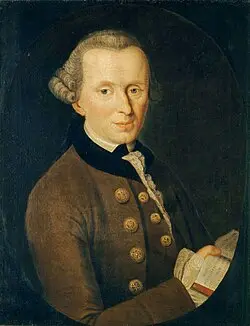
Immanuel Kant: The Philosopher Who Asked How Far Human Reason Can Go
Kant wanted to understand what human beings could know, but his search for knowledge forced him to confront the limits of reason itself. He then turned the same question toward morality: if the world does not tell us how we should live, can reason itself give us a moral law?
WHO WAS IMMANUEL KANT?
Immanuel Kant was born on April 22, 1724, in Königsberg, in East Prussia, and died in the same city on February 12, 1804.
He spent almost his entire life in and around Königsberg.
This may sound surprising.
Many great philosophers traveled widely. Kant did not.
He became famous for his extremely regular daily routine. His walks through Königsberg became so predictable that later stories claimed people could set their clocks by him.
But his intellectual world was enormous.
He studied:
philosophy,
mathematics,
physics,
logic,
metaphysics,
ethics,
geography,
natural science,
history,
religion,
and anthropology.
Kant taught at the University of Königsberg and eventually became one of the most important professors in Europe.
He never became a political revolutionary.
He did not lead armies.
He did not build a political movement.
His revolution was intellectual.
He wanted to know what human reason could legitimately claim.
And to answer that question, he had to challenge both sides of the philosophical world around him.
THE WORLD KANT INHERITED
Kant lived during the Enlightenment, a period when European thinkers increasingly questioned inherited authority.
Science was transforming the understanding of nature.
The achievements of Isaac Newton suggested that the universe could be understood through mathematical laws.
At the same time, philosophers were debating the foundations of knowledge.
Could reason discover truth by itself?
Or does all knowledge come from experience?
Religion remained enormously important.
But traditional religious authority increasingly faced criticism from science and philosophy.
Political ideas were also changing.
Thinkers were questioning:
absolute monarchy,
religious authority,
traditional social hierarchy,
and the limits of political power.
Kant’s famous demand was:
“Sapere aude”, meaning “Dare to know.”
For Kant, enlightenment meant learning to use one’s own reason instead of simply allowing others to think for you.
But this created a problem.
If reason is so powerful, what are its limits?
THE PHILOSOPHICAL WORLD BEFORE KANT
Kant inherited a major conflict between two philosophical traditions.
RATIONALISM
Thinkers such as René Descartes, Baruch Spinoza, and Gottfried Wilhelm Leibniz emphasized reason.
They believed that reason could reveal important truths about reality.
Mathematics was an obvious example.
We do not need to measure every triangle in the world to know that certain geometrical relationships hold.
Reason seems capable of discovering truths independently of particular experiences.
This encouraged rationalists to believe that metaphysics might also be established through pure reasoning.
Could reason prove:
that God exists?
that the soul is immortal?
that the universe has a beginning?
that reality has a necessary structure?
This was the ambition of rationalist metaphysics.
EMPIRICISM
Then came philosophers such as:
John Locke
George Berkeley
and especially David Hume.
They emphasized experience.
We learn about the world through our senses.
We observe.
We compare.
We remember.
We form ideas from experience.
Hume pushed this approach much further.
He questioned whether reason could justify many of the things people simply assumed were certain.
One of his most important targets was causation.
We see one event followed by another.
A ball strikes another ball.
The second ball moves.
But where do we actually see the necessary connection?
We see events occurring in sequence.
We do not literally see “necessity.”
Hume’s skepticism deeply disturbed Kant.
Kant later wrote that Hume awakened him from his “dogmatic slumber.”
The problem had become unavoidable.
If all knowledge comes from experience, how can mathematics and science contain necessary truths?
But if knowledge comes entirely from reason, how does reason connect with the actual world?
Kant wanted to find a third possibility.
KANT’S CENTRAL QUESTION
Kant’s philosophy revolves around several connected questions:
What can I know?
What should I do?
What may I hope?
What is the human being?
These questions eventually organize his philosophical system.
They correspond roughly to:
epistemology
ethics
religion and human hope
anthropology
Kant’s ambition was enormous.
He wanted to determine not only what human beings can know, but also how they should act and what kind of freedom makes morality possible.
THE INTELLECTUAL TURNING POINT
Kant’s encounter with Hume was crucial.
Hume had challenged the idea that causation could simply be read from experience.
Kant realized that something important was happening.
Perhaps the mind does not simply receive information from the world.
Perhaps the mind actively organizes experience.
This became the foundation of Kant’s mature philosophy.
Instead of asking only:
“How does the world enter the mind?”
Kant asks:
“What does the mind contribute to our experience of the world?”
This is the beginning of his famous philosophical revolution.
THE COPERNICAN REVOLUTION
Kant compared his philosophical strategy to the revolution associated with Copernicus.
Before Copernicus, people commonly imagined the heavens revolving around Earth.
Copernicus changed the perspective.
Kant proposed a similar change in epistemology.
Instead of assuming:
our knowledge must conform entirely to objects,
we should ask whether:
objects as experienced must conform partly to the structures through which our minds experience them.
This does not mean that Kant thought we invent reality.
He did not say:
“Everything exists only because I imagine it.”
His claim is more subtle.
The world exists independently of us.
But the world as we experience it is structured through the forms and concepts of human cognition.
THE PROBLEM OF KNOWLEDGE
Kant begins with a difficult observation.
Human knowledge appears to have two sources:
experience
and
reason.
Experience gives us content.
Reason and the mind provide structure.
Without experience, our concepts lack material.
Without concepts, our experiences would be unorganized.
Kant famously expresses this idea by saying:
“Thoughts without content are empty, intuitions without concepts are blind.”
The basic idea is simple.
Imagine receiving thousands of pieces of information without any way to organize them.
You would have information, but not meaningful knowledge.
Now imagine having perfect concepts but no experience of the world.
Your concepts would have nothing to apply to.
Knowledge requires both.
SENSIBILITY: HOW EXPERIENCE BEGINS
Kant argues that our mind has structures through which sensory information is received.
The two most important are:
space
and
time.
For Kant, space and time are not simply things we discover existing outside us exactly as we experience them.
They are fundamental forms through which human beings experience anything at all.
Everything we experience appears somewhere.
Everything we experience occurs at some time.
We cannot easily imagine an experience that has neither spatial nor temporal structure.
Thus space and time are conditions of human experience.
AN EXAMPLE OF SPACE AND TIME
Imagine seeing a tree.
You experience it as:
somewhere,
at a particular distance,
with a certain size,
at a particular moment.
You do not first receive a completely unstructured sensation and then decide to add space and time later.
Your experience is already spatial and temporal.
Kant argues that this structure comes from the conditions of human sensibility.
THE CATEGORIES OF THE MIND
Space and time are not enough.
The mind also organizes experience through fundamental concepts called categories.
Among them are:
unity,
plurality,
causality,
substance,
possibility,
necessity,
and others.
These concepts help turn sensory information into an intelligible world.
Consider causality.
We do not merely observe:
Event A.
Then Event B.
We understand:
A caused B.
Kant argues that causality is not simply copied from experience.
It is one of the conceptual structures through which we organize experience.
KANT AND CAUSALITY
This is Kant’s response to Hume.
Hume says:
We observe one event followed by another, but we never directly observe necessary causal connection.
Kant agrees with part of this.
We do not discover causality as a physical object.
But he argues that causality is necessary for coherent experience.
If every event could occur without any connection to anything else, the world of experience would become unintelligible.
Therefore:
The mind contributes causal structure to experience.
This does not mean causality is imaginary.
It means causality is a necessary condition for experiencing an ordered world of events.
PHENOMENA AND NOUMENA
This leads to one of Kant’s most famous distinctions.
Phenomena are things as they appear to us.
Noumena, or things-in-themselves, refer to reality considered independently of our mode of experiencing it.
This distinction is often misunderstood.
Kant does not simply say:
“The real world does not exist.”
Quite the opposite.
He insists that there is a reality independent of our experience.
But we cannot know that reality exactly as it is in itself.
We know reality as it appears under the conditions of human cognition.
THE LIMITS OF KNOWLEDGE
This is one of Kant’s most important ideas.
Human reason is powerful.
But it has boundaries.
We can know the world of possible experience.
But we cannot use theoretical reason to establish everything we might want to believe about ultimate reality.
This creates a boundary around metaphysics.
We naturally ask:
Does God exist?
Is the soul immortal?
Does the universe have a beginning?
Are we genuinely free?
These are meaningful questions.
But Kant argues that theoretical reason cannot simply solve them in the same way it solves empirical scientific questions.
WHY REASON GETS INTO TROUBLE
Human reason naturally wants completeness.
Suppose we explain one event.
Then we ask:
What caused that?
And what caused that cause?
And what caused the previous cause?
Reason keeps searching for a complete explanation.
This can lead to questions about the ultimate beginning of the universe.
But once reason tries to move beyond possible experience, it can generate apparently convincing arguments on opposite sides.
Kant calls these conflicts antinomies.
THE ANTINOMIES
Kant shows that reason can produce powerful arguments for opposing conclusions.
For example:
The universe must have had a beginning.
But another argument suggests:
The universe could not have had a beginning.
Both sides can appear rational.
What went wrong?
Kant’s answer is that reason has extended concepts beyond the domain where they can legitimately be applied.
This is a major lesson:
A logical argument can still go wrong if we use concepts outside their proper limits.
GOD, SOUL, AND FREEDOM
Kant does not simply declare:
“God does not exist.”
Nor does he say:
“The soul definitely does not exist.”
Instead, he argues that theoretical reason cannot provide the kind of proof philosophers had often tried to give.
The traditional metaphysical arguments for God’s existence have limits.
Likewise, theoretical reason cannot establish the immortality of the soul in the way we might establish a scientific fact.
And yet Kant does not abandon these ideas.
They return through another path:
practical reason.
WHAT SHOULD I DO?
This brings us from epistemology to ethics.
Kant’s ethical philosophy begins with a radically different question from:
“What will make me happy?”
He asks:
What makes an action morally right?
His answer is:
A good will.
THE GOOD WILL
Kant argues that the only thing that is good without qualification is a good will.
Intelligence can be used for evil.
Power can be used for evil.
Wealth can be used for evil.
Courage can serve criminals as well as heroes.
Even happiness does not automatically make someone morally good.
But a person who chooses to do the right thing because it is right possesses a good will.
This is central to Kant’s ethics.
MORALITY AND MOTIVATION
Suppose you help someone.
Why?
Maybe you feel sympathy.
Maybe you expect praise.
Maybe you want a favor later.
Maybe you are afraid people will judge you.
Or perhaps you help simply because you recognize:
It is your duty to help.
Kant considers the last case morally important.
The moral worth of an action is connected to the principle and motivation behind it, not merely its outcome.
This does not mean emotions are bad.
It means morality cannot depend entirely on changing emotions.
DUTY
For Kant, morality involves acting from duty.
Imagine you promise to repay a debt.
You could keep the promise because you are afraid of punishment.
Or because you want to maintain your reputation.
Or because you genuinely believe keeping promises is morally required.
The outward action is the same.
But the moral motivation differs.
Kant cares deeply about this distinction.
Doing the right thing and doing the right thing for the right reason are not identical.
THE CATEGORICAL IMPERATIVE
Kant’s most famous ethical principle is the categorical imperative.
One formulation is:
Act only according to a maxim that you could at the same time will to become a universal law.
The language sounds difficult.
The idea is simpler.
Before acting, ask:
What if everyone followed the rule I am using?
THE LYING PROMISE
Imagine you need money.
You make a false promise that you will repay it.
You know you will not.
Kant asks:
Could you consistently will that everyone use false promises whenever convenient?
If everyone did this, promises would stop functioning.
The institution of promising would collapse.
Your own action depends on a system of trust that your rule would undermine.
Therefore the maxim cannot be universalized consistently.
The problem is not simply:
“Someone might get hurt.”
The deeper problem is:
The rule destroys the very practice it depends upon.
UNIVERSAL LAW
Kant wants morality to be independent of personal preference.
If something is morally wrong for another person, it should not suddenly become morally right when I do it.
Morality must therefore have a universal structure.
This is why Kant’s ethics is very different from:
“Do whatever makes you happy.”
Or:
“Do whatever produces the best result.”
His question is:
Could the principle behind my action be a law for everyone?
THE SECOND FORMULATION: HUMAN DIGNITY
Kant gives another famous formulation:
Treat humanity, whether in yourself or in another person, always as an end and never merely as a means.
This is one of the most influential ideas in modern ethics.
What does it mean?
Suppose you lie to someone to get money.
You are using them.
You are treating them merely as a tool for your goal.
But people are not objects.
They have their own purposes.
Their own choices.
Their own dignity.
Therefore moral action requires respecting their capacity for rational self-direction.
PEOPLE ARE NOT TOOLS
Consider manipulation.
You flatter someone only because you want something from them.
You deceive someone because their ignorance benefits you.
You exploit a worker because you do not care about their humanity.
You use another person’s trust entirely for your own advantage.
Kant would say the problem is not simply that the action produces bad consequences.
The deeper problem is:
You have treated another rational person merely as an instrument.
This principle became enormously influential in later ideas of:
human rights,
autonomy,
dignity,
consent,
and moral equality.
AUTONOMY
Kant’s idea of morality is deeply connected to autonomy.
Autonomy literally means self-government.
A morally autonomous person does not simply obey:
society,
tradition,
authority,
fear,
or desire.
They use reason to determine principles for themselves.
This is why Kant connects enlightenment with intellectual independence.
To be mature is to become capable of thinking for yourself.
FREEDOM
Here Kant reaches one of his deepest problems.
If the natural world operates according to causal laws, are human beings genuinely free?
Physics tells us that events have causes.
If human actions are events in nature, perhaps our actions also have causes.
Then what does freedom mean?
Kant’s answer is subtle.
Freedom does not mean:
being completely outside causality.
Instead, moral freedom means being capable of acting according to rational principles that we give ourselves.
A person ruled entirely by impulse is not fully autonomous.
A person capable of governing themselves through reason is closer to genuine freedom.
DESIRE VS. AUTONOMY
Imagine someone wants to become healthier.
They know they should exercise.
But every evening they choose to remain on the couch.
Are they free?
In one sense, yes.
But Kant would ask whether they are actually governing themselves.
If their behavior is completely controlled by immediate desire, they are not exercising the highest form of autonomy.
Freedom is not simply:
“I can do whatever I want.”
It is:
“I can govern my choices according to rational principles.”
KANT AND HAPPINESS
Kant does not say happiness is worthless.
But he refuses to make happiness the foundation of morality.
Why?
Because happiness differs from person to person.
One person wants wealth.
Another wants knowledge.
Another wants family.
Another wants fame.
Another wants peace.
If morality depends entirely on happiness, moral rules become unstable.
Kant therefore separates:
what makes us happy
from
what makes us morally worthy.
A good action may produce suffering.
A bad action may produce pleasure.
Therefore morality cannot simply mean:
maximize pleasure.
KANT AND UTILITARIANISM
Kant’s ethics sharply contrasts with later utilitarian thinkers such as Jeremy Bentham and John Stuart Mill.
Utilitarianism asks:
Which action produces the best overall consequences?
Kant asks:
Is the action itself consistent with a universal moral principle and respect for persons?
Imagine lying to one person to prevent a larger disaster.
A utilitarian may say:
“If the lie produces the best outcome, it is justified.”
Kant’s approach is much more restrictive.
The morality of an action cannot be determined only by its consequences.
This disagreement remains alive today.
THE PROBLEM OF KANT’S STRICTNESS
Kant’s ethical system creates difficult cases.
The most famous involves lying.
Suppose a murderer asks whether an innocent person is hiding in your house.
Should you lie?
Kant’s strict commitment to universal moral law creates a difficult problem.
If lying is always wrong, even lying to protect an innocent person seems morally forbidden.
Many philosophers think this shows that Kant’s system is too rigid.
Others argue that the example reveals the danger of treating moral rules as simple formulas.
Either way, the problem is serious.
KANT AND RELIGION
Kant was deeply shaped by Christianity and Protestant religious culture.
But he believed religion should be understood through morality rather than used as a substitute for moral reasoning.
He famously argued that morality does not need to wait for religious authority to tell us what is right.
Human reason can recognize moral duties.
Religion can then be connected to moral hope.
This is a major shift.
Instead of:
God commands it, therefore it is moral.
Kant moves toward:
Reason recognizes moral obligation, and religious faith can help us understand the ultimate meaning of that moral life.
THE POSTULATES OF PRACTICAL REASON
Kant argues that practical reason leads us toward ideas that cannot be theoretically proven in the ordinary way.
These include:
freedom
God
and
immortality.
Why?
Because morality seems to require freedom.
And the moral ideal of a complete union between virtue and ultimate happiness raises questions that human experience does not fully resolve.
Kant therefore gives these ideas a role within practical reason.
He is not proving them like mathematical theorems.
He is showing why they become important from the standpoint of moral life.
“I HAD TO ABOLISH KNOWLEDGE…”
Kant famously writes that he had to “deny knowledge” in order to make room for faith.
The point is often misunderstood.
He does not mean:
“Stop believing in knowledge.”
He means:
We must recognize the limits of theoretical knowledge so that questions of faith and morality are not falsely presented as scientific proofs.
Faith becomes intellectually more honest when it stops pretending to be empirical science.
KANT AND ENLIGHTENMENT
Kant’s essay “What Is Enlightenment?” gives one of his clearest political and intellectual messages.
His answer is:
Dare to use your own reason.
People remain intellectually immature when they allow:
priests,
governments,
teachers,
traditions,
or authorities
to think for them completely.
Enlightenment requires intellectual courage.
But Kant does not simply call for rebellion against all authority.
He distinguishes between private and public uses of reason.
A functioning society may require people to perform roles.
But as thinkers and citizens, people must be able to publicly discuss and criticize ideas.
KANT AND POLITICAL PHILOSOPHY
Kant believed political life should respect human freedom and rational autonomy.
He defended:
the rule of law,
republican government,
civil freedom,
and international peace.
His political philosophy is connected to his moral philosophy.
If every human being has dignity, then political institutions cannot treat people merely as instruments.
If human beings are autonomous, political authority needs justification.
PERPETUAL PEACE
Kant’s essay Perpetual Peace imagines conditions under which international war might gradually be reduced.
He argues for ideas including:
republican constitutional government,
international cooperation,
and a system of law between states.
He believed peace could not simply depend on rulers becoming morally perfect.
Institutions had to make peace more rational and war more costly.
This is an important continuation of his broader philosophy:
Good political structures should not depend entirely on good individuals.
KANT AND HUMAN DIGNITY TODAY
Few Kantian ideas have had greater influence than human dignity.
The idea that people possess inherent worth and should not be treated merely as tools appears throughout modern moral and political thought.
It influences discussions about:
human rights,
medical ethics,
law,
consent,
privacy,
political freedom,
and technology.
When we say:
“A person has rights even when violating those rights would benefit everyone else,”
we are moving in a strongly Kantian direction.
KANT AND AI
Kant’s philosophy becomes especially interesting when applied carefully to artificial intelligence.
Suppose an AI system makes decisions about:
employment,
credit,
education,
insurance,
or criminal justice.
Kant would force us to ask:
Are people being treated as persons or merely as data points?
Are their choices respected?
Are they being manipulated?
Are they given meaningful reasons for decisions?
Are human beings being reduced to instruments for institutional goals?
This does not mean Kant directly predicted AI.
He did not.
But his principle of human dignity gives us a powerful framework for thinking about technological power.
KANT AND EVERYDAY LIFE
Kant’s philosophy becomes practical when we ask simple questions.
Should I lie when lying benefits me?
Should I keep a promise when breaking it would be convenient?
Should I manipulate someone to get what I want?
Should I treat an employee merely as a resource?
Should I respect someone’s decision even when I strongly disagree?
Should I act morally when nobody will ever know?
Kant’s answer is demanding:
Your moral duty does not disappear simply because there is no punishment.
The test is not:
“Can I get away with it?”
It is:
“Could the principle behind my action be a universal law?”
THE HUMAN SIDE OF KANT
Kant’s life was unusually disciplined.
He lived simply.
He remained largely within Königsberg.
He followed a remarkably regular daily schedule.
He valued conversation and intellectual exchange.
He never married.
He became increasingly famous but remained devoted to philosophical work.
His disciplined lifestyle has often been turned into a humorous image of the philosopher who lived like a clock.
But there is something philosophically interesting here.
Kant believed that human beings should govern themselves through rational principles.
His own life was famously organized around routines and self-discipline.
In that sense, his life reflected one of his central ideas:
freedom is not simply the absence of rules.
Sometimes freedom requires giving oneself rational rules.
THE CONTRADICTIONS IN KANT
Kant’s philosophy contains serious tensions.
He defends universal human dignity, yet some of his writings contain racial and hierarchical claims that are deeply inconsistent with the universalism of his moral philosophy.
This is an important contradiction and should not be ignored.
His ethics emphasizes universal moral equality.
But parts of his anthropology reflect eighteenth-century European ideas about race that modern evidence and moral reasoning reject.
There is also tension between his strict moral rules and difficult real-world cases.
His theory of knowledge limits metaphysical claims.
Yet he still gives metaphysical ideas an important role in practical reason.
He celebrates autonomy.
But his own ethical system imposes universal obligations that individuals cannot simply choose to reject.
These tensions are not minor.
They are part of the reason Kant remains a philosopher to argue with rather than simply admire.
CRITICISM: KANT’S ETHICS IS TOO RIGID
Critics argue that Kant focuses too heavily on rules.
Real life contains situations where every available choice may violate some principle.
What should we do when:
lying saves a life,
breaking a promise prevents catastrophe,
or violating one person’s rights prevents enormous suffering?
Consequentialists argue that outcomes matter.
Virtue ethicists argue that moral character matters.
Care ethicists argue that relationships and vulnerability matter.
Kant’s framework can struggle when these considerations conflict with strict universal rules.
CRITICISM: THE CATEGORICAL IMPERATIVE
Another problem is that universalization can be difficult to apply.
Different descriptions of the same action can produce different “maxims.”
For example:
“I may lie when it benefits me.”
is different from:
“I may lie to prevent unjust violence.”
Which maxim should we test?
Kant’s system gives us a powerful question.
But applying the question requires judgment.
The formula alone cannot always do the work.
CRITICISM: KANT’S THEORY OF KNOWLEDGE
Kant’s distinction between phenomena and noumena also creates difficulties.
If we cannot know things-in-themselves, how can we meaningfully say that they exist?
If causality applies to objects of experience, can we meaningfully speak about what lies beyond experience?
Kant’s answer is subtle, but the tension remains.
He wants to affirm an independent reality while also denying that theoretical reason can know it directly.
Later philosophers, especially Hegel, would challenge this boundary.
KANT AND HEGEL
Hegel believed Kant had made a crucial discovery but stopped too early.
Kant emphasizes the structures through which the mind knows reality.
Hegel asks:
Can we really separate thought from reality so sharply?
For Hegel, the categories of thought develop historically and dialectically.
Kant’s philosophy therefore becomes one of the starting points for German Idealism.
The chain is enormous:
Kant → Fichte → Schelling → Hegel
And later:
Kant → Schopenhauer → Nietzsche
His influence reaches into almost every major movement of nineteenth-century European philosophy.
KANT AND NIETZSCHE
Nietzsche strongly challenged Kant’s moral universalism.
Kant believes morality requires universal principles.
Nietzsche asks:
Who created these moral values, and what kind of life do they produce?
Kant sees universal duty as a foundation of dignity.
Nietzsche worries that universal moral rules can suppress individuality, strength, creativity, and the affirmation of life.
Kant asks:
What can reason universally require of every human being?
Nietzsche asks:
What happens when we question the authority of universal moral requirements themselves?
Their disagreement reaches one of the deepest questions in ethics:
Is morality discovered by reason, or created through human history and culture?
KANT AND MARX
Kant emphasizes the autonomy and dignity of the individual.
Marx later asks whether formal freedom is enough when economic structures produce material dependence.
A worker may legally be free.
But if they have no meaningful economic alternatives, how substantial is that freedom?
Kant gives us the principle:
Do not treat people merely as means.
Marx gives us a different question:
What social and economic structures cause people to become means for others?
The two traditions can therefore speak to each other.
WHAT KANT GOT RIGHT
Kant identified several enduring truths.
Human knowledge has limits.
We should distinguish what we can establish from what we merely assume.
Experience and reason work together.
Neither pure rationalism nor simple empiricism is enough.
Human beings have dignity.
People should not be reduced to instruments.
Morality requires principles.
Ethics cannot simply depend on personal convenience.
Autonomy matters.
A mature person must be capable of thinking and governing themselves.
Universal principles matter.
We should not create one moral rule for ourselves and another for everyone else.
Political freedom requires rational institutions.
Peace cannot depend entirely on personal virtue.
Intellectual independence matters.
People should dare to use their own reason.
These ideas have survived enormous philosophical criticism.
WHAT KANT GOT WRONG OR LEFT OPEN
Kant’s theory of knowledge can seem too rigid in its division between appearances and things-in-themselves.
His ethics can become excessively formal.
His treatment of difficult moral situations can seem unrealistic.
His writings on race conflict sharply with the universal dignity he defended in his moral philosophy.
His philosophy can also become extremely abstract.
The danger is that we may become so focused on universal rules that we overlook:
emotion,
relationships,
history,
culture,
social inequality,
and concrete human circumstances.
Kant gives us an extraordinary moral architecture.
But human life is often messier than architecture allows.
KANT’S GREAT ACHIEVEMENT
Kant’s greatest achievement may not be any single doctrine.
It is the way he changed the question.
Before Kant, philosophers often asked:
Can reason discover the ultimate structure of reality?
Kant asks:
Before using reason, shouldn’t we first investigate what reason itself is capable of doing?
This is a profound methodological shift.
Instead of immediately asking:
“What is reality?”
he asks:
“What conditions make knowledge of reality possible?”
Instead of simply asking:
“What is morally good?”
he asks:
“What makes moral obligation possible?”
Instead of simply asking:
“Are humans free?”
he asks:
“What conception of freedom is required for morality?”
He turns philosophy back upon the conditions of philosophical thinking itself.
KANT’S PHILOSOPHY IN ONE CONCEPTUAL MAP
KNOWLEDGE
Experience gives us material.
The mind gives experience structure.
Therefore knowledge requires both.
↓
LIMITS
We can know phenomena.
We cannot theoretically know things-in-themselves as they are independently of our mode of cognition.
↓
MORALITY
A good will acts from duty.
↓
UNIVERSALITY
Moral principles must be capable of universal application.
↓
DIGNITY
Never treat rational persons merely as means.
↓
AUTONOMY
Freedom means rational self-government.
↓
POLITICS
Free people require institutions that respect their autonomy.
↓
PEACE
International politics should move toward lawful cooperation rather than endless war.
↓
ENLIGHTENMENT
Think for yourself.
KANT’S PHILOSOPHY IN SIMPLE WORDS
Your senses give you information, but your mind helps organize it.
You can know the world as it appears through human experience, but reason has limits beyond experience.
Do not confuse what you want to believe with what you can actually know.
A morally good action is not simply one that produces a good result.
Act from principles you could accept as universal laws.
Never treat another person merely as a tool.
Every rational person has dignity.
Freedom is not simply doing whatever you want.
Real freedom involves governing yourself through reason.
Think for yourself, but recognize the limits of your own reason.
WHY KANT STILL MATTERS
Kant matters because modern life constantly confronts the problems he identified.
AI asks: Can machines make decisions about human beings without violating human autonomy?
Politics asks: Can governments protect freedom without manipulating citizens?
Science asks: What can our methods actually establish?
Ethics asks: Are people being treated as persons or merely as resources?
Technology asks: Should everything that can be done be done?
Education asks: Are we teaching people to think or merely to obey?
Law asks: What does it mean to respect human dignity?
Democracy asks: What does it mean for citizens to govern themselves?
These are not simply Kantian questions.
But Kant gives us powerful tools for thinking about them.
THE FINAL QUESTION
Kant’s philosophy begins with a crisis of reason.
What can we actually know?
His answer is that knowledge is possible because experience and the structures of human cognition work together, but reason must recognize its limits.
Then he turns to morality.
How should we live?
His answer is that we should act according to principles that can be universalized and respect every rational person as an end in themselves.
Then comes freedom.
How can we be free in a world governed by natural laws?
His answer is that freedom is not the absence of causality but the capacity for rational self-government.
And finally comes enlightenment.
How should human beings live intellectually?
His answer is:
Think for yourself.
But Kant leaves us with a tension that philosophy still has not completely resolved.
If human reason has limits, how can reason determine the limits of reason?
If morality must be universal, how do universal principles survive the complexity of real human life?
If every person has dignity, what institutions are necessary to make that dignity real rather than merely philosophical?
And if freedom means governing ourselves through reason, how much of what we call “free choice” is actually shaped by forces we do not control?
Kant did not solve every one of these problems.
His achievement was more profound.
He taught philosophy to stop asking only what the world is and begin asking what makes our knowledge, morality, and freedom possible in the first place.
That question still stands.
What can a finite human mind know, what must a free human being do, and how can we live with dignity when neither knowledge nor freedom is as unlimited as we would like to believe?