Tabula VIII
Alexander the Great
Unknown, born on July 20 or 21, 356 BC in Pella, Macedonia, and died on June 10 or 11, 323 BC in Babylon at the age of 32
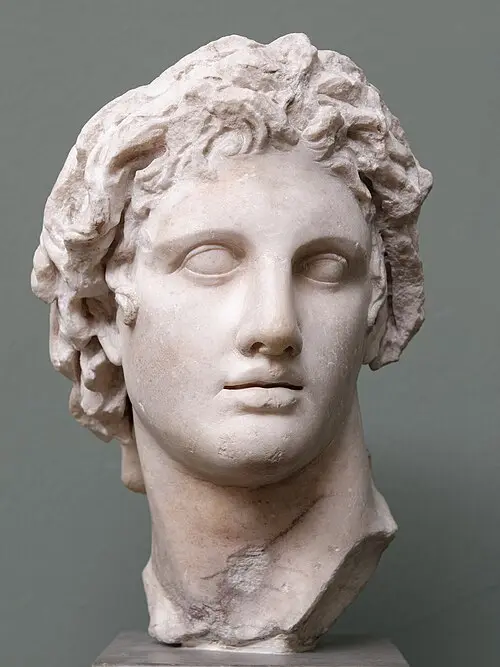
Alexander the Great: The Man Who Conquered an Empire, But Left Behind a Question About Power
Alexander conquered lands faster than most people could understand them. But his real historical mystery is not how he won so many battles. It is what he was trying to become through conquest, and whether the empire he built could ever survive the ambition that created it.
WHO WAS ALEXANDER THE GREAT?
Alexander III of Macedon, known to history as Alexander the Great, was born in 356 BCE in Pella, the capital of the ancient kingdom of Macedon.
He was the son of Philip II of Macedon and Olympias of Epirus.
His father was one of the most powerful rulers in the Greek world. Philip transformed Macedon from a kingdom on the edge of Greek politics into the dominant military power in the region.
His mother was a strong and politically influential figure. Alexander’s relationship with her remained important throughout his life.
Alexander grew up in a royal court shaped by politics, warfare, competition, religion, and ideas of heroic greatness.
He was not raised merely to become a king.
He was raised to become a conqueror.
One of the most important figures in his intellectual formation was Aristotle, who became his tutor when Alexander was a teenager.
Aristotle taught him philosophy, literature, medicine, science, and Greek culture.
Alexander reportedly carried a copy of Homer’s Iliad with him during his campaigns.
He admired Achilles, the legendary Greek warrior.
Alexander increasingly imagined his own life through heroic models.
This would become both his greatest strength and one of his greatest dangers.
THE WORLD ALEXANDER INHERITED
Alexander was born into a Greek world divided among competing city-states.
Athens.
Sparta.
Thebes.
Corinth.
And many others.
But the balance was changing.
Macedon was rising.
Philip II built a powerful army and defeated major Greek opponents.
After the Battle of Chaeronea in 338 BCE, Macedon became the dominant power over much of Greece.
Philip planned an invasion of the Persian Empire.
Persia was enormous.
It controlled territories stretching across much of the ancient Near East and beyond.
But Philip was assassinated in 336 BCE.
Alexander became king at only about twenty years old.
He inherited his father’s kingdom, army, enemies, and unfinished war.
Two years later, he crossed into Asia.
He would not return.
THE CENTRAL QUESTION OF ALEXANDER’S LIFE
Alexander was not a philosopher in the conventional sense.
He did not leave behind a systematic theory of reality, knowledge, or morality.
His philosophy must therefore be reconstructed through his actions, choices, speeches reported by ancient historians, and the political world he created.
His life revolves around several questions:
How far can human ambition go?
What makes a ruler great?
Is conquest enough, or must a conqueror create something after victory?
Can different cultures become part of one political order?
Does power reveal character or destroy it?
How much can one individual reshape history?
And perhaps the most important:
When does ambition stop being greatness and become self-destruction?
ALEXANDER’S INTELLECTUAL FORMATION
Alexander’s education under Aristotle is one of the most famous teacher-student relationships in history.
Aristotle introduced him to:
Greek literature,
philosophy,
science,
medicine,
ethics,
politics,
and geography.
Alexander’s relationship with Aristotle was important, but it should not be romanticized.
The young prince was also shaped by his father, military commanders, Macedonian aristocratic culture, Homeric heroism, and the demands of royal politics.
Aristotle taught him about the Greek intellectual world.
Philip taught him about power.
The Macedonian army taught him about war.
Homer taught him about glory.
Alexander combined all four.
ALEXANDER AND HOMER
Alexander’s relationship with Homer’s Iliad became part of his historical image.
The hero he admired most was Achilles.
Achilles represented:
courage,
speed,
honor,
military excellence,
fame,
and the pursuit of immortal reputation.
Alexander wanted his name to survive his body.
This matters because ancient Greek heroic culture placed enormous importance on kleos, or lasting glory.
A warrior could die young but achieve immortality through reputation.
Alexander seemed willing to risk his life for that kind of immortality.
THE FIRST TEST: BECOMING KING
When Philip II was assassinated in 336 BCE, Alexander inherited the throne.
But becoming king did not mean becoming secure.
There were rival claims.
There were rebellions.
There were enemies.
Alexander acted quickly.
He secured his position in Macedon and suppressed revolts in Greece.
The destruction of Thebes in 335 BCE sent a brutal message to other Greek cities.
Alexander was young.
But he wanted everyone to understand one thing:
The death of Philip would not mean the death of Macedonian power.
THE INVASION OF PERSIA
In 334 BCE, Alexander crossed the Hellespont into Asia.
He had a relatively small army compared with the vast resources of the Persian Empire.
But his army was highly trained and organized.
The Macedonian military system combined:
phalanx infantry
companion cavalry
light infantry
archers
engineers
and specialized troops.
Alexander’s greatest military talent was not simply courage.
It was coordination.
He could combine different units at the right moment.
THE BATTLE OF THE GRANICUS
Alexander’s first major battle against Persian forces occurred at the Granicus River in 334 BCE.
He won.
The victory gave him control over much of western Asia Minor.
But the war was far from over.
Persia was enormous.
Alexander still had to defeat its main armies.
THE BATTLE OF ISSUS
In 333 BCE, Alexander faced the Persian king Darius III at Issus.
The Persian army was much larger.
But geography limited its ability to use its numerical advantage.
Alexander attacked aggressively.
The Persian army collapsed.
Darius fled.
Alexander captured members of the Persian royal family.
The victory transformed the war.
Alexander was no longer simply a Macedonian prince invading Asia.
He was becoming a serious challenger to the Persian throne.
THE SIEGE OF TYRE
Alexander’s campaign was not only about battlefield victories.
Some cities resisted fiercely.
The Phoenician city of Tyre was one of the greatest examples.
Tyre was heavily fortified and located on an island.
Alexander’s army constructed a massive causeway into the sea to reach the city.
The siege lasted months.
Eventually Tyre fell.
The victory demonstrated something important about Alexander:
He was willing to use enormous resources and extraordinary engineering to overcome obstacles that appeared almost impossible.
But the conquest was also brutal.
Thousands were killed or enslaved.
Alexander’s victories came with enormous human costs.
EGYPT
Alexander then entered Egypt.
The Egyptians had little reason to love Persian rule.
Alexander was welcomed as a liberator by many Egyptians.
He founded the city of Alexandria, which would later become one of the most important intellectual centers of the ancient Mediterranean.
Alexander also visited the oracle of Amun at Siwa.
Ancient sources report that he was associated there with divine ancestry.
Whether we accept every detail of the later stories or not, the episode reflects a growing transformation in Alexander’s political image.
He was no longer presenting himself only as a Macedonian king.
He was becoming something much larger.
THE BATTLE OF GAUGAMELA
In 331 BCE, Alexander met Darius again at Gaugamela.
This became one of the decisive battles of ancient history.
Darius assembled a massive army.
Alexander’s forces were heavily outnumbered.
But Alexander used maneuver, timing, and concentration of force.
He created an opening in the Persian line.
Then he attacked.
Darius fled.
The Persian imperial center collapsed.
Alexander marched into Babylon, Susa, and eventually Persepolis.
The Persian Empire had effectively fallen.
Alexander had achieved what his father had planned.
But Alexander did not stop.
WHY DID ALEXANDER KEEP CONQUERING?
This is one of the deepest questions surrounding him.
After defeating the Persian Empire, Alexander could have returned home as one of the greatest conquerors in history.
He did not.
He continued east.
He entered Central Asia.
He crossed difficult mountains.
He fought rebellions.
He eventually invaded the Indian subcontinent.
Why?
Several explanations probably overlap.
Military ambition.
He wanted further victories.
Heroic glory.
He wanted to surpass the heroes of the past.
Political necessity.
A large empire needed to be secured.
Curiosity.
He was interested in geography, peoples, animals, and distant lands.
Personal ambition.
He may simply have wanted to see how far he could go.
And perhaps there was something deeper:
Alexander may not have known how to stop being Alexander.
Conquest had become his identity.
ALEXANDER’S RELATIONSHIP WITH POWER
Alexander’s greatest strength was his extraordinary confidence.
But confidence can become something else when no one can challenge it.
At first, his ambition produced remarkable achievements.
Later, it increasingly produced danger.
The more territory Alexander controlled, the more powerful he became.
The more powerful he became, the fewer people could tell him no.
This is a classic problem of political power:
What happens when the ruler no longer encounters meaningful limits?
ALEXANDER AND THE PERSIAN WORLD
Alexander did not simply destroy Persian institutions.
He adopted many Persian practices.
He incorporated Persian officials.
He used local administrative systems.
He adopted elements of Persian court culture.
He encouraged marriages between Macedonians and Persians.
At Susa, mass marriages connected Macedonian and Persian elites.
This suggests that Alexander’s vision gradually changed.
At first:
Macedonians conquer Persia.
Later:
Macedonians and Persians become part of a new imperial order.
This was politically useful.
But it created conflict with his Macedonian soldiers and companions.
THE PROBLEM OF CULTURAL FUSION
Alexander’s empire raises an extraordinary question:
Can an empire become more than conquest?
If Alexander simply ruled conquered peoples through Macedonian domination, his empire would remain an occupying force.
If he incorporated local elites and traditions, he could create a more integrated empire.
Alexander increasingly experimented with the second approach.
But integration has a difficult limit.
People may cooperate with a ruler while still resenting him.
Macedonian soldiers could tolerate Persian customs only to a point.
Persian subjects could accept Alexander only while his rule remained legitimate.
Cultural fusion requires more than the command of a king.
It requires institutions and shared political identity.
Alexander never had enough time to create those fully.
ALEXANDER AND HIS SOLDIERS
Alexander’s relationship with his soldiers was central to his success.
He fought alongside them.
He suffered wounds.
He shared danger.
He rewarded bravery.
This created extraordinary loyalty.
His soldiers did not see him as a distant king.
They saw him on the battlefield.
But this relationship eventually became strained.
Alexander wanted to keep moving east.
His soldiers wanted to go home.
The conflict became severe in India.
THE INDIAN CAMPAIGN
Alexander reached the northwestern Indian subcontinent in 326 BCE.
He fought King Porus at the Battle of the Hydaspes.
The battle was difficult.
Porus used war elephants.
Alexander eventually won.
But afterward, something unusual happened.
Alexander reportedly admired Porus’s courage and asked how he wished to be treated.
Porus answered that he wanted to be treated as a king.
Alexander respected him.
Porus was restored to authority and became an ally within Alexander’s imperial system.
This episode illustrates an important feature of Alexander’s rule.
He could be extraordinarily brutal toward enemies who resisted him.
But he could also admire courage in defeated opponents.
THE LIMIT OF CONQUEST
After the Hydaspes, Alexander wanted to continue eastward.
His soldiers refused.
They had been fighting for years.
They had crossed enormous distances.
They were exhausted.
Alexander eventually agreed to turn back.
This was one of the most important moments in his career.
For perhaps the first time, Alexander’s personal ambition met a limit that he could not simply overcome.
His army said:
Enough.
The conqueror had finally reached a boundary.
ALEXANDER AND HIS COMPANIONS
Alexander’s closest companions were crucial to his life.
One of the most famous was Hephaestion.
He was a trusted companion and commander.
Ancient sources describe their relationship as exceptionally close.
When Hephaestion died in 324 BCE, Alexander was devastated.
His grief was enormous.
The episode reveals something often hidden by the image of Alexander the conqueror.
Behind the empire was a human being capable of profound attachment and grief.
THE DARKER SIDE OF ALEXANDER
Alexander’s greatness cannot be separated from his violence.
He ordered or permitted:
mass killings,
enslavement,
destruction of cities,
executions,
and brutal punishments.
The destruction of Thebes is one example.
The massacre at Tyre is another.
The killing of the Persian nobleman Bessus was part of imperial consolidation.
The execution of Parmenion, an elderly and highly respected Macedonian commander, showed how suspicious Alexander could become.
Alexander’s empire was not built peacefully.
It was built through war.
ALEXANDER AND CLEITUS
One of the darkest episodes occurred in 328 BCE.
During a drunken argument, Alexander killed Cleitus the Black, one of his senior commanders and a man who had once saved Alexander’s life.
Cleitus had criticized Alexander’s growing adoption of Persian customs and his changing style of kingship.
Alexander killed him in a burst of rage.
He was devastated afterward.
This episode is philosophically important.
The man who could command an empire could not always command himself.
That is the tragedy of unchecked power.
THE CONTRADICTION OF ALEXANDER
Alexander wanted to become extraordinary.
But his pursuit of greatness created weaknesses.
He valued courage.
Yet sometimes acted recklessly.
He admired loyalty.
Yet became increasingly suspicious.
He wanted to unite cultures.
Yet used extreme violence.
He admired philosophy.
Yet ruled through conquest.
He sought immortality through glory.
Yet could not escape mortality.
He wanted to create a universal empire.
Yet depended heavily on his personal authority.
His greatness and his flaws came from the same source:
extraordinary ambition.
ALEXANDER AND ARISTOTLE
The contrast between Alexander and Aristotle is fascinating.
Aristotle’s philosophy asks:
What does it mean to live well?
Alexander’s life asks:
What can a human being achieve?
Aristotle emphasizes virtue, moderation, practical wisdom, and flourishing.
Alexander often lives through ambition, risk, conquest, and glory.
This does not mean Aristotle failed to influence him.
Rather, Alexander shows how difficult it is to turn philosophical knowledge into a way of life.
A person can be educated by one of history’s greatest philosophers and still be driven by ambition, anger, pride, and desire for glory.
Knowledge does not automatically produce virtue.
Aristotle himself would probably have recognized the problem.
ALEXANDER AND ACHILLES
Alexander’s relationship with Achilles provides another important contrast.
Achilles chooses glory over a long ordinary life.
Alexander seems to have made a similar choice.
He wanted extraordinary achievement rather than ordinary security.
This raises a timeless question:
Is a short life of extraordinary achievement better than a long life of ordinary happiness?
Alexander appears to have answered:
Yes.
But Aristotle might have asked whether such a life truly constitutes flourishing.
This creates a philosophical conflict between:
glory and happiness
achievement and moderation
immortality of reputation and quality of life
ALEXANDER’S VIEW OF GREATNESS
Alexander’s life suggests that greatness, for him, meant surpassing limits.
Surpass your father.
Surpass your enemies.
Surpass Achilles.
Cross the mountains.
Cross the deserts.
Cross the rivers.
Reach India.
Go farther.
Win again.
Become greater.
But this contains a dangerous logic.
If greatness means always going beyond the previous limit, there may never be a point at which you are satisfied.
Every victory creates another horizon.
The greatest conqueror may therefore become a prisoner of conquest.
ALEXANDER AND THE IDEA OF IMMORTALITY
Alexander knew he would die.
He could not conquer death.
So he pursued another form of immortality:
memory.
If his name survived, perhaps part of him would survive.
This is why glory mattered so much in the ancient heroic world.
Alexander’s empire eventually disappeared.
His political structure fragmented.
His generals fought among themselves.
But his name survived.
In that sense, his strategy worked.
He became historically immortal.
THE DEATH OF ALEXANDER
Alexander returned to Babylon in 323 BCE.
He was planning further campaigns.
His ambitions had not ended.
But his life did.
He became seriously ill and died at approximately thirty-two years old.
The exact cause of death remains uncertain.
Ancient sources provide different accounts, and modern speculation has included infectious disease and other possibilities.
What matters historically is the consequence.
Alexander died without a mature successor capable of immediately preserving his empire.
THE COLLAPSE OF THE EMPIRE
Alexander had conquered an enormous territory.
But conquest is easier than succession.
After his death, his generals fought over the empire.
These successor kingdoms became known as the Hellenistic kingdoms.
The empire did not remain politically unified.
But Alexander’s cultural impact lasted.
Greek language and culture spread widely across the eastern Mediterranean and Near East.
This produced the Hellenistic world.
Greek ideas interacted with:
Persian,
Egyptian,
Mesopotamian,
and other cultures.
The result was not simply “Greek culture conquering everyone.”
It was a complicated process of cultural exchange.
THE HELLENISTIC LEGACY
Alexander’s most important long-term achievement may therefore not have been the empire itself.
It may have been the creation of conditions for a wider cultural world.
Greek became a major language of administration and intellectual exchange.
Cities such as Alexandria became centers of learning.
Philosophical schools spread.
Scientific and mathematical knowledge developed.
Trade networks expanded.
Different cultures interacted more closely.
The world after Alexander was not the world before him.
ALEXANDRIA
The city of Alexandria in Egypt became particularly important.
It eventually developed into one of the greatest centers of scholarship in the ancient world.
The Library of Alexandria became associated with the preservation and collection of knowledge.
The city became a meeting point for Greek, Egyptian, Jewish, and other intellectual traditions.
Alexander himself did not live to see this full development.
But his foundation became part of the world he helped create.
ALEXANDER’S INFLUENCE ON HISTORY
Alexander changed:
military history
politics
geography
trade
culture
language
urban development
philosophy
science
religious exchange
His campaigns connected regions that had previously been politically separated.
The Hellenistic period that followed influenced the later Roman world.
And through Rome, Greek culture eventually became deeply embedded in European intellectual history.
ALEXANDER’S PLACE BESIDE SOCRATES, PLATO, ARISTOTLE, AND NIETZSCHE
Alexander is different from the philosophers in this series.
Socrates examined how a person should live.
Plato examined reality, justice, and the Good.
Aristotle examined virtue, flourishing, nature, and political life.
Nietzsche questioned inherited values and the meaning of greatness.
Alexander did not primarily write philosophical arguments.
Instead, he lived a philosophical problem.
He embodied the question:
How much should a human being desire to achieve?
His life becomes almost an experiment in ambition.
What happens when a person refuses to accept ordinary limits?
At first, the answer looks magnificent.
Then it becomes frightening.
WHAT ALEXANDER GOT RIGHT
Alexander demonstrated extraordinary qualities.
Courage
He repeatedly placed himself in danger.
Strategic intelligence
He coordinated complex military forces with remarkable skill.
Adaptability
He learned from different cultures and changed his methods.
Leadership
He inspired extraordinary loyalty among his troops.
Ambition
He possessed an almost unmatched capacity for pursuing difficult goals.
Curiosity
He was interested in the lands and peoples he encountered.
Cultural integration
His later policies showed an attempt to combine Macedonian and Persian elements rather than simply maintaining permanent separation.
These qualities help explain why his achievements remain extraordinary.
WHAT ALEXANDER GOT WRONG
His greatest failures came from the same place as his greatest achievements.
He could not always distinguish ambition from excess.
He treated conquest as a solution to problems that could not be solved through conquest.
He increasingly demanded personal loyalty.
He became suspicious of those around him.
His temper produced deadly consequences.
His empire depended too heavily on one person.
And perhaps most importantly:
he conquered faster than he could build institutions.
That is why his empire fragmented so quickly after his death.
THE PROBLEM OF GREAT LEADERS
Alexander leaves behind a political lesson that goes far beyond ancient history.
A system built around an extraordinary individual may appear extremely powerful.
But what happens when that individual disappears?
A great leader can create momentum.
But institutions create continuity.
Alexander had enormous personal authority.
He did not have enough time to establish a stable succession system capable of preserving his political creation.
This is one of the oldest problems of political power:
Can greatness become an institution, or does it die with the person who created it?
ALEXANDER AND POWER IN REAL LIFE
Alexander’s life offers a useful distinction between:
achievement
and
flourishing.
Imagine someone who keeps achieving more.
More money.
More followers.
More awards.
More power.
More status.
More influence.
At what point is enough enough?
Alexander’s life suggests a dangerous possibility:
If achievement itself becomes the measure of life, there may be no natural stopping point.
Every victory becomes the starting point for another victory.
This is not only a problem for emperors.
It can happen in careers.
Business.
Academia.
Politics.
Social media.
Even personal goals.
Ambition can build a person.
But uncontrolled ambition can consume them.
THE ARISTOTELIAN QUESTION
Aristotle gives us a powerful way to judge Alexander.
Aristotle asks:
Did Alexander flourish?
He certainly achieved extraordinary things.
But achievement alone is not eudaimonia.
Was he moderate?
No.
Did he control his anger?
Not always.
Did he maintain stable friendships?
Some were profound, but others ended violently.
Did he build a stable political community?
He began the process, but did not complete it.
Did he live according to practical wisdom?
Sometimes brilliantly.
Sometimes disastrously.
Alexander therefore becomes an interesting test of Aristotle’s philosophy.
A person can be extraordinarily successful and still fail to live well.
THE NIETZSCHEAN QUESTION
Nietzsche gives us another way to interpret Alexander.
Nietzsche admired strength, ambition, self-overcoming, and the creation of new possibilities.
Alexander certainly embodies these qualities.
He refused to remain within inherited limits.
But Nietzsche also asks whether greatness is genuine self-overcoming or merely domination.
Alexander’s life leaves this question open.
Was he creating himself?
Or was he becoming addicted to conquest?
Was he overcoming limits?
Or was he unable to overcome his own desire for more?
The distinction matters.
ALEXANDER’S GREATEST CONTRADICTION
Alexander wanted to become greater than ordinary human beings.
But the more he pursued greatness, the more clearly his humanity appeared.
He was vulnerable to:
anger,
grief,
fear,
ambition,
love,
pride,
and mortality.
He could conquer cities.
He could defeat armies.
He could cross mountains.
But he could not conquer death.
His greatest achievement therefore contains its own contradiction.
The man who conquered an enormous part of the known world could not conquer himself forever.
ALEXANDER’S PHILOSOPHY IN SIMPLE WORDS
Alexander did not leave a philosophical system.
But his life can be reduced to several ideas.
Dream beyond your circumstances.
Alexander transformed a Macedonian kingdom into an enormous empire.
Courage makes ambition possible.
He repeatedly entered situations where failure meant death.
Adaptability is power.
He learned from enemies and incorporated foreign practices.
Victory is not the same as stability.
Conquest without institutions does not last.
Power changes the person who possesses it.
Success can increase confidence, but also suspicion and arrogance.
Ambition has no natural stopping point.
If “more” becomes the goal, there may never be enough.
Greatness has a cost.
Alexander’s achievements came with enormous violence and personal sacrifice.
A conqueror can change history without fully controlling its consequences.
Alexander shaped the Hellenistic world, but could not determine what his successors would do with it.
THE FINAL QUESTION
Alexander’s life begins with a young man inheriting a kingdom.
He then becomes a conqueror.
Then a king of Persia.
Then the ruler of an enormous multicultural empire.
Then a man who wants to continue eastward even after defeating the greatest empire of his age.
And then, at only thirty-two, he dies.
His empire fractures.
His generals fight.
His political creation does not survive in the form he imagined.
Yet his name survives for more than two thousand years.
That is the paradox of Alexander.
He conquered an enormous world but could not secure his own creation.
He sought glory, and achieved it.
He sought immortality, and achieved a form of it.
But he never discovered the one thing that every conqueror eventually needs:
when to stop.
Socrates asks whether we know how to live.
Plato asks what justice and reality truly are.
Aristotle asks what makes a human life flourish.
Nietzsche asks what happens when we reject inherited values and attempt to create ourselves.
Alexander gives us a different question through his life rather than his books:
If you could become powerful enough to achieve almost anything, what would you choose to become, and would you know when you had achieved enough?
That may be Alexander’s most enduring philosophical problem.
The tragedy of Alexander the Great is not that he failed to conquer enough. It is that his greatest victory may have been the creation of a desire that could never be satisfied.