Tabulae · Tabula XXIV
Tabula XXIV
The Starry Night
When the Sky Becomes a Mirror of the Human Soul
Vincent van Gogh, 1889

Perhaps no other night sky in Western art feels so alive, as if the universe itself were breathing, moving, and searching.
The Artwork at a Glance
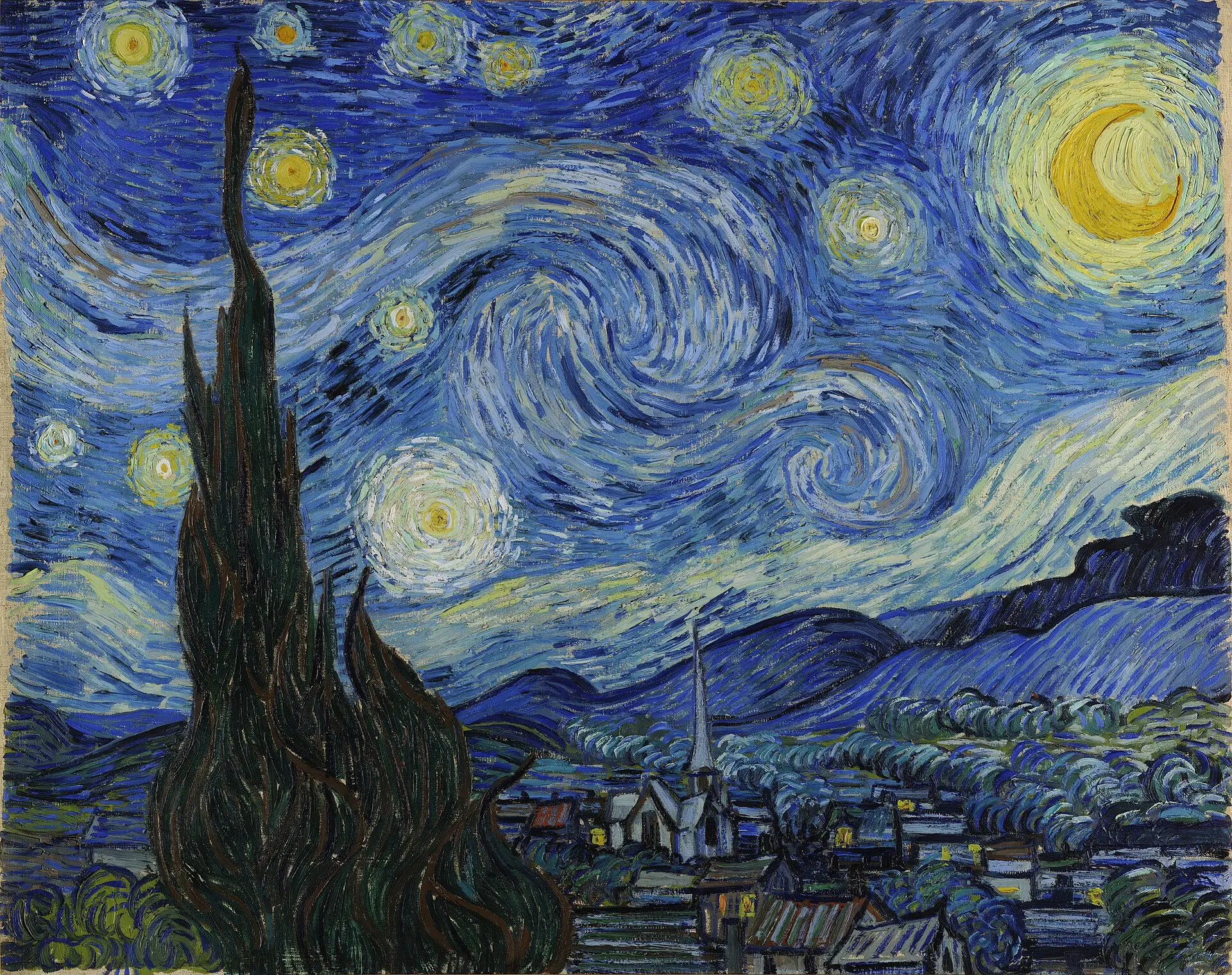
The Starry Night was painted by Vincent van Gogh in June 1889, while he was staying at the Saint-Paul-de-Mausole asylum in Saint-Rémy-de-Provence, southern France. It is an oil painting on canvas, measuring approximately 73.7 × 92.1 cm, and today it hangs in the Museum of Modern Art in New York. At first glance, it seems to be a landscape. We see a village beneath a night sky, hills in the distance, a tall dark cypress tree rising on the left, and a sky filled with stars and a glowing moon.
But The Starry Night is not simply a picture of what Van Gogh saw. It is a picture of what the night felt like to him. That difference is the key to understanding the painting. The sky does not behave like an ordinary sky. Stars seem to burn. Clouds twist into enormous currents. The moon glows like a rising flame. The hills move in waves. Nature has become emotional. The landscape is no longer merely something outside the human being.
It has become a language for the inner world.
The World Behind the Artwork
Van Gogh painted The Starry Night in 1889, during a period of profound change in European art. The nineteenth century had already seen artists challenge the academic traditions that had dominated European painting for generations. Impressionists had broken away from strict historical subjects and explored changing light, color, atmosphere, and everyday life. Van Gogh went further. He was interested in the visible world, but he did not believe that painting had to reproduce it literally. For him, color and brushwork could express emotion.
This was part of a larger transformation in modern art. Artists were increasingly asking whether painting should merely show the world as the eye sees it, or whether it could show something deeper: memory, emotion, sensation, imagination, anxiety, spirituality, or the movement of the mind itself. Van Gogh’s painting belongs to this transition. It still depicts a recognizable landscape.
But it also begins to break the boundary between observation and expression.
The Artist Behind the Work
Vincent van Gogh was born in the Netherlands in 1853 and died in France in 1890, only a year after painting The Starry Night. His life is often reduced to stories about mental illness, poverty, loneliness, and the famous incident involving his ear. Those facts matter, but they can easily distort our understanding of the painting. The Starry Night should not be treated simply as a picture of madness. Van Gogh was a serious and ambitious artist who spent years studying art, nature, literature, religion, and human emotion. He wrote extensively to his brother Theo about painting and developed a very deliberate artistic language. He wanted art to communicate something emotionally true. That is very different from simply painting whatever happened to be inside his mind.
Even when his emotions were intense, his paintings were carefully constructed. The swirling sky of The Starry Night is not accidental chaos. It is organized chaos.
What We See
The composition divides naturally into three zones. The foreground is dominated by a huge cypress tree. The middle ground contains a small village surrounded by dark hills. The upper part is almost completely occupied by the sky. This imbalance is important. The sky is enormous. The village is tiny. Human civilization seems fragile beneath the immense movement of nature. The cypress rises vertically from the lower left, almost like a flame. Behind it, the mountains form horizontal waves. Below the mountains, the village sits quietly.
The church tower rises upward, providing another vertical line. Above everything, the stars and moon dominate the scene. The result is a powerful tension between vertical and horizontal movement. The cypress reaches upward. The church tower reaches upward. The hills roll sideways. The sky swirls in circles and curves. Everything seems to move in different directions, yet the painting remains remarkably unified.
The Sky
The sky is the soul of the painting. Van Gogh does not paint it as an empty blue surface. He gives it structure. Large curved bands of blue and white sweep across it. The forms seem to circulate around the stars and moon. The stars are surrounded by halos of yellow and white. The moon is not a small distant object. It appears almost physically present. The sky seems to have weight and movement. This is one of the reasons the painting feels alive. We do not simply look at the sky.
We feel as though we are inside its movement.
How the Painting Works
Van Gogh’s brushwork is central to the experience. He uses thick, visible strokes of paint, often called impasto, allowing the surface to retain the physical presence of the brush. The paint is not merely describing objects. The paint itself becomes expressive. The direction of the brushstrokes follows the forms of the world. Curved strokes move through the sky. Shorter strokes describe the village and landscape. Vertical strokes build the cypress. The surface therefore has a kind of physical rhythm.
You can almost feel the movement of Van Gogh’s hand. This creates a fascinating relationship between subject and technique. The sky is moving because the paint is moving. The stars appear to vibrate because the surrounding strokes vibrate. The cypress seems to rise because the brushwork pushes upward. Form and emotion become inseparable.
Color and Emotion
The painting’s colors are carefully organized around a powerful contrast. Deep blues dominate the night. Against them, yellow and white stars shine intensely. The warm colors appear to push forward against the cool blue background. This makes the stars feel almost luminous. The effect is not realistic in the ordinary sense. Stars do not normally appear as enormous glowing circles surrounded by halos.
But Van Gogh is not primarily interested in astronomical accuracy. He is interested in visual intensity. The exaggerated color allows the night to become emotionally stronger than ordinary perception. The blue is not simply the color of night. It becomes a color of depth, distance, mystery, and emotional stillness. The yellow is not simply the color of stars. It becomes warmth, energy, presence, and light. The painting therefore creates a conversation between darkness and illumination.
The Cypress Tree
The cypress is perhaps the strangest element in the composition. It rises from the lower left like a dark flame. It is almost black compared with the bright sky. Its shape resembles both a tree and a column of fire. Van Gogh was deeply interested in cypresses during his time in the south of France. He often painted them because of their distinctive vertical form and their emotional presence in the landscape. The cypress also had associations with cemeteries and mourning in European culture.
That makes it tempting to interpret the tree as a symbol of death. There is some justification for such a reading, but it should not be treated as a simple code. The tree also connects earth and sky. It rises from the dark landscape toward the stars. It may therefore suggest not only death but also aspiration, longing, spiritual movement, and the connection between human life and something larger. Its ambiguity is part of its power.
The Village Below
The village is surprisingly calm. Small houses cluster beneath the enormous sky. A church steeple rises in the center. There are no visible crowds. No dramatic human activity. No individual story. The village almost feels asleep. This creates a striking contrast. Above it is movement. Below it is stillness. The sky seems emotionally enormous, while human life appears small and quiet.
Yet the village is not insignificant. The lights in the windows suggest human presence. Even in the darkness, people are there. The painting therefore holds two worlds together:
the vast universe above and the fragile human world below.
The Church Tower
The church tower is a small but important vertical element. It rises toward the sky, visually echoing the cypress. This can suggest a connection between the earthly and the spiritual. But the church itself is also tiny compared with the enormous universe surrounding it. That creates an interesting tension. Religion may offer humans a way to understand the universe, but the universe remains vastly larger than human institutions. Van Gogh had a complicated relationship with religion. He had once wanted to become a minister and spent significant time thinking about faith, spirituality, and the meaning of human suffering.
His spirituality later became less tied to formal religious institutions and more connected to nature, art, humanity, and the possibility of finding meaning. The painting reflects that complexity. It feels spiritual without being a conventional religious image.
The Stars
The stars are among the most memorable elements in the painting. They are not tiny points of light. They are enormous glowing forms. This exaggeration changes our relationship with them. Astronomically, the stars are distant objects. Emotionally, Van Gogh brings them close. They become almost intimate. The human being looks upward and sees something impossibly far away, yet Van Gogh makes it feel physically present. This is one of the painting’s deepest achievements. It turns cosmic distance into emotional closeness.
The Moon
The crescent moon glows intensely in the upper right. It is surrounded by a bright yellow halo. Like the stars, it is exaggerated. The moon becomes almost another sun. Its warmth contrasts with the cold blue of the sky. The result is not a scientifically accurate night. It is an emotional night. The moon does not simply illuminate the landscape. It participates in the painting’s emotional drama.
The Central Idea
What is The Starry Night fundamentally about? There is no single answer. But one of its deepest themes is the human desire to find meaning within an immense and mysterious universe. The painting places a tiny village beneath a gigantic sky. Human beings are small. The universe is enormous.
Yet the human gaze reaches upward. The stars matter because we look at them. The universe may be indifferent to us, but we are not indifferent to it. We search the sky. We create stories. We create religions. We create science. We create art. We try to understand where we are. Van Gogh transforms that ancient human impulse into color and movement.
Nature and the Human Soul
Van Gogh does something unusual with landscape. He does not treat nature as passive scenery. The sky seems to have a personality. The hills seem to breathe. The cypress seems to reach. The stars seem to pulse. Nature becomes almost human without becoming literally human. This suggests a philosophical idea that appears repeatedly in Romantic and modern art:
perhaps the landscape we see is partly shaped by the person who looks at it.
Two people can stand beneath the same sky and experience completely different worlds. Van Gogh’s sky is therefore both an external landscape and an internal one. It is Provence. But it is also Van Gogh.
Beauty and Suffering
The painting is extraordinarily beautiful. But knowing something about Van Gogh’s life makes that beauty more complicated. He painted it while living in an asylum after a period of serious psychological crisis. Yet it would be too simple to say that the painting is simply an expression of illness. Van Gogh was capable of extraordinary concentration and artistic discipline during difficult periods. The painting demonstrates control. Its composition is deliberate. Its color relationships are carefully constructed. Its brushwork is organized. Its movement has rhythm. This creates one of the work’s deepest contradictions:
the painting looks wild, but it is carefully made.
The sky seems to explode with emotion, yet the artist has organized that emotion into a coherent visual world.
Reality and Imagination
The Starry Night occupies an unusual space between observation and imagination. Van Gogh painted the view from his room at Saint-Paul, but the painting does not simply reproduce what he saw. The village, sky, hills, cypress, moon, and stars have been transformed. Some elements were based on observation. Others were altered. The village, for example, was not a literal view of the landscape exactly as it appeared. Van Gogh constructed a scene. He combined observation with memory, imagination, artistic tradition, and emotional expression.
This is why calling the painting “realistic” or “unrealistic” misses the point. Van Gogh was searching for another kind of truth. Not photographic truth.
Emotional truth.
Philosophy of the Painting
The painting can be understood as a meditation on the relationship between human beings and infinity. We are finite. The sky seems infinite. We live for a short time. The stars appear ancient. We know that we will die. The universe continues. This could produce despair.
But Van Gogh responds differently. He looks upward. The vastness of the universe does not make the human experience meaningless. It makes the experience mysterious. The stars become objects of wonder. The painting therefore transforms smallness into something almost beautiful. Being tiny does not necessarily mean being insignificant. A human being may be physically small and still possess the extraordinary ability to look into the universe and wonder about it.
Different Interpretations
Some viewers see The Starry Night primarily as an expression of Van Gogh’s psychological state. Others see it as a spiritual landscape. Some focus on its connection to nature and the night sky. Others emphasize its relationship to modern art, arguing that Van Gogh helped move painting away from literal representation toward subjective expression. There have also been attempts to connect the swirling forms in the sky with scientific ideas about turbulence and fluid motion.
Such comparisons can be fascinating, but they should be handled carefully. Van Gogh was certainly an attentive observer of nature, but we should not assume that the painting was secretly intended as a scientific diagram. The strongest interpretation remains closer to the artwork itself: Van Gogh transformed the night into a visual language of movement, emotion, and wonder.
The Artist’s Intention and the Viewer
Van Gogh wrote often about his desire to express more than ordinary visual appearance. He wanted art to communicate emotion and spiritual intensity. But The Starry Night has become something larger than anything Van Gogh could have predicted. For some viewers it represents hope. For others, loneliness. For others, mental struggle. For others, beauty. For others, the mystery of the cosmos. These meanings do not necessarily belong to Van Gogh personally. They belong partly to the viewers who encounter the painting. This is how great art survives. The artist creates the image. History keeps changing what the image means.
Reception and Historical Importance
Van Gogh was not famous in the way he is today during his lifetime. He sold very few paintings and struggled to gain broad recognition. After his death, his reputation grew dramatically. His work became central to the development of Expressionism and had a major influence on twentieth-century artists who wanted painting to express subjective experience rather than simply reproduce appearances. The Starry Night eventually became one of the most recognizable paintings in Western culture.
Its image has appeared on posters, books, films, clothing, advertisements, classrooms, and countless reproductions. But its popularity can create a strange problem. Because we have seen it so many times, we can forget to actually look at it. The painting is not merely a beautiful picture of stars. It is a radical transformation of landscape.
Why It Still Matters
Modern people live under a very different sky from Van Gogh’s world. Cities are brighter. Screens compete with stars. Images arrive constantly. We can photograph the night with extraordinary precision. Yet something in The Starry Night remains beyond photography. A camera can record what the sky looks like. Van Gogh asks what the sky means to the person looking at it. That distinction still matters. We do not experience the world as cameras. We experience it through memory, emotion, fear, desire, imagination, and hope. A sunset can remind someone of childhood. A storm can make someone anxious.
A familiar street can suddenly feel strange after loss. The world outside us is never entirely separate from the world inside us. Van Gogh understood this intuitively.
A Deeper Reading
Look again at the composition. The village is quiet. The hills are dark. The cypress rises like a flame. Above everything, the sky is moving. The stars are burning. The moon glows. Nothing stays completely still. The painting therefore creates a strange balance. The human world is small, but it is not meaningless. Nature is enormous, but it is not emotionally empty. Darkness exists, but so does light. Suffering exists, but so does beauty. The universe is immense, but the human capacity to wonder is also immense.
Perhaps this is why The Starry Night continues to affect people who know nothing about Van Gogh’s biography or nineteenth-century art. It speaks to a feeling that is much older than modern painting. We stand beneath something larger than ourselves. We do not fully understand it. We know our time is limited. And still, we look upward. Van Gogh’s great achievement was to turn that moment of looking into a world of swirling blue, burning yellow, restless hills, and impossible light.
The stars in his painting are not merely objects in the sky. They are reminders that even in darkness, the human mind keeps searching for something bright enough to follow.