Tabula XIV
The Giant Wheel, plate 9 from Imaginary Prisons
Giovanni Battista Piranesi, 1761
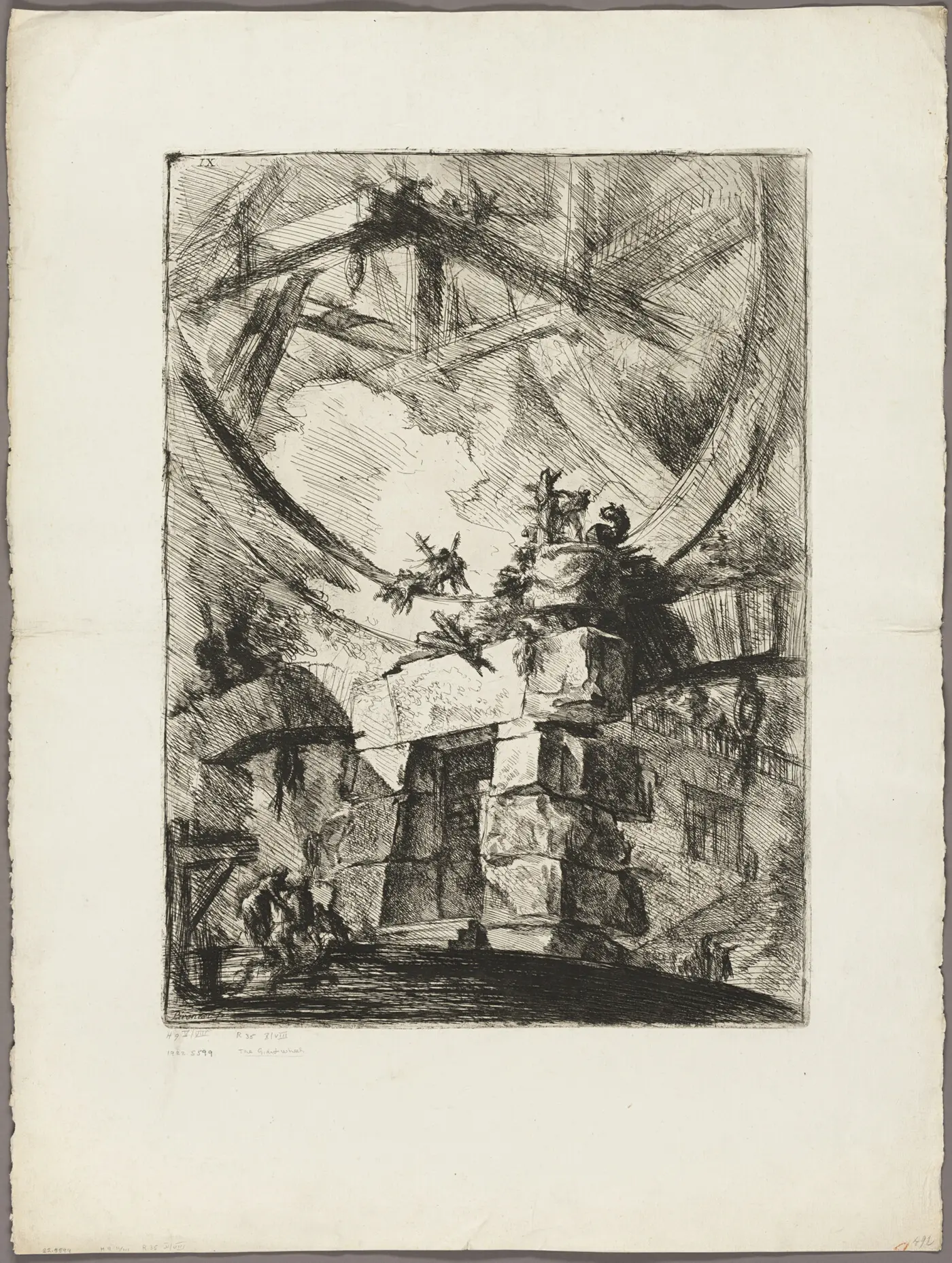
The Giant Wheel: When Architecture Becomes a Machine of Fear
Piranesi does not build a prison with walls alone. He builds one from scale, machinery, darkness, and the terrifying feeling that there may be no way out.
The Artwork at a Glance
The Giant Wheel is Plate IX from Carceri d’invenzione, or Imaginary Prisons, by the Italian artist and printmaker Giovanni Battista Piranesi. The Carceri series was first published in the 1740s and substantially revised and republished in 1761.
The series consists of imaginary architectural spaces filled with enormous staircases, bridges, arches, towers, chains, machines, platforms, and mysterious figures. They look like prisons, but they do not behave like ordinary prisons. Their spaces seem to obey their own impossible logic.
The Giant Wheel belongs to this world.
The enormous wheel dominates the composition, surrounded by monumental architectural structures and tiny human figures. Its scale is so extreme that the human beings seem almost insignificant.
Yet the work is not really about a wheel.
It is about what happens when human beings enter a world whose scale and complexity exceed their ability to understand it.
Piranesi turns architecture into psychology.
The World Behind the Artwork
Piranesi lived during the eighteenth century, a period when Europe was fascinated by the ancient world, scientific discovery, engineering, travel, archaeology, and the possibilities of human reason.
The Enlightenment was encouraging people to believe that the world could be studied, measured, classified, and understood.
At the same time, artists were fascinated by ruins and by the overwhelming remains of ancient Rome.
Piranesi was deeply connected to this fascination.
He was born in Venice in 1720, but spent much of his adult life in Rome. Rome became the central subject of his career.
He produced views of ancient monuments, ruins, streets, and buildings with extraordinary precision.
But alongside these apparently factual images, he created something completely different.
The Carceri.
These imaginary prisons do not document Rome.
They invent another Rome, one built from memory, imagination, archaeology, theatrical design, and architectural fantasy.
The contradiction is fascinating.
The same artist who could record architecture with extraordinary accuracy could also create architecture that seems impossible.
The Artist Behind the Work
Piranesi was trained in architecture and became one of Europe’s most celebrated printmakers.
He was fascinated by the power of buildings.
For him, architecture was not merely a practical activity.
It could express history, power, ambition, memory, and human achievement.
His images of Rome often make ancient ruins appear enormous and emotionally overwhelming.
The Carceri take this interest to a darker extreme.
What if architecture lost its human scale?
What if stairs did not lead clearly anywhere?
What if bridges crossed empty spaces?
What if machines became larger than the people operating them?
What if a building became so vast that the human mind could no longer understand its structure?
That is the world Piranesi creates.
What We See
The first thing that strikes us is scale.
The architecture is enormous.
The giant wheel occupies a dominant position within the composition, becoming both an architectural object and a machine.
Around it are massive stone structures.
Staircases rise and disappear.
Platforms connect different levels.
Arches open into darkness.
Beams and mechanical elements overlap.
Small human figures occupy the lower parts of the composition.
They are almost swallowed by the environment.
This relationship between gigantic architecture and tiny humanity is one of Piranesi’s most important visual strategies.
The people are not the protagonists.
The structure is.
The building seems to have become the main character.
The Giant Wheel
The wheel is visually fascinating because it is both recognizable and mysterious.
We know what a wheel is.
It suggests rotation, movement, machinery, labor, and repetition.
But here it is enormous.
Its size removes it from ordinary human experience.
We cannot easily understand what purpose such a machine could serve.
That uncertainty is essential.
Piranesi gives us something familiar and makes it strange.
The wheel becomes a symbol of a system whose purpose we cannot fully grasp.
It might represent work.
Punishment.
Time.
Industrial force.
Mechanical repetition.
Or simply the frightening power of human invention.
We should be cautious about assigning one fixed meaning.
Piranesi’s machines often resist exact interpretation.
Their mystery is part of their function.
Architecture as a Machine
The prison seems to operate like a machine.
Stairs lead upward.
Platforms connect spaces.
Chains and beams cross the composition.
The wheel suggests continuous mechanical movement.
Everything appears to belong to a larger system.
But the system is impossible to understand completely.
This creates a disturbing contradiction.
Architecture is supposed to create order.
It gives spaces purpose.
It separates inside from outside.
It tells us where to go.
Piranesi’s architecture does the opposite.
It creates order without clarity.
There are structures everywhere, but we do not know how they fit together.
There are stairs, but we cannot confidently say where they lead.
There are bridges, but their destinations remain uncertain.
The building is organized and irrational at the same time.
How the Artwork Works
Piranesi’s medium is crucial.
The Carceri are etchings, allowing him to construct enormous visual complexity through dense networks of lines.
Dark areas are built through layers of marks.
Stone surfaces become rough.
Metal becomes hard.
Shadows become deep.
The architecture seems to emerge gradually from darkness.
This gives the work a theatrical quality.
It resembles a stage set for a drama that has already begun but whose story we do not understand.
Light does not simply illuminate the architecture.
It selectively reveals it.
Some structures are visible.
Others disappear into darkness.
This partial visibility keeps the viewer uncertain.
The eye can never possess the entire space at once.
Perspective and Impossible Space
Piranesi’s perspective is one of the most important parts of the series.
The spaces appear to follow architectural rules, but those rules become unstable.
One level seems to lead into another.
A staircase rises toward an area that does not appear to have a clear destination.
A bridge crosses a vast gap.
A platform appears suspended.
The eye tries to construct a complete map.
It fails.
This failure is central to the experience.
We are used to architecture helping us understand space.
Piranesi makes architecture produce confusion.
The viewer becomes psychologically trapped.
We are not physically inside the prison.
But our eyes are.
The Tiny Human Figures
The people are essential precisely because they are so small.
If the figures were large, the architecture would feel like a setting.
Because they are tiny, the architecture becomes overwhelming.
The people seem to perform small tasks inside an immense system.
Some climb.
Some stand.
Some appear to work.
Others seem simply to exist within the machinery.
Their individual identities are almost irrelevant.
They become evidence of scale.
A human being is only a tiny mark against the structure.
This produces a disturbing question:
Who controls whom?
Are the people using the architecture?
Or has the architecture absorbed the people?
The Prison Without Visible Bars
There is an important difference between Piranesi’s prisons and ordinary prisons.
There do not need to be bars.
The space itself becomes the prison.
A person can be trapped by distance.
By confusion.
By endless stairs.
By impossible architecture.
By scale.
By uncertainty.
This makes Piranesi’s prison surprisingly modern.
A prison does not always need to lock the body.
It can also disorient the mind.
The Central Idea
At its deepest level, The Giant Wheel is about human power becoming larger than human control.
The structures are products of human intelligence.
Someone designed them.
Someone built them.
Someone operates the machinery.
Yet once the system becomes enormous enough, the individual becomes insignificant.
This creates a paradox.
Human beings are powerful enough to imagine monumental architecture.
But inside the systems they create, they can become powerless.
That idea extends far beyond eighteenth-century architecture.
It can describe governments.
Cities.
Machines.
Institutions.
Economic systems.
Bureaucracies.
Technology.
Any structure that begins as a human creation can eventually become something that humans struggle to understand or control.
Piranesi could not have predicted modern technological society.
But his architecture gives visual form to the fear of being swallowed by one’s own creations.
Philosophy of the Prison
Piranesi’s imagined prison raises a philosophical question:
Can freedom exist inside a system whose structure we cannot understand?
The human figures appear to move.
They can climb.
They can work.
They can travel from one platform to another.
Yet the overall environment remains oppressive.
Movement does not necessarily equal freedom.
A person can be physically active and still be trapped inside a larger system.
This is one of the most disturbing ideas in the image.
The prisoners do not necessarily need to be chained.
They only need to be unable to see the whole structure.
The Sublime
Piranesi’s work also belongs to the eighteenth-century fascination with the sublime.
The sublime describes experiences in which something is so vast, powerful, frightening, or overwhelming that ordinary understanding begins to fail.
A mountain can produce the sublime.
A storm can.
The ocean can.
Piranesi produces it through architecture.
The building is too large.
The spaces are too deep.
The machinery is too strange.
The darkness is too extensive.
The human figure becomes tiny.
The viewer experiences both attraction and fear.
We want to explore the space.
But we also feel that entering it would be dangerous.
That mixture is the essence of the sublime.
Beauty and Fear
Piranesi’s prison is frightening.
But it is also beautiful.
The architecture is carefully composed.
The lines are extraordinarily controlled.
The arches, stairs, beams, shadows, and machines create a powerful visual rhythm.
This creates another contradiction:
we are attracted to the thing that threatens us.
The prison is beautiful enough that we want to enter it with our eyes.
That makes the work psychologically clever.
The viewer becomes complicit.
We willingly explore the prison.
We want to know what lies around the next corner.
We search for the logic of the space.
And the more we look, the more trapped we feel.
The Wheel and Time
The wheel can also suggest a broader idea of repetition.
A wheel turns.
It returns to where it began.
This makes it a natural image for cycles.
Work repeats.
Punishment repeats.
Time repeats.
Human beings repeat mistakes.
Systems reproduce themselves.
Again, this should not be treated as a definite symbolic key imposed on the work.
But the wheel’s circular form naturally creates this association.
The prisoner may move through the architecture, yet the system itself continues.
The person changes position.
The machine remains.
The Ancient World and Modern Anxiety
Piranesi’s architectural language often draws from ancient Rome.
Massive arches.
Ruined stone.
Monumental engineering.
Classical architectural forms.
But the Carceri do not simply celebrate Roman achievement.
They transform it into something unsettling.
Ancient architecture becomes almost too powerful.
This creates an interesting ambiguity.
Is Piranesi celebrating human civilization?
Or warning us about it?
Perhaps both.
Human beings can build extraordinary things.
But greatness has a psychological cost when scale becomes detached from human needs.
A monument can inspire awe.
It can also make the individual feel insignificant.
Different Interpretations
Some scholars have viewed the Carceri as architectural fantasies, exercises in imagination and perspective.
Others have connected them to theatrical stage design, where elaborate structures create dramatic environments.
Some readings emphasize the idea of imprisonment and psychological anxiety.
Others see them as reflections on the grandeur and decay of Rome.
Still others have interpreted the series through later ideas about bureaucracy, modernity, technology, and alienation.
The last interpretations are especially interesting, but they should not be confused with Piranesi’s original intentions.
An eighteenth-century artist did not know our modern world.
Yet great artworks can acquire new meanings because their structures of feeling remain open.
The Artist’s Intention and the Viewer
Piranesi was fascinated by architecture, antiquity, and the imaginative possibilities of printmaking.
He wanted viewers to experience architectural grandeur.
He also enjoyed transforming familiar architectural forms into fantastic combinations.
But the viewer can experience something he could not have fully predicted.
The prison can become a metaphor for modern life.
A person surrounded by systems they did not design.
A worker inside an institution.
A citizen inside a bureaucracy.
A user inside a technological platform.
Someone overwhelmed by information.
The architecture changes.
The feeling remains.
Reception and Historical Importance
The Carceri became some of Piranesi’s most influential works.
Their impact reached far beyond architecture.
Later artists, architects, writers, and filmmakers found inspiration in their impossible spaces.
The series became particularly important to the history of the sublime, architectural fantasy, Romanticism, and later Surrealist and modernist ideas about space.
Piranesi demonstrated that an architectural drawing did not have to show a building that could actually be built.
It could show a building that could only exist in the imagination.
That opened a huge creative possibility.
Architecture could become a form of fiction.
Why It Still Matters
Piranesi’s world feels surprisingly familiar today.
We live inside systems that are often too complex for any one person to understand completely.
Modern cities are enormous.
Computer networks are enormous.
Financial systems are enormous.
Governments are enormous.
Artificial intelligence systems are increasingly complex.
Social platforms connect billions of people.
We participate in these structures every day.
But how much of their total operation can any individual actually see?
This is where Piranesi becomes strangely contemporary.
His prisoners move through a system whose complete structure remains invisible.
That experience is no longer limited to imaginary prisons.
It is part of modern life.
A Deeper Reading
Look at the giant wheel.
It is enormous.
The people beside it are tiny.
The architecture rises beyond them.
Stairs disappear into darkness.
Bridges lead somewhere we cannot clearly see.
Machines continue beyond the limits of our understanding.
The prison has no obvious entrance.
It does not need one.
The deeper we look, the more the architecture expands.
That may be Piranesi’s most powerful trick.
He does not imprison the figures alone.
He imprisons our imagination.
We enter the image searching for order.
We expect architecture to explain itself.
Instead, the building becomes larger and stranger the longer we study it.
And perhaps that is why The Giant Wheel remains so unsettling.
It reminds us that human beings are extraordinary builders. We create cities, institutions, machines, technologies, and systems of astonishing complexity.
But once those creations become larger than the individual, another possibility appears.
The thing we built can become the thing that contains us.
Piranesi’s giant wheel keeps turning.
The people remain small.
And somewhere inside that enormous architecture, the question quietly returns:
Are we still the masters of the systems we create, or have we already begun living inside them?