Tabula XV
Self-Portrait Etching at a Window
Rembrandt van Rijn, 1648
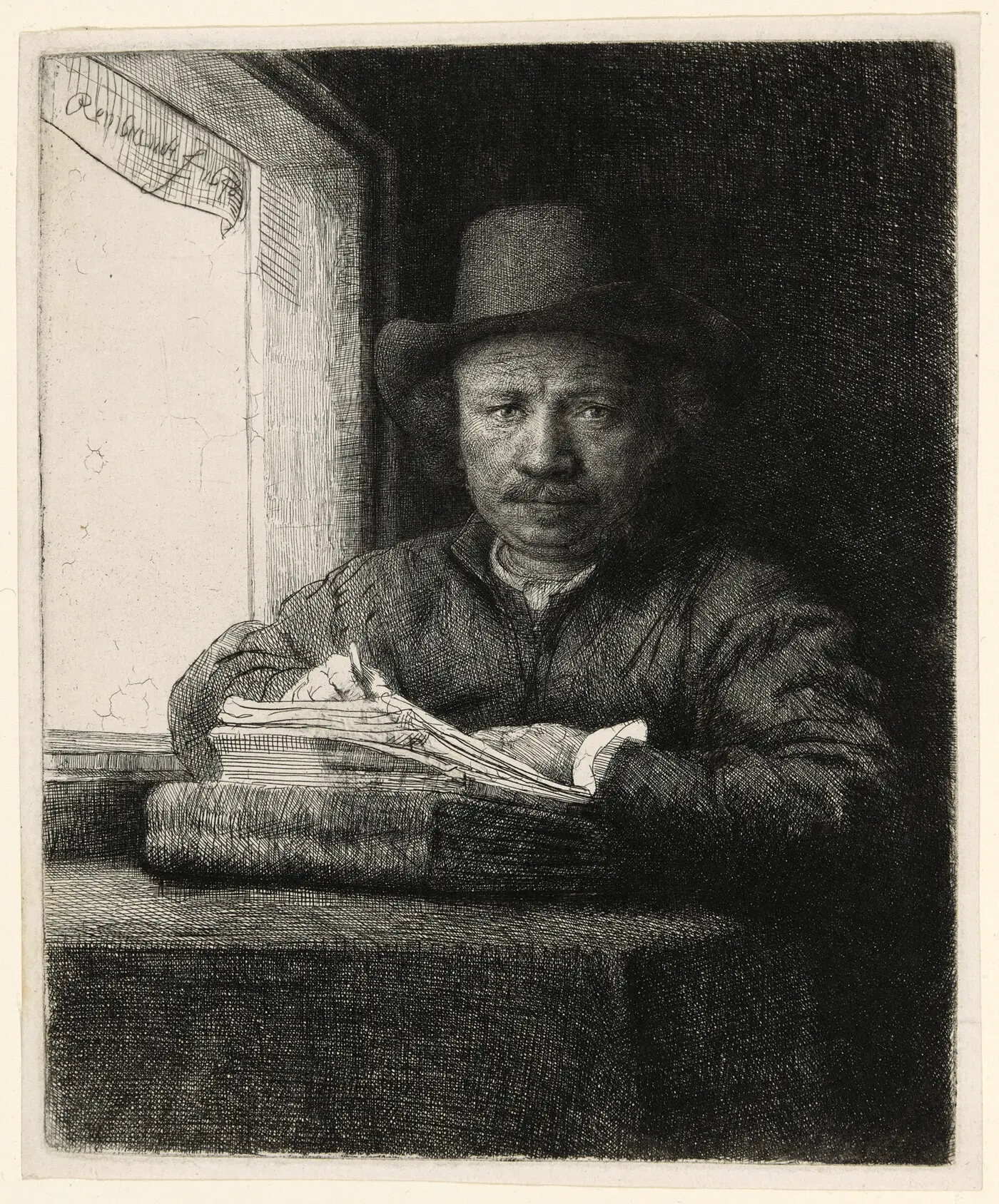
Self-Portrait Etching at a Window: The Artist Caught Between Looking and Being Seen
Rembrandt does something remarkably simple here: he places himself before us, and then makes us wonder whether we are really seeing the man at all.
The Artwork at a Glance
Self-Portrait Etching at a Window is a self-portrait print by Rembrandt van Rijn, made in 1648. It is an etching, created on a copper plate, and belongs to Rembrandt’s extraordinary body of self-portrait prints and drawings.
Rembrandt made an unusually large number of self-portraits throughout his life. But these images were not simply records of his appearance. They became a sustained investigation into identity, age, emotion, expression, performance, and the act of looking itself.
In this work, Rembrandt appears near a window, turning toward the viewer. The setting is simple. There is no grand costume, heroic pose, or elaborate background designed to announce his importance.
Instead, there is a man looking outward.
And because he is an artist, the situation becomes more complicated.
He is looking at us.
We are looking at him.
And somewhere between those two acts of looking lies the subject of the work.
The World Behind the Artwork
Rembrandt created this etching in the Dutch Golden Age, when the Netherlands was experiencing remarkable economic, cultural, and artistic growth.
Amsterdam had become a major center of trade and commerce.
A wealthy merchant class supported art.
Private homes contained paintings.
Portraiture became increasingly important.
But Dutch art differed in important ways from the grand court and church art found elsewhere in Europe.
Artists often painted merchants, scholars, domestic interiors, landscapes, still lifes, ordinary people, and scenes of everyday life.
This culture created an unusually rich environment for observing the individual.
A person’s face could become a subject in itself.
Rembrandt took that possibility further than almost anyone.
He repeatedly turned his own face into a laboratory for studying what it means to be human.
The Artist Behind the Work
Rembrandt was born in Leiden in 1606 and died in Amsterdam in 1669.
His career passed through extraordinary success and painful decline.
He became famous while still relatively young.
He received important commissions.
He lived an expensive life.
He collected art and objects.
Later, financial difficulties damaged his position, and he experienced personal losses, including the deaths of people close to him.
By the time he made this etching, he was in his early forties.
This matters because Rembrandt’s self-portraits were never separated completely from time.
He kept returning to his own face as it changed.
Youth disappeared.
Features became heavier.
The face accumulated experience.
His self-portraiture therefore became a visual record of a human life unfolding.
What We See
The composition is remarkably direct.
Rembrandt appears beside a window or opening, leaning or standing near it.
His figure emerges from a relatively dark environment.
His face and upper body receive the viewer’s attention.
He looks outward.
The surrounding space is not richly described.
The window becomes an important structural element because it separates two spaces.
Rembrandt is inside.
We are outside.
Yet the image creates a strange intimacy.
The physical distance between artist and viewer becomes almost nonexistent.
He seems close enough to speak to.
There is no grand theatrical gesture.
No symbolic throne.
No declaration of wealth.
Only the presence of a person.
The Window
The window is more than a piece of architecture.
It creates a boundary.
On one side is the artist’s world.
On the other is ours.
The window allows vision to pass between these spaces.
Rembrandt can look outward.
We can look inward.
This creates a subtle metaphor for portraiture itself.
A portrait is always a kind of window.
We look through an image and imagine that we are seeing another person’s interior life.
But can we really?
A face gives us information.
It also hides things.
We can see Rembrandt’s features.
We cannot see everything he is thinking.
The window therefore becomes a powerful image of the limits of human knowledge.
We can look at another person.
But we can never completely enter their mind.
The Gaze
The gaze is central.
Rembrandt does not present himself as a distant historical figure.
He meets the viewer’s presence.
This makes the image feel conversational.
But it also reverses the normal relationship between portrait and viewer.
We think we are observing the artist.
Yet he is observing us.
For a moment, the viewer becomes part of the subject.
Who is looking?
Who is being examined?
The artist studies himself.
The viewer studies the artist.
The artist appears to study the viewer.
The simple self-portrait becomes a chain of observation.
Self-Portraiture as Investigation
Rembrandt’s self-portraits are unusual because they do not seem to be interested only in making himself look attractive.
He shows himself at different ages and in different emotional states.
Sometimes dignified.
Sometimes amused.
Sometimes uncertain.
Sometimes dramatic.
Sometimes vulnerable.
This is very different from the polished self-presentation we often associate with portraits of powerful people.
Rembrandt seems willing to let the face remain human.
Wrinkles.
Unevenness.
Signs of age.
The physical evidence of life.
The portrait therefore becomes less about ideal beauty and more about presence.
How the Etching Works
The medium is essential.
Etching allows an artist to draw lines into a wax-coated copper plate and then use acid to bite those lines into the metal.
The resulting print can create remarkable variations of line and tone.
Rembrandt used this technique with extraordinary freedom.
He could create dark areas with dense networks of lines.
He could leave areas almost untouched.
He could use rapid, expressive marks.
He could build the impression of light without drawing every object in detail.
This gives the work a sense of immediacy.
It does not feel mechanically polished.
It feels drawn.
The viewer can almost sense the artist’s hand moving across the plate.
Light and Darkness
Light is one of Rembrandt’s greatest artistic tools.
He does not illuminate everything equally.
Some parts of the figure emerge clearly.
Others disappear into shadow.
This creates a psychological effect.
We never receive the entire person at once.
The face is present, but the surrounding body remains less certain.
The darkness becomes part of the portrait.
This is important because Rembrandt’s art often suggests that human identity contains both what can be seen and what remains hidden.
The face is visible.
The person is not completely knowable.
The Difference Between Appearance and Identity
A self-portrait seems to promise something very simple:
Here is the artist.
But the longer we look, the more complicated the promise becomes.
A face is not an identity.
It is evidence of an identity.
Rembrandt can show us his features.
He can show us his expression.
He can control his pose.
But he cannot put his entire consciousness onto the copper plate.
The self-portrait therefore contains an unavoidable gap.
The image is the person, and yet it is not the person.
This tension gives self-portraiture much of its philosophical power.
The Central Idea
At its deepest level, the work is about the unstable relationship between seeing oneself and knowing oneself.
Rembrandt looks at his own appearance.
But what does he discover?
A face?
An aging body?
An artist?
A social identity?
A private person?
The self is not something that can be completely captured by a mirror.
The portrait can record the surface.
But the human being extends beyond the surface.
This makes the work more than a portrait.
It becomes a meditation on identity.
Philosophy of the Artwork
The work naturally raises an old philosophical question:
What makes me the same person over time?
Rembrandt at twenty is not physically the same as Rembrandt at forty.
His face changes.
His experiences change.
His relationships change.
His social position changes.
His understanding of himself changes.
Yet we still call all of these images “Rembrandt.”
The self-portrait quietly confronts this problem.
Perhaps identity is not a fixed object.
Perhaps it is something continuously formed through memory, experience, body, relationships, and consciousness.
Rembrandt’s repeated self-portraits make this question visible across his life.
The Artist as Observer
There is another philosophical layer.
Rembrandt is both the subject and the observer.
Usually, an artist observes someone else.
Here he must turn observation toward himself.
But this is impossible in a completely direct sense.
He cannot see himself exactly as another person sees him.
He needs a mirror, memory, or another visual reference.
Even then, the act of observing oneself changes the self being observed.
The moment we know we are being watched, we begin to perform.
That means every self-portrait contains a tension between authenticity and performance.
Rembrandt may appear natural.
But he is still making artistic choices.
Truth and Performance
This is especially important when thinking about Rembrandt.
We often praise him for honesty.
But honesty in portraiture does not mean the absence of construction.
He chooses the angle.
He chooses the light.
He chooses the expression.
He chooses what to reveal and what to hide.
He decides how much of the body should appear.
He decides where the viewer should look.
So even an apparently unguarded portrait is an artistic performance.
This does not make it dishonest.
It makes the question of truth more interesting.
Perhaps a portrait can reveal truth precisely through conscious construction.
The Human Face
The face is one of the oldest subjects in art.
We look at faces because faces allow us to recognize other minds.
When we see someone’s expression, we instinctively search for emotion.
Is the person happy?
Sad?
Tired?
Angry?
Thoughtful?
Rembrandt understood this deeply.
His faces rarely feel empty.
Even when the expression is restrained, there is a sense of psychological presence.
The face becomes a meeting point between body and mind.
We see skin.
But we search for consciousness.
Age and Mortality
Rembrandt’s self-portraiture becomes especially powerful when viewed across his life.
He repeatedly recorded himself aging.
This is almost like a conversation with time.
Most people experience their own aging privately.
A mirror changes gradually.
A photograph captures isolated moments.
Rembrandt made the process into art.
His face becomes a historical record.
This makes the self-portrait a meditation on mortality.
Every line tells us that time is moving.
The artist can record himself.
He cannot stop himself from changing.
The image therefore preserves something that life cannot preserve.
A moment.
But the preservation itself reminds us that the moment is gone.
The Window and Mortality
The window adds another dimension to this idea.
A window separates interior and exterior.
It separates the private world from the public world.
It also connects them.
Rembrandt stands at this boundary.
The artist is both private individual and public figure.
The man exists in his own room.
The artist exists in the eyes of strangers.
The print carries his face beyond the moment in which it was created.
The window therefore becomes almost symbolic of the artwork itself.
It allows a private person to become visible to people who will never meet him.
Different Interpretations
One interpretation sees the work primarily as a study of Rembrandt’s appearance and artistic technique.
Another emphasizes its psychological intimacy.
Another sees the window as an important metaphor for the relationship between artist and viewer.
The image can also be understood as part of Rembrandt’s broader lifelong investigation into human expression.
There is no need to choose only one.
The work can be technically brilliant and psychologically rich at the same time.
Its simplicity allows multiple readings because it does not tell us exactly what Rembrandt is thinking.
The Artist’s Intention and the Viewer
Rembrandt probably intended to create a self-portrait, but that description is too simple.
He was also exploring the possibilities of etching, expression, light, and psychological presence.
The modern viewer brings additional questions.
We live in a world of photographs, mirrors, webcams, profile pictures, and social media.
We constantly produce images of ourselves.
Rembrandt’s problem suddenly becomes familiar.
How do we decide what version of ourselves to show?
What is authentic?
What is performance?
What happens when our image becomes more familiar to others than our actual presence?
Rembrandt could not have imagined social media.
But his self-portrait asks the same fundamental question:
How much of a person can an image reveal?
Reception and Historical Importance
Rembrandt’s self-portraits became central to his artistic reputation.
They contributed to the later image of Rembrandt as an artist deeply interested in psychological truth.
His printmaking was equally influential.
He demonstrated that an etching could possess extraordinary emotional depth and visual freedom.
Later artists studied his ability to create atmosphere with minimal lines and to transform technical marks into expressive presence.
His self-portraits also helped establish the idea that an artist’s own face could become an important subject of lifelong artistic investigation.
Why It Still Matters
The work remains powerful because we still struggle with the same problem.
We know what our faces look like.
But we do not know exactly how other people experience us.
We can photograph ourselves thousands of times.
Yet the image never quite captures the person.
We can present ourselves carefully.
Yet there is always something that escapes presentation.
Rembrandt’s portrait belongs to a world before photography, but its question feels remarkably contemporary.
Every profile picture asks:
Who am I showing you?
And beneath that question lies another:
Is that really me?
A Deeper Reading
Look again at the man near the window.
He is not dressed like a king.
He is not surrounded by symbols of wealth.
He does not need an elaborate setting to prove his importance.
He simply looks outward.
The simplicity is powerful because it strips away many of the things people normally use to define themselves.
Status disappears.
Possessions disappear.
Reputation disappears.
What remains is a face.
And yet even the face refuses to give us everything.
We can see the artist.
We can study his expression.
We can examine every line.
But we cannot enter his mind.
Perhaps this is what makes the image so deeply human.
Rembrandt spends his life trying to see himself clearly, and in the process he discovers the limit of seeing.
A face can be observed.
A life can be recorded.
A person can be remembered.
But the self always remains partly hidden behind the image.
The window opens.
The artist looks out.
We look in.
And for a brief moment, across nearly four centuries, two acts of looking meet.
Perhaps a self-portrait does not finally tell us who the artist is. Perhaps it reminds us that every human being remains, even to themselves, partly a mystery.