Tabula XIII
A Sheet of Anatomical Studies
Peter Paul Rubens, 1600/10
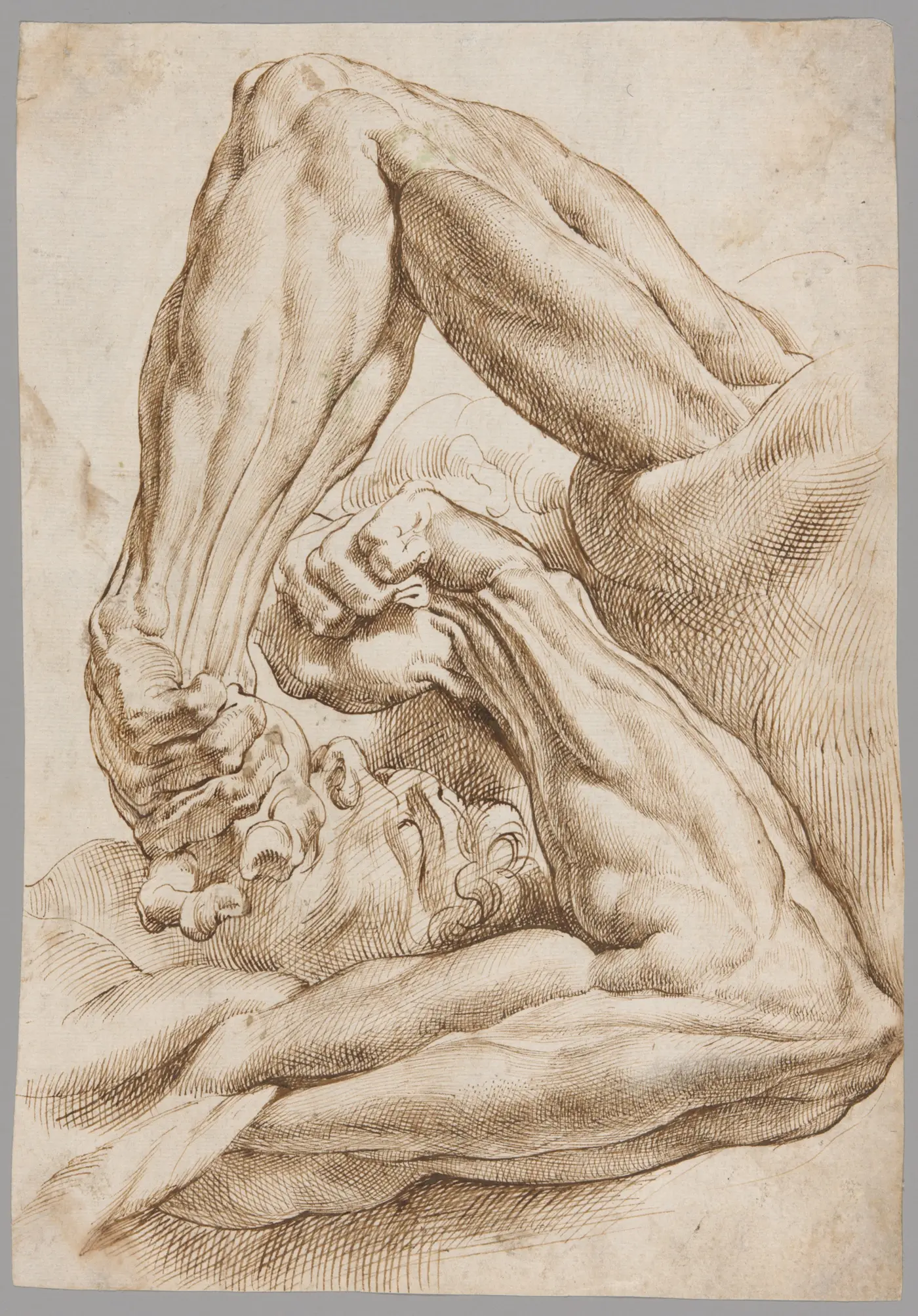
A Sheet of Anatomical Studies: When the Human Body Becomes a Language
Before Rubens painted bodies as heroes, lovers, saints, and kings, he had to understand the body itself.
The Artwork at a Glance
A Sheet of Anatomical Studies is a drawing by Peter Paul Rubens, one of the greatest painters of the European Baroque. Created in the early seventeenth century, it belongs to a group of anatomical studies in which Rubens closely observed the structure and movement of the human body.
Unlike a finished history painting, this work is a study sheet. It is not designed as a single, unified scene. Instead, the page gathers different views and studies of human anatomy, allowing Rubens to investigate muscles, limbs, posture, proportion, and the way the body changes when it moves.
That makes the sheet unusually revealing.
A finished painting shows us the result of an artist’s thinking.
A study sheet shows us the thinking itself.
Here Rubens is not yet asking the body to become a hero, a saint, or a mythological figure.
He is asking a more basic question:
How does the human body actually work?
The World Behind the Artwork
Rubens worked during the early seventeenth century, a period now associated with the Baroque.
Europe was experiencing enormous religious and political conflict. The Protestant Reformation had challenged the authority of the Catholic Church, and the Catholic response encouraged powerful forms of religious art designed to move viewers emotionally.
At the same time, Renaissance humanism had created a deep interest in the human body.
Artists increasingly studied anatomy because the body was central to visual storytelling.
A saint suffering on a cross needed believable anatomy.
A warrior needed convincing muscles.
A mythological god needed an idealized body.
A grieving mother needed expressive posture.
The human body became one of the central instruments through which artists communicated emotion and meaning.
Rubens inherited this tradition and pushed it toward extraordinary physical energy.
His figures do not merely stand.
They twist.
They struggle.
They fall.
They embrace.
They fight.
They carry.
They reach.
To paint such bodies convincingly, he needed to understand what existed underneath the skin.
The Artist Behind the Work
Peter Paul Rubens was born in Siegen in 1577 and died in Antwerp in 1640.
He was not simply a painter.
He was a scholar, diplomat, collector, designer, and one of the most intellectually ambitious artists of his age.
He traveled widely and studied the art of Italy, especially the work of ancient Roman sculpture and Renaissance masters such as Michelangelo, Raphael, Titian, and Leonardo.
His fascination with anatomy was part of this broader intellectual culture.
Rubens understood that artistic beauty was not created by copying the surface of the body.
It required understanding its underlying structure.
This is why anatomical studies were so important to him.
They gave him a vocabulary.
Once he understood the body, he could transform it.
What We See
The sheet contains multiple studies of the human body rather than one finished figure.
Different limbs and bodily structures are examined from different angles.
The studies focus on muscles, joints, bones, and the relationships between different parts of the body.
Some figures appear more complete than others.
Some are isolated fragments.
This fragmentation is important.
A finished painting encourages us to see the body as a complete person.
An anatomical study breaks that unity apart.
The arm becomes an arm.
The leg becomes a system of muscles.
The torso becomes a structure.
The body becomes something that can be examined.
Yet Rubens never completely loses the sense that these parts belong to living human beings.
The drawings retain movement.
The muscles seem ready to contract.
The limbs seem capable of changing position.
Anatomy becomes dynamic rather than merely scientific.
How the Study Works
The most important quality of the sheet is observation.
Rubens is trying to understand form through repeated looking.
He studies how muscles attach.
How they swell.
How they disappear beneath other structures.
How the skin changes when a limb bends.
How one part of the body affects another.
This is not anatomy for its own sake.
It is anatomy in service of painting.
Rubens needed to know what the body looked like when it performed extreme actions.
A classical hero twisting backward.
A warrior lifting a sword.
A saint reaching toward heaven.
A figure falling.
A body struggling against another body.
These actions become convincing only when the artist understands the mechanics beneath them.
The Difference Between Science and Art
The sheet occupies an interesting space between scientific observation and artistic invention.
Rubens is studying the body seriously.
But he is not producing an anatomical textbook.
His purpose is different.
A scientist asks:
What is the structure of the human body?
Rubens asks:
How can I use this structure to create a believable and expressive human figure?
The difference is subtle but important.
He does not simply want accurate information.
He wants usable knowledge.
He wants to understand the body well enough that he can later exaggerate it without losing its credibility.
That is one of the secrets behind his monumental figures.
Their physical exaggeration works because it is built on anatomical understanding.
The Body as Movement
Rubens’s art is famous for movement.
His bodies often twist in powerful spirals.
This creates a sense that the figure is caught in the middle of an action.
Anatomy makes this possible.
A muscle is not simply a shape.
It is an agent of movement.
When a joint bends, muscles change position.
When weight shifts, the entire body reorganizes itself.
When a person reaches forward, the shoulder, torso, spine, and hips participate.
Rubens’s anatomical studies allow him to think of the body as a system of forces.
This is why his later figures often feel almost explosive.
They appear to be moving even when they are frozen on canvas.
The Human Body and Beauty
Rubens did not simply want to reproduce ordinary bodies.
He wanted to create bodies that were powerful, beautiful, and expressive.
This is where anatomy becomes connected to idealization.
Knowing the real structure of the body allows an artist to depart from ordinary reality.
Rubens can enlarge muscles.
Strengthen curves.
Increase physical volume.
Emphasize shoulders.
Expand torsos.
Create dramatic gestures.
Yet the figure still feels anatomically possible.
This is the difference between arbitrary exaggeration and informed idealization.
Rubens does not ignore reality.
He learns reality deeply enough to transform it.
The Influence of Classical Sculpture
Rubens’s anatomical thinking was closely connected to his admiration for ancient Greek and Roman sculpture.
Ancient sculptures presented the body as an ideal of physical strength, balance, and beauty.
Rubens studied these works intensely.
But he did not simply imitate them.
He added movement.
His bodies often appear more active and emotionally charged.
Classical sculpture gave him the vocabulary of ideal form.
Anatomy gave him structural knowledge.
Baroque art gave him drama.
The result was a new kind of body.
A body that seems simultaneously classical and alive.
Anatomy and Emotion
It may seem strange to connect anatomy with emotion.
But Rubens understood that emotion is physical.
Fear changes posture.
Grief changes the face.
Anger changes muscle tension.
Desire changes the body.
Pain twists the torso.
Exhaustion collapses the shoulders.
A person does not simply “feel” emotion inside the mind.
Emotion appears through the body.
This is why anatomical knowledge can become psychological knowledge.
To understand how the body moves is partly to understand how human beings express themselves.
The Central Idea
At the deepest level, the anatomical sheet is about understanding the relationship between structure and life.
The body is not a collection of disconnected parts.
It is an organized system.
Muscles depend on bones.
Movement depends on joints.
Expression depends on posture.
Gesture depends on structure.
Rubens’s studies therefore reveal an artist learning the grammar of the body.
A finished painting is like a sentence.
Anatomical studies are like learning the alphabet.
Before Rubens could make a body speak through painting, he had to learn how that body was built.
Philosophy of the Human Body
The Renaissance and Baroque fascination with anatomy raises a philosophical question:
What is a human being?
Is a person a soul living inside a body?
Is the body merely a physical machine?
Or is the body part of who we are?
Rubens’s drawings do not offer a philosophical argument.
But they make one thing impossible to ignore.
Human experience is embodied.
We understand the world through bodies.
We communicate through bodies.
We suffer through bodies.
We love through bodies.
We age through bodies.
We eventually die through bodies.
The anatomical study begins with muscle and bone but leads naturally toward questions about human existence.
Beauty and Mortality
There is also a quiet tension between beauty and death.
Rubens studies the body because the living body is extraordinary.
It moves.
It stretches.
It bends.
It creates expression.
But anatomy also reveals something less comfortable.
The body is physical.
It can be opened.
Measured.
Examined.
Damaged.
Aging and death are written into its structure.
This gives anatomical study a double meaning.
It celebrates the complexity of life while reminding us that life has a physical limit.
The Body as Object and Person
There is an important contradiction in the sheet.
When Rubens studies a limb, he turns part of a person into an object of observation.
The arm becomes structure.
The muscle becomes form.
The body becomes measurable.
But the purpose of the study is ultimately to return that knowledge to the representation of a complete human being.
Rubens breaks the person apart in order to understand how to put the person back together.
That is a fascinating artistic paradox.
Analysis separates.
Art reunites.
The Artist’s Method
Rubens’s studies show that great painting does not begin with inspiration alone.
It begins with discipline.
Looking.
Repeating.
Correcting.
Comparing.
Studying.
Remembering.
Testing.
The romantic idea of the artist as someone who simply follows spontaneous emotion is not enough to explain Rubens.
His apparent freedom was built on knowledge.
His energetic figures were possible because he had trained his eye.
His confidence came from preparation.
The study sheet is therefore a reminder that artistic freedom often depends on discipline.
Different Interpretations
An art historian may see the sheet as evidence of Rubens’s anatomical training and his engagement with Renaissance traditions.
A viewer interested in science may see it as an example of the historical relationship between art and anatomical investigation.
Another viewer may see something more human.
The sheet is a record of someone trying to understand the body.
That effort is recognizable even outside art.
Human beings have always tried to understand themselves by examining themselves.
We study our bodies because they are both familiar and mysterious.
We live inside them every moment, yet their complexity remains extraordinary.
The Artist’s Intention and the Viewer
Rubens’s immediate purpose was practical.
He needed anatomical knowledge for his art.
But the sheet now has a different significance.
We can look at it as evidence of artistic education.
We can study it as historical anatomy.
We can appreciate its lines as drawings.
Or we can see it as a glimpse into the mind of an artist at work.
That last possibility is perhaps the most compelling.
The sheet shows us Rubens before the spectacle.
Before the grand painting.
Before the dramatic mythology.
Before the heroic body is transformed into a finished image.
We see the artist learning.
Why It Still Matters
Today, anatomy can be explored through medical imaging, digital models, animation software, and three-dimensional visualization.
An artist can rotate a virtual skeleton.
A computer can show muscles moving.
Technology can reveal structures Rubens could only study through direct observation and existing anatomical knowledge.
Yet the basic artistic problem has not disappeared.
How does a body move?
How does structure create expression?
How can a still image communicate motion?
How can a painted figure feel alive?
These remain central questions in painting, sculpture, animation, film, illustration, and digital art.
Rubens’s study therefore belongs not only to the history of anatomy or Renaissance art.
It belongs to the long human effort to understand movement through images.
A Deeper Reading
Look at the sheet without thinking about the famous Rubens paintings that came later.
It is easy to see fragments.
Arms.
Legs.
Muscles.
Bodies.
But gradually another idea emerges.
These are not simply pieces of flesh.
They are the foundations of gesture.
A muscle will contract.
A joint will bend.
A hand will reach.
A torso will twist.
A body will carry another body.
A person will fall, rise, embrace, fight, pray, dance, suffer, or celebrate.
Rubens is studying the machinery that makes human expression possible.
And this is why the sheet matters.
It shows that the grandeur of Baroque painting was not produced by emotion alone.
Behind the dramatic saints, gods, warriors, lovers, and heroes was patient observation.
Before the body could become a symbol, it had to become believable.
Before Rubens could make the human figure appear larger than life, he had to understand life at the level of muscle and bone.
Perhaps that is the deepest lesson of this seemingly simple sheet of studies:
great art does not begin when the artist finally knows everything. It begins when the artist becomes curious enough to study what everyone else takes for granted.