Tabula XVII
Niccolò Machiavelli
Unknown, born on May 3, 1469, and died on June 21, 1427 (at age 58), in Florence, Italy.
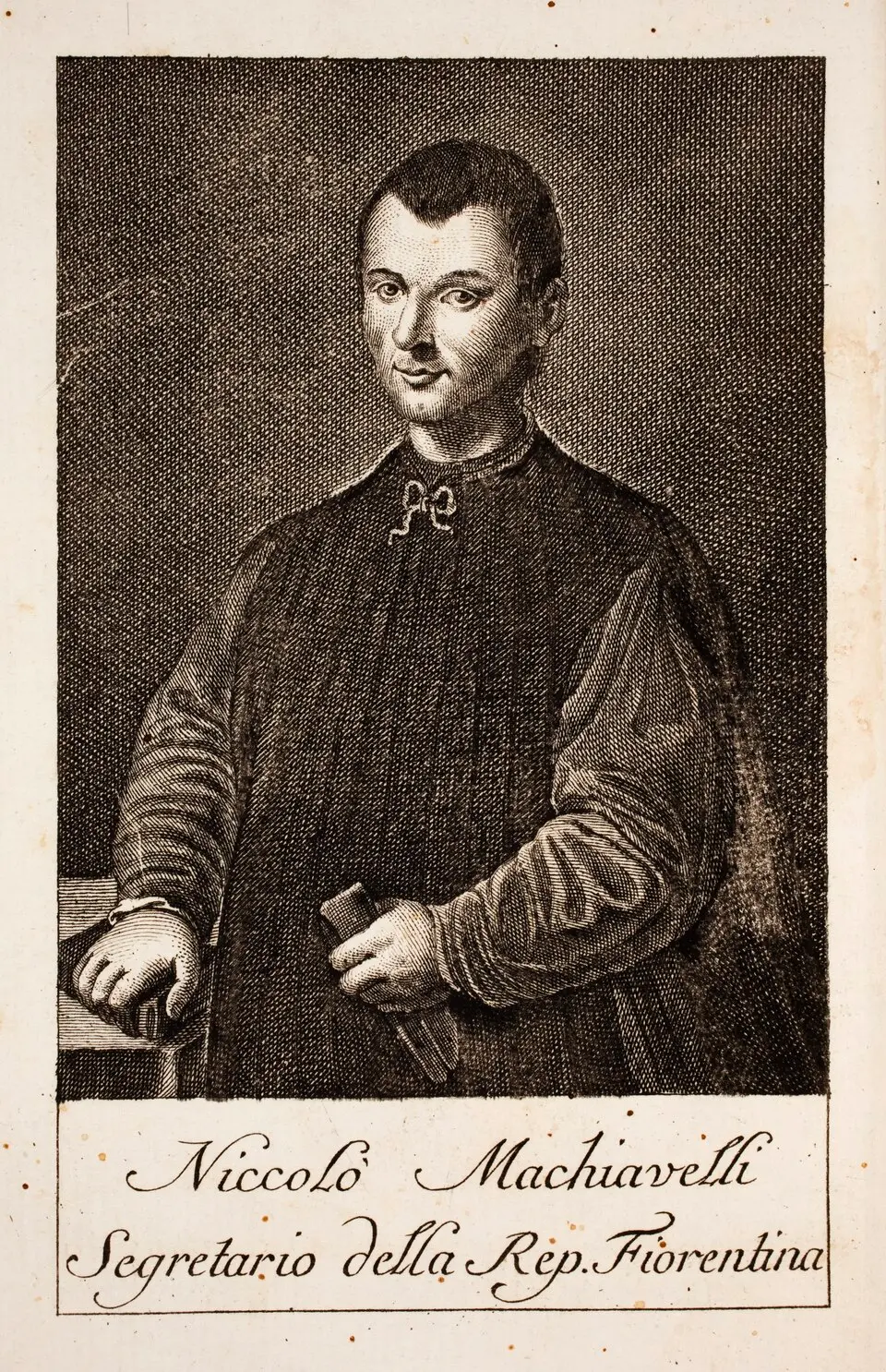
Niccolò Machiavelli: The Philosopher Who Asked What Power Really Requires
Machiavelli forced political thought to confront an uncomfortable truth: the virtues we admire in private life are not always the same qualities that allow a ruler to survive, protect a state, and hold power.
WHO WAS NICCOLÒ MACHIAVELLI?
Niccolò di Bernardo dei Machiavelli was born on May 3, 1469, in Florence, in the Italian Renaissance, and died there on June 21, 1527.
He was born into a relatively modest but educated Florentine family.
His father, Bernardo Machiavelli, was a lawyer from an old family whose finances had declined. His mother was Bartolomea di Stefano Nelli.
Machiavelli did not come from the most powerful aristocratic families of Florence.
This mattered.
He grew up close enough to politics to understand how power worked, but not so powerful that he could take political authority for granted.
His education included Latin literature and the study of classical history.
The ancient world became one of his greatest intellectual resources.
He admired Roman political history, especially the struggles, institutions, military organization, and civic virtues of the Roman Republic.
But Machiavelli was not simply a scholar.
He became a diplomat, government official, political observer, military thinker, writer, and eventually a political exile.
His experience in government shaped his philosophy more deeply than abstract theory alone.
He watched rulers negotiate.
He watched alliances collapse.
He watched armies fail.
He watched powerful people make promises and break them.
And he became convinced that political life could not be understood by pretending people were more virtuous than they actually were.
THE WORLD MACHIAVELLI INHERITED
Machiavelli lived during the Italian Renaissance.
But Renaissance Italy was not a unified country.
The peninsula was divided among competing political powers:
Florence
Venice
Milan
Naples
the Papal States
and numerous smaller states and territories.
Foreign powers also intervened.
France.
Spain.
The Holy Roman Empire.
The papacy.
Italy was wealthy and culturally sophisticated, but politically fragmented.
Wars were frequent.
Political alliances changed quickly.
Rulers could be overthrown.
Cities could be invaded.
Mercenary armies could change sides.
Machiavelli saw a world where political survival was uncertain.
This environment helps explain his philosophy.
He was not writing political theory from a peaceful university.
He was trying to understand how states survive in a dangerous world.
THE HISTORICAL CRISIS OF FLORENCE
Florence was especially important to Machiavelli.
The city experienced political instability throughout his lifetime.
The powerful Medici family dominated Florentine politics for long periods.
In 1494, the Medici were expelled.
A republican government was established.
Machiavelli entered government service under the Florentine Republic.
He served as a diplomat and official for many years.
He traveled to courts and met major political figures.
One of the most important was Cesare Borgia.
Machiavelli observed Borgia closely.
Borgia was ruthless, ambitious, intelligent, and politically dangerous.
Machiavelli became fascinated by how Borgia acquired and maintained power.
Then history turned against Machiavelli.
The Medici returned to Florence in 1512.
The republic collapsed.
Machiavelli lost his position.
He was imprisoned and tortured after being suspected of conspiracy.
He was eventually released and forced into political retirement.
He withdrew to his property outside Florence.
There, partly excluded from political life, he wrote some of his most important works.
THE CENTRAL QUESTION
Machiavelli’s philosophy revolves around a deceptively simple question:
How can political power actually be acquired, maintained, and used in a dangerous world?
This question leads to others:
What makes a ruler effective?
Why do states collapse?
Can a ruler afford to be morally good all the time?
Should leaders keep promises when keeping them destroys the state?
Is fear better than love?
What is the relationship between force and legitimacy?
Why do republics succeed or fail?
How should political leaders deal with fortune and uncertainty?
Machiavelli’s importance comes from his willingness to ask these questions without assuming that political life follows the moral rules of ordinary private life.
THE PHILOSOPHICAL WORLD BEFORE MACHIAVELLI
Before Machiavelli, much political philosophy focused on the question:
What should the ideal ruler be like?
Plato described the philosopher-king.
Aristotle examined different constitutions and the conditions of political flourishing.
Medieval Christian thinkers often connected political authority with divine and moral order.
Political writing commonly discussed the virtues a good ruler should possess:
justice,
wisdom,
temperance,
piety,
honor,
and generosity.
Machiavelli does something different.
He asks:
What happens when the world does not cooperate with our moral ideals?
Suppose a ruler is honest.
But his enemy lies.
Suppose a ruler is merciful.
But rebels interpret mercy as weakness.
Suppose a ruler keeps every promise.
But circumstances change.
What should the ruler do?
Machiavelli’s answer is uncomfortable:
Political judgment must begin with reality, not wishful thinking.
REALISM: LOOK AT PEOPLE AS THEY ARE
One of Machiavelli’s greatest contributions is political realism.
He does not begin with:
“How should human beings behave in an ideal society?”
He begins with:
“How do human beings actually behave?”
People can be:
ambitious,
fearful,
greedy,
ungrateful,
self-interested,
deceptive,
loyal,
courageous,
and changeable.
A political system that assumes universal virtue is fragile.
A ruler who ignores human weakness may lose power.
This does not mean Machiavelli thinks every human being is evil.
His point is more practical:
A political leader must plan for human beings as they actually behave, not as we wish they behaved.
THE PROBLEM OF POLITICAL MORALITY
Here is the basic conflict.
Traditional moral view:
A good ruler should always be honest, generous, merciful, and faithful.
Machiavelli’s problem:
What if behaving this way destroys the state?
Imagine a ruler who refuses to punish a violent rebel because punishment seems cruel.
The rebellion grows.
Thousands die.
Was the ruler morally good?
Machiavelli forces us to confront the possibility that private morality and political responsibility may conflict.
VIRTÙ
One of Machiavelli’s most important concepts is virtù.
It is often translated as “virtue,” but this can be misleading.
Machiavelli’s virtù is closer to:
political skill
courage
decisiveness
strategic intelligence
adaptability
strength
initiative
capacity to act
A ruler with virtù can recognize opportunities and act effectively.
They do not simply wait for circumstances to improve.
They shape circumstances.
This is one of Machiavelli’s major departures from traditional moral philosophy.
A ruler may be personally kind but politically incompetent.
Another ruler may be morally troubling but politically effective.
Machiavelli wants us to understand the second kind of ability.
FORTUNA
The opposite force is fortuna, or fortune.
Fortuna represents the unpredictable forces of life:
war,
economic change,
political accidents,
betrayal,
natural disasters,
unexpected opportunities,
and the decisions of other people.
Human beings cannot control everything.
But Machiavelli argues that effective leaders prepare for fortune.
The best ruler does not assume everything will go according to plan.
They build flexibility.
They anticipate danger.
They act when opportunity appears.
VIRTÙ VS. FORTUNA
The relationship can be expressed simply:
Fortuna creates circumstances.
Virtù determines how you respond.
Imagine two leaders facing the same crisis.
One panics.
The other adapts.
The crisis itself was not under their control.
Their response was.
This is one reason Machiavelli remains relevant.
Political leadership, business, military strategy, and even ordinary life involve uncertainty.
The question is rarely:
Can I control everything?
It is:
Can I respond effectively when I cannot control everything?
THE PRINCE
Machiavelli’s most famous book is The Prince, written around 1513.
It is a short but explosive work about political power.
Machiavelli examines:
how rulers gain power,
how they lose it,
how new states are created,
how conquered territories should be managed,
how rulers should use force,
how reputation works,
and how leaders should respond to changing circumstances.
The book is often treated as a manual for evil rulers.
That is too simple.
Machiavelli’s real project is more disturbing.
He wants to explain politics without pretending that politics is morally clean.
THE FAMOUS QUESTION: SHOULD A RULER BE LOVED OR FEARED?
Machiavelli asks whether it is better for a ruler to be loved or feared.
His answer is:
It is safest to be feared if one cannot be both.
But there is an essential qualification.
A ruler should avoid being hated.
Why?
Fear can produce obedience.
Hatred can produce rebellion.
This distinction is crucial.
Machiavelli is not saying:
“Be cruel whenever possible.”
He is saying:
If political survival requires choosing between love and fear, fear is often more reliable.
But unnecessary cruelty can create hatred and eventually destroy the ruler.
THE PROBLEM OF LOVE
Why is love politically unreliable?
Because human loyalty can change.
People may love a ruler while life is comfortable.
When circumstances become difficult, loyalty can disappear.
Fear is more predictable.
But fear also has limits.
If people fear a ruler but do not hate them, political stability may be possible.
If fear becomes hatred, stability becomes dangerous.
This is Machiavelli’s cold calculation.
THE QUESTION OF CRUELTY
Machiavelli distinguishes between forms of cruelty.
Some cruelty is used quickly and strategically to establish order.
Other cruelty is repeated and uncontrolled.
The first may stabilize a state.
The second creates hatred.
This leads to one of his most disturbing political insights:
Political violence can sometimes be more destructive when it is inconsistent than when it is decisive.
A ruler who constantly punishes people creates permanent insecurity.
A ruler who acts decisively and then restores order may create greater stability.
Whether one accepts this argument is another matter.
But the logic is clear.
THE MORAL PROBLEM
Here is where Machiavelli becomes genuinely difficult.
Suppose a ruler must choose between:
doing something morally wrong
and
allowing the state to collapse.
Should the ruler choose the immoral action?
Machiavelli’s political realism suggests that sometimes they must.
But this creates an enormous danger.
If leaders decide that “saving the state” justifies anything, almost any crime can be defended.
So the question becomes:
Who decides what counts as necessary?
This is one of Machiavelli’s greatest unresolved problems.
THE END AND THE MEANS
Machiavelli is often summarized as saying:
“The ends justify the means.”
But he never actually writes that exact phrase.
The idea is nevertheless associated with his thought.
His argument is more complicated.
Political leaders sometimes face situations where morally pure methods cannot achieve politically necessary goals.
A ruler must therefore consider consequences.
But Machiavelli does not provide an unlimited license for cruelty.
His central concern is political survival and stability.
The danger is that once necessity becomes the justification, rulers can redefine almost anything as necessary.
CESARE BORGIA
Cesare Borgia became one of Machiavelli’s most important examples.
Borgia was the son of Pope Alexander VI.
He acquired territories in central Italy and attempted to build his own political power.
Machiavelli admired his:
decisiveness,
strategic intelligence,
ability to use force,
ability to manipulate alliances,
and capacity to act quickly.
One famous episode involves Borgia’s use of Ramiro de Orco, a brutal official, to impose order in Romagna.
After order was established, Borgia had Ramiro executed publicly.
The message was politically clever:
Borgia could punish disorder, but he could also distance himself from excessive cruelty.
Machiavelli saw this as an example of political theater combined with strategic force.
MACHIAVELLI’S ARGUMENT ABOUT APPEARANCE
A ruler cannot survive through action alone.
They must also manage perception.
People judge leaders largely by what they see.
Therefore a ruler should appear:
merciful,
faithful,
religious,
honest,
and humane.
But Machiavelli warns that a ruler must be capable of acting differently when circumstances require it.
This creates a distinction between:
appearance
and
reality.
A leader may need to appear virtuous while retaining the ability to act ruthlessly.
This is one of the most controversial aspects of Machiavelli.
THE FOX AND THE LION
Machiavelli gives us one of his most memorable political images:
The lion and the fox.
The lion represents strength.
The fox represents cunning.
A ruler needs both.
Why?
Force alone cannot defeat every problem.
A ruler can be powerful but trapped by deception.
Cunning alone is also insufficient.
A ruler may manipulate others but be unable to defend the state.
The successful ruler therefore combines:
the strength to confront enemies
with
the intelligence to recognize traps.
PROMISES AND POLITICAL NECESSITY
Should a ruler always keep promises?
Machiavelli says no.
If circumstances change and keeping a promise threatens the state, the ruler may need to break it.
His reasoning is based on political reality.
Other rulers may not keep their promises.
If you remain bound by promises while everyone else acts strategically, you may destroy yourself.
But again, there is a problem.
If rulers become known for breaking promises, why should anyone trust them?
Machiavelli’s answer is partly reputation.
A ruler must appear trustworthy.
So political stability may require selective dishonesty combined with the appearance of reliability.
This is morally troubling.
But it reveals Machiavelli’s attempt to describe politics as it actually operates.
MACHIAVELLI AND RELIGION
Machiavelli understood the political power of religion.
He respected its ability to shape social behavior and political unity.
But his relationship with Christianity was complicated.
He believed Christianity could weaken certain Roman civic virtues by encouraging humility, otherworldliness, and submission.
He admired the civic strength he associated with ancient Roman religion.
This does not mean Machiavelli simply rejected religion.
He understood that religion could be politically powerful.
His question was:
What does religion do to political communities?
That is different from asking whether religious doctrines are metaphysically true.
MACHIAVELLI AND THE REPUBLIC
This is where Machiavelli becomes more interesting than the reputation of The Prince suggests.
Machiavelli was not simply a defender of dictators.
His Discourses on Livy strongly explore republican government.
He admired the Roman Republic.
Why?
Because he believed political liberty requires institutions, civic participation, military strength, and mechanisms that prevent one person from becoming permanently dominant.
This creates an important tension:
The Prince studies how rulers acquire and maintain power.
The Discourses studies how republican political life can preserve liberty.
Machiavelli therefore cannot simply be reduced to “the philosopher of tyranny.”
MACHIAVELLI’S REPUBLICANISM
Machiavelli believed conflict between social groups could sometimes strengthen a republic.
This is surprising.
Traditional political thinkers often treated internal conflict as something to eliminate.
Machiavelli saw conflict between elites and ordinary citizens as potentially productive.
Why?
Because competing groups can limit each other’s power.
A society in which one class dominates completely may become unstable.
A society with institutions that channel conflict may preserve freedom.
This is a remarkably modern idea.
CONFLICT CAN PROTECT LIBERTY
Suppose powerful elites control everything.
There is little resistance.
They can abuse their power.
But if citizens have institutions through which they can resist elite domination, power becomes more balanced.
Machiavelli therefore sees a strange possibility:
Political conflict is not always the enemy of freedom.
Sometimes conflict is what prevents one group from becoming completely dominant.
The goal is not always harmony.
Sometimes the goal is controlled competition within institutions.
MACHIAVELLI AND MILITARY POWER
Machiavelli strongly opposed dependence on mercenary armies.
He believed a state should maintain its own citizen army.
Mercenaries fight for money.
Their loyalty is therefore uncertain.
A citizen army has a deeper connection to the political community.
This is both a military and political argument.
A state that cannot defend itself is vulnerable.
Political independence requires military capacity.
For Machiavelli:
political freedom without the ability to defend oneself is fragile.
POLITICS AND HUMAN NATURE
Machiavelli’s political realism depends on a certain view of human beings.
People generally care about:
security,
property,
status,
family,
honor,
and personal interest.
They can be loyal.
But loyalty can change.
They can be generous.
But generosity can disappear under pressure.
They can support a leader.
But they may abandon that leader when circumstances change.
Therefore political institutions must not depend entirely on human goodness.
This is one of Machiavelli’s most important insights.
Good institutions should work even when people are imperfect.
MACHIAVELLI AND HUMAN NATURE: A PROBLEM
But is Machiavelli too pessimistic?
Humans can cooperate.
People sacrifice for others.
People defend principles even when doing so costs them.
People can be loyal without personal benefit.
Communities can develop trust.
If Machiavelli underestimates these capacities, his political realism may become unnecessarily cynical.
The challenge is therefore:
How much selfishness should political institutions assume?
Too much optimism creates vulnerability.
Too much pessimism can destroy trust.
FORTUNA AND POLITICAL LEADERSHIP TODAY
Machiavelli’s idea of fortune remains highly relevant.
A political leader cannot control:
economic crises,
wars,
natural disasters,
technological change,
public opinion,
international events,
or the decisions of rivals.
The leader can only control their response.
This is why Machiavelli values adaptability.
A rigid leader can be destroyed by changing circumstances.
A flexible leader can survive.
MACHIAVELLI AND MODERN POLITICS
Machiavelli’s questions remain alive whenever we discuss:
political propaganda,
leadership,
elections,
state power,
war,
diplomacy,
national security,
political communication,
public image,
and institutional design.
Modern politics often separates:
what leaders privately believe,
what they publicly say,
and what they actually do.
Machiavelli would immediately recognize the problem.
He would ask:
What is the political purpose of the performance?
MACHIAVELLI AND SOCIAL MEDIA POLITICS
Modern politicians constantly manage appearances.
A leader must appear:
strong,
empathetic,
patriotic,
honest,
competent,
and relatable.
A single photograph can influence public perception.
A carefully chosen speech can change political narratives.
A political scandal can destroy trust.
Machiavelli would probably see modern politics as an enormous laboratory of reputation management.
But his deeper question would remain:
Does political appearance merely communicate reality, or does it become reality in the minds of citizens?
MACHIAVELLI IN EVERYDAY LIFE
Machiavelli is not only useful for understanding presidents and kings.
Consider a workplace.
A manager wants everyone to like them.
They avoid difficult decisions.
Employees stop respecting their authority.
Another manager is feared.
Employees obey but secretly hate them.
Neither is ideal.
Machiavelli would ask:
What kind of authority creates stable cooperation?
The answer is not necessarily kindness or fear.
It is effective authority.
The same problem appears in:
families,
organizations,
businesses,
universities,
political parties,
and social groups.
Power exists wherever people must coordinate despite competing interests.
THE HUMAN SIDE OF MACHIAVELLI
Machiavelli’s personal life is more complicated than his reputation suggests.
He was witty.
Social.
Interested in theater.
Interested in literature.
Interested in politics.
He wrote the comedy The Mandrake, which shows his ability to understand human desire, deception, hypocrisy, and social performance.
He was not simply a cold political theorist.
He was deeply interested in human behavior.
His letters also reveal humor and personality.
After political exile, he continued writing and hoping to return to public service.
He never fully accepted political exclusion.
That personal frustration matters.
Machiavelli was not observing politics from a comfortable distance.
He had experienced the loss of political power personally.
THE CONTRADICTION OF MACHIAVELLI
Machiavelli’s greatest contradiction is this:
He is famous for teaching rulers how to acquire power, but he also wrote extensively about republican liberty.
He is associated with tyranny, yet admired institutions that restrain rulers.
He emphasizes force, yet understands the importance of consent.
He emphasizes fear, yet warns against hatred.
He emphasizes deception, yet understands the importance of reputation.
He accepts political violence, yet worries about political instability.
He appears cynical about human nature, yet believes citizens can defend liberty.
These contradictions are not simply mistakes.
They reveal the complexity of politics itself.
THE CRITICISM OF MACHIAVELLI
The most obvious criticism is moral.
If rulers are allowed to lie, manipulate, and use violence whenever they believe it is politically necessary, what prevents tyranny?
A second criticism is epistemological.
How does a ruler know what is truly necessary?
A leader can claim:
“I had no choice.”
But perhaps they simply wanted more power.
A third criticism concerns human nature.
If leaders constantly assume everyone is selfish and untrustworthy, they may create the very world they fear.
Distrust creates distrust.
Fear creates resistance.
Manipulation destroys genuine loyalty.
So Machiavellian politics can become a self-fulfilling prophecy.
WHAT MACHIAVELLI GOT RIGHT
Machiavelli correctly recognized that:
Power is not the same as morality.
Political institutions operate under pressure.
Leaders face conflicting responsibilities.
Protecting a state may require difficult choices.
Human beings are imperfect.
Politics cannot assume universal virtue.
Reputation matters.
People respond to what they believe about leaders.
Institutions matter.
Stable political systems cannot depend entirely on individual goodness.
Conflict can sometimes protect liberty.
Competing interests can prevent domination.
Military independence matters.
A state unable to defend itself is vulnerable.
Fortune matters.
No political plan controls everything.
These insights helped establish modern political realism.
WHAT MACHIAVELLI GOT WRONG OR LEFT OPEN
Machiavelli sometimes reduces political life too heavily to power and survival.
Political communities also depend on:
trust,
justice,
legitimacy,
shared identity,
law,
and moral commitment.
A state cannot survive indefinitely through fear alone.
Citizens must eventually believe that the political order is worth preserving.
Machiavelli understood legitimacy, but his emphasis on strategy can sometimes make politics look more cynical than it really is.
His theory also leaves a difficult question:
Can a ruler use immoral means temporarily without becoming morally transformed by them?
Power changes people.
The ruler who repeatedly lies may eventually lose the ability to distinguish strategy from character.
MACHIAVELLI AND PLATO
The contrast with Plato is dramatic.
Plato asks:
What should the ideal ruler know?
Machiavelli asks:
What does a ruler actually need to survive?
Plato’s philosopher-king is guided by knowledge of the Good.
Machiavelli’s prince must understand:
force,
fear,
fortune,
deception,
alliances,
and human weakness.
Plato begins with an ideal.
Machiavelli begins with reality.
This marks one of the great shifts in political thought.
MACHIAVELLI AND ARISTOTLE
Aristotle asks how political communities can create conditions for human flourishing.
Machiavelli asks how political communities survive conflict and instability.
Aristotle focuses heavily on virtue.
Machiavelli focuses heavily on effectiveness.
Aristotle asks:
What makes a good political order?
Machiavelli asks:
What keeps a political order alive?
Both questions matter.
A political system can be morally admirable but politically fragile.
A political system can be politically stable but morally oppressive.
The deepest political problem lies somewhere between these extremes.
MACHIAVELLI AND NIETZSCHE
Nietzsche later shares Machiavelli’s suspicion of conventional moral language.
Both ask us to look beneath appearances.
Both are interested in:
power,
motivation,
conflict,
human psychology,
and the origins of values.
But their projects differ.
Machiavelli asks:
How should political power be used?
Nietzsche asks:
What kind of human being is created by the values and power structures around us?
Machiavelli is primarily political.
Nietzsche is more psychological, cultural, and philosophical.
Yet both challenge comfortable moral stories.
MACHIAVELLI’S LEGACY
Machiavelli transformed political thought.
He helped shift attention from:
ideal politics
toward
actual political behavior.
Later thinkers would debate his ideas in political science, international relations, military strategy, constitutional theory, and political philosophy.
His name even became an adjective:
Machiavellian.
Today it usually means manipulative, calculating, and willing to use others for personal advantage.
But this popular meaning is narrower than Machiavelli himself.
Machiavelli was not simply teaching people to be selfish.
He was trying to understand the relationship between:
power, necessity, morality, institutions, and political survival.
WHY MACHIAVELLI STILL MATTERS
Machiavelli remains relevant because politics still contains the conflict he identified.
We want leaders to be:
honest,
kind,
principled,
transparent,
and morally good.
But we also expect them to:
protect citizens,
make difficult decisions,
negotiate with hostile actors,
manage crises,
defend national interests,
and prevent political collapse.
What happens when these responsibilities conflict?
Suppose telling the truth causes panic.
Suppose a compromise prevents war but violates a campaign promise.
Suppose punishing a corrupt official threatens political stability.
Suppose a leader must cooperate with someone morally unpleasant to prevent a greater danger.
There is no simple answer.
That is why Machiavelli remains uncomfortable.
MACHIAVELLI’S PHILOSOPHY IN SIMPLE WORDS
Look at political reality as it is, not as you wish it were.
Human beings are imperfect, so institutions must account for that.
Power requires judgment, not merely good intentions.
A leader must understand both force and persuasion.
Fear can be more reliable than love, but hatred is dangerous.
Reputation matters because political power depends partly on perception.
Fortune is unpredictable, so adaptability matters.
Political conflict can sometimes protect liberty.
A strong state requires institutions, not merely a strong ruler.
Morality and political necessity can come into conflict.
And perhaps the most important:
Never confuse having good intentions with knowing how to govern.
THE FINAL QUESTION
Machiavelli begins with a problem that earlier political philosophy often tried to avoid.
Human beings are not always virtuous.
States are not always peaceful.
Enemies do not always follow moral rules.
Political circumstances change.
And rulers sometimes face choices in which every option carries a cost.
His answer is political realism.
Understand power.
Understand people.
Understand fortune.
Build institutions.
Adapt.
Do what is necessary to preserve political order.
But his answer creates a danger of its own.
If political necessity can excuse almost anything, who decides where necessity ends and corruption begins?
That is the question Machiavelli never allows us to escape.
Plato asks us to imagine the ideal ruler.
Aristotle asks what makes political life flourish.
Machiavelli asks what happens when the ideal ruler meets the real world.
And the real world is full of fear, ambition, deception, war, uncertainty, and competing interests.
Machiavelli’s enduring lesson is therefore not simply “be ruthless.” It is more unsettling: if you want to understand power, you must be willing to look at what people actually do when survival, ambition, and political necessity collide with morality.
And once we see politics that way, another question becomes unavoidable:
How much of morality can a political community sacrifice in order to survive before survival itself stops being worth defending?